PLEnlist

15 September in military history: the Inchon landing, 1950, and the Battle of Peleliu, 1944

Military history · 15 September · Korean War and Second World War · Full calendar

Black and white photograph of a gray sea under an overcast sky: a line of small landing craft packed with men heads toward a low wooded island, with a small warship on the right.
The first wave of U.S. Marines heads for the beach in LCVP landing craft at Inchon, 15 September 1950. The U.S. Navy caption suggests this is the landing on Red Beach; the small warship on the right belongs to the Republic of Korea Navy. Public domain. U.S. Navy photograph NH 96877, Naval History and Heritage Command.
Quick answer

On 15 September 1944 the 1st Marine Division landed on Peleliu in the Palau Islands, the start of one of the bloodiest battles of the Pacific War. On 15 September 1950 U.S. Marines stormed Inchon, far behind the North Korean armies, and reversed the course of the Korean War. Each battle has its own full story below.

Peleliu, 1944
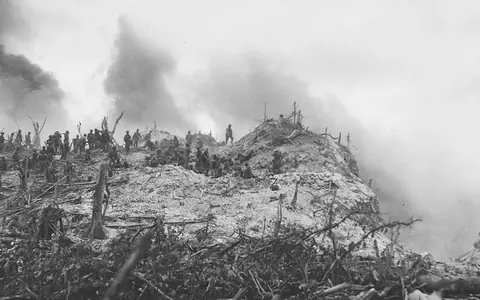
The 1st Marine Division landed on Peleliu expecting a short fight, but Colonel Kunio Nakagawa's garrison held out in the caves of the Umurbrogol ridges for more than two months. The figures differ: the National WWII Museum gives about 10,900 Japanese killed and some 9,600 American casualties, HistoryNet 10,700 and 9,800.1

Read the full story of Peleliu, 1944 ›

Inchon, 1950

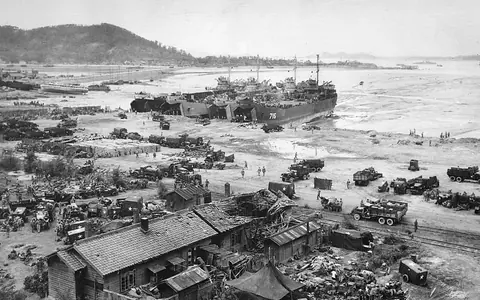
MacArthur landed X Corps at Inchon, the port of Seoul, despite a narrow channel, tides of about 10 meters and sea walls instead of beaches. Marines took Wolmi-do in the morning and the Inchon waterfront on the evening tide, and Seoul fell within two weeks.2

Read the full story of Inchon, 1950 ›


Frequently asked questions

What happened at Peleliu on 15 September 1944?

The 1st Marine Division landed on Peleliu in the Palau Islands. A battle its commander expected to last a few days went on for more than two months against Japanese troops dug into caves in the island's ridges.

Peleliu, 1944 ›

What was the Inchon landing?

An amphibious assault by U.S. and South Korean forces at the port of Inchon, near Seoul, on 15 September 1950, planned by General Douglas MacArthur. It struck far behind the North Korean armies besieging the Pusan Perimeter and reversed the course of the Korean War.

Inchon, 1950 ›

Notes

A number in the text points to a note; each note names the works that paragraph draws on, listed in full under Sources.

  1. John Curatola, “The Battle of Peleliu”; HistoryNet, “Battle of Peleliu”. ↩
  2. Encyclopaedia Britannica, “Inchon landing”; Naval History and Heritage Command, “Operation Chromite”. ↩

Sources

Battle honours of your homeland

The turning points of history

Marathon, Gaugamela, Cannae, Constantinople, Waterloo, Stalingrad: the days the world changed course.

Based on your country, which we do not store · why? ·

Relive the great battles

Echoes of Battle brings the great battles of history to life, scene by scene on the real map. Enlist below and we will send word to your inbox the day it launches.

Or supply the campaign on Ko-fi ›