

Who won the Battle of Cannae?
Hannibal's Carthaginian army won the Battle of Cannae in 216 BC. Using a double envelopment, he surrounded and destroyed a much larger Roman army, killing or capturing most of a force of about 86,000. It is still studied as the classic battle of annihilation.3
Most great victories are won by breaking the enemy's line. At Cannae, Hannibal won by inviting the Romans to break his, and then closing around them. It remains the classic example of a smaller army destroying a larger one, and 2,200 years later it is still taught as the ideal shape of a battle. It ranks among the greatest battles of antiquity.
The battle from both sides
Two perspectivesHannibal came to Cannae outnumbered and turned that into a trap. He bowed his center of Gauls and Spaniards forward in a crescent, inviting the massive Roman infantry to push into it, while his veteran African foot waited on the wings and his superior cavalry cleared the Roman horse from the field. As the Romans drove the center back, the Africans wheeled inward and the returning cavalry sealed the rear: a complete double envelopment. His smaller army destroyed the largest force Rome had ever fielded, a masterpiece of maneuver still taught in war colleges. Yet without siege power or reinforcement, Hannibal could not take Rome itself, and the triumph never became final victory.

Rome came to Cannae to crush Hannibal by sheer mass, fielding about 86,000 men under the consuls Varro and Paullus. Confident in their heavy legions, they concentrated on smashing straight through the Carthaginian center, exactly as Hannibal intended. The line that gave way was bait; the Roman host packed itself so tightly it could barely lift its weapons as the African wings and enemy cavalry closed around it. The consul Paullus was killed, Varro fled, and tens of thousands died in a single day, one of the worst defeats in Rome's history. Yet the Republic refused to surrender, raised fresh armies, avoided open battle, and ground the war back in its favor over the years that followed.4
Two years of disaster
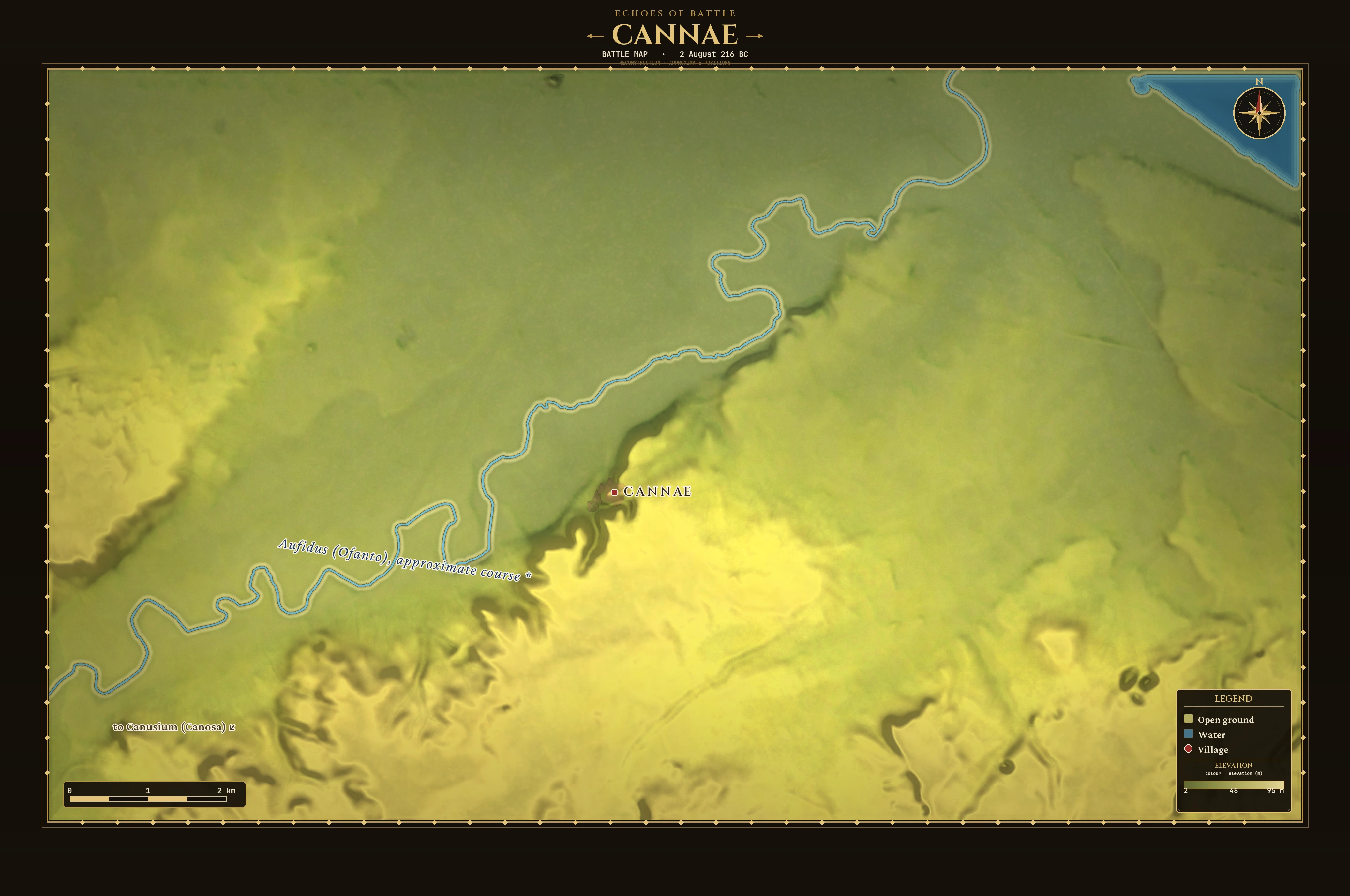
By the summer of 216 BC Hannibal Barca, son of Hamilcar Barca, had been loose in Italy for two years, wrecking Roman armies at the Trebia and Lake Trasimene. Rome answered with the largest force it had ever fielded, under the consuls Lucius Aemilius Paullus and Gaius Terentius Varro. On the flat plain by the Aufidus river (see the map below), the Romans meant to use their weight to simply push through.5
How big were the armies at Cannae?
Polybius, the closest ancient source, gives Rome about 80,000 infantry and just over 6,000 cavalry, against some 40,000 Carthaginian foot and 10,000 horse. Livy admits that his own authorities disagreed and reports one total of 87,200 Romans. Every version leaves Rome far stronger in infantry and Hannibal far stronger in cavalry.6
The senate voted to put eight legions into the field at once, which Polybius says had never been done before, each of about 5,000 citizens, with as many allied infantry again beside them.7
Paullus told the troops they outnumbered the enemy "by more than two to one". Not all of that mass stood in the battle line. Paullus left 10,000 men in the camp with orders to attack Hannibal's camp during the fighting, and most of them ended the day as prisoners.8
Livy himself warns that his sources disagreed so widely on the size and makeup of the new levies that he hardly dared state any figure as certain, so the ancient totals call for care. The shape of the contest is clearer, and Polybius drew the lesson himself: it is better to fight with half as many infantry and an overwhelming cavalry than to match the enemy man for man.9
The command was split as well, and the two consuls did not agree. Paullus, who had fought the Illyrian war a few years before and carried the senate's hopes, wanted to avoid the flat, treeless plain where Hannibal's horsemen had the advantage. Varro, whom Polybius dismisses as inexperienced, wanted to close with the enemy.10
Livy tells the same quarrel from the other side, with Varro furious that Paullus called off a pursuit after a skirmish won on one of Paullus's days. On the morning of the battle it was Varro's turn. He led the army across the Aufidus and formed it facing south, with the Roman cavalry by the river on the right and the allied horse on the left.11
Who commanded at Cannae?
Rome's army was led by the two consuls of 216 BC, Gaius Terentius Varro and Lucius Aemilius Paullus, who held the supreme command on alternate days. Hannibal led the Carthaginians in person from the center with his brother Mago, while Hasdrubal commanded the cavalry on the left and Hanno, or Maharbal in Livy's version, the Numidians on the right.12
Paullus took the Roman right with the citizen cavalry, and Varro the left with the allied horse. Polybius places the consuls of the previous year, Marcus Atilius and Gnaeus Servilius, in charge of the infantry in the center. The cavalry commander Hasdrubal was not Hannibal's brother of that name, whom Hannibal had left in charge of Spain. Paullus fell in the fighting, while Varro escaped to Venusia with about seventy horsemen in Polybius's account, about fifty in Livy's.13
How did Hannibal win at Cannae?
Hannibal won with a double envelopment. His Gallic and Spanish infantry advanced in a crescent and then gave way before the legions, drawing them forward until his African infantry on both wings turned inward against their flanks. His cavalry, having driven the Roman horse from the field, then struck the legions from behind.14
Hannibal shaped his line to fail on purpose. He pushed his least reliable troops, Gauls and Iberians, forward into a shallow crescent bulging toward the enemy, and held his hardened African veterans back on either flank. When the massed Roman infantry hit the center, it gave ground slowly, the crescent flattening and then caving inward. To the Romans it looked like victory. They pressed deeper, packing tighter, into a pocket.15

Varro set his maniples closer together than usual and made each many times deeper than it was wide, trading width for weight. Hannibal's Africans carried the best of the Roman arms captured in his earlier victories, so that, in Livy's phrase, they looked like Romans.16
The cavalry closes the ring
The trap needed the wings. By the river, Hannibal's Spanish and Celtic horse under Hasdrubal met the Roman cavalry in a space too narrow for maneuver and cut most of them down. Hasdrubal then brought his horsemen across to the far wing, where the Numidians had been keeping the allied horse busy. The allies broke and fled, and he left the Numidians to pursue them. He turned his squadrons against the rear of the legions, already pinned by the African infantry on both flanks. Hemmed in on every side, the legions kept fighting, but the ring tightened rank by rank until almost the whole mass had been cut down.17

How many Romans died at Cannae?
No one knows exactly. Polybius puts the Roman dead at about 70,000, with some 10,000 more captured; Livy gives 45,500 infantry and 2,700 cavalry, or 48,200 dead, plus 4,500 taken in the battle. Britannica gives a range of 55,000 to 70,000. Hannibal lost roughly 5,700 to 8,000 men.18
Livy lists among the Roman dead the consul Paullus, both quaestors, twenty-nine military tribunes, several former consuls and eighty men who were senators or had held offices that qualified them for the senate. Hannibal's own losses, by Polybius's count, were about 4,000 Celts, 1,500 Spaniards and Africans and 200 horsemen; Livy says some 8,000 of his best troops were buried.19

It is one of the deadliest days in the history of warfare. And yet Cannae did not win the war: Rome refused every overture, wore Hannibal down over years, and finally beat him at Zama in 202 BC.
Why didn't Hannibal march on Rome after Cannae?
Livy says Hannibal's cavalry commander Maharbal begged him to march on Rome at once, and Hannibal asked for time to think. Instead of attacking the city, Hannibal set out to break Rome's network of allies in southern Italy. Many of them went over to him, but Rome itself refused to negotiate, and that refusal outlasted the victory.
The scene in Livy is famous. As the officers crowded round to congratulate Hannibal, Maharbal predicted that within five days he would be feasting on the Capitol, and offered to ride ahead with the cavalry. When Hannibal hesitated, Maharbal gave the answer that has followed him ever since: "You know how to win victory, Hannibal, you do not know how to use it." Livy adds that the delay of that one day was believed to have saved the city and the empire. Whether the words were really spoken we cannot know, and the wider reasons Hannibal never took Rome are weighed in our life of Hannibal Barca.20
What followed was a test of nerve. Hannibal let the Roman prisoners send ten envoys to the senate to arrange a ransom, and a Carthaginian noble, Carthalo, went with them to sound out terms of peace. A lictor met Carthalo on the road and ordered him off Roman territory before nightfall, and the senate refused to buy back the prisoners.21
A dictator was named, youths of seventeen and some younger were enrolled, and 8,000 young slaves were armed at public cost.22
The allies were another matter. Livy lists the peoples who went over to Hannibal, among them the Bruttii, the Lucanians, most of the Samnites and Greek cities of the south such as Tarentum, Croton and Locri. The greatest prize was Capua, the rich city of Campania, whose leaders made a treaty with Hannibal and welcomed him inside their walls. Polybius adds that Tarentum surrendered at once and that days later the army Rome had sent to Cisalpine Gaul was destroyed by the Celts in an ambush. On Tarentum he runs ahead of events: in Livy's account the city was betrayed to Hannibal by a group of its young nobles only years later, and its citadel held out for Rome.23
Still no one in Rome spoke the word peace. When Varro came home, a crowd from every class went out to meet him, and he was formally thanked because he "had not despaired of the republic". Rome went back to the cautious strategy of Fabius Maximus, avoiding pitched battle with Hannibal and wearing him down instead of risking everything on one field. How that patience and Rome's reserves of manpower won the long war is told in Rome vs Carthage.24
The disgraced legions of Cannae
Rome punished the men who survived. The senate ordered that the soldiers who had fled from Cannae be shipped to Sicily and kept there for as long as the war in Italy went on. Years later, Livy has them send a spokesman to the general Marcellus, begging for a chance to fight. More than 50,000 men had fallen at Cannae, he argued, and the consul who fled with seventy horsemen had been thanked and given command after command, while the soldiers were left to grow old in exile with no hope of wiping out their shame.25
The senate would not soften. Marcellus could use them if he wished, but none were to be discharged, decorated or brought back to Italy while the enemy was still there.26
Their chance came with Scipio Africanus. When he prepared to invade Africa from Sicily, he found the survivors of Cannae there and did not despise them. Livy says Scipio knew the defeat had not been their fault, and that no soldiers in the Roman army had more experience of every kind of fighting and of sieges. They became his fifth and sixth legions, each brought up to 6,200 men, and they sailed with him to Africa. That army went on to beat Hannibal at Zama in 202 BC. The men Rome had refused to forgive helped to finish the war that Cannae had nearly lost.27
Why is Cannae still studied?
Cannae is the classic model of a battle of annihilation, in which a smaller army surrounds and destroys a larger one instead of merely driving it off. Britannica calls it a classic example of double envelopment, and the German chief of staff Alfred von Schlieffen built his idea of encirclement around it.28
Schlieffen wrote a book on the battle, and HistoryNet traces to his studies a "Cannae concept" that treated encircling and wiping out the enemy army as the supreme goal of battle, and that shaped the Schlieffen Plan, the basis of German war planning before 1914. The German victory at Tannenberg in 1914 invites the comparison, but Britannica stresses that it was no second Cannae planned in advance: the double envelopment there was an afterthought. Writing in The Strategy Bridge, Diane L. Maye traces the same principles of envelopment from Cannae through both world wars to the "left hook" of Desert Storm in 1991.29

Where was Cannae fought? The battlefield today
Cannae lies in Apulia, in south-eastern Italy, by the river the Romans called the Aufidus, today the Ofanto. The ruined hill town of Canne della Battaglia stands on the hills above the Ofanto valley. Before the battle Hannibal seized the town's citadel, where the Romans stored grain from the country around Canusium.30
Where exactly the armies fought is still argued. Polybius says the Romans crossed the river and drew up facing south; Livy has them facing north, with the wind the locals called the Vulturnus blowing dust into their eyes. The ground has not settled the question: the Italian Ministry of Culture notes that no archaeological evidence of the battle of 216 BC has yet been found at the site.31
The date has its own puzzle. The Roman annalist Claudius Quadrigarius, quoted by both Macrobius and Aulus Gellius, put the slaughter on the fourth day before the Nones of Sextilis, the month later renamed August, which gives the traditional 2 August.32
Today the hill is an archaeological park. Its antiquarium, built in 1958 at the foot of the fortified citadel, holds finds from excavations in the area, and the ruins on the hill trace a settlement that lasted from the Neolithic to the late Middle Ages. From the top you look out over the Ofanto valley where, somewhere below, the two armies met. For the campaign that brought them there, see the earlier disasters at the Trebia and Lake Trasimene.33
Could you spot this battlefield from its map alone? Try Guess the Battle from the Map, or test what you know in the Roman battles quiz.





