

What is the military history of ancient Rome?
It is the history of the wars of the Roman Republic and the Roman Empire: the conquest of Italy, the Punic Wars against Carthage, Caesar’s conquest of Gaul, the civil wars that ended the Republic, the long defense of the frontiers, the Gothic victory at Adrianople in 378 and the end of the western empire in 476.1
For almost a thousand years, Rome’s history was a history of war. A small city on the Tiber built an army that conquered Italy, beat Carthage and the Hellenistic kingdoms, then turned on itself in civil wars, held frontiers from Scotland to Mesopotamia and finally lost the West to the peoples it had long recruited, fought and settled. This guide follows those wars era by era, explains how the legion worked and gives Rome’s enemies their own reasons and its defeats the same weight as its victories. Start with our battle guides to the Battle of Cannae (216 BC), the siege of Alesia (52 BC), the Battle of Actium (31 BC), the Battle of the Teutoburg Forest (AD 9) and the Battle of the Milvian Bridge (AD 312).2
How did the Roman army work? From the phalanx to the legion
Rome’s first soldiers fought like Greek hoplites, shoulder to shoulder in a phalanx with thrusting spears, and the Republic, traditionally founded in 509 BC, kept that style at first. The long war with the Etruscan city of Veii, which Rome took in 396 BC, brought the first changes: the army was paid for its service for the first time.3
A disaster followed. Around 390 BC a Gallic army beat the Romans at the Allia River, north of the city, and captured Rome itself; Britannica notes that the later story of a Roman victory over the same Gauls was probably invented to soften the defeat. Over the following generations the Romans replaced the phalanx, too unwieldy for fighting in the hills and valleys of central Italy, with small, flexible units called maniples, and their soldiers took up the throwing spear, the pilum.4
By the time of the wars with Carthage, the Greek historian Polybius, who saw the army at first hand, describes a legion of 4,200 infantry, raised to 5,000 in times of exceptional danger. It fought in three lines, the young hastati in front, the principes behind them and the veteran triarii at the back, with light skirmishers called velites ahead of them all. The maniples stood with gaps between them like a checkerboard, so that a tired line could fall back through the one behind it. The two weapons that made the system famous were the pilum and the gladius, a short sword of Spanish origin.5
Discipline held it together. Each night the army built a fortified camp to a fixed plan, and a unit that ran without cause could be decimated, one man in ten chosen by lot and beaten to death. Rome’s Italian allies, the socii, usually fielded as many infantry as the citizen legions, and Bowman’s EBSCO survey names that Italian manpower, which let Rome absorb defeats, as the deepest reason for its success. More on the system in our guides to how the Roman legion worked and the phalanx against the legion.6
How did Rome conquer Italy? The Samnites and Pyrrhus
Rome’s first great rivals in Italy were the Samnites, Oscan-speaking mountain peoples of south central Italy who, in Jeffrey Buller’s words, resented Rome’s intrusion into a region they regarded as their own. Rome fought a series of Samnite wars in the late 4th and early 3rd centuries BC. In the hills the Samnites had the advantage: in 321 BC, in the narrow pass of the Caudine Forks, a Samnite army under Gavius Pontius trapped a Roman army and forced it to surrender and pass under a yoke of spears, a unique disgrace. Rome recovered, and the third war left it master of almost the whole peninsula.7
The Greek cities of southern Italy then called in Pyrrhus, king of Epirus. He crossed to Italy and won at Heraclea in 280 BC and at Ausculum in 279 BC, but both victories cost him so many men that they gave the world the phrase “Pyrrhic victory”. After heavy losses at Beneventum in 275 BC he left Italy for good. By 264 BC Rome controlled the whole peninsula south of the Po valley. For the later history of the land, see our hub on the military history of Italy.8
Rome against Carthage: the Punic Wars and the Mediterranean
Control of Italy drew Rome into Sicily, where Carthage, the great trading power of North Africa, had long tried to complete its chain of island bases. The First Punic War (264 to 241 BC) forced Rome to become a sea power. It built its first large fleet and used grappling and boarding to fight at sea like infantry, and a final naval victory off the Aegates Islands in 241 BC drove the Carthaginians out of Sicily.9
In the Second Punic War (218 to 201 BC) the Carthaginian general Hannibal crossed the Alps into Italy and destroyed Roman armies at the Trebia, at Lake Trasimene in 217 BC and at Cannae in 216 BC. His hope was to break up Rome’s system of alliances, but most of the Italian allies stayed loyal, and the dictator Fabius Maximus answered by refusing battle and wearing the invaders down, which earned him the nickname “the Delayer”. In 207 BC the Romans destroyed the army of Hannibal’s brother Hasdrubal on the Metaurus, where Hasdrubal fell, and Britannica judges that this campaign decided the war in Italy.10
Scipio, later called Africanus, carried the war to Africa. At Zama in 202 BC he defeated Hannibal with the help of the Numidian ruler Masinissa, whose cavalry, posted on the Roman right, returned from the pursuit at the decisive moment. Rome then went east and broke the Macedonian kingdom in decisive battles at Cynoscephalae in 197 BC and Pydna in 168 BC. The Third Punic War ended in 146 BC with the destruction of Carthage and the enslavement of its people. Our hub on the Punic Wars tells the story from both sides.11
Who was Gaius Marius, and how did the army change?
At the end of the 2nd century BC, the migrating Cimbri and Teutones defeated a succession of Roman armies in the north. The man who stopped them was Gaius Marius, a general from outside the old aristocracy who was consul in 107 BC and every year from 104 to 100 BC. Short of men, he enrolled volunteers who did not meet the property qualification that had limited service to men of means. He beat the Teutones at Aquae Sextiae in 102 BC and, with his colleague Quintus Catulus, the Cimbri at Vercellae in 101 BC.12
The late Republic’s army looked different from Polybius’s. The cohort replaced the maniple as the main tactical unit, ten cohorts to a legion, drawn up four, three and three, and soldiers carried their own kit, earning the nickname “Marius’s mules”. Bowman notes that Marius is credited only “by some” with turning a citizen militia into a professional army, and many of these changes came gradually. The political result was clearer: soldiers now looked to their general for land when they left the army, and their loyalty followed him rather than the state.13
That loyalty soon turned inward. In 88 BC, when the command against Mithridates VI of Pontus was taken from him, Sulla marched his army on Rome, and Marius and Cinna answered in kind. More in our profile of Gaius Marius.14
Caesar’s conquest of Gaul and the siege of Alesia
From 58 BC Julius Caesar fought in Gaul, roughly today’s France. Livius gives the aim as ending a perceived Gallic threat to Italy; the EBSCO account stresses Caesar’s own wealth and political standing. In 52 BC the Gauls rose together under Vercingetorix, a young nobleman of the Arverni whom the confederates made their king and general. Vercingetorix fought on his own terms: he attacked Caesar’s supply lines, chose ground that did not suit the legions and held the hill fort of Gergovia against Caesar’s assault.15
After a failed attack on the Roman army, Vercingetorix fell back to the fortified hill town of Alesia. Caesar shut him in with two rings of siege works, one facing the town and one facing outward against a relief army. In the autumn the relief army attacked from outside while Vercingetorix struck from within, and the Romans beat off both. With the relief army defeated and their food gone, the defenders surrendered, and there was no serious rising in Gaul after Alesia.16

The Roman civil wars: Pharsalus, Philippi and Actium
In 49 BC the Senate refused to let Caesar stand for the consulship while he kept his army, declared him a public enemy and turned to Pompey. Caesar crossed the Rubicon, the border between Gaul and Italy, and the civil war spread across the Mediterranean. At Pharsalus in Greece, on 9 August 48 BC, his more experienced legions beat Pompey’s larger army; about 6,000 Romans were killed. Further victories followed in Africa and Spain, but Caesar was murdered by a conspiracy led by Brutus and Cassius on 15 March 44 BC.17
Caesar’s heir Octavian, Mark Antony and Lepidus formed the Second Triumvirate and went east against the assassins, who had raised the eastern provinces. At Philippi in October 42 BC the armies of Cassius and then of Brutus were broken, and both men took their own lives. Britannica calls it the final destruction of those who favored the old Republican constitution.18
The victors then fell out. Antony allied himself with Cleopatra VII of Ptolemaic Egypt, and on 2 September 31 BC Octavian’s fleet under Agrippa defeated them at Actium off western Greece. Antony and Cleopatra killed themselves in Alexandria the next year. Octavian, named Augustus in 27 BC, cut the 60 legions of the civil wars to 28, matched them with about as many auxiliaries from the provinces, kept a permanent bodyguard, the Praetorian Guard, and made the army a long-service professional force stationed mostly on the frontiers. The full story is in our hub on the Roman civil wars.19
The frontiers: Teutoburg Forest, Boudica and Hadrian’s Wall
Augustus tried to push the frontier from the Rhine to the Elbe, and by AD 6 the land between them was being run as a Roman province by Publius Quinctilius Varus. In September AD 9 a coalition of Germanic tribes led by Arminius, a Cheruscan noble who had served in the Roman army, ambushed Varus’s three legions, the 17th, 18th and 19th, on the march through forest and marsh in the Teutoburg Forest. The legions were destroyed and Varus killed himself. Seen from the other side, it was a rising against a governor who, as the EBSCO account puts it, treated the Germans as inferior and tried to Romanize them against their will.20
Rome came back with eight legions and three years of hard campaigning, but in AD 16 the emperor ordered a withdrawal, and the lost legions were never replaced. Germania between the Rhine and the Elbe stayed outside the empire, and Roman policy on the Rhine became defensive. Excavations since 1989 at Kalkriese, north of Osnabrück, have uncovered the debris of a crushing Roman defeat in a narrow strip of land between a hill and a bog, which both the museum on the site and Livius take to be one of the places where Varus’s army was destroyed.21
In Britain, invaded under the emperor Claudius, the crisis came in AD 60 or 61. When Prasutagus, client king of the Iceni in today’s Norfolk, died, Roman officials seized his kingdom, flogged his widow Boudica and raped their daughters. With the neighboring Trinovantes, Boudica rose while the governor Suetonius Paulinus was campaigning in Wales and burned Camulodunum (Colchester), Londinium (London) and Verulamium (St Albans). Paulinus then defeated the Britons in a hard battle, and Boudica died soon after.22
The frontier later hardened into walls. Hadrian visited Britain in AD 122 and ordered a barrier across the island from the Tyne to the Solway, with regular towers, small forts called milecastles and larger forts along its line. It was garrisoned by auxiliaries, infantry and cavalry raised from the empire’s subject peoples. It was not meant as a fighting platform: in Breeze’s words in Britannica, its purpose was to control movement across the frontier. Under Antoninus Pius the army moved north to the Antonine Wall between the Forth and the Clyde, but abandoned it within a generation. Hadrian’s Wall became a UNESCO World Heritage Site in 1987; for the island’s later wars, see our hub on the military history of Britain.23

Rome against Parthia and Persia
In the east, Rome met a power as large as itself. In 53 BC Marcus Crassus, one of the triumvirs, began a war against the Parthian empire that Britannica calls unprovoked. Near Carrhae, today’s Harran in Turkey, the Parthian general Surena destroyed or captured nearly all of his seven legions with horse archers and armored cavalry, and Crassus was killed at a parley. Lendering argues that the Parthians simply had more and better troops and better supplies, including camels loaded with arrows.24
Later emperors fought back. Trajan conquered Dacia, today’s Romania, early in the 2nd century and waged a war of conquest against Parthia. In the 3rd century the Sasanian dynasty overthrew the Parthians and pressed Rome hard, and in AD 260 Shapur I captured the emperor Valerian, who died a prisoner.25
The crisis of the third century and Constantine
From the Severans on, power rested openly on the army. Septimius Severus, who seized Rome in 193, raised the soldiers’ pay, and in 212 his son Caracalla gave citizenship to most free people of the empire. Between 235 and 284, the age of the soldier-emperors, the empire suffered invasion and internal chaos, and Germanic peoples and Sasanian armies broke through the frontiers. The Met counts at least sixteen men who held the title of emperor in those years, almost all of whom came to a violent end.26
Diocletian, from 284, shared power in 293 in a Tetrarchy of two senior and two junior emperors, meant to end the wars of succession. It did not outlast him. Constantine, the son of one of the tetrarchs, invaded Italy and defeated Maxentius at the Milvian Bridge outside Rome on 28 October 312; according to Christian sources he had turned to the Christian God just before the battle. In 324 he beat Licinius at Adrianople and Chrysopolis and ruled East and West alone. He disbanded the Praetorian Guard, which had backed Maxentius.27

Adrianople and the fall of the Western Roman Empire
In the 370s the Huns pushed the Goths west toward the Danube. The Tervingi, whom later writers called Visigoths, were admitted into the empire to settle on the frontier, but their grievances against Roman officials grew and in 376 they revolted under Fritigern. The eastern emperor Valens attacked them near Adrianople, today’s Edirne, on 9 August 378 without waiting for his nephew Gratian’s western army. Gothic cavalry broke the Roman infantry, about two-thirds of the eastern army was destroyed, and Valens was killed; his body was never found.28
Valens’s successor Theodosius could not drive the Goths out; by 382 he made peace and let them stay inside the empire, and Rome increasingly fought its wars with such settled allies, the foederati, who owed military service to the emperor. In 410 the Visigoths under Alaric took Rome. The Visigoths had been settled and recruited by Rome for a generation; now they plundered its old capital.29

The western army now depended on Germanic soldiers. In 476 Odoacer, a Germanic officer in Roman service, led his men in a revolt that Britannica traces to a broken promise of land in Italy, was proclaimed king by his troops and deposed the young emperor Romulus Augustulus. That year is traditionally taken as the end of the Western Roman Empire. The eastern provinces survived and developed into the Byzantine Empire.30
Famous Roman generals and their opponents
Rome’s best-known commanders include Scipio Africanus, who beat Hannibal at Zama; Gaius Marius, who stopped the Cimbri and Teutones; Julius Caesar, conqueror of Gaul and winner of the civil war; Agrippa, the admiral of Actium; and Constantine, who ruled East and West alone from 324. Their opponents were often as able: Pyrrhus, Hannibal, Vercingetorix, Arminius, the Parthian Surena and Fritigern, whose Goths destroyed an imperial army at Adrianople. See our lists of the greatest commanders of ancient Rome and the greatest battles of ancient Rome.31
Major battles of ancient Rome, era by era
Every battle we have written up in which the Roman Republic or the Roman Empire fought, including battles between rival Roman armies, grouped by era and in date order:
Antiquity to AD 476 · 13
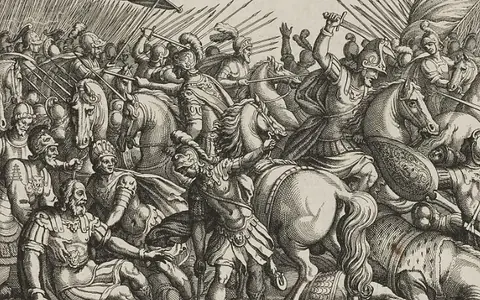
- 218 BCThe Battle of the Trebia, 218 BCCarthage vs Roman Republic
Hannibal's first great victory in Italy: a freezing river and a hidden ambush.
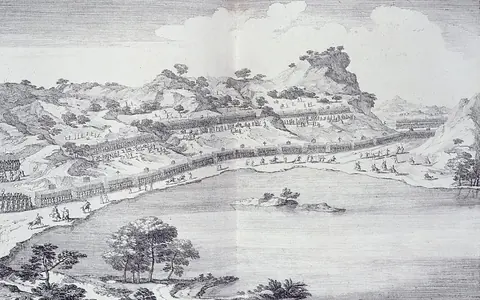
- 217 BCThe Battle of Lake Trasimene, 217 BCCarthage vs Roman Republic
The largest ambush of the ancient world: a Roman army destroyed in the mist.
- 216 BCThe Battle of Cannae, 216 BCCarthage vs Roman Republic
Outnumbered, Hannibal let his center bend inward, then closed both wings. The double envelopment that generals have studied for 2,200 years.

- 207 BCBattle of the Metaurus, 207 BCRoman Republic vs Carthage
How Rome destroyed Hasdrubal's army at the Metaurus in 207 BC and sealed Hannibal's fate in Italy.
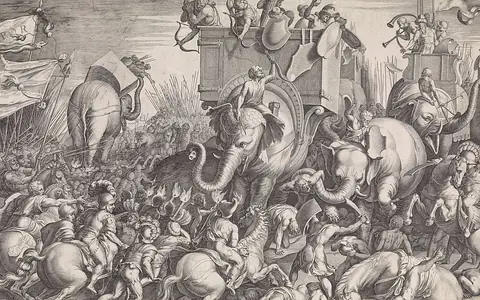
- 202 BCThe Battle of Zama, 202 BCRoman Republic and Numidia vs Carthage
Scipio beats Hannibal and ends the Second Punic War.
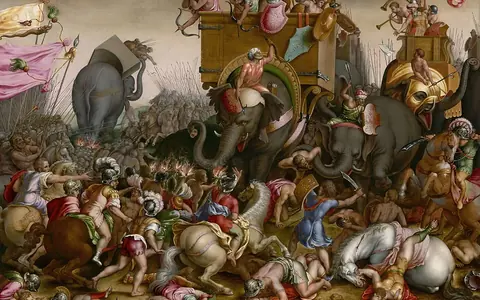
- 52 BCThe Battle of Alesia, 52 BCRoman Republic vs Gallic tribes
Caesar traps Vercingetorix behind a double ring of siege walls and wins all of Gaul.
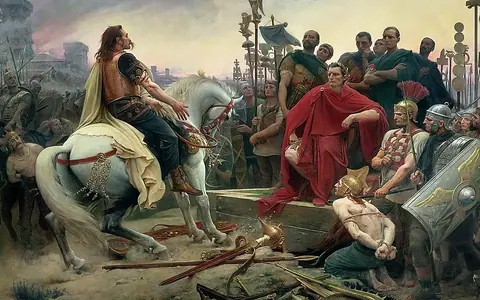
- 48 BCThe Battle of Pharsalus, 48 BCCaesar's legions vs The Senate's army
How Caesar, outnumbered two to one, broke Pompey the Great and won Rome's civil war.
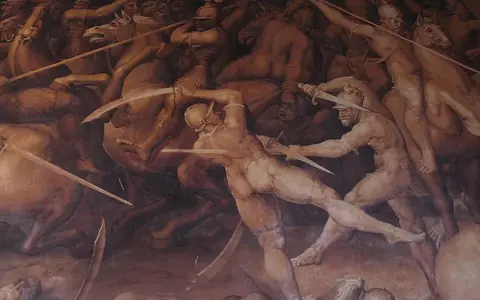
- 42 BCThe Battle of Philippi, 42 BCThe Second Triumvirate vs The Liberators
How Antony and Octavian beat Caesar's assassins Brutus and Cassius, and the Roman Republic died with them.
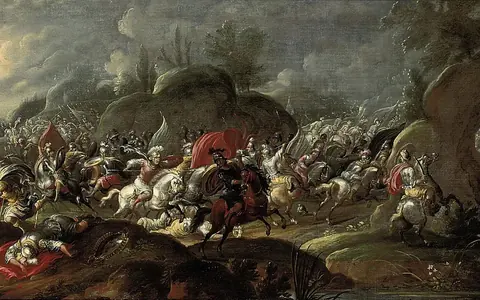
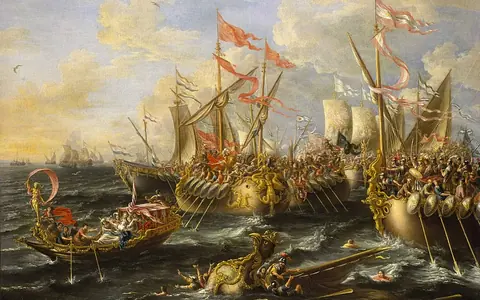
- 31 BCThe Battle of Actium, 31 BCRoman Republic (Octavian) vs Ptolemaic Egypt and Mark Antony
The sea battle that ended the Roman Republic and made an emperor.
- 9Battle of the Teutoburg Forest, AD 9Germanic tribes vs Roman Empire
How Arminius lured three Roman legions into the German forests and destroyed them, halting Rome at the Rhine for good.
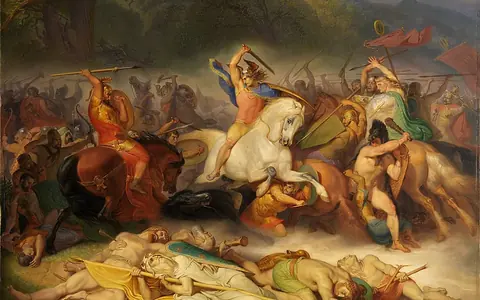
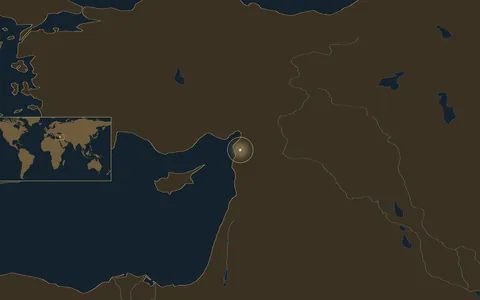
- 218Battle of Antioch, 218Emperor Macrinus vs Elagabalus ("Antoninus")
On 8 June 218, near Antioch, legions backing the 14-year-old Elagabalus beat Emperor Macrinus. He fled in disguise, was caught at Chalcedon and put to death.
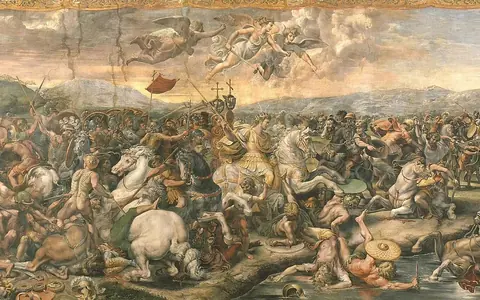
- 312Battle of the Milvian Bridge, AD 312Constantine's forces vs Maxentius's forces
Constantine's victory over Maxentius at the Tiber, and the turning point that carried Christianity to power in Rome.
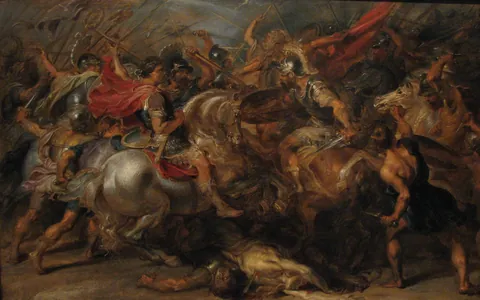
- 324Battle of Chrysopolis, 324Constantine vs Licinius
On 18 September 324 Constantine defeated Licinius at Chrysopolis on the Bosphorus, became sole Roman emperor and soon refounded Byzantium as Constantinople.
Timeline of Roman military history
- 509 BCTraditional date of the founding of the Republic.32
- c. 390 BCGauls defeat Rome at the Allia and capture the city.33
- 321 BCSamnite victory at the Caudine Forks.34
- 280 BCPyrrhus wins a costly victory at Heraclea.35
- 241 BCNaval victory off the Aegates Islands ends the First Punic War.36
- 216 BC
- 202 BC
- 146 BCCarthage is destroyed.39
- 101 BCMarius and Catulus defeat the Cimbri at Vercellae.40
- 53 BCThe Parthians destroy Crassus’s army at Carrhae.41
- 52 BC
- 48 BC
- 31 BC
- AD 9Arminius destroys three legions in the Teutoburg Forest.45
- AD 60/61
- AD 122Hadrian orders the wall in Britain.47
- AD 260Shapur I captures the emperor Valerian.48
- AD 312Constantine wins at the Milvian Bridge.49
- AD 378The Goths defeat and kill Valens at Adrianople.50
- AD 410Alaric’s Visigoths take Rome.51
- AD 476Odoacer deposes Romulus Augustulus.52
Memory and further reading
Rome’s enemies became national heroes long after their defeats. In the 19th century Arminius, renamed Hermann, became a symbol of German unity, while the French took up Vercingetorix and the British Boudica, whom Britannica calls a national heroine of England. Kalkriese’s museum notes that hardly any event fueled German identity and nationalism as much as the Varus battle. Hadrian’s Wall, the most visible Roman frontier, draws visitors from around the world.53
For the wars in more depth, see our hubs on the Punic Wars and the Roman civil wars; for the Greek world Rome inherited, the wars of Alexander the Great and the Greco-Persian Wars; and for the lands Rome ruled, the military history of Italy and the military history of Britain.
Notes
A number in the text points to a note; each note names the works that paragraph draws on, listed in full under Sources.
- Denvy A. Bowman, “Warfare of the Roman Republic”; Department of Greek and Roman Art, “The Roman Republic”; EBSCO Research Starters, “Warfare of the Roman Empire”; Christopher S. Lightfoot, “The Roman Empire (27 B.C. to 393 A.D.)”; Michael Kerrigan, “Battle of Adrianople”; Encyclopaedia Britannica, “Odoacer”. ↩
- Denvy A. Bowman, “Warfare of the Roman Republic”; EBSCO Research Starters, “Warfare of the Roman Empire”; Christopher S. Lightfoot, “The Roman Empire (27 B.C. to 393 A.D.)”. ↩
- Denvy A. Bowman, “Warfare of the Roman Republic”; Encyclopaedia Britannica, “Legion”; Department of Greek and Roman Art, “The Roman Republic”; Encyclopaedia Britannica, “Marcus Furius Camillus”. ↩
- Denvy A. Bowman, “Warfare of the Roman Republic”; Encyclopaedia Britannica, “Marcus Furius Camillus”; Encyclopaedia Britannica, “Legion”. ↩
- Polybius, Histories; Denvy A. Bowman, “Warfare of the Roman Republic”; Encyclopaedia Britannica, “Legion”. ↩
- Denvy A. Bowman, “Warfare of the Roman Republic”; Polybius, Histories. ↩
- Jeffrey L. Buller, “Samnite Wars”; Encyclopaedia Britannica, “Caudine Forks”; Denvy A. Bowman, “Warfare of the Roman Republic”. ↩
- Encyclopaedia Britannica, “Pyrrhus”; Denvy A. Bowman, “Warfare of the Roman Republic”. ↩
- Encyclopaedia Britannica, “Punic Wars”; Denvy A. Bowman, “Warfare of the Roman Republic”. ↩
- Encyclopaedia Britannica, “Punic Wars”; Denvy A. Bowman, “Warfare of the Roman Republic”; Jona Lendering, “Lake Trasimene (217 BCE)”; Polybius, Histories. ↩
- Patrick Hunt, “Battle of Zama”; Polybius, Histories; Denvy A. Bowman, “Warfare of the Roman Republic”; Jona Lendering, “Cynoscephalae (197 BCE)”; Jona Lendering, “Pydna (168 BCE)”; Encyclopaedia Britannica, “Punic Wars”. ↩
- John P. V. Dacre Balsdon, “Gaius Marius”; Denvy A. Bowman, “Warfare of the Roman Republic”; Daniel J. Taravella, “Roman Civil Wars of 88-30 BCE”. ↩
- Denvy A. Bowman, “Warfare of the Roman Republic”; Encyclopaedia Britannica, “Legion”; Plutarch, Life of Marius; Daniel J. Taravella, “Roman Civil Wars of 88-30 BCE”; John P. V. Dacre Balsdon, “Gaius Marius”. ↩
- Daniel J. Taravella, “Roman Civil Wars of 88-30 BCE”; Denvy A. Bowman, “Warfare of the Roman Republic”. ↩
- Paul K. Davis, “Battle of Alesia”; Jona Lendering, “Alesia (52 BCE)”; Encyclopaedia Britannica, “Vercingetorix”. ↩
- Paul K. Davis, “Battle of Alesia”; Jona Lendering, “Alesia (52 BCE)”; Encyclopaedia Britannica, “Vercingetorix”. ↩
- Daniel J. Taravella, “Roman Civil Wars of 88-30 BCE”; Jona Lendering, “Pharsalus (48 BCE)”; Department of Greek and Roman Art, “The Roman Republic”. ↩
- Rupert Matthews, “Battle of Philippi”; Jona Lendering, “Philippi (42 BCE)”; Daniel J. Taravella, “Roman Civil Wars of 88-30 BCE”. ↩
- EBSCO Research Starters, “Battle of Actium”; Daniel J. Taravella, “Roman Civil Wars of 88-30 BCE”; Jona Lendering, “Actium (31 BCE)”; Encyclopaedia Britannica, “Augustus”; Denvy A. Bowman, “Warfare of the Roman Republic”; EBSCO Research Starters, “Battle of Teutoburg Forest”. ↩
- EBSCO Research Starters, “Battle of Teutoburg Forest”; Jona Lendering, “Teutoburg Forest (9 CE)”; Museum und Park Kalkriese, “The Varus Battle”. ↩
- Museum und Park Kalkriese, “The Varus Battle”; EBSCO Research Starters, “Battle of Teutoburg Forest”; Jona Lendering, “Teutoburg Forest (9 CE)”; Jona Lendering, “Kalkriese”. ↩
- Encyclopaedia Britannica, “Boudicca”; London Museum, “Boudica”; University of Warwick, Boudica. ↩
- David J. Breeze, “Hadrian’s Wall”; UNESCO World Heritage Centre, “Frontiers of the Roman Empire”; English Heritage, “History of Housesteads Roman Fort”; EBSCO Research Starters, “Warfare of the Roman Empire”. ↩
- Myles Hudson, “Battle of Carrhae”; Jona Lendering, “Carrhae (53 BCE)”. ↩
- Christopher S. Lightfoot, “The Roman Empire (27 B.C. to 393 A.D.)”; EBSCO Research Starters, “Warfare of the Roman Empire”; Blair Fowlkes-Childs, “The Sasanian Empire (224 to 651 A.D.)”; Encyclopaedia Britannica, “Valerian”. ↩
- Christopher S. Lightfoot, “The Roman Empire (27 B.C. to 393 A.D.)”; EBSCO Research Starters, “Warfare of the Roman Empire”; Blair Fowlkes-Childs, “The Sasanian Empire (224 to 651 A.D.)”. ↩
- Myles Hudson, “Battle of the Milvian Bridge”; Encyclopaedia Britannica, “Constantine I”; Christopher S. Lightfoot, “The Roman Empire (27 B.C. to 393 A.D.)”; EBSCO Research Starters, “Warfare of the Roman Empire”. ↩
- Michael Kerrigan, “Battle of Adrianople”; EBSCO Research Starters, “Battle of Adrianople”; Christopher S. Lightfoot, “The Roman Empire (27 B.C. to 393 A.D.)”. ↩
- EBSCO Research Starters, “Battle of Adrianople”; Michael Kerrigan, “Battle of Adrianople”; Christopher S. Lightfoot, “The Roman Empire (27 B.C. to 393 A.D.)”; EBSCO Research Starters, “Warfare of the Roman Empire”; Encyclopaedia Britannica, “Alaric”. ↩
- Encyclopaedia Britannica, “Odoacer”; Christopher S. Lightfoot, “The Roman Empire (27 B.C. to 393 A.D.)”; EBSCO Research Starters, “Warfare of the Roman Empire”. ↩
- Patrick Hunt, “Battle of Zama”; John P. V. Dacre Balsdon, “Gaius Marius”; Daniel J. Taravella, “Roman Civil Wars of 88-30 BCE”; EBSCO Research Starters, “Battle of Actium”; Encyclopaedia Britannica, “Constantine I”; Encyclopaedia Britannica, “Pyrrhus”; Encyclopaedia Britannica, “Vercingetorix”; Jona Lendering, “Teutoburg Forest (9 CE)”; Myles Hudson, “Battle of Carrhae”; EBSCO Research Starters, “Battle of Adrianople”. ↩
- Department of Greek and Roman Art, “The Roman Republic”; Denvy A. Bowman, “Warfare of the Roman Republic”. ↩
- Denvy A. Bowman, “Warfare of the Roman Republic”; Encyclopaedia Britannica, “Marcus Furius Camillus”. ↩
- Jeffrey L. Buller, “Samnite Wars”; Encyclopaedia Britannica, “Caudine Forks”. ↩
- Encyclopaedia Britannica, “Pyrrhus”; Denvy A. Bowman, “Warfare of the Roman Republic”. ↩
- Encyclopaedia Britannica, “Punic Wars”; Denvy A. Bowman, “Warfare of the Roman Republic”. ↩
- Encyclopaedia Britannica, “Punic Wars”; Denvy A. Bowman, “Warfare of the Roman Republic”. ↩
- Patrick Hunt, “Battle of Zama”; Polybius, Histories. ↩
- Encyclopaedia Britannica, “Punic Wars”; Denvy A. Bowman, “Warfare of the Roman Republic”. ↩
- John P. V. Dacre Balsdon, “Gaius Marius”; Denvy A. Bowman, “Warfare of the Roman Republic”. ↩
- Myles Hudson, “Battle of Carrhae”; Jona Lendering, “Carrhae (53 BCE)”. ↩
- Paul K. Davis, “Battle of Alesia”; Jona Lendering, “Alesia (52 BCE)”. ↩
- Daniel J. Taravella, “Roman Civil Wars of 88-30 BCE”; Jona Lendering, “Pharsalus (48 BCE)”. ↩
- EBSCO Research Starters, “Battle of Actium”; Daniel J. Taravella, “Roman Civil Wars of 88-30 BCE”. ↩
- EBSCO Research Starters, “Battle of Teutoburg Forest”; Jona Lendering, “Teutoburg Forest (9 CE)”. ↩
- Encyclopaedia Britannica, “Boudicca”; London Museum, “Boudica”. ↩
- David J. Breeze, “Hadrian’s Wall”; UNESCO World Heritage Centre, “Frontiers of the Roman Empire”. ↩
- Encyclopaedia Britannica, “Valerian”; Blair Fowlkes-Childs, “The Sasanian Empire (224 to 651 A.D.)”. ↩
- Myles Hudson, “Battle of the Milvian Bridge”; Encyclopaedia Britannica, “Constantine I”. ↩
- Michael Kerrigan, “Battle of Adrianople”; EBSCO Research Starters, “Battle of Adrianople”. ↩
- Encyclopaedia Britannica, “Alaric”; Christopher S. Lightfoot, “The Roman Empire (27 B.C. to 393 A.D.)”. ↩
- Encyclopaedia Britannica, “Odoacer”; Christopher S. Lightfoot, “The Roman Empire (27 B.C. to 393 A.D.)”. ↩
- Jona Lendering, “Teutoburg Forest (9 CE)”; Museum und Park Kalkriese, “The Varus Battle”; Encyclopaedia Britannica, “Boudicca”; David J. Breeze, “Hadrian’s Wall”; UNESCO World Heritage Centre, “Frontiers of the Roman Empire”. ↩
Sources
- Denvy A. Bowman, EBSCO Research Starters, “Warfare of the Roman Republic”.
- Department of Greek and Roman Art, The Metropolitan Museum of Art, Heilbrunn Timeline of Art History, “The Roman Republic”.
- EBSCO Research Starters, “Warfare of the Roman Empire”.
- Christopher S. Lightfoot, The Metropolitan Museum of Art, Heilbrunn Timeline of Art History, “The Roman Empire (27 B.C. to 393 A.D.)”.
- Michael Kerrigan, Encyclopaedia Britannica, “Battle of Adrianople”.
- Encyclopaedia Britannica, “Odoacer”.
- Encyclopaedia Britannica, “Legion”.
- Encyclopaedia Britannica, “Marcus Furius Camillus”.
- Polybius, Histories 6.19 to 6.42, translated by W. R. Paton (Loeb Classical Library), LacusCurtius, “Polybius, Histories, Book VI”.
- Jeffrey L. Buller, EBSCO Research Starters, “Samnite Wars”.
- Encyclopaedia Britannica, “Caudine Forks”.
- Encyclopaedia Britannica, “Pyrrhus”.
- Encyclopaedia Britannica, “Punic Wars”.
- Jona Lendering, Livius.org, “Lake Trasimene (217 BCE)”.
- Polybius, Histories 11.1 to 11.3, translated by W. R. Paton (Loeb Classical Library), LacusCurtius, “Polybius, Histories, Book XI”.
- Patrick Hunt, Encyclopaedia Britannica, “Battle of Zama”.
- Polybius, Histories 15.5 to 15.14, translated by W. R. Paton (Loeb Classical Library), LacusCurtius, “Polybius, Histories, Book XV”.
- Jona Lendering, Livius.org, “Cynoscephalae (197 BCE)”.
- Jona Lendering, Livius.org, “Pydna (168 BCE)”.
- John P. V. Dacre Balsdon, Encyclopaedia Britannica, “Gaius Marius”.
- Daniel J. Taravella, EBSCO Research Starters, “Roman Civil Wars of 88-30 BCE”.
- Plutarch, Life of Marius 13, translated by Bernadotte Perrin (Loeb Classical Library), LacusCurtius, “Plutarch, The Life of Marius”.
- Paul K. Davis, EBSCO Research Starters, “Battle of Alesia”.
- Jona Lendering, Livius.org, “Alesia (52 BCE)”.
- Encyclopaedia Britannica, “Vercingetorix”.
- Jona Lendering, Livius.org, “Pharsalus (48 BCE)”.
- Rupert Matthews, Encyclopaedia Britannica, “Battle of Philippi”.
- Jona Lendering, Livius.org, “Philippi (42 BCE)”.
- EBSCO Research Starters, “Battle of Actium”.
- Jona Lendering, Livius.org, “Actium (31 BCE)”.
- Encyclopaedia Britannica, “Augustus”.
- EBSCO Research Starters, “Battle of Teutoburg Forest”.
- Jona Lendering, Livius.org, “Teutoburg Forest (9 CE)”.
- Museum und Park Kalkriese, “The Varus Battle”.
- Jona Lendering, Livius.org, “Kalkriese”.
- Encyclopaedia Britannica, “Boudicca”.
- London Museum, “Boudica: Rebel queen of the Iceni”.
- University of Warwick, Warwick Classics Network (after Caitlin C. Gillespie, Boudica: Warrior Woman of Roman Britain, 2018), “Boudica’s Revolt AD 60-61”.
- David J. Breeze, Encyclopaedia Britannica, “Hadrian’s Wall”.
- UNESCO World Heritage Centre, “Frontiers of the Roman Empire”.
- English Heritage, “History of Housesteads Roman Fort”.
- Myles Hudson, Encyclopaedia Britannica, “Battle of Carrhae”.
- Jona Lendering, Livius.org, “Carrhae (53 BCE)”.
- Blair Fowlkes-Childs, Department of Ancient Near Eastern Art, The Metropolitan Museum of Art, Heilbrunn Timeline of Art History, “The Sasanian Empire (224 to 651 A.D.)”.
- Encyclopaedia Britannica, “Valerian”.
- Myles Hudson, Encyclopaedia Britannica, “Battle of the Milvian Bridge”.
- Encyclopaedia Britannica, “Constantine I”.
- EBSCO Research Starters, “Battle of Adrianople”.
- Encyclopaedia Britannica, “Alaric”.




