

What were the Greco-Persian Wars and who won?
The Greco-Persian Wars were fought between the Achaemenid Persian Empire and Greek city-states from the Ionian Revolt of 499 BC to the Peace of Callias, traditionally 449 BC. Persia won at Lade and Thermopylae, but the Greeks beat both invasions at Marathon, Salamis and Plataea. The Greeks won; Persia remained a great power.1
For half a century the Achaemenid Persian Empire, which stretched from the Indus valley to the Aegean Sea and under Darius I stood at the height of its power, fought the small, quarrelsome city-states of Greece. Our battle guides follow the decisive years from the Athenian victory at the Battle of Marathon in 490 BC, through the last stand of Leonidas at the Battle of Thermopylae and the sea fight at the Battle of Salamis in 480 BC, to the Battle of Plataea in 479 BC. Below: why the wars began, what Persia wanted, who fought and who won.2
Causes of the Greco-Persian Wars
The Greeks of Asia Minor came under Persian rule after Cyrus the Great defeated Croesus of Lydia and took Sardis in the 540s BC. Darius I, who reigned from 522 to 486 BC, organized the empire into provinces called satrapies. Subject peoples owed tribute and military service, but as long as they obeyed they kept their own religions and ran their own local affairs.3
In 499 BC the Ionian Greek cities rose in revolt. The spark was Aristagoras, the tyrant of Miletus, who had failed in a Persian-backed attack on the island of Naxos and feared punishment. Behind him lay wider grievances: the Persians ruled the cities through local tyrants and demanded taxes and military service. Sparta refused to help, but Athens sent 20 ships and Eretria 5, and in 498 BC the rebels burned most of Sardis, the seat of Persian government in the west.4
Persia answered slowly but in overwhelming strength. Its armies retook Cyprus and the Hellespont, and in 494 BC a fleet drawn largely from Phoenicia, Egypt and Cyprus crushed the 353 ships of the Ionian fleet near the island of Lade. Miletus fell the same year; its people were killed, enslaved or deported, and the last embers of the revolt were stamped out by 493 BC. Many accounts treat the revolt as the opening chapter of the Greco-Persian Wars; others, Britannica among them, date the wars from 492 to 449 BC.5
Almost everything we know about these events comes from one Greek writer, Herodotus, who blames the revolt mostly on the personal ambitions of Aristagoras and his father-in-law Histiaeus. Modern accounts weigh the deeper causes more heavily, and Rüdiger Schmitt, writing in the Encyclopaedia Iranica, calls Herodotus's version detailed but extremely biased.6
What did Persia want? Darius called himself king of all peoples and claimed a mandate to rule the world, and his empire had been pressing westward into Thrace and the Aegean for years. The Athenian and Eretrian help for the rebels gave him a reason to strike: he set out to punish both cities and to restore Hippias, the exiled tyrant of Athens, as a Persian client. No Persian account of the wars survives, so the king's own view has to be inferred from Greek writers and royal inscriptions.7
Who fought in the Greco-Persian Wars
On one side stood the Achaemenid Persian Empire, ruled from Susa and Persepolis. Its army combined archers, shield-bearing infantry, Median and Persian cavalry and the best troops of the subject peoples; its navy came from Phoenicia, Egypt, Cyprus and the Greek cities of Asia Minor. In 480 BC the Ionian Greeks themselves supplied ships for Xerxes' fleet.8
On the other side there was no single Greek state. In 481 BC about 30 cities that chose to resist formed an alliance, agreed to stop their wars with one another and gave the command on land and sea to Sparta. Sparta and its Peloponnesian allies provided the core of the army, and Athens the core of the fleet.9
Many Greeks fought for Persia or bowed to it, a choice the others condemned as medism, from the Greek name for the Persians, the Medes. Thebes and much of central and northern Greece joined Xerxes in 480 BC, and Thebes became the base of the Persian army before Plataea.10

The first invasions and the Battle of Marathon (492 to 490 BC)
In 492 BC Darius's son-in-law Mardonius crossed the Hellespont with an army and a fleet. The expedition secured Thrace and Macedonia for Persia, but much of the fleet was wrecked in a storm off Mount Athos and the campaign went no further. In 491 BC Persian envoys toured the Greek cities to ask for earth and water, the tokens of submission.11
In the summer of 490 BC a second force under Datis and Artaphernes sailed straight across the Aegean. It took Naxos and other islands, captured Eretria and in September landed on the plain of Marathon, northeast of Athens. Its size is uncertain: Britannica and National Geographic put it at about 25,000 fighting men, while Schmitt allows perhaps as many as 90,000.12
About 10,000 Athenian hoplites, joined by about 1,000 Plataeans, blocked the road to Athens; the Spartans, delayed by a religious festival, arrived only after the battle. Miltiades, who knew Persian methods from his years as a vassal of Darius, persuaded his fellow generals to attack. He thinned the center of the Greek line and strengthened its wings, and when the heavily armed wings broke the Persians they turned inward on the Persian center.13
According to Herodotus, 6,400 of the invaders and 192 Athenians died. The survivors escaped to their ships and sailed around Cape Sounion toward Athens, but the Athenian army marched back in time to guard the city, and the Persians went home. The defeat did not threaten the empire, yet it showed that a Persian army could be beaten on land.14
Xerxes' invasion and the Battle of Thermopylae (480 BC)
Darius began preparing a far larger expedition, but a revolt in Egypt and his death in 486 BC delayed it. His son Xerxes I took up the plan. His engineers bridged the Hellespont with boats and cut a canal through the Athos peninsula so that the fleet would not have to round the cape where the ships of 492 BC were lost. In late spring 480 BC the army crossed into Europe, with the fleet moving along the coast to supply it.15

How big was Xerxes' army? Herodotus gives the land army as 1,700,000 men and, with sailors and camp followers, puts the whole host at 5,283,220. No modern historian accepts these figures. Schmitt calls them gross exaggerations and suggests about 100,000 men and 600 warships; other modern estimates run from about 70,000 to 300,000, limited by what an ancient army could feed and supply on the march.16
The Greeks first planned to hold the Vale of Tempe in Thessaly, then fell back to the narrow pass of Thermopylae, where about 7,000 men under the Spartan king Leonidas could block the coastal road while the allied fleet held the strait of Artemisium nearby. In August Xerxes attacked the pass for two days without success, even with his elite infantry, the Immortals.17
A local Greek, Ephialtes, then showed the Persians a mountain path around the pass. As the Immortals came down behind the Greek position, Leonidas sent most of the army away and stayed with his 300 Spartans, the 700 men of Thespiae and a contingent of Thebans. The Spartans and Thespians fought until they were killed, Leonidas among them; the Thebans surrendered. Thermopylae was a Persian victory, and it opened the road to central Greece.18
At sea the allies fought indecisive but costly actions off Artemisium, while a storm wrecked about 200 Persian ships off Euboea. When news of Thermopylae arrived, the Greek fleet withdrew to the island of Salamis. The Athenians had already evacuated their city, and the Persians took Athens and sacked the Acropolis.19
The Battle of Salamis (480 BC): the turning point
Athens had a fleet worth fighting with because of Themistocles. In 483 BC he persuaded the Athenians to spend the silver of a rich new vein in their mines on warships, and by 480 BC the Athenian navy numbered about 200 triremes, the largest contingent in the alliance.20
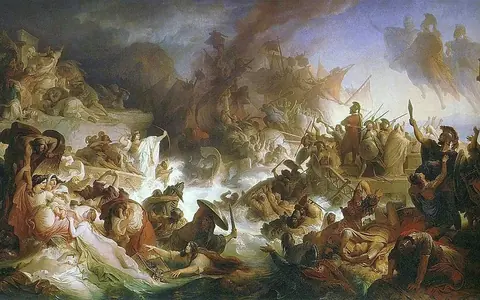
The allied commanders argued over whether to fight at Salamis or fall back to the Isthmus of Corinth. Themistocles held out for a battle in the narrow waters at Salamis, and according to Herodotus he sent Xerxes a secret message that the Greeks were about to slip away. Late in September the Persian fleet rowed into the strait. There, in confined water, the heavier Greek triremes rammed their opponents, and the crowded Persian ships fouled one another while Xerxes watched from the shore.21
The size of the two fleets is as uncertain as the size of the army. Herodotus counts 378 Greek triremes. Modern accounts differ widely: Britannica's article on the battle gives about 800 Persian galleys against about 370 Greek triremes, while the EBSCO account has about 350 Persian ships against probably 310 Greek ones. All agree that Persian losses were heavy and that the Greeks won command of the sea.22
Xerxes then went back to Asia with much of his army and what was left of the fleet, leaving his general Mardonius to winter in Thessaly with a smaller army. Why he left is debated: fear of a revolt in Babylonia, the end of the sailing season and the difficulty of feeding a large army without command of the sea have all been suggested.23
The Battles of Plataea and Mycale (479 BC)
In the summer of 479 BC Mardonius marched south again and set up his base in the territory of Persia's ally Thebes, near Plataea in Boeotia. The allied Greek army, with the Spartans on the right wing and the Athenians on the left, assembled on the hills opposite under the Spartan regent Pausanias.24
For days neither side would attack. Persian cavalry cut the Greek supply routes and fouled their springs, and Pausanias ordered a night withdrawal that left his army scattered at dawn. Mardonius attacked at once. The Spartans and Tegeans bore the brunt, and their heavier armor and close formation prevailed; Mardonius was killed fighting the Spartans, his army broke, and the Greeks stormed the Persian camp.25

Meanwhile the allied fleet under the Spartan king Leotychides crossed to Asia Minor. At Mycale, opposite Samos, the Persians beached their ships and joined a land army, but the Greeks landed and won a complete victory. Herodotus says Mycale was fought on the same day as Plataea, which Schmitt doubts. Together the two battles ended the invasion, and Persia never again invaded mainland Greece.26
The Delian League and the Peace of Callias (478 to 449 BC)
After 479 BC Sparta had little wish to campaign overseas, while Athens was ready to keep fighting for the Greeks of Asia Minor. In 478 BC it founded the Delian League, an alliance of island and coastal cities with its treasury on Delos, to free the Ionians and take revenge on Persia. League fleets drove Persian garrisons out of Thrace and the Aegean.27
The greatest victory came under Cimon, son of Miltiades, who led a league fleet along the southern coast of Asia Minor and defeated a Persian fleet and army at the Eurymedon River in Pamphylia. The date is uncertain, somewhere between about 469 and 466 BC. A later Athenian expedition to support a revolt in Egypt ended in disaster in 454 BC.28
After Cimon's last campaign on Cyprus, an Athenian embassy led by Callias concluded a peace with King Artaxerxes I, traditionally dated 449 BC. Under the terms reported later, Persian fleets stayed out of the Aegean and the Greek cities of the Asian coast were left free of the king's tribute and garrisons, while Athens accepted that it could not free every Greek city under Persian rule.29
The peace is disputed. No surviving Greek writer of the fifth century mentions it, and the German scholar Klaus Meister rejected it as a later fabrication. Ernst Badian argued that it was real, the first compromise treaty between Achaemenid Persia and a Greek city, and that it renewed an earlier peace made in the 460s BC. Schmitt describes its historicity as still at issue.30
The war also changed Athens. The league's treasury moved to Athens in 454 BC, the allies became tribute-paying subjects of an Athenian empire, and league money helped to rebuild the temples on the Acropolis that the Persians had destroyed.31
Key commanders of the Greco-Persian Wars
On the Persian side, Darius I launched the war against the mainland Greeks; Datis and Artaphernes led the expedition of 490 BC; Xerxes I led the great invasion of 480 BC in person; and Mardonius commanded the army left in Greece until his death at Plataea. On the Greek side, Miltiades planned the attack at Marathon, Leonidas held Thermopylae, the Spartan Eurybiades held the formal command of the allied fleet while Themistocles shaped its strategy at Salamis, Pausanias won at Plataea, Leotychides at Mycale, and Cimon led the Delian League's offensive.32

Who won the Greco-Persian Wars, and why did Persia fail?
The Greeks won the wars they fought on their own soil: both Persian invasions of mainland Greece failed, and in the following years the Greeks of Ionia were freed. Britannica's verdict is that the Greek triumph ensured the survival of Greek culture and political institutions. For Persia the defeat was serious but not fatal. The Gale encyclopedia calls the wars in Greece ultimately a sideshow for the empire, and after 479 BC the kings mostly sought to hold their existing frontiers. The empire lasted until Alexander the Great conquered it, some 150 years after Marathon.33
Why did Persia fail? Britannica credits Spartan leadership, Athenian loyalty and Greek fighting power. The Greek hoplite, with a longer spear and heavier armor, had the advantage in close combat at Marathon and Plataea, and at Thermopylae and Salamis the Greeks chose narrow ground and narrow water where Persian numbers counted for little. Once the fleet lost command of the sea, supplying the huge army became impossible. Schmitt adds that Xerxes made major errors in the timing of his advance and his decision to attack.34
The long view is less one-sided. Persian gold financed the Spartan fleet in the last years of the Peloponnesian War between Athens and Sparta, and by the King's Peace of 387 to 386 BC the Greek cities of Asia Minor were handed back to the Persian king. Schmitt quotes the historian A. T. Olmstead's judgment that Persia had thus won the second great war with the European Greeks.35
How the Greco-Persian Wars are remembered
The wars are known to us chiefly through Herodotus, who wrote his Histories decades after the events and is the main source on which every later account must rely. The playwright Aeschylus, who fought at Marathon, put the Persian defeat on the Athenian stage in his tragedy The Persians in 472 BC, set in the aftermath of the Persian defeat.36
Marathon became the proudest memory of democratic Athens. Herodotus tells of the runner Pheidippides, sent from Athens to Sparta before the battle to ask for help; the later legend of a messenger who ran from Marathon to Athens with news of the victory and died inspired the modern marathon race. Thermopylae became the model of a heroic last stand, though the Thespians and others who died beside the 300 Spartans are often forgotten.37
The memory of the invasion also served later wars. After his victory at Chaeronea in 338 BC, Philip II of Macedon proclaimed a war of all the Greeks against Persia to avenge what Xerxes had done in 480 BC, and his son Alexander the Great carried it out, destroying the Achaemenid Empire within a decade. That story continues in our guide to the wars of Alexander the Great.38
Major battles of the Greco-Persian Wars
Our guides to the battles of the Greco-Persian Wars are listed below in date order. For a wider view see the greatest battles of ancient Greece and the greatest battles of the Persian Empire, and for the infantry formation that won at Marathon and Plataea, what a phalanx was.39
- 490 BCThe Battle of Marathon, 490 BCAthens and Plataea vs Persian Empire
Outnumbered Athenians charged the Persian line at a run, and the upset that saved the city gave the world the marathon.

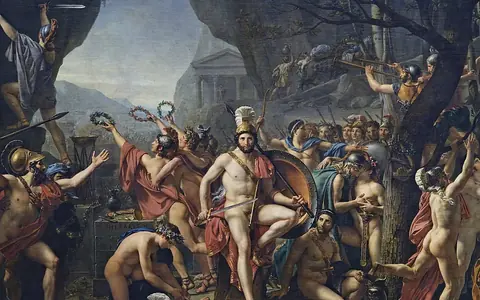
- 480 BCThe Battle of Thermopylae, 480 BCHellenic League vs Persian Empire
A handful of Greeks held the narrow pass for three days against a vast Persian army. What actually happened, beyond the legend of the 300.
- 480 BCThe Battle of Salamis, 480 BCHellenic alliance (Athens, Sparta, Corinth) vs Persian Empire (Achaemenids)
Athens was burning. A smaller Greek fleet lured Persia into a strait and shattered it, saving Greece.
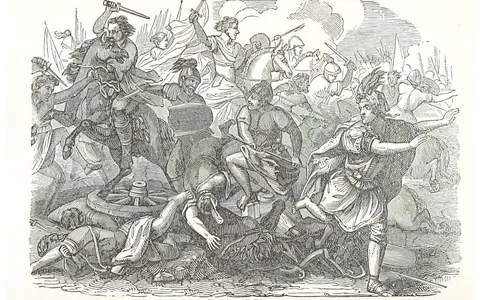
- 479 BCBattle of Plataea, 479 BCGreek alliance vs Persian Empire
How the largest Greek army ever assembled ended the Persian invasion for good.
Timeline of the Greco-Persian Wars
- about 546 BCCyrus the Great defeats Croesus of Lydia; the Greek cities of Asia Minor come under Persian rule.40
- 499 BCThe Ionian Revolt begins at Miletus under Aristagoras.41
- 498 BCIonian, Athenian and Eretrian forces burn most of Sardis.42
- 494 BCThe Persian fleet wins at Lade; Miletus falls.43
- 492 BCMardonius's expedition secures Thrace and Macedonia; his fleet is wrecked off Mount Athos.44
- 490 BCDatis and Artaphernes take Eretria; the Athenians and Plataeans win at Marathon in September.45
- 486 BCDarius I dies; Xerxes I succeeds him.46
- 481 BCAbout 30 Greek cities form an alliance under Spartan command.47
- 480 BCXerxes crosses the Hellespont; Persian victory at Thermopylae, indecisive fighting off Artemisium, the sack of Athens and the Greek naval victory at Salamis.48
- 479 BCGreek victories at Plataea, where Mardonius is killed, and Mycale.49
- 478 BCAthens founds the Delian League.50
- about 469 to 466 BCCimon defeats the Persians at the Eurymedon River.51
- 449 BCTraditional date of the Peace of Callias between Athens and Persia (disputed).52
Where to read next
The Greco-Persian Wars belong to antiquity. Read the lives of Darius the Great, Xerxes I, Leonidas and Themistocles, and compare the two leading Greek cities in Sparta vs Athens. The next great wars of the ancient world have their own guides: the wars of Alexander the Great, the Punic Wars between Rome and Carthage, and the Roman civil wars.53
Notes
A number in the text points to a note; each note names the works that paragraph draws on, listed in full under Sources.
- Britannica Editors, “Greco-Persian Wars”; Britannica Editors, “Greco-Persian Wars”; Samuel K. Eddy and Jon L. Berquist, “Persian Invasion of Greece”; Rüdiger Schmitt, “Greece i. Greco-Persian Political Relations”. ↩
- Britannica Editors, “Greco-Persian Wars”; Rüdiger Schmitt, “Greece i. Greco-Persian Political Relations”; National Geographic History, “At the Battle of Marathon, Athens’ underdog victory stunned Persia”. ↩
- Britannica Editors, “Greco-Persian Wars”; Rüdiger Schmitt, “Greece i. Greco-Persian Political Relations”; Gale Encyclopedia of World History: War, “Greek-Persian Wars”. ↩
- Britannica Editors, “Greco-Persian Wars”; Eugene Larson, “Ionian Revolt”; Rüdiger Schmitt, “Greece i. Greco-Persian Political Relations”. ↩
- Britannica Editors, “Greco-Persian Wars”; Britannica Editors, “Greco-Persian Wars”; Eugene Larson, “Ionian Revolt”; Rüdiger Schmitt, “Greece i. Greco-Persian Political Relations”. ↩
- Eugene Larson, “Ionian Revolt”; Rüdiger Schmitt, “Greece i. Greco-Persian Political Relations”. ↩
- Britannica Editors, “Greco-Persian Wars”; Britannica Editors, “Greco-Persian Wars”; Rüdiger Schmitt, “Greece i. Greco-Persian Political Relations”; National Geographic History, “Betrayal crushed Sparta’s last stand at the Battle of Thermopylae”; Gale Encyclopedia of World History: War, “Greek-Persian Wars”. ↩
- Britannica Editors, “Greco-Persian Wars”; Rüdiger Schmitt, “Greece i. Greco-Persian Political Relations”; Gale Encyclopedia of World History: War, “Greek-Persian Wars”. ↩
- Britannica Editors, “Greco-Persian Wars”; Samuel K. Eddy and Jon L. Berquist, “Persian Invasion of Greece”; Rüdiger Schmitt, “Greece i. Greco-Persian Political Relations”. ↩
- Britannica Editors, “Greco-Persian Wars”; Samuel K. Eddy and Jon L. Berquist, “Persian Invasion of Greece”; Donald Sommerville, “Battle of Plataea”. ↩
- Britannica Editors, “Greco-Persian Wars”; Samuel K. Eddy and Jon L. Berquist, “Persian Invasion of Greece”; Rüdiger Schmitt, “Greece i. Greco-Persian Political Relations”; Gale Encyclopedia of World History: War, “Greek-Persian Wars”. ↩
- Britannica Editors, “Greco-Persian Wars”; Rüdiger Schmitt, “Greece i. Greco-Persian Political Relations”; National Geographic History, “At the Battle of Marathon, Athens’ underdog victory stunned Persia”; Gale Encyclopedia of World History: War, “Greek-Persian Wars”. ↩
- Britannica Editors, “Greco-Persian Wars”; National Geographic History, “At the Battle of Marathon, Athens’ underdog victory stunned Persia”; Gale Encyclopedia of World History: War, “Greek-Persian Wars”. ↩
- Britannica Editors, “Greco-Persian Wars”; National Geographic History, “At the Battle of Marathon, Athens’ underdog victory stunned Persia”; Gale Encyclopedia of World History: War, “Greek-Persian Wars”; Herodotus, 6.117. ↩
- Britannica Editors, “Greco-Persian Wars”; Samuel K. Eddy and Jon L. Berquist, “Persian Invasion of Greece”; Rüdiger Schmitt, “Greece i. Greco-Persian Political Relations”; National Geographic History, “Betrayal crushed Sparta’s last stand at the Battle of Thermopylae”; Gale Encyclopedia of World History: War, “Greek-Persian Wars”; Christopher Brooks, “The Persian Wars”. ↩
- Samuel K. Eddy and Jon L. Berquist, “Persian Invasion of Greece”; Rüdiger Schmitt, “Greece i. Greco-Persian Political Relations”; National Geographic History, “Betrayal crushed Sparta’s last stand at the Battle of Thermopylae”; Gale Encyclopedia of World History: War, “Greek-Persian Wars”; Kate Lohnes and Donald Sommerville, “Battle of Thermopylae”; Herodotus, 6.117. ↩
- Britannica Editors, “Greco-Persian Wars”; Samuel K. Eddy and Jon L. Berquist, “Persian Invasion of Greece”; Rüdiger Schmitt, “Greece i. Greco-Persian Political Relations”; National Geographic History, “Betrayal crushed Sparta’s last stand at the Battle of Thermopylae”; Kate Lohnes and Donald Sommerville, “Battle of Thermopylae”. ↩
- Britannica Editors, “Greco-Persian Wars”; Samuel K. Eddy and Jon L. Berquist, “Persian Invasion of Greece”; National Geographic History, “Betrayal crushed Sparta’s last stand at the Battle of Thermopylae”; Kate Lohnes and Donald Sommerville, “Battle of Thermopylae”. ↩
- Britannica Editors, “Greco-Persian Wars”; Samuel K. Eddy and Jon L. Berquist, “Persian Invasion of Greece”; Rüdiger Schmitt, “Greece i. Greco-Persian Political Relations”; Christopher Brooks, “The Persian Wars”. ↩
- Britannica Editors, “Greco-Persian Wars”; Gale Encyclopedia of World History: War, “Greek-Persian Wars”; Andrew Robert Burn, “Themistocles”. ↩
- Britannica Editors, “Greco-Persian Wars”; Samuel K. Eddy and Jon L. Berquist, “Persian Invasion of Greece”; Rüdiger Schmitt, “Greece i. Greco-Persian Political Relations”; Gale Encyclopedia of World History: War, “Greek-Persian Wars”; Britannica Editors, “Battle of Salamis”. ↩
- Samuel K. Eddy and Jon L. Berquist, “Persian Invasion of Greece”; Gale Encyclopedia of World History: War, “Greek-Persian Wars”; Britannica Editors, “Battle of Salamis”; Herodotus, 6.117. ↩
- Rüdiger Schmitt, “Greece i. Greco-Persian Political Relations”; Gale Encyclopedia of World History: War, “Greek-Persian Wars”; Donald Sommerville, “Battle of Plataea”. ↩
- James P. Sickinger, “Battle of Plataea”; Donald Sommerville, “Battle of Plataea”. ↩
- Britannica Editors, “Greco-Persian Wars”; James P. Sickinger, “Battle of Plataea”; Donald Sommerville, “Battle of Plataea”. ↩
- Britannica Editors, “Greco-Persian Wars”; Samuel K. Eddy and Jon L. Berquist, “Persian Invasion of Greece”; Rüdiger Schmitt, “Greece i. Greco-Persian Political Relations”; Gale Encyclopedia of World History: War, “Greek-Persian Wars”; Donald Sommerville, “Battle of Plataea”. ↩
- Britannica Editors, “Greco-Persian Wars”; Rüdiger Schmitt, “Greece i. Greco-Persian Political Relations”; Britannica Editors, “Delian League”; Open Yale Courses, “Week 8”. ↩
- Britannica Editors, “Greco-Persian Wars”; Rüdiger Schmitt, “Greece i. Greco-Persian Political Relations”; Britannica Editors, “Delian League”; Open Yale Courses, “Week 8”. ↩
- Britannica Editors, “Greco-Persian Wars”; Rüdiger Schmitt, “Greece i. Greco-Persian Political Relations”; Ernst Badian, “Callias, Peace of”. ↩
- Rüdiger Schmitt, “Greece i. Greco-Persian Political Relations”; Ernst Badian, “Callias, Peace of”. ↩
- Ernst Badian, “Callias, Peace of”; Britannica Editors, “Delian League”. ↩
- Britannica Editors, “Greco-Persian Wars”; Samuel K. Eddy and Jon L. Berquist, “Persian Invasion of Greece”; Rüdiger Schmitt, “Greece i. Greco-Persian Political Relations”; Gale Encyclopedia of World History: War, “Greek-Persian Wars”. ↩
- Britannica Editors, “Greco-Persian Wars”; Samuel K. Eddy and Jon L. Berquist, “Persian Invasion of Greece”; Rüdiger Schmitt, “Greece i. Greco-Persian Political Relations”; Gale Encyclopedia of World History: War, “Greek-Persian Wars”. ↩
- Britannica Editors, “Greco-Persian Wars”; Rüdiger Schmitt, “Greece i. Greco-Persian Political Relations”; National Geographic History, “Betrayal crushed Sparta’s last stand at the Battle of Thermopylae”; Gale Encyclopedia of World History: War, “Greek-Persian Wars”; Britannica Editors, “Battle of Salamis”; Christopher Brooks, “The Persian Wars”. ↩
- Rüdiger Schmitt, “Greece i. Greco-Persian Political Relations”; Ernst Badian, “Callias, Peace of”. ↩
- Eugene Larson, “Ionian Revolt”; National Geographic History, “At the Battle of Marathon, Athens’ underdog victory stunned Persia”; Open Yale Courses, “Week 8”. ↩
- Britannica Editors, “Greco-Persian Wars”; Samuel K. Eddy and Jon L. Berquist, “Persian Invasion of Greece”; National Geographic History, “At the Battle of Marathon, Athens’ underdog victory stunned Persia”; National Geographic History, “Betrayal crushed Sparta’s last stand at the Battle of Thermopylae”. ↩
- Rüdiger Schmitt, “Greece i. Greco-Persian Political Relations”; Gale Encyclopedia of World History: War, “Greek-Persian Wars”. ↩
- Britannica Editors, “Greco-Persian Wars”; Rüdiger Schmitt, “Greece i. Greco-Persian Political Relations”. ↩
- Britannica Editors, “Greco-Persian Wars”; Rüdiger Schmitt, “Greece i. Greco-Persian Political Relations”. ↩
- Eugene Larson, “Ionian Revolt”; Rüdiger Schmitt, “Greece i. Greco-Persian Political Relations”. ↩
- Britannica Editors, “Greco-Persian Wars”; Eugene Larson, “Ionian Revolt”. ↩
- Britannica Editors, “Greco-Persian Wars”; Eugene Larson, “Ionian Revolt”. ↩
- Samuel K. Eddy and Jon L. Berquist, “Persian Invasion of Greece”; Gale Encyclopedia of World History: War, “Greek-Persian Wars”. ↩
- Britannica Editors, “Greco-Persian Wars”; National Geographic History, “At the Battle of Marathon, Athens’ underdog victory stunned Persia”. ↩
- Britannica Editors, “Greco-Persian Wars”; Christopher Brooks, “The Persian Wars”. ↩
- Britannica Editors, “Greco-Persian Wars”; Rüdiger Schmitt, “Greece i. Greco-Persian Political Relations”. ↩
- Britannica Editors, “Greco-Persian Wars”; Samuel K. Eddy and Jon L. Berquist, “Persian Invasion of Greece”; Rüdiger Schmitt, “Greece i. Greco-Persian Political Relations”. ↩
- Britannica Editors, “Greco-Persian Wars”; Donald Sommerville, “Battle of Plataea”. ↩
- Britannica Editors, “Delian League”; Open Yale Courses, “Week 8”. ↩
- Britannica Editors, “Delian League”; Open Yale Courses, “Week 8”. ↩
- Britannica Editors, “Greco-Persian Wars”; Ernst Badian, “Callias, Peace of”. ↩
- Britannica Editors, “Greco-Persian Wars”; Rüdiger Schmitt, “Greece i. Greco-Persian Political Relations”. ↩
Sources
- Britannica Editors, Encyclopaedia Britannica, “Greco-Persian Wars”.
- Britannica Editors, revised by Michael Ray, Encyclopaedia Britannica, “Greco-Persian Wars: The Ionian Revolt” (with the sections on Marathon, the expedition of Xerxes and the Peace of Callias).
- Samuel K. Eddy and Jon L. Berquist, EBSCO Research Starters, “Persian Invasion of Greece”.
- Rüdiger Schmitt, Encyclopaedia Iranica, “Greece i. Greco-Persian Political Relations” (2002).
- National Geographic History, “At the Battle of Marathon, Athens’ underdog victory stunned Persia”.
- Gale Encyclopedia of World History: War, via Encyclopedia.com, “Greek-Persian Wars”.
- Eugene Larson, EBSCO Research Starters, “Ionian Revolt”.
- National Geographic History, “Betrayal crushed Sparta’s last stand at the Battle of Thermopylae”.
- Donald Sommerville, Encyclopaedia Britannica, “Battle of Plataea”.
- Herodotus, The Histories, translated by A. D. Godley (Harvard University Press, 1920), Perseus Digital Library: 6.117, 7.60, 7.186, 8.48.
- Christopher Brooks, “The Persian Wars”, in Birth of Europe (CUNY Pressbooks, adapted from his Western Civilization: A Concise History).
- Kate Lohnes and Donald Sommerville, Encyclopaedia Britannica, “Battle of Thermopylae”.
- Andrew Robert Burn, Encyclopaedia Britannica, “Themistocles”.
- Britannica Editors, Encyclopaedia Britannica, “Battle of Salamis”.
- James P. Sickinger, EBSCO Research Starters, “Battle of Plataea”.
- Britannica Editors, revised by Kathleen Kuiper, Encyclopaedia Britannica, “Delian League”.
- Open Yale Courses, Introduction to Ancient Greek History (CLCV 205), “Week 8: The Athenian Empire”, key words and chronology (PDF).
- Ernst Badian, Encyclopaedia Iranica, “Callias, Peace of” (1990).




