

What were the wars of Alexander the Great and who won?
They were the campaigns of Alexander III of Macedon from 336 to 323 BC. He defeated Darius III at Issus and Gaugamela, and the Persian Empire fell by 330 BC. He beat Porus at the Hydaspes, but his army forced him to turn back, and he died in Babylon in 323 BC.1
In eleven years of war, Alexander the Great, king of Macedon, led an army from the Hellespont to the valley of the Indus and brought down the Achaemenid Persian Empire. Our battle guides follow the decisive moments: the Battle of Issus in 333 BC, where Darius III first faced him in person, the Battle of Gaugamela in 331 BC, which broke the Persian royal army, and the Battle of the Hydaspes in 326 BC against the Indian king Porus. Below: why the wars began, how Persia fought back, how big the armies really were, and what became of the empire after Alexander died.2
Causes of the wars of Alexander the Great
The war was Philip II's before it was Alexander's. Philip had made Macedon the leading military power of the Greek world, planned an invasion of the Persian Empire and had already sent an advance force into Asia Minor when he was assassinated in 336 BC. His son, then 20, succeeded him and took over the plan.3
The stated aim was a Panhellenic war: to free the Greek cities of Asia Minor, under Persian rule for about two centuries, and to avenge the Persian invasion of Greece in the Greco-Persian Wars. That was the justification, not the whole story. The Getty Museum notes that Alexander presented himself both as the liberator of the Greeks in Asia Minor and as the rightful king of Persia, and the historian Pierre Briant argues that from 334 BC he had in view the whole empire as it had been under Darius I.4
On the Persian side, Darius III had come to the throne in 336 BC after the court official Bagoas poisoned two kings, Artaxerxes III and Arses; Darius soon forced Bagoas to drink his own poison. Ernst Badian argues in the Encyclopaedia Iranica that a king of doubtful legitimacy, facing revolts in Egypt and Babylon, was slow to strengthen his western frontier and would not trust a single commander with it.5
Alexander first secured his rear. In 335 BC he campaigned north across the Danube and against the Illyrians, then turned on Thebes, which had revolted on a rumor of his death. He razed the city: about 6,000 Thebans were killed and the survivors were sold into slavery, a warning the other Greek states heeded.6
Who fought in the wars of Alexander the Great
Alexander's army was Macedonian at its core, with contingents sent by the Greek states of the League of Corinth and other allies. Its striking force was the cavalry, above all the Companions, with a phalanx of heavy infantry armed with long pikes at its center. Antipater, one of Philip's old generals, stayed behind to hold Macedonia and Greece.7
The Achaemenid Empire fought with the resources of a realm that reached from the Aegean to Central Asia. At Gaugamela Darius commanded Persians, Bactrian and Saka horsemen from the east, Mesopotamians, Medes, Armenians, Cappadocians and Indians. Thousands of Greek mercenaries also served Persia, so this was never simply a war of Greeks against Persians.8
In the east Alexander met the peoples of Bactria and Sogdiana and then the kingdoms of the Punjab. Some Indian rulers, such as Taxiles of Taxila, joined him; Porus, whose realm lay between the Hydaspes (Jhelum) and Acesines (Chenab) rivers, chose to fight.9
The Battles of the Granicus and Issus (334 to 333 BC)
Alexander crossed the Hellespont in the spring of 334 BC. In May or June, at the Granicus River near the Sea of Marmara, he met an army led by several Persian satraps rather than the king. Diodorus reports that the Greek commander Memnon of Rhodes advised them to avoid battle and strip the country of supplies; they fought instead, with a force divided among commanders, and their line broke. Briant calls the satraps' tactics foolish.10

The victory opened western Asia Minor. Sardis surrendered and Greek cities such as Ephesus and Miletus passed to Alexander, though Halicarnassus, defended by Memnon, held out for a long time. Refusing a naval battle, Alexander disbanded his own fleet and set out to defeat the Persian navy on land by taking its harbors. Persia struck back: Memnon led a naval counteroffensive in the Aegean until his death, and Persian forces counterattacked in Asia Minor.11
Darius now took the field himself. He raised a large army with great speed and, through a failure of Macedonian intelligence, appeared behind Alexander at Issus in the autumn of 333 BC, probably in November. He fought on a small coastal plain along the Pinarus River, where his superior cavalry could not envelop the enemy. Alexander led the charge across the river, broke the Persian left and turned on the Greek mercenaries in the center, and the Persian army collapsed.12
Darius escaped, but his mother, wife and children and his baggage fell to Alexander. Greek writers called his flight cowardice. Badian argues instead that Darius understood the kingdom could survive only if he did: had he died, no successor could have led the resistance. Darius then offered a large ransom, wide territories and a marriage alliance; Alexander rejected the terms and demanded to be recognized as lord of Asia.13
The siege of Tyre, Gaza and Egypt (332 to 331 BC)
Instead of pursuing Darius, Alexander marched south along the coast to take the last bases of the Persian fleet. Byblos and Sidon opened their gates, but Tyre, on its island, refused. It held out for seven months until Alexander stormed it in July 332 BC; thousands of its defenders were killed and the women and children were sold into slavery. Gaza then resisted for two months before it too was taken by storm.14
Egypt, which had rebelled against Persian rule several times in the fourth century, surrendered without a fight in the winter of 332 to 331 BC, and the ancient writers say the Egyptians welcomed Alexander. There he founded Alexandria, the first of many cities to bear his name. With the coast in his hands the Persian fleet lost its bases, and Persian resistance in the Aegean collapsed.15
The Battle of Gaugamela and the fall of the Persian Empire (331 to 330 BC)
Darius used the time to build a new army, largely from the eastern satrapies, and to choose his ground. He waited on a broad plain near Gaugamela, east of the Tigris near modern Mosul, and had it leveled for his scythed chariots and cavalry. Mazaeus, satrap of Babylonia, burned supplies ahead of the Macedonians but left the river crossings open, steering them toward the battlefield Darius wanted. A lunar eclipse on 20 September 331 BC was read as an omen of the king's defeat.16
Battle came on 1 October 331 BC, after Darius had kept his men under arms all night for fear of a night attack. Alexander edged to the right, drawing the Persian left after him; javelin men and archers shot down the scythed chariots, and when a gap opened near the Persian center, Alexander drove into it with the Companion cavalry and the phalanx, straight at Darius. The king fled a second time, while on the other wing Parmenio was hard pressed until the Persian collapse spread.17

Gaugamela destroyed the last Achaemenid royal army. Babylon surrendered and Alexander made Mazaeus its satrap; Susa gave up immense treasures. In January 330 BC the satrap Ariobarzanes held the Persian Gates, a pass in the Zagros, and inflicted on Alexander what Badian calls the only defeat he is known to have suffered at Persian hands, but Alexander found a way around and reached Persepolis. In the spring he burned the palace of Xerxes, perhaps as a symbol that the war of revenge was over, though a later tradition blamed a drunken revel.18
Darius fell back to Ecbatana and then east. In July 330 BC Bessus, satrap of Bactria and a kinsman of the king, and other nobles took him prisoner and stabbed him before Alexander could reach him. Bessus claimed the throne as Artaxerxes. The Achaemenid dynasty was over, but, as Briant stresses, the Iranian resistance was not.19
Bactria and Sogdiana: the war in Central Asia (330 to 327 BC)
Some of the hardest fighting came after the great battles. In Bactria and Sogdiana, in modern Afghanistan, Uzbekistan and Tajikistan, Bessus and then the Sogdian Spitamenes led a resistance backed by the local nobility. Ptolemy captured Bessus, who was later executed, but Spitamenes kept up a war of raids that Britannica calls the most determined opposition Alexander met, until he was killed in the winter of 328 to 327 BC. Briant counts three years of heavy fighting.20
Alexander won by force and by marriage. He planted thousands of Greek and Macedonian settlers in garrisons and new cities, used mass deportations and terror, and married Roxana, the daughter of the local noble Oxyartes. He also adopted Persian royal dress and court ceremony to win over the Iranian elite, which angered many Macedonians: Philotas and his father Parmenio had already been put to death in 330 BC after an alleged plot, and in a drunken quarrel Alexander killed his officer Cleitus.21
The Battle of the Hydaspes and the mutiny in India (327 to 325 BC)
In 327 BC Alexander crossed the Hindu Kush into the valleys of the Kabul and Swat rivers, where the fighting was merciless; he stormed the mountain stronghold of Aornos and, in the spring of 326 BC, crossed the Indus to Taxila.22
Porus waited on the far bank of the Hydaspes with his army, chariots and war elephants. After repeated feints, Alexander crossed by night in a storm some 17 or 18 miles upstream, while Craterus held the main camp opposite Porus. On the far bank his cavalry attacked Porus's wings while the infantry faced the elephants, and Craterus crossed with the rest of the army. Porus's army was destroyed: Diodorus counts more than 12,000 Indian dead and Britannica repeats that figure as an estimate.23
Porus fought on to the end. Alexander left him in charge of his kingdom, now as an ally and subordinate, and founded two cities by the river, Nicaea and Bucephala, the latter named after his horse. Little is known of Porus except from Greek writers.24
Alexander wanted to push further east, but at the Hyphasis (Beas) River his weary army refused to go on. Coenus, one of his senior officers, spoke for the men, and Alexander turned back. The voyage down the Indus brought more heavy slaughter, and Alexander was badly wounded storming a town of the Malli. In 325 BC he led part of the army through the Gedrosian desert in modern Baluchistan, where many died of heat, thirst and hunger.25
How big were Alexander's and Darius's armies?
Alexander's own army is fairly well documented. Modern reference works put the force that crossed into Asia in 334 BC at about 30,000 to 43,000 infantry and 5,000 to 5,500 cavalry, and Plutarch already reported a range from 30,000 foot and 4,000 horse to 43,000 foot and 5,000 horse. At Gaugamela Alexander had about 40,000 infantry and 7,000 cavalry.26
The figures for Darius's armies are another matter. Plutarch gives him 600,000 men at Issus and a million at Gaugamela; Diodorus gives half a million at Issus and 800,000 foot with 200,000 horse at Gaugamela. Historians reject these totals. Ernst Badian calls the ancient numbers for Gaugamela worthless, and Britannica describes some of them as quite fantastic. Modern scholars agree only that the Persians outnumbered Alexander, above all in cavalry; there is no reliable figure.27
Key commanders of the wars of Alexander the Great
Alexander led in person, commanding the Companion cavalry on the right wing in his great battles. Parmenio, his father's veteran general, held the left at Issus and Gaugamela until his killing in 330 BC; Craterus held the camp at the Hydaspes; and Ptolemy, later king of Egypt, captured Bessus. On the Persian side, Darius III led the royal armies at Issus and Gaugamela; Memnon of Rhodes, a Greek in Persian service, commanded the fleet until his death in 333 BC; Mazaeus held the right at Gaugamela; Ariobarzanes defended the Persian Gates; and Bessus and Spitamenes led the resistance in the east. In India, Porus commanded at the Hydaspes.28
Who won the wars of Alexander the Great?
Alexander won. Between 334 and 330 BC he destroyed the Achaemenid armies, took the Persian capitals and outlived the last Achaemenid king, and he ruled from Greece and Egypt to the Indus valley as king of Asia. But he did not end the war on his own terms. His army stopped him at the Hyphasis, and by the time he came back west, revolts in Sogdiana, the Punjab and the Indus valley were, in Jona Lendering's account, beyond his power to suppress.29

To hold the empire he kept much of the Persian system of government and used local elites: Mazaeus in Babylon, Persian nobles at court, and 30,000 Iranian youths trained as Macedonian soldiers. Many Macedonians resented it, and in 324 BC they mutinied at Opis when he sent veterans home; Alexander broke the mutiny by enrolling Persians in their place.30
Alexander died in Babylon in June 323 BC, about ten days after falling ill following a banquet. He had named no heir. His generals made his half-brother Philip Arrhidaeus and his son by Roxana, born after his death, joint kings, shared out the satrapies and then fought a series of wars over the empire. By about 300 BC it had split into three great parts in Europe, Asia and Egypt, the kingdoms of the Antigonids, Seleucids and Ptolemies that define what historians call the Hellenistic period.31
How Alexander is remembered in Greece, Iran and beyond
Alexander's conquests carried Greek settlers, cities and culture from Egypt to Central Asia and laid the foundations of the Hellenistic world. But the record is lopsided. As Ernst Badian notes, almost everything known about Darius III comes from Greek and Roman writers centuries later, who used him as a foil for Alexander; there are no Persian royal texts from his reign. Porus, too, is known almost only through Greek sources.32
Iranian tradition kept two opposite pictures. Zoroastrian texts of the Sasanian era call him the accursed Alexander, who killed the king, burned the sacred texts and destroyed the priests. Persian epic made him a legitimate king instead: in Firdawsi's Shahnameh, completed around 1010, Iskandar is the half-brother of Darius, who dies in his arms.33

Major battles of the wars of Alexander the Great
Our guides to the battles of Alexander's wars are listed below in date order. For the earlier struggle between the Greek cities and Persia that Alexander claimed to avenge, see the Greco-Persian Wars, including the Battle of Marathon and the Battle of Thermopylae.34
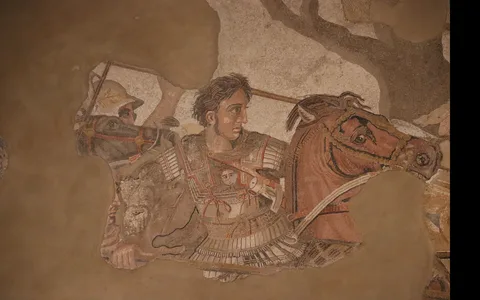
- 333 BCBattle of Issus, 333 BCMacedon and allies vs Persian Empire
How Alexander the Great beat a far larger Persian army and sent King Darius fleeing.
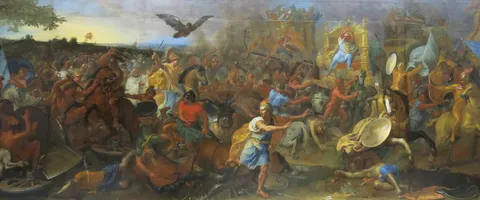
- 331 BCThe Battle of Gaugamela, 331 BCMacedon and the Hellenic League vs Persian Empire (Achaemenids)
Outnumbered on ground his enemy chose, Alexander aimed one cavalry charge at a king and broke an empire.
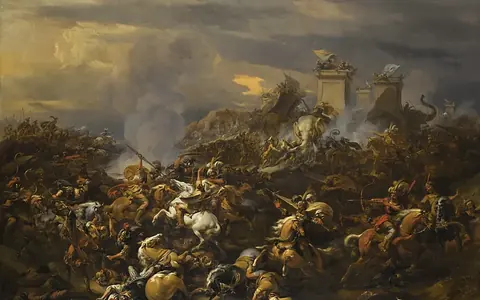
- 326 BCThe Battle of the Hydaspes, 326 BCMacedon vs Kingdom of Porus
A storm crossing, war elephants, and a king who asked to be treated as a king.
Timeline of the wars of Alexander the Great
- 336 BCPhilip II is assassinated and Alexander becomes king of Macedon; Darius III takes the Persian throne.35
- 335 BCAlexander campaigns across the Danube and destroys Thebes.36
- 334 BCAlexander crosses the Hellespont and defeats the satraps at the Granicus.37
- 333 BCBattle of Issus: Darius flees and his family is captured.38
- 332 BCTyre falls after a seven-month siege; Gaza is taken.39
- 332 to 331 BCEgypt submits and Alexandria is founded.40
- 331 BCBattle of Gaugamela, 1 October.41
- 330 BCThe Persian Gates; Persepolis is burned; Bessus kills Darius in July.42
- 329 to 327 BCWar in Bactria and Sogdiana; Spitamenes is killed.43
- 326 BCBattle of the Hydaspes against Porus; the army refuses to go on at the Hyphasis.44
- 325 BCMarch through the Gedrosian desert.45
- 324 BCMutiny of the Macedonian veterans at Opis.46
- 323 BCAlexander dies in Babylon in June.47
Where to read next
The wars of Alexander belong to Antiquity. Read the lives of Alexander the Great and his father Philip II, learn how the phalanx fought and how armies met war elephants, see where Issus and Gaugamela rank among the greatest battles of the Persian Empire, and follow the Mediterranean's next great wars in the Punic Wars and the Roman civil wars.
Notes
A number in the text points to a note; each note names the works that paragraph draws on, listed in full under Sources.
- Frank W. Walbank, “Alexander the Great”; Colette Hemingway and Seán Hemingway, “The Rise of Macedon and the Conquests of Alexander the Great”; Pierre Briant, “Alexander the Great”. ↩
- Colette Hemingway and Seán Hemingway, “The Rise of Macedon and the Conquests of Alexander the Great”; Frank W. Walbank, “Alexander the Great”; Pierre Briant, “Alexander the Great”. ↩
- Colette Hemingway and Seán Hemingway, “The Rise of Macedon and the Conquests of Alexander the Great”; Encyclopaedia Britannica, “Darius III”; Pierre Briant, “Alexander the Great”; Frank W. Walbank, “Alexander the Great”. ↩
- J. Paul Getty Museum, “Persia”; Ursula Sims-Williams, “Alexander the Great in Persia and beyond”; Pierre Briant, “Alexander the Great”; Frank W. Walbank, “Alexander the Great”. ↩
- Encyclopaedia Britannica, “Darius III”; Kriston J. Udd, “Darius III”; Ernst Badian, “Darius III”. ↩
- Frank W. Walbank, “Alexander the Great”; Diodorus Siculus, Book XVII, chapters 1 to 16. ↩
- Frank W. Walbank, “Alexander the Great”; Encyclopaedia Britannica, “Battle of Gaugamela”; Jona Lendering, “Alexander the Great”. ↩
- Samuel K. Eddy and Jeffrey L. Buller, “Battle of Gaugamela”; Encyclopaedia Britannica, “Battle of Gaugamela”; Frank W. Walbank, “Alexander the Great”. ↩
- Sanat Pai Raikar, “Battle of the Hydaspes”; Frank W. Walbank, “Alexander the Great”. ↩
- Frank W. Walbank, “Alexander the Great”; Pierre Briant, “Alexander the Great”; Diodorus Siculus, Book XVII, chapters 17 to 39; Ernst Badian, “Darius III”. ↩
- Jona Lendering, “Alexander the Great”; Frank W. Walbank, “Alexander the Great”; Ernst Badian, “Darius III”; Pierre Briant, “Alexander the Great”. ↩
- Ernst Badian, “Darius III”; Frank W. Walbank, “Alexander the Great”; Encyclopaedia Britannica, “Battle of Issus”; Pierre Briant, “Alexander the Great”; Jona Lendering, “Battle of Issus”. ↩
- Encyclopaedia Britannica, “Darius III”; Pierre Briant, “Alexander the Great”; Ernst Badian, “Darius III”; Frank W. Walbank, “Alexander the Great”; Kriston J. Udd, “Darius III”. ↩
- Frank W. Walbank, “Alexander the Great”; Diodorus Siculus, Book XVII, chapters 40 to 63; Pierre Briant, “Alexander the Great”. ↩
- Frank W. Walbank, “Alexander the Great”; Pierre Briant, “Alexander the Great”; Jona Lendering, “Alexander the Great”. ↩
- Ernst Badian, “Gaugamela”; Pierre Briant, “Alexander the Great”; Encyclopaedia Britannica, “Battle of Gaugamela”; Jona Lendering, “Alexander the Great”. ↩
- Ernst Badian, “Darius III”; Ernst Badian, “Gaugamela”; Jona Lendering, “Battle of Gaugamela”; Encyclopaedia Britannica, “Battle of Gaugamela”; Samuel K. Eddy and Jeffrey L. Buller, “Battle of Gaugamela”. ↩
- Frank W. Walbank, “Alexander the Great”; Pierre Briant, “Alexander the Great”; Ernst Badian, “Darius III”; Ernst Badian, “Gaugamela”. ↩
- Ernst Badian, “Darius III”; Pierre Briant, “Alexander the Great”; Frank W. Walbank, “Alexander the Great”; Samuel K. Eddy and Jeffrey L. Buller, “Battle of Gaugamela”. ↩
- Pierre Briant, “Alexander the Great”; Frank W. Walbank, “Alexander the Great”; Jona Lendering, “Alexander the Great”. ↩
- Pierre Briant, “Alexander the Great”; Jona Lendering, “Alexander the Great”; Frank W. Walbank, “Alexander the Great”. ↩
- Frank W. Walbank, “Alexander the Great”; Jona Lendering, “Alexander the Great”. ↩
- Sanat Pai Raikar, “Battle of the Hydaspes”; Ian Worthington, “Battle of Hydaspes”; Diodorus Siculus, Book XVII, chapters 84 to 103. ↩
- Ian Worthington, “Battle of Hydaspes”; Frank W. Walbank, “Alexander the Great”; Sanat Pai Raikar, “Battle of the Hydaspes”; Diodorus Siculus, Book XVII, chapters 84 to 103. ↩
- Frank W. Walbank, “Alexander the Great”; Jona Lendering, “Alexander the Great”; Ian Worthington, “Battle of Hydaspes”; Pierre Briant, “Alexander the Great”. ↩
- Frank W. Walbank, “Alexander the Great”; Colette Hemingway and Seán Hemingway, “The Rise of Macedon and the Conquests of Alexander the Great”; Plutarch, part 1; Samuel K. Eddy and Jeffrey L. Buller, “Battle of Gaugamela”; Ernst Badian, “Gaugamela”. ↩
- Plutarch, part 1; Plutarch, part 2; Diodorus Siculus, Book XVII, chapters 17 to 39; Diodorus Siculus, Book XVII, chapters 40 to 63; Ernst Badian, “Gaugamela”; Encyclopaedia Britannica, “Battle of Gaugamela”. ↩
- Frank W. Walbank, “Alexander the Great”; Ernst Badian, “Darius III”; Ernst Badian, “Gaugamela”; Samuel K. Eddy and Jeffrey L. Buller, “Battle of Gaugamela”; Ian Worthington, “Battle of Hydaspes”; Jona Lendering, “Alexander the Great”. ↩
- J. Paul Getty Museum, “Persia”; Colette Hemingway and Seán Hemingway, “The Rise of Macedon and the Conquests of Alexander the Great”; Jona Lendering, “Alexander the Great”; Frank W. Walbank, “Alexander the Great”. ↩
- Frank W. Walbank, “Alexander the Great”; Pierre Briant, “Alexander the Great”; Jona Lendering, “Alexander the Great”. ↩
- Frank W. Walbank, “Alexander the Great”; Jona Lendering, “Alexander the Great”; Jona Lendering, “Diadochi 1”; Colette Hemingway and Seán Hemingway, “The Rise of Macedon and the Conquests of Alexander the Great”. ↩
- Frank W. Walbank, “Alexander the Great”; Colette Hemingway and Seán Hemingway, “The Rise of Macedon and the Conquests of Alexander the Great”; Ernst Badian, “Darius III”; Sanat Pai Raikar, “Battle of the Hydaspes”. ↩
- Philip G. Kreyenbroek and Firoze M. P. Kotwal, “Alexander the Great ii. In Zoroastrian Tradition”; Ursula Sims-Williams, “Alexander the Great in Persia and beyond”. ↩
- J. Paul Getty Museum, “Persia”; Pierre Briant, “Alexander the Great”. ↩
- Colette Hemingway and Seán Hemingway, “The Rise of Macedon and the Conquests of Alexander the Great”; Encyclopaedia Britannica, “Darius III”. ↩
- Frank W. Walbank, “Alexander the Great”; Diodorus Siculus, Book XVII, chapters 1 to 16. ↩
- Frank W. Walbank, “Alexander the Great”; Pierre Briant, “Alexander the Great”. ↩
- Pierre Briant, “Alexander the Great”; Encyclopaedia Britannica, “Darius III”. ↩
- Frank W. Walbank, “Alexander the Great”; Diodorus Siculus, Book XVII, chapters 40 to 63. ↩
- Frank W. Walbank, “Alexander the Great”; Pierre Briant, “Alexander the Great”. ↩
- Ernst Badian, “Gaugamela”; Samuel K. Eddy and Jeffrey L. Buller, “Battle of Gaugamela”. ↩
- Pierre Briant, “Alexander the Great”; Ernst Badian, “Darius III”. ↩
- Pierre Briant, “Alexander the Great”; Jona Lendering, “Alexander the Great”. ↩
- Frank W. Walbank, “Alexander the Great”; Ian Worthington, “Battle of Hydaspes”. ↩
- Frank W. Walbank, “Alexander the Great”; Jona Lendering, “Alexander the Great”. ↩
- Frank W. Walbank, “Alexander the Great”; Jona Lendering, “Alexander the Great”. ↩
- Frank W. Walbank, “Alexander the Great”; Jona Lendering, “Diadochi 1”. ↩
Sources
- Frank W. Walbank, Encyclopaedia Britannica, “Alexander the Great”.
- Colette Hemingway and Seán Hemingway, The Metropolitan Museum of Art, Heilbrunn Timeline of Art History, “The Rise of Macedon and the Conquests of Alexander the Great”.
- Pierre Briant, Encyclopaedia Iranica, “Alexander the Great”.
- Encyclopaedia Britannica, “Darius III”.
- J. Paul Getty Museum, “Persia: Ancient Iran and the Classical World”.
- Ursula Sims-Williams, The Past, “Alexander the Great in Persia and beyond”.
- Kriston J. Udd, EBSCO Research Starters, “Darius III”.
- Ernst Badian, Encyclopaedia Iranica, “Darius III”.
- Diodorus Siculus, Library of History 17.1 to 16, tr. C. Bradford Welles (Loeb Classical Library, 1963), LacusCurtius, Book XVII, chapters 1 to 16.
- Encyclopaedia Britannica, “Battle of Gaugamela”.
- Jona Lendering, Livius.org, “Alexander the Great”.
- Samuel K. Eddy and Jeffrey L. Buller, EBSCO Research Starters, “Battle of Gaugamela”.
- Sanat Pai Raikar, Encyclopaedia Britannica, “Battle of the Hydaspes”.
- Diodorus Siculus, Library of History 17.17 to 39, tr. C. Bradford Welles (Loeb Classical Library, 1963), LacusCurtius, Book XVII, chapters 17 to 39.
- Encyclopaedia Britannica, “Battle of Issus”.
- Jona Lendering, Livius.org, “Battle of Issus”.
- Diodorus Siculus, Library of History 17.40 to 63, tr. C. Bradford Welles (Loeb Classical Library, 1963), LacusCurtius, Book XVII, chapters 40 to 63.
- Ernst Badian, Encyclopaedia Iranica, “Gaugamela”.
- Jona Lendering, Livius.org, “Battle of Gaugamela”.
- Ian Worthington, EBSCO Research Starters, “Battle of Hydaspes”.
- Diodorus Siculus, Library of History 17.84 to 103, tr. C. Bradford Welles (Loeb Classical Library, 1963), LacusCurtius, Book XVII, chapters 84 to 103.
- Plutarch, Life of Alexander, tr. Bernadotte Perrin (Loeb Classical Library, 1919), LacusCurtius, part 1 (chapters 1 to 22).
- Plutarch, Life of Alexander, tr. Bernadotte Perrin (Loeb Classical Library, 1919), LacusCurtius, part 2.
- Jona Lendering, Livius.org, “Diadochi 1: The Babylon Settlement”.
- Philip G. Kreyenbroek and Firoze M. P. Kotwal, Encyclopaedia Iranica, “Alexander the Great ii. In Zoroastrian Tradition”.




