

Who won the Battle of Thermopylae?
The Persian Empire under Xerxes won the Battle of Thermopylae in 480 BC. A far smaller Greek force under the Spartan king Leonidas, about 7,000 strong including the famous 300 Spartans, held the narrow pass for three days until a local named Ephialtes revealed a mountain path that let the Persians encircle them. It was a tactical defeat, but the stand became one of history's most famous moral victories.1
In the late summer of 480 BC, a small Greek force chose a stretch of coast barely wide enough for a cart and dared the largest army the ancient world had ever assembled to come through it. For three days it could not. Thermopylae is remembered for the way it ended, but the reason it still matters is how nearly it worked.2

The battle from both sides
Two perspectivesFor the Greek alliance the pass was a way to make numbers irrelevant. Leonidas of Sparta held Thermopylae with perhaps 7,000 men, rotating city contingents through the narrow gap where the Persian multitude could not deploy. For two days the hoplite phalanx, long spears and locked shields, held and bled the attackers, even the elite Immortals. Betrayed by the local Ephialtes, who showed the Persians a mountain path, Leonidas dismissed most of the army and stayed with 300 Spartans, 700 Thespians and others to cover the retreat. The Spartans and Thespians died to the last, but the stand bought Greece time and became the moral heart of the war it would go on to win at Salamis and Plataea.3

For Xerxes the pass was an obstacle on the road to conquering Greece, not a battle he expected to lose men over. His vast army, drawn from across the empire, assumed weight of numbers would sweep the Greeks aside; instead the narrow ground robbed him of that advantage, and his assaults, including those of the feared Immortals, broke on the Greek spears for two days. The traitor Ephialtes handed him the solution, a path to the Greek rear, and on the third day the encircled defenders were annihilated. Xerxes had his victory and marched on to burn Athens, but the delay and the cost foreshadowed the reverses to come.

Why a narrow pass: the Hot Gates
King Xerxes I of Persia had crossed into Greece to finish what his father Darius had begun a decade earlier at Marathon. His army was vast: ancient writers claim millions, while modern estimates land somewhere between about 80,000 (World History Encyclopedia) and 300,000, still overwhelming. Numbers like that are only an advantage where they can be brought to bear. The Greek plan, urged by the Spartans, was to deny them the space: hold the coastal defile at Thermopylae, where the mountains pinch the road against the sea (see the map below). Its Greek name means the "Hot Gates," after the warm sulfur springs there.4
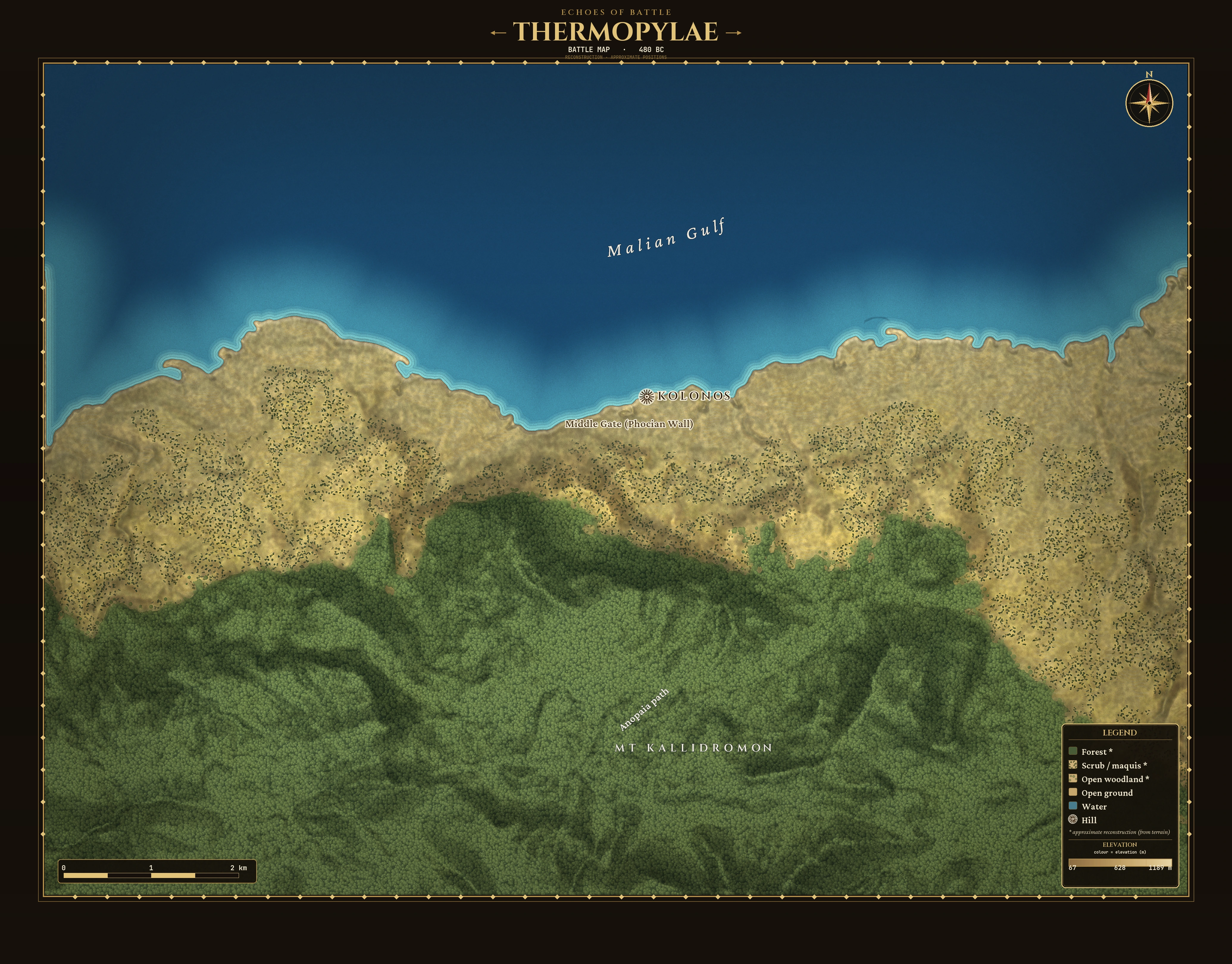
Roughly 7,000 Greeks gathered there under the Spartan king Leonidas I: his own 300 Spartiates, plus Thespians, Thebans, Arcadians, Corinthians and others. In the bottleneck, a Persian could only ever meet a Greek one or two at a time, and the heavily armored hoplite, fighting shoulder to shoulder in the phalanx with his long spear, was built for exactly that.5

Why Sparta sent only 300
Sparta took the invasion seriously, so why did it send so few men? Herodotus gives a plain answer. The Spartans were keeping the Carneia, a festival during which they would not march, and the Olympic festival fell at the same time. So Leonidas went ahead with what Herodotus calls "the three hundred who were appointed by law", and he chose "men who chanced to have sons". They were an advance guard. Once the festival was over, the plan was to leave a garrison at home and bring the whole Spartan army north in haste. On the march Leonidas gathered allies until he had the roughly 7,000 men described above. The main Spartan army never arrived in time.6
Three days at the wall
For two days the Persians threw wave after wave into the pass and were cut down against the old Phocian wall the Greeks had rebuilt. Even Xerxes' elite Immortals, his ten thousand household guard, could make no headway. The Greeks rotated fresh men to the front and, by some accounts, feigned retreats to draw the Persians onto their spears. The battle was going, impossibly, in the defenders' favor.7
The path over the mountain
It was betrayed, not beaten. A local named Ephialtes, hoping for reward, showed the Persians the Anopaia path, a track through the hills that came out behind the Greek position. Warned he was about to be surrounded, Leonidas dismissed most of the allied contingents to fight another day and stayed to cover their retreat with his 300 Spartans, the 700 Thespians who refused to leave, and the Thebans, whom Herodotus says Leonidas kept back as hostages. The Spartans and Thespians were enveloped and killed almost to the last man, while the Thebans surrendered to the Persians; Leonidas fell with his men, and the Persians fought bitterly over his body.8

A defeat that won a war
Thermopylae was a tactical loss. Its value was strategic and moral. The stand, fought alongside the naval action at Artemisium the same days, where the allied Greek fleet blocked the Persian navy, bought Greece time and proof that Persia could be resisted. Within months the Greek fleet destroyed Xerxes' navy at Salamis, and in 479 BC the army was broken at Plataea. The invasion failed. Sparta and Athens fought on the same side in that war, a partnership that later broke down, as told in Sparta vs Athens.9
When was the Battle of Thermopylae, and how long did it last?
The Battle of Thermopylae was fought in 480 BC, at the same time as the sea battle of Artemisium. The exact days are disputed: modern reconstructions range from July to September, and World History Encyclopedia dates it to August. The fighting lasted three days. The Persians won on the third, when the Greek rearguard was surrounded and destroyed, so the Greeks lost the battle but not the war.10
The festivals are also the best clue to the date. Herodotus names no day, and one reconstruction puts the battle in mid-September, when a near-full moon would have lit the Persians' night march over the mountain.11
How long did Leonidas hold the Hot Gates? Longer than the fighting alone suggests. When Xerxes reached the pass, he let four days go by, expecting the Greeks to run. Only on the fifth day did he attack. The fighting then lasted three days, so the Greeks stood in the Hot Gates for about a week, and fought for three days of it.12
The 300: legend and reality
Popular memory recalls 300 Spartans alone, but the pass was held by a much larger Greek force of around 7,000. Leonidas did bring a hand-picked guard of 300 Spartans, yet on the final day they fought and died alongside some 700 Thespians who chose to stay, while the Thebans who remained surrendered to the Persians.13
The Spartan defiance became legend: asked to give up his weapons, Leonidas is said, in a saying preserved by Plutarch, to have answered 'molon labe', come and take them. An epitaph traditionally attributed to the poet Simonides told passers-by that here the Greeks lay obedient to their laws. Modern films have magnified the myth of the 300, but the history is a shared last stand, not a solo one.14 › Battle of Tirad Pass, 1899
The Hot Gates today
Anyone who visits the Hot Gates today will look in vain for a narrow pass. At its tightest point in 480 BC, Herodotus says, the road had room for a single wagon. Since then silt from the Spercheios river has pushed the shoreline several kilometers away from the pass, and the old spring-fed marsh has turned into a thick layer of travertine. What was a strip of road between cliff and sea is now a wide plain.15
Some things have survived. The sulfur springs that gave the place its name still flow at the foot of the mountains. In 480 BC the sea reached about as far inland as the modern road that now runs past the site. Beside the road stands the bronze statue of Leonidas, the center of a monument made in 1955 by the sculptor Vasos Falireas.16
Opposite rises the low Kolonos hill, where the last defenders are believed to have made their final stand and been buried. The evidence is in the ground. Excavations on and around the hill, including those of the archaeologist Spyridon Marinatos, found large numbers of bronze arrowheads of Persian type, and that find is what fixes the last stand to this hill. Today a reconstruction of the epitaph for the Spartan dead stands at the site.17
Think you could have held the pass? Test yourself in the Greek battles quiz, or find the battlefield on the map in Where Was the Battle?






