

What were the Roman civil wars and who won?
The Roman civil wars were wars between Roman commanders and their armies, from Sulla's march on Rome in 88 BC to AD 324. Julius Caesar beat Pompey at the Battle of Pharsalus; Octavian beat Antony and Cleopatra at the Battle of Actium, became Augustus and ended the Republic.1
For more than a century, the men who led Rome's armies turned them on each other. Sulla took Rome by force in 88 BC; Julius Caesar fought Pompey the Great and the Senate from Spain to Egypt; Caesar's heirs avenged his murder at the Battle of Philippi; and Octavian ended the cycle at Actium. This guide follows those wars of the late Republic through the lives of Julius Caesar, Pompey and Augustus, with a head to head in Pompey vs Caesar. Civil war returned under the emperors, so the guide ends with two later episodes that have battle guides of their own: the fall of the emperor Macrinus in AD 218 and Constantine's wars of AD 312 to 324. Below: what caused the Roman civil wars, who fought them and who won.2
Causes of the Roman civil wars
The first civil war began over a command. In 88 BC the war against Mithridates VI of Pontus went to Sulla, consul for that year. The tribune Publius Sulpicius then had the command transferred to Gaius Marius, Sulla's rival. Sulla answered in a way no one expected: he persuaded the army he had led in the Social War, still camped in Campania, to march on Rome, and he took the city and had Sulpicius killed, while Marius escaped.3
It was the first time a Roman army had occupied Rome. The historian Appian, writing in the second century AD, saw it as the moment when Rome's quarrels came to be settled only by force of arms. In Britannica, Ramsay MacMullen explains it by two changes: Marius's reform of the army, which created soldiers loyal chiefly to their commander, and the Social War against Rome's Italian allies, which had made fighting inside Italy seem normal. Stephen Stertz makes the same point for the empire: armies were often more loyal to their generals than to the state.4
That pattern ran through every war in this guide. Caesar crossed into Italy in 49 BC because giving up his army, as the Senate ordered, would have ended his career; Pompey led the Senate's forces against him. Two and a half centuries later, Macrinus became emperor when his army proclaimed him, and lost the throne when the eastern legions went over to a rival.5
Sulla, Marius and the first civil war (88 to 82 BC)
As soon as Sulla left for the East, the consul Cinna moved against his measures. Driven from Rome, Cinna raised an army and, with Marius, who had come back from Africa, took the city after a siege in 87 BC. Leading men were killed and Sulla was declared an enemy of the state. Marius was elected consul for the seventh time but died early in 86 BC, only days into his term.6
Sulla came back from the East with his veterans. One of the men who joined him was the young Pompey, who raised three legions in Picenum on his own authority and brought them to Sulla. Sulla's army broke the resistance of his enemies in Italy, and in 82 BC their last army was defeated at the Colline Gate, just outside Rome, after which Sulla occupied the city.7
Sulla was named dictator and began the proscriptions: lists of enemies who could be killed without trial and whose property was seized and handed to his supporters. Land in the parts of Italy that had resisted him went to his soldiers. He then laid down his power, and he died in 78 BC.8
Caesar against Pompey: the civil war of 49 to 45 BC
By 49 BC Julius Caesar, the conqueror of Gaul, was in Cisalpine Gaul when the Senate ordered him to give up his legions. Pompey, once his ally, now stood with the Senate. Early in 49 BC the Senate declared Caesar an outlaw, and two tribunes who supported him, Mark Antony among them, fled to his camp. Caesar crossed the Rubicon, the stream that marked the border of his province, and brought his army into Italy.9
Pompey had a plan of his own. With only two legions in Italy, he left Rome and then took his army and many senators across the Adriatic from Brundisium. He meant to bottle Caesar up in Italy and starve him out while the eastern provinces and the client kings of the East built up a new army and a fleet. Myles Hudson writes in Britannica that Pompey intended to come back and save the Republic from despotism, as Sulla had done.10
Caesar struck first where his enemies were weakest. He took Massilia and beat Pompey's commanders in Spain at Ilerda in 49 BC, then crossed to Greece. At Dyrrhachium, on the Adriatic coast, he tried to wall Pompey in, but Pompey broke the blockade and beat him. Caesar marched inland across the Pindus mountains, and on 9 August 48 BC the two armies met near Pharsalus.11

Almost everything known about the numbers at Pharsalus comes from Caesar's own account. He gives himself about 22,000 legionaries in 80 cohorts against Pompey's 110 cohorts of 45,000 men, with some 7,000 horsemen on Pompey's side against his own 1,000. He claimed about 15,000 enemy dead and 24,000 prisoners. Historians are more cautious: Myles Hudson calls Caesar's report of only about 230 dead of his own improbably low, and Asinius Pollio, an officer who fought for Caesar that day, put the dead at no more than 6,000 soldiers, the figure that Jona Lendering of Livius.org accepts.12
Pompey escaped by sea to Egypt, hoping that the young king Ptolemy XIII would take him in. The king's advisers had him killed as he came ashore. Caesar pardoned many of his defeated opponents; one of them was Marcus Brutus, who would help to kill him four years later.13
Pharsalus did not end the war. In Alexandria Caesar took sides in a struggle for the Egyptian throne, was besieged there through the winter and in the end placed Cleopatra on the throne. The Pompeians fought on in Africa until Caesar destroyed their army at Thapsus in 46 BC, and Cato, one of their leaders, took his own life at Utica rather than accept a pardon. In Spain, Pompey's sons raised a new army, and Caesar beat it at Munda in 45 BC, the bloodiest battle of the war.14
The Ides of March and the Battle of Philippi (44 to 42 BC)
On 15 March 44 BC, the Ides of March, more than sixty senators, former friends and old enemies alike, struck Caesar down in the Senate. Their leaders, Gaius Cassius and Marcus and Decimus Brutus, expected Romans to welcome the return of freedom. But the armies, above all in the West, were loyal to Caesar's memory, and the conspirators soon left Italy for the eastern provinces.15
Mark Antony, the surviving consul, took control of Rome. His rival for the leadership of Caesar's party was Octavian, Caesar's great-nephew and adopted heir, not yet 20 years old. With Cicero leading the Senate against Antony, Octavian helped to defeat him at Mutina in 43 BC, then took the consulship by force and joined Antony and Lepidus as triumvirs. They secured Italy with a new wave of proscriptions, and Cicero, Antony's chief enemy, was among the first to die.16
The triumvirs then crossed to Macedonia, where Brutus and Cassius had gathered the armies of the East. Appian gives each side nineteen legions; Britannica's account says only that the two sides were roughly equal. In the first battle at Philippi in October 42 BC, Antony stormed Cassius's camp while Brutus broke into Octavian's. Cassius, not knowing that Brutus had won, killed himself. A second battle followed: Britannica dates it to 23 October, about three weeks later, while Livius.org reads the ancient accounts as placing it only days later. This time Brutus was routed, and he too took his own life.17
Antony, Cleopatra and the Battle of Actium (32 to 30 BC)
The victors divided the Roman world. Octavian took Italy and the West and Antony the East, while Lepidus was pushed aside and in 36 BC lost his place as triumvir. In 40 BC the two leaders sealed their alliance at Brundisium, where Antony married Octavia, Octavian's sister, and Octavian's admiral Agrippa destroyed the fleet of Sextus Pompeius, Pompey's son, who had held the islands off Italy.18
The peace between the victors was uneasy. In Italy, Antony's brother Lucius and his wife Fulvia took up arms against Octavian, but Antony sent them no help, and they were defeated at Perusia in 41 BC. Each triumvir then campaigned in his own half of the empire, Octavian in Illyricum and Antony against Parthia, Rome's great rival in the East. Antony's Parthian campaign was a costly failure, and he tried to make Egypt his military and political base.19
Cleopatra VII had aims of her own. The Ptolemaic queen of Egypt needed Roman support to keep her throne, and she hoped to restore the power of the first Ptolemies and win back their old lands, including southern Syria. In 41 BC she sailed up the Cydnus to meet Antony at Tarsus, and the two became allies and lovers. In 34 BC, at a ceremony in Alexandria known as the Donations, Antony gave Cleopatra and her children kingdoms in the East and proclaimed her son Caesarion the son of Julius Caesar, a direct challenge to Octavian's claim as Caesar's heir.20

A war of propaganda followed. Octavian persuaded Italy and the West that Antony was giving away Roman lands and meant to rule the Roman world from Alexandria. He took Antony's will from the Vestal Virgins and read out its contents, including Antony's wish to be buried beside Cleopatra. Then war was declared, not on Antony but on Cleopatra, so that a civil war could be fought as a foreign one.21
Antony and Cleopatra brought their fleet and army to the west coast of Greece. Early in 31 BC Agrippa seized Methone in the southwest of Greece, and he and Octavian shut Antony's fleet inside the Gulf of Ambracia. The size of the fleets is disputed: Plutarch gives Antony at least 500 warships, 100,000 infantry and 12,000 cavalry, while Jona Lendering of Livius.org counts about 230 vessels and an army of perhaps 23 legions at paper strength.22
On 2 September 31 BC Antony tried to break out. Cleopatra's squadron passed through a gap in the fighting and sailed for Egypt, and Antony followed her with part of his fleet. Plutarch tells it as a flight, but Livius.org reads it as the break-out Antony had planned. E. Badian, writing in Britannica, judges that Actium was in itself not a major victory, but Antony's forces fell apart after it. In 30 BC Octavian took Egypt, and Antony and Cleopatra killed themselves in Alexandria. Octavian had Caesarion executed and made Egypt part of the empire of the Roman people.23
Who won the Roman civil wars?
There was no single winner, because these were separate wars fought by different men. Sulla won the first, Caesar the second and the triumvirs the third. The last war of the Republic made Octavian sole master of the Roman world: in January 27 BC the Senate gave him the name Augustus, and in his own record of his deeds he says that he had put out the flames of civil war and handed the state back to the Senate and people.24
Historians agree that these wars destroyed the Roman Republic, but they place the end at different points. MacMullen sees the end of the Republic foreshadowed in Sulla's march of 88 BC; Lendering writes that Caesar's victory at Pharsalus marked the end of the Republic, and that Octavian founded the monarchy at Actium. What followed was the principate, a system of government that left one man in control of the state.25

The civil wars of the empire (AD 218 to 324)
Civil war returned whenever armies made and unmade emperors. Macrinus, a praetorian prefect, was proclaimed emperor by his army in 217 after the murder of the emperor Caracalla. He made an unfavorable peace with Parthia and cut the soldiers' pay, and Julia Maesa, a woman of Caracalla's family, spread the claim that her grandson Elagabalus was Caracalla's son. In 218 a legion in Syria declared the boy emperor, and the eastern armies deserted Macrinus. He was beaten in battle near Antioch, then caught and executed. Our main ancient source, Cassius Dio, was a senator of the time and hostile to the new emperor.26
A century later the Tetrarchy, Diocletian's system of two senior and two junior emperors, broke down after his abdication in 305. In 312 Constantine invaded Italy against Maxentius, who held Rome, and on 28 October beat him at the Milvian Bridge outside the city. Maxentius drowned as his army fell back over the Tiber, and the victory made Constantine ruler of the West.27

The last war of this guide was fought between Constantine and Licinius, the emperor of the East. In 324 Constantine beat Licinius at Adrianople, his fleet besieged Byzantium and his army won the decisive battle at Chrysopolis, on the Asian shore of the Bosporus. Constantine was now sole ruler of the Roman Empire, and he refounded Byzantium as Constantinople, his new capital.28
Constantine's wars are also remembered for his faith. According to the Christian writer Lactantius, before the Battle of the Milvian Bridge Constantine saw Christ in a dream and was told to mark his soldiers' shields with a Christian sign; Eusebius later described a cross he saw in the sky. Historians still debate when his conversion happened and how deep it went.29
Key commanders of the Roman civil wars
The first round was fought between Sulla and Gaius Marius. Julius Caesar and Pompey the Great led the second; Brutus and Cassius led the last army fighting for the old Republic at Philippi; Mark Antony and Octavian, later Augustus, won there and then fought each other. Marcus Agrippa, Octavian's admiral, won his battles at sea, and Cleopatra brought Egypt's wealth and fleet to Antony's side. In the later wars, Constantine defeated Maxentius and Licinius to rule alone.30
How the Roman civil wars are remembered
The winners wrote much of the story. The main account of Pharsalus is Caesar's own, written by the victor about his enemies, and historians treat his numbers with care. The image of Antony as a Roman lost to an Eastern queen goes back to Octavian's propaganda war of 32 BC, and the story of Constantine's conversion comes from Christian writers who admired him. Reading the civil wars well means asking who told each story and why.31
Even the battlefield of Pharsalus is uncertain. The ancient accounts disagree on where Pompey camped, and modern scholars are divided between the slopes near the town of Pharsalus, modern Farsala, and a site north of the Enipeus River near Old Pharsalus, which would make it properly the Battle of Palaepharsalus.32
Major battles of the Roman civil wars
Our guides to the battles of the Roman civil wars are listed below in date order. For a wider view see the greatest battles of ancient Rome, the greatest commanders of ancient Rome and how the Roman legion worked.33
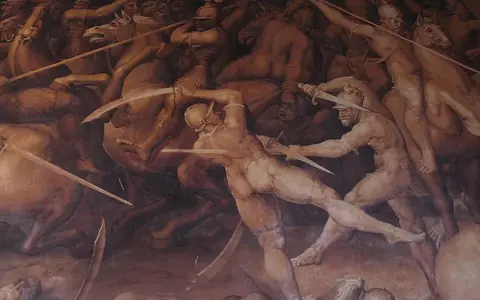
- 48 BCThe Battle of Pharsalus, 48 BCCaesar's legions vs The Senate's army
How Caesar, outnumbered two to one, broke Pompey the Great and won Rome's civil war.
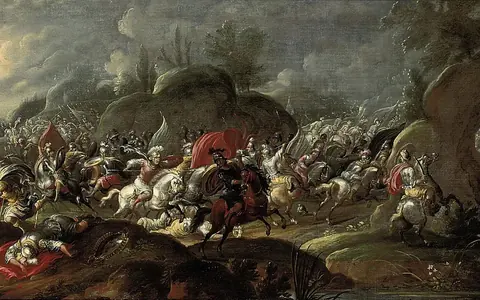
- 42 BCThe Battle of Philippi, 42 BCThe Second Triumvirate vs The Liberators
How Antony and Octavian beat Caesar's assassins Brutus and Cassius, and the Roman Republic died with them.
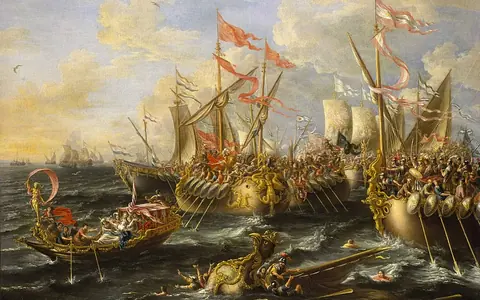
- 31 BCThe Battle of Actium, 31 BCRoman Republic (Octavian) vs Ptolemaic Egypt and Mark Antony
The sea battle that ended the Roman Republic and made an emperor.
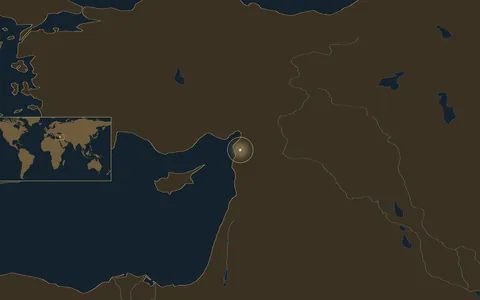
- 218Battle of Antioch, 218Emperor Macrinus vs Elagabalus ("Antoninus")
On 8 June 218, near Antioch, legions backing the 14-year-old Elagabalus beat Emperor Macrinus. He fled in disguise, was caught at Chalcedon and put to death.
- 312Battle of the Milvian Bridge, AD 312Constantine's forces vs Maxentius's forces
Constantine's victory over Maxentius at the Tiber, and the turning point that carried Christianity to power in Rome.
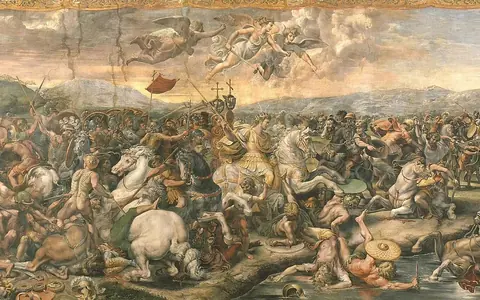
- 324Battle of Chrysopolis, 324Constantine vs Licinius
On 18 September 324 Constantine defeated Licinius at Chrysopolis on the Bosphorus, became sole Roman emperor and soon refounded Byzantium as Constantinople.
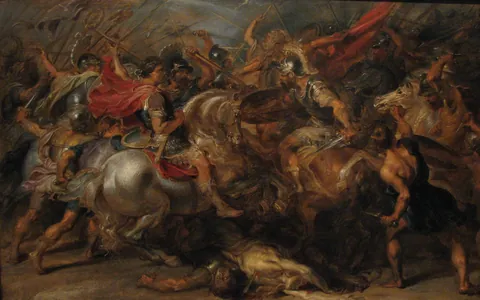
Timeline of the Roman civil wars
- 88 BCSulla marches his army on Rome and occupies the city.34
- 87 BCCinna and Marius take Rome while Sulla is in the East.35
- 82 BCSulla wins at the Colline Gate, occupies Rome and becomes dictator.36
- 49 BCCaesar crosses the Rubicon; Pompey and many senators leave Italy.37
- 9 August 48 BC
- 46 to 45 BCCaesar defeats the Pompeians at Thapsus in Africa and at Munda in Spain.39
- 15 March 44 BCCaesar is murdered in the Senate.40
- 43 BCOctavian, Antony and Lepidus become triumvirs; the proscriptions begin.41
- October 42 BC
- 2 September 31 BC
- 30 BCAntony and Cleopatra die in Alexandria; Octavian takes Egypt.44
- 16 January 27 BCOctavian receives the name Augustus.45
- AD 218
- 28 October AD 312Constantine defeats Maxentius at the Milvian Bridge.47
- AD 324Constantine defeats Licinius at Adrianople and Chrysopolis and rules alone.48
Where to read next
The Roman civil wars belong to antiquity. Read the lives of Julius Caesar, Pompey the Great, Augustus and Gaius Marius. Rome's earlier wars have their own guides: the Punic Wars against Carthage, while the Greco-Persian Wars and the wars of Alexander the Great tell the story of the Greek world before Rome.49
Notes
A number in the text points to a note; each note names the works that paragraph draws on, listed in full under Sources.
- Ramsay MacMullen and others, “Ancient Rome”; E. Badian and Richard P. Saller, “Ancient Rome”; Jona Lendering, “Actium (31 BCE)”. ↩
- Ramsay MacMullen and others, “Ancient Rome”; E. Badian and Richard P. Saller, “Ancient Rome”; Jona Lendering, “Pharsalus (48 BCE)”; Stephen A. Stertz, “Roman Civil Wars of 235 to 394”. ↩
- Ramsay MacMullen and others, “Ancient Rome”; Plutarch, “Life of Sulla”. ↩
- Ramsay MacMullen and others, “Ancient Rome”; Appian, “Civil Wars, book 1”; Stephen A. Stertz, “Roman Civil Wars of 235 to 394”. ↩
- Myles Hudson, “Battle of Pharsalus”; E. Badian and Richard P. Saller, “Ancient Rome”; Britannica Editors, “Macrinus”; Cassius Dio, “Roman History, book 79”. ↩
- Ramsay MacMullen and others, “Ancient Rome”; Plutarch, “Life of Marius”. ↩
- Ramsay MacMullen and others, “Ancient Rome”; Plutarch, “Life of Pompey”; Appian, “Civil Wars, book 1”; Plutarch, “Life of Sulla”. ↩
- Ramsay MacMullen and others, “Ancient Rome”; Plutarch, “Life of Sulla”; Appian, “Civil Wars, book 1”. ↩
- E. Badian and Richard P. Saller, “Ancient Rome”; Myles Hudson, “Battle of Pharsalus”; Suetonius, “Life of Julius Caesar”; Plutarch, “Life of Caesar”. ↩
- E. Badian and Richard P. Saller, “Ancient Rome”; Myles Hudson, “Battle of Pharsalus”; Plutarch, “Life of Pompey”. ↩
- E. Badian and Richard P. Saller, “Ancient Rome”; Myles Hudson, “Battle of Pharsalus”; Jona Lendering, “Pharsalus (48 BCE)”. ↩
- Myles Hudson, “Battle of Pharsalus”; Jona Lendering, “Pharsalus (48 BCE)”; Plutarch, “Life of Caesar”. ↩
- Myles Hudson, “Battle of Pharsalus”; Plutarch, “Life of Pompey”; Plutarch, “Life of Caesar”. ↩
- E. Badian and Richard P. Saller, “Ancient Rome”; Encyclopaedia Britannica, “Cleopatra”; Plutarch, “Life of Caesar”. ↩
- E. Badian and Richard P. Saller, “Ancient Rome”; Suetonius, “Life of Julius Caesar”. ↩
- E. Badian and Richard P. Saller, “Ancient Rome”; Plutarch, “Life of Antony”. ↩
- Britannica Editors, “Philippi”; Jona Lendering, “Philippi (42 BCE)”; Plutarch, “Life of Brutus”. ↩
- E. Badian and Richard P. Saller, “Ancient Rome”; Encyclopaedia Britannica, “Augustus”; Plutarch, “Life of Antony”. ↩
- E. Badian and Richard P. Saller, “Ancient Rome”; Encyclopaedia Britannica, “Cleopatra”. ↩
- Encyclopaedia Britannica, “Cleopatra”; Plutarch, “Life of Antony”. ↩
- E. Badian and Richard P. Saller, “Ancient Rome”; Encyclopaedia Britannica, “Cleopatra”; Encyclopaedia Britannica, “Augustus”; Plutarch, “Life of Antony”. ↩
- Encyclopaedia Britannica, “Augustus”; Jona Lendering, “Actium (31 BCE)”; Plutarch, “Life of Antony”. ↩
- E. Badian and Richard P. Saller, “Ancient Rome”; Encyclopaedia Britannica, “Augustus”; Jona Lendering, “Actium (31 BCE)”; Plutarch, “Life of Antony”; Augustus, “Res Gestae Divi Augusti, chapters 25 to 33”. ↩
- Ramsay MacMullen and others, “Ancient Rome”; E. Badian and Richard P. Saller, “Ancient Rome”; Jona Lendering, “Augustus”; Augustus, “Res Gestae Divi Augusti, chapters 34 and 35”. ↩
- Ramsay MacMullen and others, “Ancient Rome”; Jona Lendering, “Pharsalus (48 BCE)”; Jona Lendering, “Actium (31 BCE)”; Encyclopaedia Britannica, “Augustus”. ↩
- Britannica Editors, “Macrinus”; Encyclopaedia Britannica, “Elagabalus”; Cassius Dio, “Roman History, book 79”. ↩
- Myles Hudson, “Battle of the Milvian Bridge”; Encyclopaedia Britannica, “Constantine I”; Stephen A. Stertz, “Roman Civil Wars of 235 to 394”. ↩
- Encyclopaedia Britannica, “Constantine I”; Stephen A. Stertz, “Roman Civil Wars of 235 to 394”. ↩
- Myles Hudson, “Battle of the Milvian Bridge”; Encyclopaedia Britannica, “Constantine I”; F. X. Murphy, “Constantine I, the Great, Roman Emperor”. ↩
- E. Badian and Richard P. Saller, “Ancient Rome”; Ramsay MacMullen and others, “Ancient Rome”; Encyclopaedia Britannica, “Augustus”; Jona Lendering, “Actium (31 BCE)”; Encyclopaedia Britannica, “Constantine I”. ↩
- Myles Hudson, “Battle of Pharsalus”; E. Badian and Richard P. Saller, “Ancient Rome”; Encyclopaedia Britannica, “Cleopatra”; Encyclopaedia Britannica, “Constantine I”. ↩
- Myles Hudson, “Battle of Pharsalus”; Jona Lendering, “Pharsalus (48 BCE)”. ↩
- E. Badian and Richard P. Saller, “Ancient Rome”; Stephen A. Stertz, “Roman Civil Wars of 235 to 394”. ↩
- Ramsay MacMullen and others, “Ancient Rome”; Appian, “Civil Wars, book 1”. ↩
- Ramsay MacMullen and others, “Ancient Rome”; Plutarch, “Life of Marius”. ↩
- Ramsay MacMullen and others, “Ancient Rome”; Plutarch, “Life of Sulla”. ↩
- E. Badian and Richard P. Saller, “Ancient Rome”; Suetonius, “Life of Julius Caesar”. ↩
- Myles Hudson, “Battle of Pharsalus”; Jona Lendering, “Pharsalus (48 BCE)”. ↩
- E. Badian and Richard P. Saller, “Ancient Rome”; Plutarch, “Life of Caesar”. ↩
- E. Badian and Richard P. Saller, “Ancient Rome”; Suetonius, “Life of Julius Caesar”. ↩
- E. Badian and Richard P. Saller, “Ancient Rome”; Plutarch, “Life of Antony”. ↩
- Britannica Editors, “Philippi”; Jona Lendering, “Philippi (42 BCE)”. ↩
- E. Badian and Richard P. Saller, “Ancient Rome”; Jona Lendering, “Actium (31 BCE)”. ↩
- E. Badian and Richard P. Saller, “Ancient Rome”; Encyclopaedia Britannica, “Augustus”. ↩
- Jona Lendering, “Augustus”; Augustus, “Res Gestae Divi Augusti, chapters 34 and 35”. ↩
- Britannica Editors, “Macrinus”; Cassius Dio, “Roman History, book 79”. ↩
- Myles Hudson, “Battle of the Milvian Bridge”; Stephen A. Stertz, “Roman Civil Wars of 235 to 394”. ↩
- Encyclopaedia Britannica, “Constantine I”; Stephen A. Stertz, “Roman Civil Wars of 235 to 394”. ↩
- E. Badian and Richard P. Saller, “Ancient Rome”; Ramsay MacMullen and others, “Ancient Rome”. ↩
Sources
- Ramsay MacMullen and others, Encyclopaedia Britannica, “Ancient Rome: Wars and dictatorship (c. 91 to 80 BC)”.
- E. Badian and Richard P. Saller, Encyclopaedia Britannica, “Ancient Rome: Pompey and Crassus” (the late Republic from the civil war of 49 BC to Actium).
- Jona Lendering, Livius.org, “Actium (31 BCE)”.
- Jona Lendering, Livius.org, “Pharsalus (48 BCE)”, with Caesar's own account (Civil War 3.88 to 99, translated by W. A. McDevitte and W. S. Bohn).
- Stephen A. Stertz, EBSCO Research Starters, “Roman Civil Wars of 235 to 394”.
- Plutarch, “Life of Sulla”, translated by Bernadotte Perrin (Loeb Classical Library), LacusCurtius.
- Appian, “Civil Wars, book 1”, translated by Horace White (Loeb Classical Library), LacusCurtius.
- Myles Hudson, Encyclopaedia Britannica, “Battle of Pharsalus”.
- Britannica Editors, revised by Michael Ray, Encyclopaedia Britannica, “Macrinus”.
- Cassius Dio, “Roman History, book 79”, translated by Earnest Cary (Loeb Classical Library), LacusCurtius.
- Plutarch, “Life of Marius”, translated by Bernadotte Perrin (Loeb Classical Library), LacusCurtius.
- Plutarch, “Life of Pompey”, translated by Bernadotte Perrin (Loeb Classical Library), LacusCurtius.
- Suetonius, “Life of Julius Caesar”, translated by J. C. Rolfe (Loeb Classical Library), LacusCurtius.
- Plutarch, “Life of Caesar”, translated by Bernadotte Perrin (Loeb Classical Library), LacusCurtius.
- Encyclopaedia Britannica, “Cleopatra”.
- Plutarch, “Life of Antony”, translated by Bernadotte Perrin (Loeb Classical Library), LacusCurtius.
- Britannica Editors, Encyclopaedia Britannica, “Philippi”.
- Jona Lendering, Livius.org, “Philippi (42 BCE)”, with Appian, Civil Wars 4.105 to 138 (translated by Horace White).
- Plutarch, “Life of Brutus”, translated by Bernadotte Perrin (Loeb Classical Library), LacusCurtius.
- Encyclopaedia Britannica, “Augustus”.
- Augustus, “Res Gestae Divi Augusti, chapters 25 to 33”, translated by Frederick W. Shipley (Loeb Classical Library), LacusCurtius.
- Jona Lendering, Livius.org, “Augustus”.
- Augustus, “Res Gestae Divi Augusti, chapters 34 and 35”, translated by Frederick W. Shipley (Loeb Classical Library), LacusCurtius.
- Encyclopaedia Britannica, “Elagabalus”.
- Myles Hudson, Encyclopaedia Britannica, “Battle of the Milvian Bridge”.
- Encyclopaedia Britannica, “Constantine I”.
- F. X. Murphy, New Catholic Encyclopedia (Gale), via Encyclopedia.com, “Constantine I, the Great, Roman Emperor”.





