

Who won the Battle of Actium?
Octavian won the Battle of Actium on 2 September 31 BC1, when his fleet under Agrippa broke the combined force of Mark Antony and Cleopatra off the west coast of Greece. The victory ended the last war of the Roman Republic and cleared Octavian's path to rule alone as Augustus, the first Roman emperor.
On 2 September 31 BC, off the western coast of Greece, the last war of the Roman Republic was decided at sea. The fleet of Octavian, commanded by his admiral Agrippa, broke the combined force of Mark Antony and Cleopatra of Egypt. Within a few years Octavian would rule alone as Augustus, the first Roman emperor.

The last civil war
After the murder of Julius Caesar, the Roman world had been carved up between his heirs. In the end it came down to two men: Octavian in the west, and Antony in the east, bound to Cleopatra and the wealth of Egypt. Rome was told it faced not a civil war but a foreign queen2, and the propaganda did its work.
The trap of the gulf
Agrippa outmaneuvered Antony at sea and cut his supply lines, penning his fleet inside the Ambracian Gulf (see the map below)3. Trapped through the summer, Antony's crews were thinned by hunger and disease4, and desertion spread through his camp before a blow was struck.
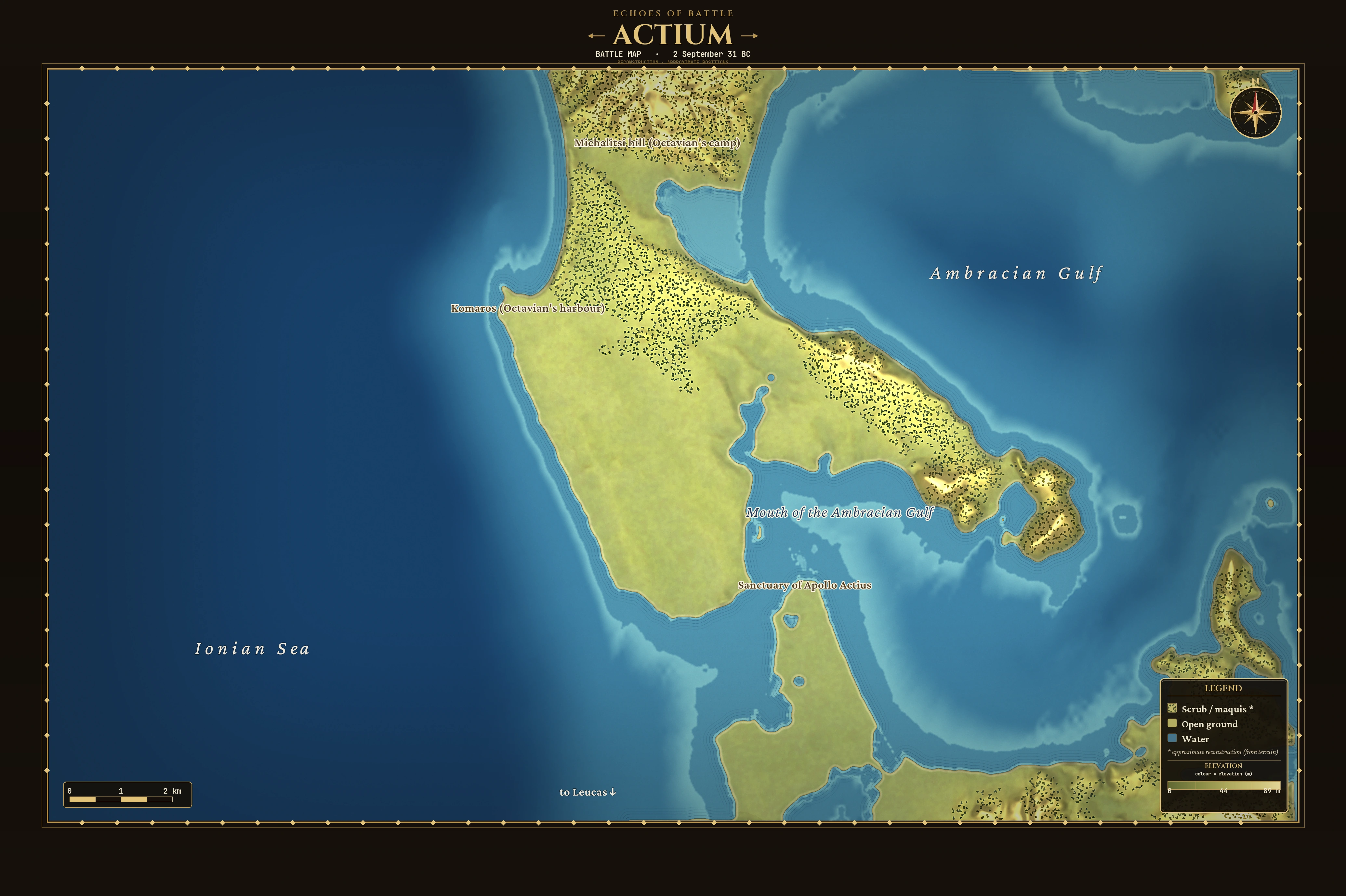

How Agrippa won the war of Actium before the battle
The war of Actium lasted months, not an afternoon. Antony had brought his fleet and army west to Greece and wintered there with his ships spread along the coast. By spring his crews, raised from many different peoples, had not trained together, and disease and desertion had thinned them.4 Octavian's admiral Marcus Agrippa struck first. He stormed Methone in the south-west Peloponnese, killing Bogud, a former Mauretanian king fighting for Antony, then preyed on the merchant ships bringing in supplies and raided the Greek coast.4
Octavian then carried his army across the Ionian Sea from Brundisium, took Corcyra and came south to the mouth of the Ambracian Gulf, where most of Antony's fleet lay at anchor. He fortified the high ground on the north side of the strait, where the city of Nicopolis would later stand, and ran walls down to the harbour below.4 Plutarch preserves Cleopatra's joke when news came that Octavian had seized a place called Toryne, which means "ladle": what was so dreadful, she asked, about Caesar sitting at a ladle?5 Antony's men camped on the low, broad ground beside the sanctuary of Apollo on the southern shore of the strait. Dio says it suited a battle better than a camp, and disease spread there all through the summer.4
Over the summer Agrippa tightened the ring. He seized Leucas and the ships there, beat Antony's admiral Quintus Nasidius at sea to take Patrae, and then took Corinth. On land Antony's cavalry was beaten.4 Then his allies began to slip away. Gnaeus Domitius Ahenobarbus, consul the year before, crossed to Octavian in a small boat while sick with fever, and Antony sent his baggage, friends and servants after him.5 The client kings Amyntas of Galatia and Deiotarus went over too.5 Antony grew suspicious of everyone, had Iamblichus, an Arabian king, tortured and put to death, and feared that Quintus Dellius would desert as well, which he did.4
How many ships fought at Actium?
No one knows exactly, and the sources differ. Plutarch credits Antony with at least 500 warships and Octavian with 250, but Antony burned many of his own before the battle for lack of crews. Modern reconstructions vary widely. Octavian himself, as Plutarch reports, claimed 300 ships captured and no more than 5,000 dead.5
Plutarch's figures cover the whole war. He gives Antony no fewer than 500 fighting ships, many of them huge vessels with eight or ten banks of oars, plus 100,000 infantry and 12,000 cavalry, with kings from Libya to Thrace and Pontus at his side. Octavian had 250 warships, 80,000 infantry and about as many horsemen as his enemy.5 Antony's big ships were short of rowers, and his captains pressed travellers, mule drivers and harvesters on the Greek roads into service.5 Before the battle he burned all the Egyptian ships except sixty and manned the largest and best, from triremes up to "tens", with 20,000 legionaries and 2,000 archers.5 Modern accounts do not agree on the final count. World History Encyclopedia, for one, puts Octavian's fleet at over 400 ships.6
The fighting did not look like a classic sea battle. Antony held his right wing with Publicola, Agrippa faced him on Octavian's left, and Octavian took his own right.5 Antony's heavy ships could not build up the speed to ram, and Octavian's lighter ships dared not strike their armoured sides, so three or four of them closed on one big ship and fought it like soldiers storming a walled town.5 Dio adds that Octavian finally sent for fire from his camp and burned ships he had hoped to capture with their treasure.4 Antony's fleet held out until the tenth hour. His land army, nineteen legions and 12,000 horse, waited seven days for him to come back, then went over to Octavian after its general Canidius slipped away by night.5
The breakout
Antony at last tried to force his way out. In the confusion of the fighting, Cleopatra's squadron hoisted sail and ran for the open sea5, and Antony broke off to follow her. Leaderless, the rest of his fleet was burned or surrendered6.
Did Cleopatra flee or break out at Actium?
The ancient writers present it as panic, but their accounts show a plan. Plutarch says the sails were taken aboard and Dio that valuables were loaded in secret before the battle, so modern historians often read Actium as a planned breakout to Egypt. It saved Cleopatra, her treasury and about sixty ships, but cost Antony his fleet and army.546
Both main accounts are hostile to Cleopatra, which makes their details more telling. Plutarch says she was already thinking of flight and placed her squadron where it could most easily get away. He also says Antony made the ships' masters carry their sails on board, claiming he wanted to catch any enemy who ran.5 That order matters. Ships cleared for battle fought under oars, and Dio notes that Octavian's ships could not chase the fugitives because they had no sails with them.4 Dio goes further. At a council of war, he says, Cleopatra won the argument to leave garrisons in the key positions and take the rest back to Egypt, disguising the departure as preparation for a sea fight, and the most valuable possessions were put aboard secretly by night.4
Yet when Dio reaches the battle itself, he falls back on the old stereotype. Cleopatra, he writes, could not bear the suspense "as a woman and an Egyptian" and suddenly fled, and Antony followed because he thought her ships were running in defeat.4 In Plutarch her sixty ships hoist sail and cut through the battle line, making for the Peloponnese on the wind, while Antony jumps into a five-banked galley and goes after her.5 Plutarch also notes that a wind rose from the sea around midday, just what a fleet under sail needed.5 Whether the plan was to fight first and run only if the battle went badly, or to run from the start, the result was the same. The queen and her treasury got away. Antony's legions did not.
What the day decided
Antony and Cleopatra fled to Egypt, where both took their own lives the following year1. Octavian was left master of the Roman world.2 In 27 BC the Senate granted him the name Augustus6, and the Republic of five centuries gave way to an empire that would endure for many more.
From Actium to Alexandria: how Antony and Cleopatra died
Octavian did not go after the pair at once. He first had to settle Greece and calm a mutiny of veterans in Italy.9 When winter was over he closed on Egypt from two directions, marching through Syria while his generals came through Libya.5 At Alexandria, on 1 August 30 BC13, Antony watched from the hills as his last fleet rowed out, saluted Octavian's crews with raised oars and changed sides. His cavalry deserted the same morning and his infantry was beaten.5
Cleopatra shut herself inside her tomb and sent word that she was dead. Antony believed it and stabbed himself in the belly. The wound was slow to kill. Told that she was alive after all, he had himself carried to the tomb, was hauled up to a window on ropes, and died there with her.5 Cleopatra was taken alive soon afterwards, but she denied Octavian his chance to parade her in a triumph. Plutarch tells the famous story of an asp smuggled in with a basket of figs, then admits that "the truth of the matter no one knows": others spoke of poison hidden in a hollow comb. She was 39.5 Octavian had Caesarion, her son by Julius Caesar, caught and killed, but spared and raised her children by Antony, and he made Egypt a Roman province.9
From republic to empire
Actium was the last battle of the Roman Republic and the first act of the empire. With Antony and Cleopatra defeated and, within a year, dead by their own hands, Octavian was left the sole master of the Roman world. He kept the forms of the old Republic while holding its real power, and in 27 BC the Senate granted him the name Augustus. The long civil wars that had torn Rome for a century were over, and the peace that followed, the Pax Romana, would last generations. A single afternoon in the Ionian Sea closed one Roman age and opened another that shaped Europe for centuries.

Nicopolis and the poets: how Actium became a legend
Octavian made sure Actium would never be forgotten. Dio says the years of his sole rule were reckoned from the day of the battle, 2 September 31 BC. He dedicated a captured ship of every class, from a trireme up to a "ten", to Apollo of Actium, enlarged the god's temple and founded the Actian Games, held every four years.8 On the site of his camp he founded a new city, Nicopolis, "Victory City".89
Above the city, where his tent had stood, he laid a platform of squared stone, decorated it with the bronze rams of captured warships and set an open-air shrine on top.8 Its remains survive on the Michalitsi hill, about seven miles north of modern Preveza. Some three dozen rams, decreasing in size, once lined the front of the podium beneath a Latin inscription about 48 metres long. It records that Imperator Caesar, son of the deified Julius, victorious in the war he waged for the republic in this region, "with peace won on land and sea", consecrated the camp to Mars and Neptune.10 Suetonius adds that he set up bronze statues there of a man and his donkey whom he had met on the morning of the battle, with names that meant "Lucky" and "Victor".9
The poets finished the work. On the shield that Vulcan forges for Aeneas in book 8 of the Aeneid, Virgil puts the "Actian war" at the centre: Augustus leading the Italians with the senate and people, Agrippa with his fleet, Antony with the wealth of the East and, the shame of it, an Egyptian wife, while Apollo of Actium bends his bow over the scene.11 Horace greeted the news of Cleopatra's death with "Nunc est bibendum", "now is the time to drink", and called her a "fatale monstrum", a deadly portent, yet closed his ode with grudging praise for a queen too proud to be led in a triumph.12 That became the Actium Rome remembered: Italy's victory over an Eastern queen. For the commander who turned it into an empire, see our life of Augustus, and for Actium's place among the great sea fights, the greatest naval battles in history.