

Hannibal or Alexander: what does the evidence say?
Alexander the Great (356 to 323 BC) and Hannibal Barca (about 247 to about 183 BC) never met. Alexander, king of Macedon, conquered the Persian Empire and died at thirty-two without losing a pitched battle. Hannibal, a Carthaginian general, invaded Italy and fought Rome for sixteen years, then lost his war at Zama. Historians have not settled who was the greater general. Livy, Plutarch and Appian tell that Hannibal himself gave Alexander the first place, while Treccani calls Hannibal the greatest general of antiquity. Dodge declined to rank them, calling Alexander the captain of fortune and Hannibal the captain of misfortune. This page sets out the evidence for each and leaves the final verdict to you.
Alexander had been dead for about seventy-five years when Hannibal was born. The link between them comes from Hannibal himself. In a story told by Livy, Plutarch and Appian, Hannibal was asked who was the greatest general and named Alexander first, Pyrrhus second and himself third. Napoleon's maxims later put both on the short list of captains every soldier should study.1
This is not a ranking. Below are the two careers side by side, the nearest things to an encounter the sources offer, and six questions on which a general can be judged, each with the strongest evidence for Hannibal and for Alexander. At the end the decision is yours.
Side by side
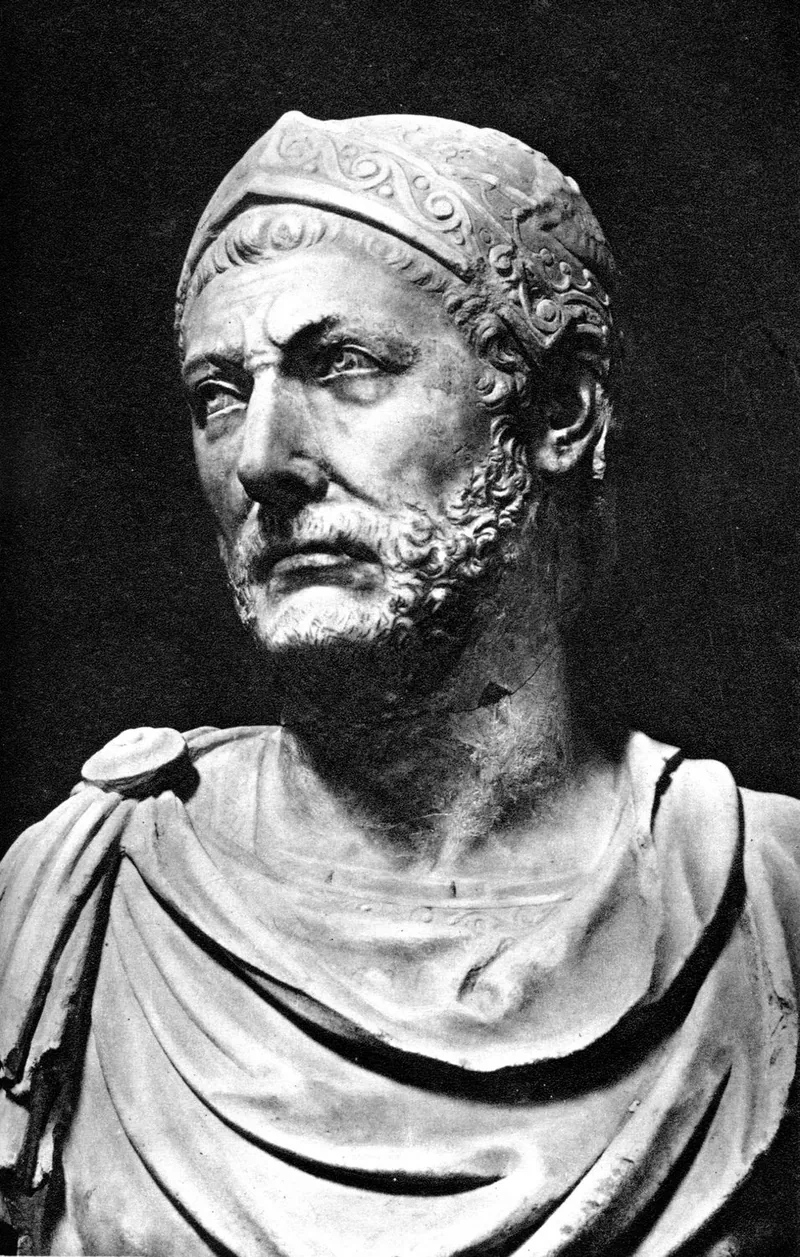
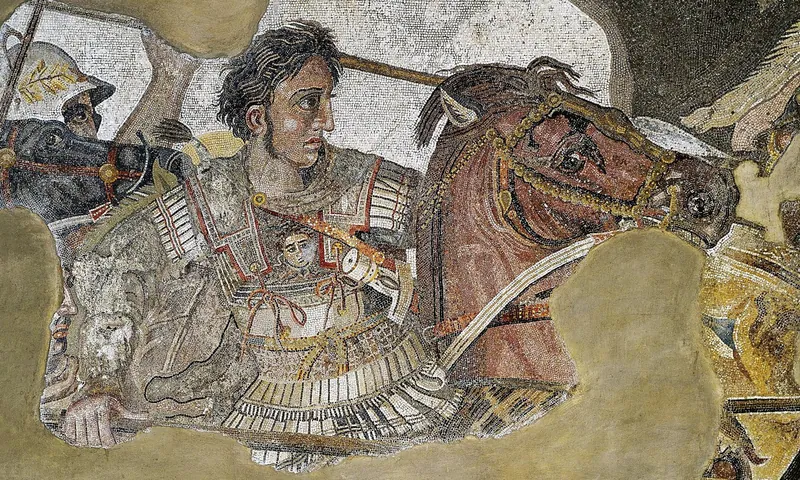
- Lived
- About 247 to about 183 BC
- 356 to 323 BC
- Origin
- Carthage, son of the general Hamilcar Barca
- Macedon, son of King Philip II and Olympias
- First command
- 221 BC, the Carthaginian army in Spain
- 336 BC, king of Macedon at twenty
- Wars in command
- Second Punic War 218 to 202. Later adviser and admiral of Antiochus III
- The Balkans 335, the Persian Empire 334 to 330, Bactria and Sogdiana 329 to 327, India 327 to 325
- Notable opponents
- Sempronius, Flaminius, Paullus and Varro, Fabius, Marcellus, Scipio Africanus
- Darius III, Memnon of Rhodes, Bessus, Spitamenes, Porus
- Death
- Took poison in Bithynia rather than be handed over to Rome
- At Babylon in 323 BC, of a fever, aged thirty-two
Dates and commands from the Treccani encyclopedia, Bret Mulligan's chronology of Hannibal's life and Plutarch. The Hannibal portrait is a traditional identification. We give no win and loss totals because no source counts their battles the same way.2
Did they ever meet? Hannibal's own ranking
They did not. Alexander died in June 323 BC, Justin says in his thirty-third year, and Hannibal was born around 247 BC. Historians compare them on what the sources offer: Hannibal's own opinion of Alexander, the elephants both met in battle, and the way Polybius, Livy and the later military writers set them side by side.3
The conversation at Ephesus
Livy, citing the historian Claudius, who followed the Greek history of Acilius, says Scipio Africanus met Hannibal on an embassy and asked whom he thought the greatest commander. Hannibal answered Alexander of Macedon, because with a small force he routed innumerable armies and reached the most distant shores of the world. Second came Pyrrhus, and third, without hesitation, himself. Asked what he would say if he had beaten Scipio, he answered that he would then rank himself above Alexander, Pyrrhus and all other commanders.4
Plutarch tells the same story at Ephesus, with Hannibal calling Alexander the mightiest of generals and Scipio asking, with a quiet smile, what he would have said if he had not been beaten.5
Appian has Hannibal justify his third place: as a young man he conquered Spain and crossed the Alps with an army, the first after Hercules, and he did it with neither money nor reinforcements from Carthage. Appian's translator adds that most modern critics consider the whole tale a fiction, since Livy's own account of the embassy does not include Scipio.6
Elephants at the Hydaspes and at Zama
Alexander faced elephants at the river Hydaspes in 326 BC. Arrian says he could not cross where King Porus was camped, because his horses would panic at the sight and trumpeting of the beasts, so he stole a crossing elsewhere by night. Porus brought 200 elephants, 30,000 infantry and 4,000 horse against him, and lost.7
Frontinus counts the crossing among the great stratagems: Alexander made his men run down to the water again and again until Porus guarded the opposite bank by habit, then suddenly crossed elsewhere.8
Hannibal brought elephants over the Alps, thirty-seven of them by Treccani's and Eutropius' count, and put eighty in front at Zama. There, Frontinus writes, Scipio left gaps in his lines for them to pass through, and Livy says the trumpets turned many of them back on Hannibal's own Numidian cavalry.9

Strategy: the plan for a whole war
The case for Hannibal
Hannibal's plan was to carry the war into Italy by land and break Rome's alliances there. Polybius writes that of all that befell Romans and Carthaginians, the cause was one man and one mind, Hannibal. After Cannae, Mulligan's chronology records, Capua and many regions of southern Italy went over to him, and he made an alliance with Philip V of Macedon.10
His critics fasten on what came after. Florus repeats the remark of his cavalry commander Maharbal that Hannibal knew how to win a victory but not how to use it, and the jibe that Capua was Hannibal's Cannae. B. H. Liddell Hart judged him outstandingly great as a tactician but not impressive as a strategist.11
The case for Alexander
Alexander had a war aim and an order of work. After Issus he did not chase Darius inland. Arrian gives his reasoning in a speech before Tyre: while the Persians held the sea, an advance on Babylon was unsafe, but with Tyre taken the Phoenician fleet, the best in the Persian navy, would come over, Egypt would follow, and Babylon could be attacked in safety. Diodorus tells how Tyre was then besieged and taken, and Alexander went on to Egypt and Gaugamela. Arrian says he was very clever in seeing what had to be done before others noticed it.12
Justin, abridging the lost history of Pompeius Trogus, sums up the result: Alexander never met an enemy he did not defeat, never besieged a city he did not take and never approached a people he did not trample.13
Battlefield tactics
The case for Hannibal
At the Trebia in 218 BC, Frontinus says, Hannibal hid his brother Mago in ambush, lured the consul Sempronius across the freezing river with his Numidian horse and fell on the Romans from behind.14
At Lake Trasimene in 217 BC he caught the consul Flaminius on the lakeshore road, and Treccani and Eutropius give fifteen thousand and twenty-five thousand Roman dead.15
At Cannae in 216 BC Polybius gives the Romans about eighty thousand foot against Hannibal's forty thousand foot and ten thousand horse. Hannibal advanced his centre in a crescent, let it be pushed back, and closed his African infantry and cavalry around the Romans. Polybius counts about seventy thousand Roman dead, Florus sixty thousand. T. A. Dodge wrote that no battle in history is a finer sample of tactics.16

The case for Alexander
Alexander won four pitched battles against kings and satraps of the largest empire of his day, fighting in the front rank. At the Granicus in 334 BC, Plutarch writes, a javelin pierced the joint of his breastplate, he broke his spear on one Persian commander and took a blow from another's axe that split his helmet. Diodorus tells the same fight.17
At Gaugamela in 331 BC Arrian gives Darius a force said to number 40,000 horse and 1,000,000 foot against Alexander's 7,000 horse and about 40,000 foot. The Persian figures are ancient exaggerations, but the army was far larger than his.18
Diodorus gives Darius at Gaugamela about 800,000 foot and at least 200,000 horse, a different count again. Dodge set Alexander's wedge at Arbela, the old name for Gaugamela, beside Hannibal's withdrawing salient at Cannae as the striking tactical formations of the ancient world.19
Odds and resources
The case for Hannibal
Hannibal fought for years in the enemy's country with an army he could not easily replace. Polybius says he lost about half his force crossing the Alps, and the men who came down looked more like beasts than men. Dodge argued that of all the generals the world has seen, Hannibal fought against the greatest odds, the only one of the great ancient captains to face forces better armed, more intelligent and ably led.20
Nepos claims that whenever Hannibal met the Romans in Italy he came off better, and that only the jealousy of his own citizens kept him from beating them. Treccani blames the outcome on the poor support he received from the factional oligarchy at home.21
The case for Alexander
Alexander inherited his father's army and crossed to Asia with, by Arrian's count, not much more than 30,000 foot and more than 5,000 horse, and Diodorus gives an itemised total of 32,000 foot and 4,500 horse. With that he took on an empire. Plutarch says that as a boy he complained that his father would anticipate everything and leave him no great achievement to display to the world.22
Leading men
The case for Hannibal
No one, Polybius writes, can withhold admiration for Hannibal's generalship. For sixteen years he kept a large army free from sedition towards him or among themselves, although it was made up of Africans, Spaniards, Ligurians, Celts, Phoenicians, Italians and Greeks. Eutropius notes that many Ligurians and Gauls joined him once he was in Italy.23
The case for Alexander
Arrian describes Alexander as exceedingly fond of incurring danger and very renowned for rousing the courage of his soldiers, filling them with hope and dispelling their fear by his own freedom from fear. Justin says that with him present his soldiers feared no enemy's arms even when they were unarmed themselves.24
His men did refuse him once. In India in 326 BC the army would go no further, and Plutarch says they violently opposed crossing the Ganges after the hard fight against Porus. Alexander turned back.25
Sieges and setbacks
The case for Hannibal
Hannibal took Saguntum in 219 BC, the start of the war, and later Tarentum. But Dodge says he disliked siege work and that Saguntum was his only brilliant siege. He never took Rome, and in 211 BC his march on the city did not save Capua, which fell.26
His late defeats were final. His brother Hasdrubal was destroyed at the Metaurus in 207 BC, and Florus says Hannibal recognised the ill luck of Carthage when Hasdrubal's head was thrown into his camp. After Zama he lost his only sea battle, at the Eurymedon in 190 BC, in the service of Antiochus III.27
The case for Alexander
Alexander's sieges were among his greatest feats. Tyre held out for seven months, Diodorus says, before it was stormed. In Sogdiana the defenders of a mountain fortress told him to find soldiers with wings, and Arrian tells how volunteer climbers took the rock. Dodge rated Alexander far above Hannibal in regular sieges.28
The cost was heavy. Diodorus says more than seven thousand Tyrians were cut down, two thousand men crucified and the women and children sold. On the march back through the Gedrosian desert in 325 BC, Arrian writes, the scorching heat and lack of water destroyed a great part of the army.29

Character and fortune
The case for Hannibal
Dodge, who wrote full histories of both, thought Hannibal the better man. Neither permitted contradiction, he wrote, but Hannibal was far beyond Alexander in self-restraint, and Hannibal was never guilty of an act like Alexander's killing of Cleitus. His ambition was for Carthage, and his service of his country after Zama, as sufete, shows it.30
Livy, no friend of Carthage, paints him as a man equally fit to command and to obey, first into battle and last to leave it, who slept on the ground among the sentries in his soldier's cloak. In the same chapter he charges him with inhuman cruelty and a perfidy worse than Punic.31
Polybius records the charges against Hannibal too: among the Carthaginians he was notorious for love of money, among the Romans for cruelty. Polybius found it hard to judge, given the influence of his friends and of circumstances.32
He accepted defeat. Mommsen praised the magnanimous submission of Hannibal to what was inevitable after Zama, and when, years later, Roman envoys surrounded his house in Bithynia, Nepos says he took the poison he always carried rather than fall into their hands.33
The case for Alexander
Alexander's courage and energy are not in doubt. Arrian says that in matters of the body he had perfect self-control, and of the pleasures of the mind praise was the only one he could not get enough of. On his deathbed, Justin writes, asked whom he made his heir, he answered: the most worthy.34
His critics point to the same deathbed. Leaving no named heir, he left his generals to fight over the empire, and Justin says the answer worked among his friends like a call to war. When his army refused to cross the Ganges, Plutarch writes, Alexander shut himself up in his tent from displeasure and wrath, counting retreat a confession of defeat.35
Plutarch also records the murder of Cleitus, the officer who had saved his life at the Granicus, killed by Alexander in his cups, and says Alexander later blamed it on the anger of Dionysus. Strabo notes that after Alexander's ten or eleven years of rule the empire of Asia was divided among his successors.36
How historians have judged them
Ancient opinion gave the first place to Alexander, and the story has Hannibal himself agree. Livy, Plutarch and Appian all tell it. Nepos, for his part, wrote that Hannibal surpassed other commanders in skill as much as the Roman people surpassed other nations in courage, and Polybius praised Hannibal's dispositions even in his last defeat.37
Treccani, a modern encyclopedia, calls Hannibal the greatest general of antiquity for the daring of his plans and the genius of his tactics. Liddell Hart, on the other side, did not rate him as a strategist.38
Dodge declined to make a ranking. In intellectual grasp, he wrote, the great captains stand side by side. In enthusiastic activity and in all the qualities which compel good fortune Alexander stands clearly at the head, while in a long struggle against Fortune's frowns Hannibal stands alone and incomparable. Alexander was always daring, never cautious, he added, and Hannibal always cautious, often daring.39
The maxims collected under Napoleon's name say Alexander, Hannibal and Caesar all acted on the same principles: to keep their forces united, to leave no weak part unguarded and to seize important points with speed.40
Battles on the site
Every battle page on the site that involves one of the two men, with the guides around them.
 Hannibal in command · 216 BCBattle of Cannae
 Alexander in command · 331 BCBattle of Gaugamela
 Alexander in command · 333 BCBattle of Issus
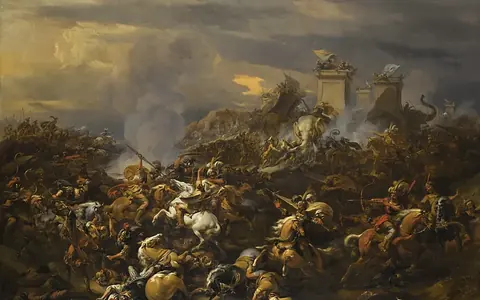 Alexander in command · 326 BCBattle of the Hydaspes
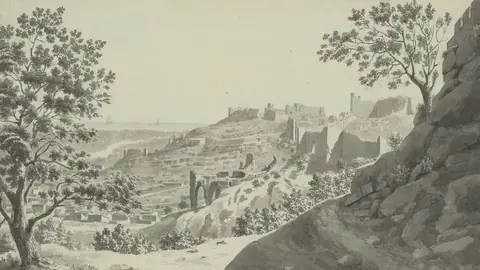 Hannibal in command · 219 BCSiege of Saguntum
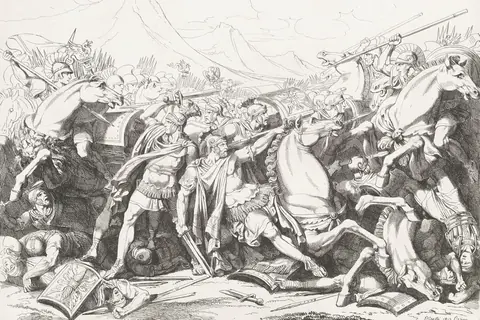 Hannibal in command · 218 BCBattle of the Ticinus
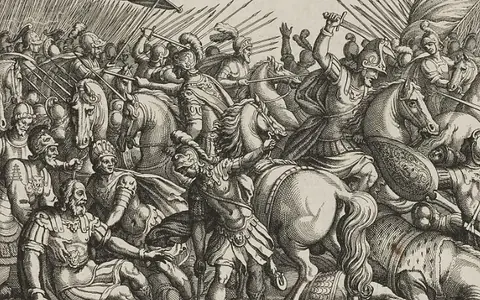 Hannibal in command · 218 BCBattle of the Trebia
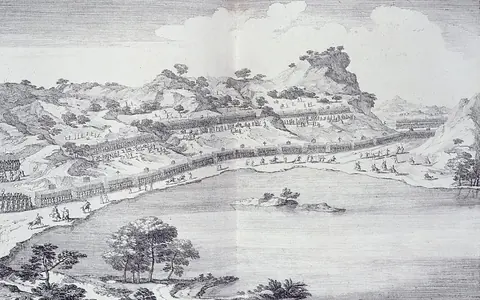 Hannibal in command · 217 BCBattle of Lake Trasimene
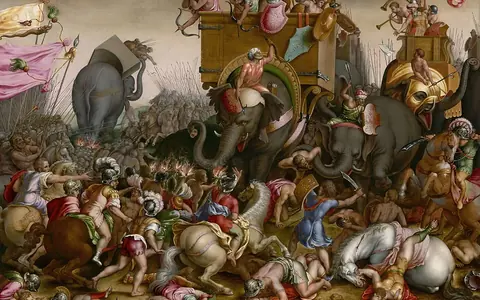 Hannibal in command · 202 BCBattle of Zama
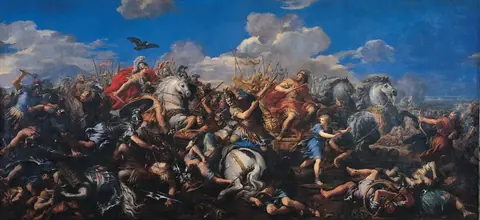 Guide · 336 to 323 BCThe Wars of Alexander the Great
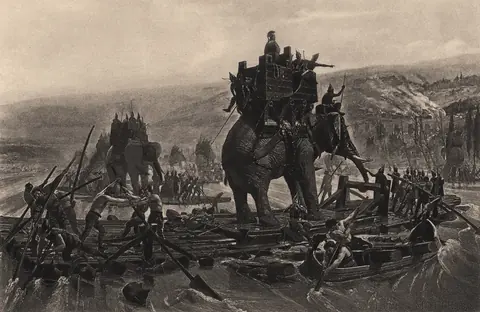 Guide · 264 to 146 BCThe Punic Wars
 CommanderHannibal Barca
 CommanderAlexander the Great
ExplainerWar Elephants in History
Head to headPhalanx vs Legion
 RankingThe Greatest Ancient Battles
See also Hannibal vs Scipio, Caesar vs Hannibal, Alexander vs Caesar and Philip II of Macedon. The Granicus, Tyre and the Alpine crossing have no page of their own yet.
Your verdict
We do not pick a winner. Here are the two cases at their strongest, and the questions that decide which one you find more convincing.
For Hannibal
- Cannae, the model of encirclement
- Sixteen years in enemy country with a mixed army that held together
- Little money and few reinforcements from home
- Opponents armed and trained as well as his own men
- Self-restraint and loyalty to his city, in Dodge's view
For Alexander
- Four pitched battles fought, four won
- The Persian Empire conquered in a few years
- Tyre and the Sogdian Rock, sieges thought impossible
- Ranked first among generals by Hannibal himself, if the story is true
- Courage that carried his army to the Indus
Questions to weigh before you decide:
- Is it harder to win with a kingdom behind you or to win for years with almost no help from home?
- Does Hannibal's own ranking settle anything, or was it courtesy, or a story the Romans liked to tell?
- Alexander died at thirty-two and never lost a pitched battle. Would his record have survived another twenty years?
- Cannae or Gaugamela: which battle is the greater feat, given the sources' numbers?
- Should Tyre and Gedrosia, or Hannibal's alleged cruelty, weigh in a judgement of a general?
Cast your vote below and see how other readers have judged them.




