

Caesar or Hannibal: what does the evidence say?
Julius Caesar (100 to 44 BC) and Hannibal Barca (about 247 to about 183 BC) never met. Hannibal invaded Italy against Rome and lost his war at Zama in 202 BC. Caesar, a Roman, conquered Gaul and won a civil war against his own Republic. Historians have not settled it. Treccani calls Hannibal the greatest general of antiquity, and Mommsen called Caesar Rome's only creative genius. Dodge, who wrote histories of both, refused to rank them but judged that Hannibal fought against the greatest odds. This page sets out the evidence for each and leaves the final verdict to you.
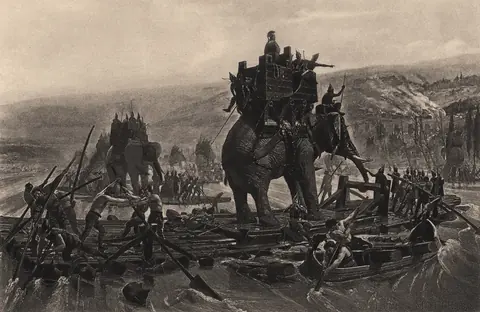
Hannibal died more than eighty years before Caesar was born, so the two never faced each other. What invites the comparison is that each led an army into Italy against the government in Rome, Hannibal over the Alps in 218 BC and Caesar over the Rubicon in 49 BC, and that later soldiers put them side by side. The maxims collected under Napoleon's name tell a would-be general to read again and again the campaigns of Alexander, Hannibal and Caesar, and say all three acted on the same principles.1
This is not a ranking. Below are the two careers side by side, the nearest things to an encounter the sources offer, and six questions on which a general can be judged, each with the strongest evidence for Hannibal and for Caesar. At the end the decision is yours.
Side by side
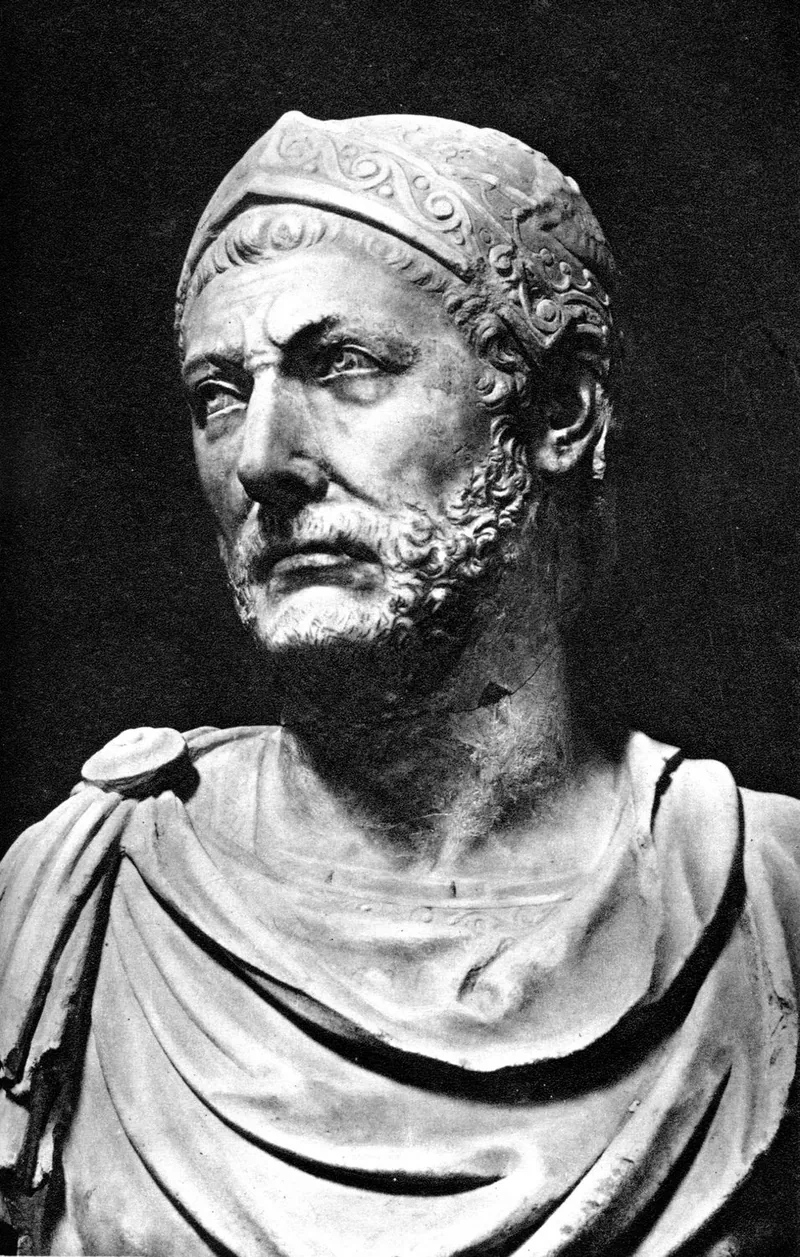
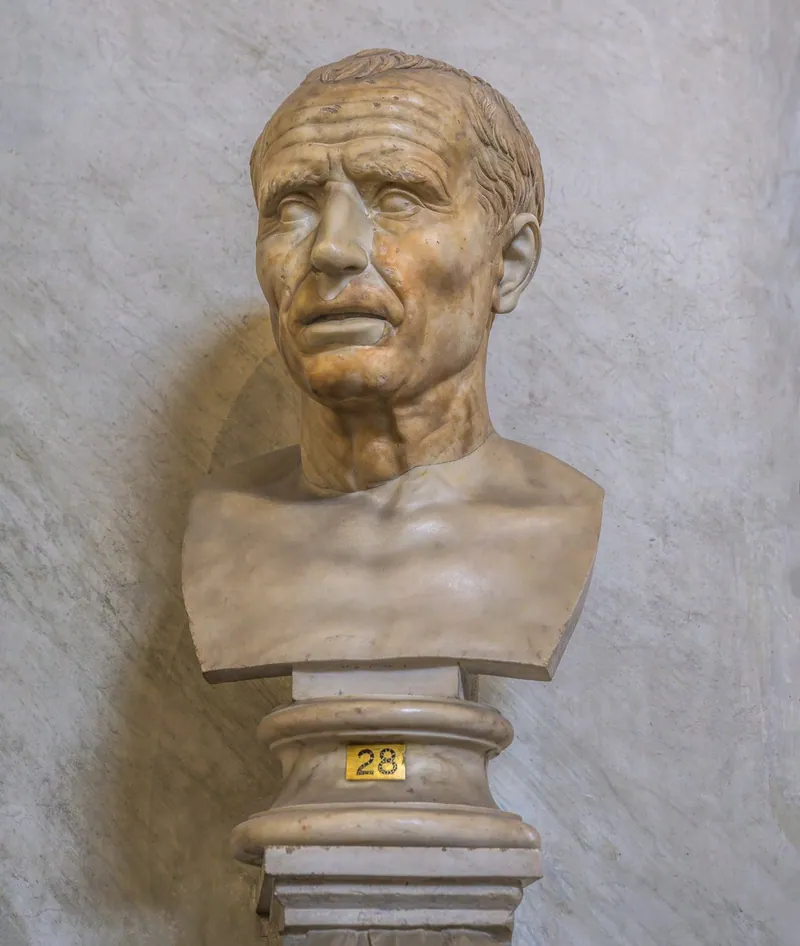
- Lived
- About 247 to about 183 BC
- 100 to 44 BC (some date his birth to 102)
- Origin
- Carthage, son of the general Hamilcar Barca
- Rome, the old noble family of the Julii
- First command
- 221 BC, the Carthaginian army in Spain
- 61 BC, governor in Further Spain
- Wars in command
- Second Punic War 218 to 202. Later adviser and admiral of Antiochus III
- Spain 61 to 60, Gaul 58 to 50, the civil war 49 to 45
- Highest office
- Sufete, chief magistrate of Carthage, 196 BC
- Consul from 59 BC, then dictator
- Notable opponents
- Sempronius, Flaminius, Paullus and Varro, Fabius, Marcellus, Scipio Africanus
- The Helvetii, the Nervii, Vercingetorix, Pompey, Pharnaces II, Pompey's sons
- Battles named here
- Trebia, Trasimene, Cannae, Zama
- The Sambre, Gergovia, Alesia, Dyrrachium and Pharsalus, Munda
- Death
- Took poison in Bithynia rather than be handed over to Rome
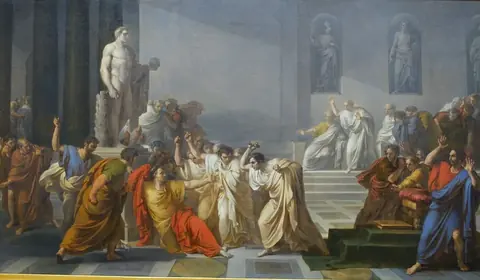
- Killed in Rome on 15 March 44 BC
Dates, offices and commands from the Treccani encyclopedia, Bret Mulligan's chronology of Hannibal's life and Plutarch. The Hannibal portrait is a traditional identification. We give no win and loss totals because no source counts their battles the same way.2
Did they ever meet? Two marches on Italy
They did not. Hannibal took poison in Bithynia around 183 BC, and Caesar was born in 100 or 102 BC. Historians compare them on the ground they shared: an army led into Italy against the will of the Senate, a battle of annihilation against heavier odds, and the Gauls, whom one recruited and the other conquered.3
Over the Alps, 218 BC
Hannibal set out from Spain, crossed the Pyrenees and opened the Alps for himself where no army had passed, as Eutropius puts it. Treccani gives him about twenty-six thousand men and thirty-seven elephants on arrival.4
Polybius says he lost about half his force in the passes, and that the survivors looked more like beasts than men. Florus has the war burst through the Alps and fall on Italy like a missile hurled from the skies.5

Over the Rubicon, 49 BC
Caesar's march was short and political. When the Senate, backed by Pompey, ordered him to give up his command, he crossed the Rubicon in January 49 BC. Plutarch says that in sixty days, and without bloodshed, he became master of all Italy. Pompey had already sailed for Greece, and Caesar turned first on Pompey's legates in Spain, going, Suetonius reports, to meet an army without a leader before he met a leader without an army.6

Two battles against the odds: Cannae and Pharsalus
At Cannae in 216 BC Polybius gives the Romans about eighty thousand foot against Hannibal's forty thousand and ten thousand horse. Hannibal drew back his flanks and pushed his centre forward, Frontinus writes, and when the Romans drove it in, his flanks closed round them. Polybius counts about seventy thousand Roman dead, Eutropius forty thousand foot and 3,500 horse.7
At Pharsalus in 48 BC Caesar gives Pompey 110 cohorts, about 45,000 men, and some 7,000 horse, against his own 22,000 and 1,000 horse. Pompey massed his cavalry to ride round Caesar's right. Caesar took six cohorts from his third line and hid them as a fourth line, and when the charge came they drove the horsemen off and turned on Pompey's flank.8
The dead are disputed. Caesar puts the Pompeian dead at about 15,000, while Asinius Pollio, as Appian reports, counted 6,000.9
War and politics
The case for Hannibal
T. A. Dodge, the American soldier who wrote on both men, put the difference in one line: Hannibal employed statecraft to further his warlike aims, Caesar waged war to further his political aims. Hannibal, he adds, had no political ambition at all, and his service to Carthage after Zama shows the patriot. Treccani blames the failure of his war above all on the poor support he received from the factional oligarchy at home.10
His strategy has its critics. B. H. Liddell Hart judged him outstandingly great as a tactician but not impressive as a strategist. Florus repeats the remark of his cavalry commander Maharbal that Hannibal knew how to win a victory but not how to use it, and Mulligan's chronology records that his march on Rome in 211 BC did not save Capua.11
The case for Caesar
Caesar won the wars he fought and kept what he won. Suetonius says that after nine years of command he turned all of Gaul into a province paying a fixed yearly tribute.12
In the civil war he struck before Pompey's levies were raised, took Italy, then Spain, and crossed the Adriatic in midwinter. Dodge calls his strategy broad and far-seeing, and his use of central lines in the civil war a model, though he also lists his errors of haste at Dyrrachium, at Alexandria, in Pontus and in Africa.13
Liddell Hart saw Caesar as stronger in logistical strategy than in tactics, and added a warning: his moves in Gaul were made against barbarians, not trained generals such as those Hannibal and Scipio fought. Theodor Mommsen, on the other side, called Caesar the sole creative genius produced by Rome.14
Battlefield tactics
The case for Hannibal
Hannibal's battles are the ones tacticians still copy. At Lake Trasimene in 217 BC he caught the consul Flaminius in an ambush on the lakeshore road, and Treccani gives fifteen thousand Roman dead. Dodge names Hannibal's withdrawing salient at Cannae, with Epaminondas' oblique order and Alexander's wedge at Arbela, among the striking tactical formations of the ancient world, and in his Hannibal he wrote that no battle in history is a finer sample of tactics.15
His battles were won before they began. At the Trebia in the winter of 218 BC, Frontinus writes, Hannibal hid his brother Mago with picked men in ambush, sent his Numidian horse to lure the consul Sempronius across the freezing river, and fell on the Romans from behind. Eutropius records Sempronius' defeat on the Trebia, after the consul Scipio had been beaten and wounded at the Ticinus.16

The case for Caesar
Dodge calls Caesar's tactics simple and finds no formation in his battles to set beside Cannae. His strength was judgement in the moment. Suetonius says he joined battle not only after planning his movements but on a sudden opportunity, often straight from the march and in the foulest weather.17
On the Sambre in 57 BC, when the Nervii caught his army building its camp, Caesar writes that he took a shield from a soldier in the rear rank, went to the front line and called the centurions by name, and Plutarch agrees that this saved the day.18
Speed and siegecraft
The case for Hannibal
Hannibal's march from Spain over the Alps into Italy is the logistical feat his name stands for. Dodge wrote that no captain ever marched to and fro among so many armies superior to his own so fearlessly and skilfully, and in the Ephesus story told by Appian Hannibal boasts that he did it while receiving neither money nor reinforcements from Carthage.19
He could also get out of traps. In 217 BC, hemmed in by the dictator Fabius, he tied burning faggots to the horns of about two thousand captured oxen and drove them at night towards the passes, and the Romans guarding them, thinking his whole army was on the move, abandoned their posts. Plutarch and Frontinus both tell the story.20
Sieges were his weak side. Dodge says he disliked siege work and that his only brilliant siege was Saguntum. Nepos, a weak witness on most things, claims that had the jealousy of his fellow citizens not weakened him, he could have beaten the Romans.21
The case for Caesar
Suetonius says Caesar travelled a hundred miles a day in a hired carriage with little baggage. In 47 BC he beat Pharnaces II at Zela and reported it in three words, I came, I saw, I conquered, which Suetonius says were carried in his Pontic triumph to show the speed of the war. Pliny marvelled at his vigour of mind, a promptness that acted like a flash of lightning.22
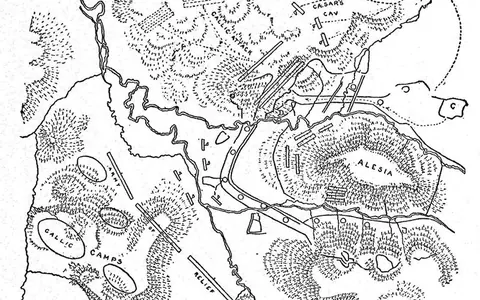
At Alesia in 52 BC he shut Vercingetorix inside a ring of siege works eleven miles round, then built a second line fourteen miles round, facing out, against a relief army he puts at 8,000 horse and about 250,000 foot. Both lines held. Treccani calls it a work of military genius.23

Leading men
The case for Hannibal
His army was built on the march. Eutropius notes that many Ligurians and Gauls joined Hannibal once he was in Italy, the same Gauls Caesar would conquer a century and a half later.24
No one, Polybius writes, can withhold admiration for Hannibal's generalship. For sixteen years he held his army together, like a good ship's captain, and kept it free from sedition, though it was made up of Africans, Spaniards, Ligurians, Celts, Phoenicians, Italians and Greeks.25
The case for Caesar
Caesar called his men comrades, and Suetonius says that when the civil war began every centurion offered to equip a horseman from his own savings, and that throughout the long struggle not one deserted. When the tenth legion mutinied before the African war, he addressed them as citizens, not soldiers, and Suetonius says that one word turned them.26
His veterans repaid him. At Pharsalus, Plutarch tells, the centurion Crastinus opened the attack, promising Caesar his thanks alive or dead, and was killed in it.27
He could also be hard. When the ninth legion mutinied at Placentia in 49 BC, Appian says he announced its decimation, then limited the punishment to 120 ringleaders, of whom twelve were chosen by lot to die.28
The cost of war
The case for Hannibal
Hannibal's war was fought for his city, and after Zama he served it as sufete before Rome drove him into exile. Polybius records the charges against him: among the Carthaginians he was notorious for love of money, among the Romans for cruelty, and Polybius himself found it hard to judge, given the influence of friends and circumstances.29
The case for Caesar
Caesar's conquest of Gaul came at a price his own contemporaries noticed. Plutarch says he fought pitched battles with three million men, killed a million and took as many prisoner. Pliny gives 1,192,000 slain in his battles, not counting the civil wars, and refuses to count it as glory, calling it an outrage committed upon mankind.30
After the massacre of the Usipetes and Tencteri, Plutarch reports from Tanusius, Cato proposed handing Caesar over to the barbarians for breaking a truce.31
In the civil war his policy was clemency. At Corfinium in 49 BC he released the senators he captured and even returned the public money found in the town, and Velleius calls his pardon of all who had fought against him an act of generosity almost passing belief. Suetonius records that he even set up again the statues of Sulla and Pompey that the crowd had broken.32
Defeat and recovery
The case for Hannibal
Hannibal's defeats came late and could not be repaired. His brother Hasdrubal's army was destroyed at the Metaurus in 207 BC, Florus says Hannibal recognised the ill luck of Carthage when his brother's head was thrown into his camp, and at Zama in 202 BC he lost the war. Polybius writes that no commander with the same arms could have made better dispositions, and that a man who had never before suffered defeat must be pardoned if, after every possible step, he failed.33
That claim of no earlier defeat needs care. Mulligan's chronology records his attempts on Nola repulsed in 216 and 215 BC, Eutropius says Marcellus fought well against him there, and after the war he lost his only sea battle, at the Eurymedon in 190 BC.34
The case for Caesar
Caesar lost battles and won the wars that followed. Suetonius names three reverses in Gaul, the worst a legion routed at Gergovia, and Caesar admits losing forty-six centurions and nearly seven hundred men there. Suetonius adds that in the civil war his success was in doubt only twice: at Dyrrachium, where he was put to flight, and in the final battle in Spain, at Munda, where he thought of suicide.35
After Dyrrachium he marched into Thessaly and won at Pharsalus within weeks. Munda in 45 BC was closer. Florus writes that Caesar's usual good fortune was lacking there and the struggle long in doubt, and Velleius that in that battle the commander showed more courage than his men.36
How historians have judged them
Ancient judges admired both. Polybius wrote of the one man and one mind behind the whole Hannibalic war. Nepos claimed Hannibal surpassed other commanders in skill as much as Rome surpassed other nations in courage. Pliny made Caesar his example of vigour of mind and says he fought as many as fifty pitched battles, more than Marcus Marcellus with his thirty-nine.37
Modern writers divide. Treccani calls Hannibal the greatest general of antiquity, for the daring of his plans and the genius of his tactics, and Mommsen gave Caesar the title of Rome's only creative genius. Liddell Hart was cool on both: on Hannibal as a strategist, and on Caesar's Gallic moves, made against barbarians rather than trained generals.38
Dodge, who wrote full histories of both men, refused to rank them. Alexander, he wrote, will always remain the captain of fortune, Hannibal the captain of misfortune, and Caesar holds a middle place. Hannibal was always cautious, often daring, while Caesar was over-daring and over-cautious by turns. Of all the generals the world has seen, he wrote, Hannibal fought against the greatest odds, and in personal character Hannibal stands higher than either Alexander or Caesar. Of Caesar he wrote that had Fortune not rushed to the rescue on many occasions, Caesar would never have lived to be Caesar, and he warned that reducing great captains to statistics savours of the absurd.39
Caesar's record has one more problem: much of it is his own. Suetonius reports that Asinius Pollio, who served under him, thought the Commentaries were put together somewhat carelessly and without strict regard for truth. Hannibal's story, by contrast, comes almost entirely from his enemies' side.40
Battles on the site
Every battle page on the site that involves one of the two men, with the guides around them.
 Hannibal in command · 216 BCBattle of Cannae
 Caesar in command · 48 BCBattle of Dyrrachium
 Caesar in command · 48 BCBattle of Pharsalus
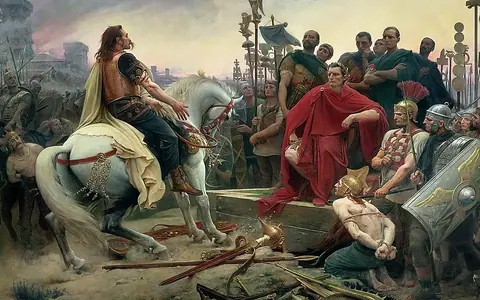 Caesar in command · 52 BCBattle of Alesia
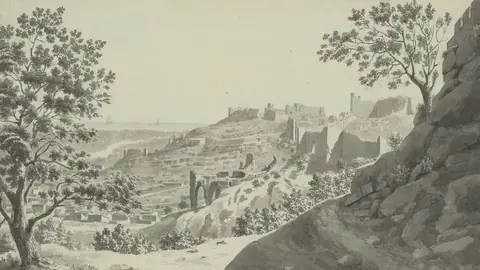 Hannibal in command · 219 BCSiege of Saguntum
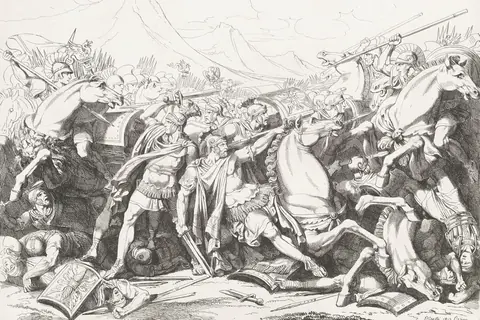 Hannibal in command · 218 BCBattle of the Ticinus
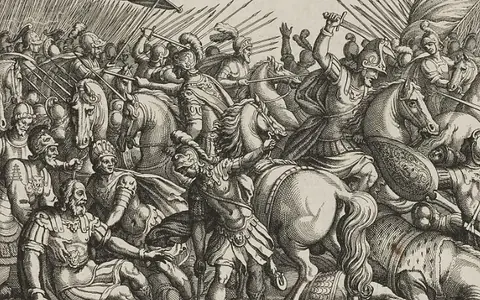 Hannibal in command · 218 BCBattle of the Trebia
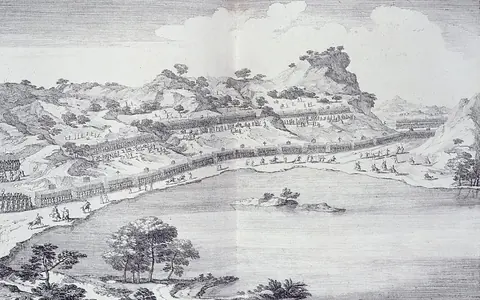 Hannibal in command · 217 BCBattle of Lake Trasimene
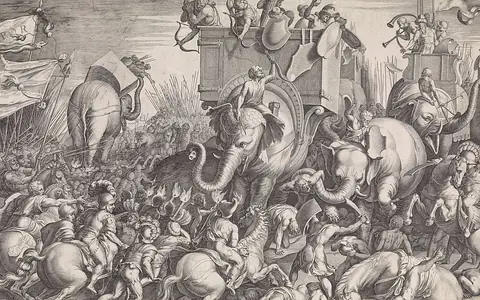 Hasdrubal's march · 207 BCBattle of the Metaurus
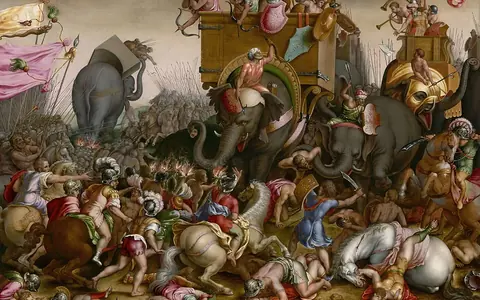 Hannibal in command · 202 BCBattle of Zama
 Before the civil war · 53 BCBattle of Carrhae
 Guide · 88 BC to AD 324The Roman Civil Wars
 Guide · 264 to 146 BCThe Punic Wars
 CommanderHannibal Barca
 CommanderJulius Caesar
 RankingThe Greatest Commanders of Ancient Rome
RankingThe Greatest Commanders of Carthage
See also Hannibal vs Scipio, Pompey vs Caesar, Alexander vs Caesar, How the Roman Legion Worked and Gaius Marius.
Your verdict
We do not pick a winner. Here are the two cases at their strongest, and the questions that decide which one you find more convincing.
For Hannibal
- The march over the Alps with no help from home
- Trasimene and Cannae, the models of ambush and encirclement
- Sixteen years in enemy country with a mixed army that held together
- The greatest odds any ancient general faced, in Dodge's view
- A war fought for his city, not for himself
For Caesar
- Gaul conquered and turned into a province in nine years
- Alesia, two lines of siege works held against two armies
- Pharsalus won with half the enemy's numbers
- Speed that kept every opponent off balance, from Italy to Zela
- Wars won, and defeats like Gergovia and Dyrrachium repaired
Questions to weigh before you decide:
- Is winning the war the true test, or winning battles against a stronger state?
- Should Caesar's victories over fellow Romans count the same as Hannibal's over Rome?
- How far can we trust a record written by Caesar himself, or one written entirely by Hannibal's enemies?
- Does the cost to the defeated, from Gaul to Italy, belong in a judgement of generalship?
- Hannibal fought with what Carthage did not send him, Caesar built his own army and his own politics. Which is the harder feat?
Cast your vote below and see how other readers have judged them.





