PLJoin the list

The Battle of Zama, 202 BC: Hannibal's downfall

Ancient · 19 October 202 BC · Rome vs Carthage · ~7 min read · Updated September 2026

Next anniversary: 19 October 2026, the 2227th anniversary On this day ›

Roman legions meeting Carthaginian war elephants at the Battle of Zama, 202 BC

At a glance

Roman Republic and NumidiaScipio Africanus
vs
CarthageHannibal
Date
202 BC
Location
Zama, near Carthage (Tunisia)
Period
Ancient
Outcome
Decisive Roman victory; end of the Second Punic War
By the numbers
SideStrengthCasualtiesKilled
Roman Republic and Numidia~43,000~2,500~1,500
Carthage~50,000~40,000~20,000

Rounded historical estimates; Carthaginian casualties include about 20,000 taken prisoner.

Balance of forces

Roman Republic and Numidia~43,000
Carthage~50,000

Approximate strength; estimates vary.

Quick answer

Who won the Battle of Zama?

Rome under Scipio, later called Africanus, won a decisive victory at Zama in 202 BC, defeating Hannibal himself in North Africa and ending the Second Punic War. It was the first and last time the two greatest commanders of the age met in battle, and it broke the power of Carthage for good.

In 202 BC, on the plains of North Africa, the Second Punic War came to its end1. The Roman general Scipio, later called Africanus, defeated Hannibal himself at Zama. It was the first and last time the two greatest commanders of the age faced each other, and it broke the power of Carthage for good.

Engraving of two mounted commanders facing each other on a battlefield
Scipio and Hannibal meet before the battle, as the ancient historians say they did. A 19th-century engraving after Hermann Vogel. Public domain

Carrying the war to Carthage

For sixteen years Hannibal had ranged across Italy, winning victory after victory yet never taking Rome. Scipio changed the war by refusing to fight him there. He invaded Africa instead, threatening Carthage directly, and the city recalled Hannibal home to defend it2.
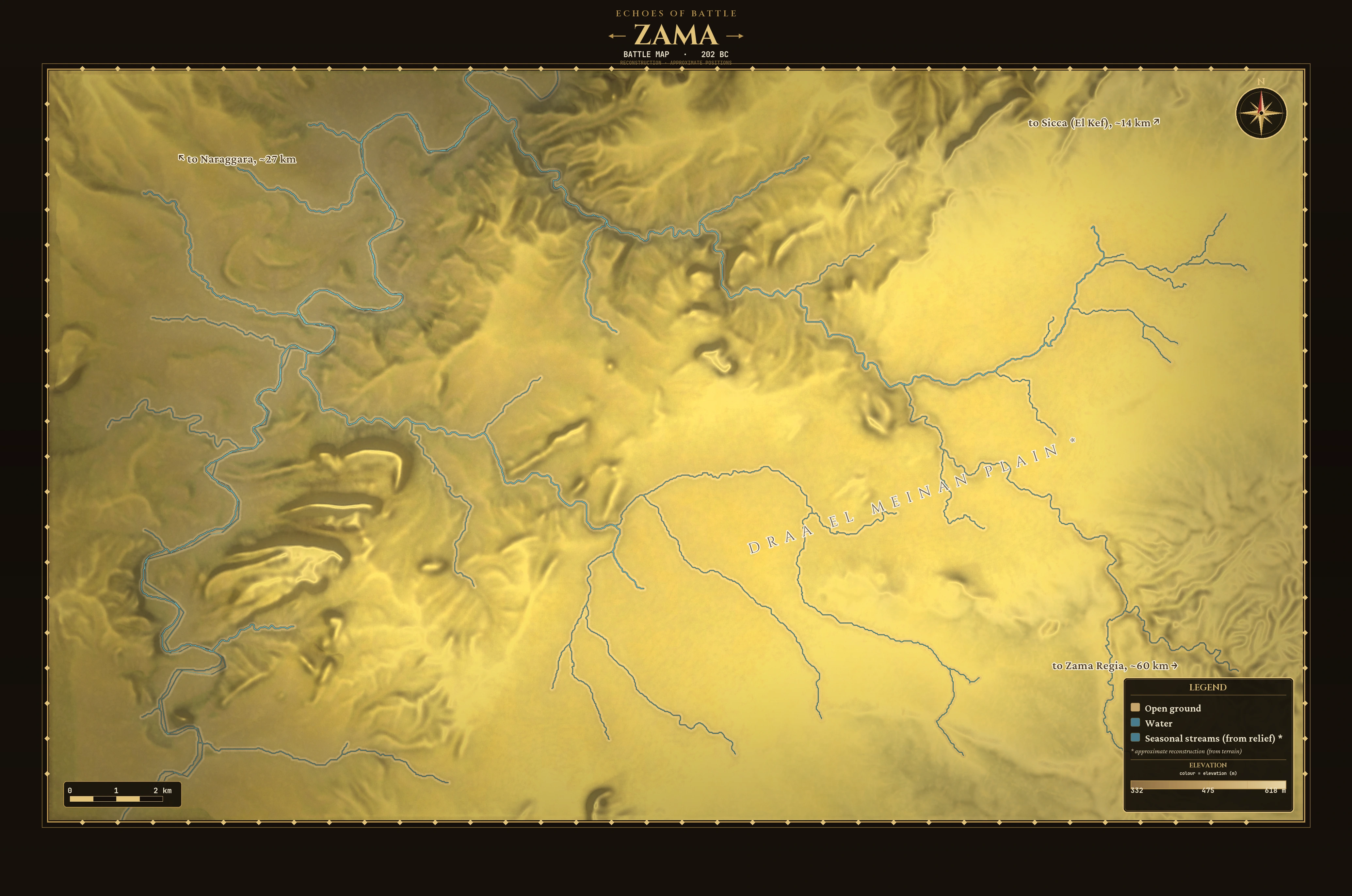
Terrain map of the probable battlefield of Zama: the open Draa el Meinan plain crossed by seasonal stream beds, broken hills to the west and north, and the directions to Naraggara, Sicca (El Kef) and Zama Regia
Our reconstruction of the likely battlefield in today's western Tunisia: the broad, open Draa el Meinan plain, cut only by shallow seasonal streams, with rougher hills to the west toward Naraggara and to the north toward Sicca (El Kef). The battle takes its name from Zama, some 60 km away, and the exact site is still debated, so the location and all positions are approximate; open ground like this let both sides deploy elephants and cavalry in full. Tap to enlarge. Map: Echoes of Battle. Relief: Copernicus DEM GLO-30 (ESA/Airbus). Rivers and roads: © OpenStreetMap contributors

The elephants pass

Hannibal opened with a charge of war elephants.3 Scipio had prepared for it: instead of a solid line he left lanes through his ranks3, and the beasts thundered harmlessly down them or were turned back into their own side. On the wings, the Roman cavalry under Laelius and the Numidian horse under Masinissa drove the Carthaginian horse from the field.

The teacher of Cannae was beaten by his own lesson, enveloped from the rear.

The lines close

The infantry met in a long and even struggle3, Hannibal's veterans against the hardened legions. Then the Roman and Numidian cavalry, having scattered their opponents, returned and struck Hannibal's army in the rear. Caught between the legions and the horsemen, the Carthaginian line collapsed.3

Battle diagram of Zama with Roman units in red and Carthaginian units in blue
Diagram of the battle: the Roman and Numidian horse drive off the Carthaginian cavalry, the legions push back Hannibal's first lines, and the returning cavalry strikes his veterans from the rear. Public domain

What the day decided

Carthage sued for peace and accepted harsh terms, giving up its empire and its fleet. Rome stood unrivalled in the western Mediterranean, and the road to its dominance of the ancient world lay open. Hannibal, undefeated for so long, had lost the one battle that mattered most.

The end of Carthage as a great power

Zama did not just end a battle, it ended an era. The peace Rome imposed in 201 BC stripped Carthage of its war fleet3, forced a crushing fifty-year indemnity3, and forbade it to wage war outside Africa at all, or inside Africa without Rome's consent. A city that had contested the western Mediterranean for a century was reduced to a client that survived only on Roman sufferance. Scipio took the honorific Africanus for the victory4, and Rome emerged as the unrivalled power of the western sea. The resentment left behind festered until Rome found a pretext to finish the job, razing Carthage completely in the Third Punic War of 146 BC5.

Aerial view of a circular lagoon with a round island near the sea at Carthage
The circular military harbour of Carthage, where its war fleet was kept, seen from the air on a 1958 postcard. The peace of 201 BC took that fleet away. Public domain

Frequently asked questions

Why was the Battle of Zama in 202 BC decisive?

Zama in 202 BC ended the Second Punic War and broke the power of Carthage for good, leaving Rome unrivalled in the western Mediterranean and opening the road to its dominance of the ancient world.

How did Scipio deal with Hannibal's war elephants at Zama?

At Zama in 202 BC Scipio left lanes through his ranks instead of a solid line, so Hannibal's charging elephants thundered harmlessly down them or were turned back into their own side.

Why did Scipio invade Africa instead of fighting Hannibal in Italy?

For sixteen years Hannibal had won in Italy without taking Rome, so before Zama in 202 BC Scipio changed the war by invading Africa and threatening Carthage directly, which recalled Hannibal home to defend it.

How was Hannibal finally defeated at Zama?

At Zama in 202 BC the Roman cavalry under Laelius and the Numidian horse under Masinissa drove the Carthaginian horse from the field, then returned to strike Hannibal's army in the rear, so the master of Cannae was enveloped by his own kind of tactic.

What terms did Carthage accept after the Battle of Zama in 202 BC?

After Zama in 202 BC Carthage sued for peace and accepted harsh terms, giving up its empire and its fleet, while the long undefeated Hannibal had lost the one battle that mattered most.

Who won the Battle of Zama?

Rome won the Battle of Zama in 202 BC, when Scipio, later called Africanus, defeated Hannibal and Carthage and ended the Second Punic War.

Sources and notes

Numbered notes in the text point to the works below.

  1. World History Encyclopedia (Joshua J. Mark), “The Battle of Zama - The Beginning of Roman Conquest” ↩
  2. World History Encyclopedia (Joshua J. Mark), “Scipio Africanus the Elder” ↩
  3. Polybius, Histories, Book 15: Scipio's order of battle and the lanes for the elephants 15.9; Hannibal's elephants (over eighty) 15.11; the battle 15.12 to 14 (losses 15.14); peace terms 15.18. Loeb translation online at LacusCurtius: https://penelope.uchicago.edu/Thayer/E/Roman/Texts/Polybius/15*.html. ↩ a b c d e f
  4. H. H. Scullard, Scipio Africanus: Soldier and Politician (Thames and Hudson, 1970). ↩
  5. Adrian Goldsworthy, The Punic Wars (Cassell, 2000). ↩
  6. Wikipedia, “Battle of Zama”

Take command at Zama

Zama is one of 40 battles in Echoes of Battle, told scene by scene, with a real-time tactical mode in the works, and pinned to the ground where Hannibal met his match.

Or support the app on Ko-fi ›