

What was the Korean War?
The Korean War was fought from 25 June 1950, when North Korea invaded South Korea, to the armistice of 27 July 1953. South Korea and a United Nations Command led by the United States fought North Korea and, from October 1950, Chinese forces styled the Chinese People's Volunteers, while the Soviet Union armed the communist side. The front swung from the far south to the Chinese border and back, then settled close to the 38th parallel, where Korea is still divided. No peace treaty has ever been signed.1
The war killed millions of people, most of them Koreans, and left almost the same border it began with. Americans often call it the Forgotten War; in Beijing it is the War to Resist US Aggression and Aid Korea, and in Pyongyang the Fatherland Liberation War. This page sets out its causes, the sides, the swings of the front, the leaders, the cost and the way each side remembers it, and lists our articles on its battles.2
Causes: a divided country
Japan had ruled Korea since 1910, and its rule lasted until Japan's defeat in World War II. In August 1945 the Soviet Union and the United States agreed that Soviet forces would take the Japanese surrender north of the 38th parallel and US forces south of it, a line meant to be temporary. Our article on the US military government in Korea, 1945 to 1948 covers the southern zone.3
Neither occupying power would accept unification on the other's terms. A joint US and Soviet commission made no progress, and elections held under UN supervision in 1948 took place only in the south, where Syngman Rhee became president of the Republic of Korea. In the north a communist Democratic People's Republic of Korea was proclaimed under Kim Il-sung, with Soviet backing. Soviet troops left the north at the end of 1948 and US troops left the south in 1949.4
Both governments claimed the whole peninsula. Britannica and the US Army's campaign history both say that after subversion, guerrilla warfare and border raids failed to bring down the South, the North decided to unify Korea by force. Stalin refused Kim's request in 1949 but approved an invasion after Kim's visit to Moscow in March and April 1950; the Soviet Union supplied arms and China released Korean veterans of its People's Liberation Army. Historians reading the Soviet archives still debate whether the initiative was Stalin's or Kim's.5
At about 4 a.m. on 25 June 1950 the Korean People's Army crossed the 38th parallel at several points, with its main effort toward Seoul, which fell on 28 June. Pyongyang radio announced that the South had invaded first and that the northern army was counterattacking; the UN Commission on Korea reported that South Korea's president and foreign minister called the claim entirely false.6
The sides
The UN Security Council called for a ceasefire on 25 June and on 27 June recommended that members help South Korea repel the attack; the Soviet Union, which could have vetoed both resolutions, was boycotting the Council. Truman committed US air and naval forces, then ground troops, which began landing on 1 July.7
On 7 July the Council asked the United States to name a commander, and Truman appointed General of the Army Douglas MacArthur; on 14 July President Rhee placed the South Korean forces under the UN Command. Britannica counts 16 nations that sent troops, the figure Eisenhower used in 1953, while a US Army medical history counts 22 that gave ground, air, naval or medical support.8
South Korea bore the heaviest share of the ground war. In August 1951, the US Army records, the UN ground forces under Eighth Army command numbered 549,224: 268,320 in the Republic of Korea Army, 248,320 US Army and Marine troops and 32,874 from seventeen other nations. Britain sent the 27th Brigade from Hong Kong in August 1950, which fought on the Naktong, and from July 1951 its units served in the 1st Commonwealth Division; about 60,000 British servicemen served in Korea.9
On the other side, the Korean People's Army of North Korea was joined in October 1950 by Chinese forces, which crossed the Yalu at North Korea's request, according to Beijing's official account. They were officially called the Chinese People's Volunteers, the name used in the armistice agreement, although they were units of China's army; Britain's National Army Museum, for example, describes the intervention as one by the Chinese People's Liberation Army.10
The Soviet Union armed and advised the North Korean army, and when it retreated in October 1950 Soviet advisers and air defense forces went north with its last divisions. Stalin agreed to give China air support, and from November 1950 Soviet-built MiG-15 jet fighters, flown by Chinese and, Britannica notes, sometimes Soviet pilots, fought UN aircraft over the north.11
The course of the war
Invasion and the Pusan Perimeter, June to September 1950
The South Korean army, smaller and with no tanks or combat aircraft, could not stop the invasion, and US divisions rushed from Japan were committed in small units and also driven back. On 1 August the US Eighth Army under Lieutenant General Walton Walker withdrew into a final defensive line around the port of Pusan, a perimeter about 75 miles from north to south, where South Korean, US and newly arrived British troops held through August and early September.12
Inchon and the advance to the Yalu, September to November 1950
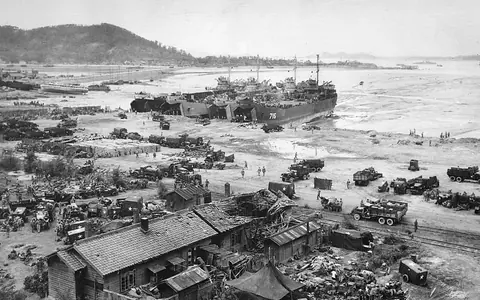
MacArthur answered with a landing far behind the front at Inchon, the port of Seoul, which almost no one else in the chain of command favored: its channels were full of shoals and a tidal range of as much as 35 feet left only short windows for landing. On 15 September 1950 the 1st Marine Division took Wolmi-do and then Inchon, in an operation of nearly 70,000 men and 230 ships from seven navies. The Eighth Army broke out of the perimeter on 16 September, the two forces met near Suwon on 26 September and Seoul was retaken by 28 September. Our article on the Battle of Inchon tells the story in detail.13

The UN war aim then grew from restoring South Korea to occupying the North: South Korean troops crossed the 38th parallel on 1 October and US troops on 7 October, the UN General Assembly endorsed the aim of a united Korea, and Pyongyang fell on 19 October. A South Korean regiment reached the Yalu River at Ch'osan on 26 October, and US troops reached it at Hyesanjin on 21 November. China had warned that it would intervene.14
China enters the war, October 1950 to January 1951
The landing at Inchon and the collapse of the North Korean army alarmed Mao Zedong and Stalin; Kim Il-sung appealed to both for direct military help, and Stalin agreed to provide air support for a Chinese intervention. Chinese troops, moving by night and hiding by day, first clashed with UN forces in late October, and within ten days of 1 November twelve Chinese divisions had been identified. The UN Command misjudged their strength and on 24 November opened what MacArthur hoped would be the final offensive of the war.15
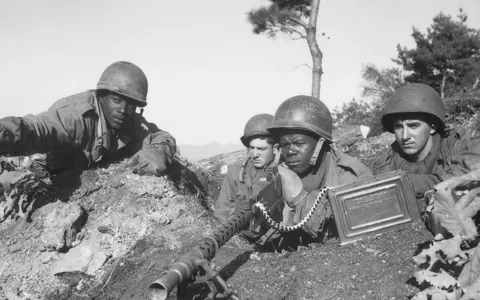
The Chinese counteroffensive struck within days. In the west it broke the South Korean II Corps; the reserves that Walker rushed to the gap, among them the 1st Cavalry Division, the Turkish Brigade and two British brigades, could not stop it, and the Eighth Army fell back south across the Ch'ongch'on River and out of Pyongyang. The US 2nd Infantry Division had to withdraw under fire south of Kunu-ri, a passage the US Army remembers as the Kunu-ri gauntlet; on 30 November its engineers held the rear against what Stars and Stripes describes as five Chinese divisions. Our article on the Battle of the Ch'ongch'on River follows the fighting.16
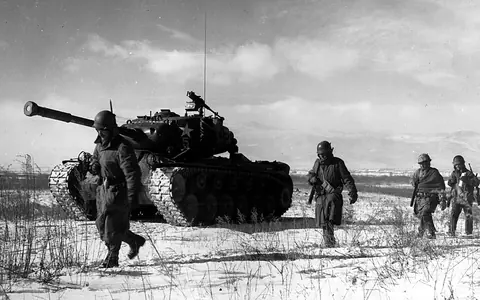
In the north-east, Chinese forces surrounded the regiments of the US 1st Marine Division along the mountain road to the Changjin (Chosin) Reservoir, in temperatures as low as minus 25 degrees Fahrenheit. Major General Oliver P. Smith pulled them back to Hagaru-ri, and from 6 December the division fought its way out to Hungnam, helped by close air support and airdrops. The Oxford Companion to American Military History gives 4,400 battle casualties among some 15,000 Marines, almost all of them frostbitten, and perhaps 25,000 Chinese dead. For China the battle helped drive the UN out of north-east Korea; for the UN it was a fighting withdrawal that saved the division. See our article on the Battle of the Chosin Reservoir.17

Between 11 and 24 December, 173 ships evacuated X Corps from Hungnam and two smaller ports: about 105,000 troops and more than 98,000 civilians by the US Army's count, over 100,000 soldiers and 90,000 civilians from Hungnam by the National Army Museum's. Chinese and North Korean forces then crossed the 38th parallel and in early January 1951 took Seoul again.18
Back to the 38th parallel, 1951
Lieutenant General Matthew Ridgway, who took over the Eighth Army in December, steadied the front and restored UN morale. From 25 January his forces advanced again and retook Seoul in mid-March. On 11 April Truman relieved MacArthur, who had publicly pressed for a wider war against China; Ridgway replaced him and James Van Fleet took the Eighth Army. China's spring offensives of April and May were held near Kapyong and on the Imjin River, where the British 29th Brigade held the main line from 22 to 25 April, and by mid-June the UN line stood mostly north of the 38th parallel.19
Talking and fighting, 1951 to 1953
Both coalitions now concluded that neither could win outright at an acceptable cost. Armistice talks opened at Kaesong on 10 July 1951 and later moved to Panmunjom, while Mao, according to Britannica, approved a strategy of holding the line from tunnels and bunkers and wearing down the UN forces with night attacks. When the talks broke down in August, Van Fleet's limited offensives took Bloody Ridge and Heartbreak Ridge by October.20

For the next two years the front barely moved: the war became one of patrols, artillery, air attack and costly assaults on hills such as White Horse, Old Baldy and Triangle Hill. Britannica puts the losses of the autumn 1952 battles alone at 10,000 for the Eighth Army and 15,000 for the Chinese.21
The main obstacle to an armistice was the fate of prisoners: nearly half of those held by the UN, and three quarters of the Chinese, did not want to return to communist rule, and the UN refused to send them back by force. After Stalin's death on 5 March 1953 the Soviet leadership decided that the war should end, and China accepted voluntary repatriation. In June Rhee, who opposed any armistice that left Korea divided, let some 27,000 Korean prisoners held by his forces walk free, and China answered with a last offensive against South Korean lines.22

Battles of the Korean War
Our articles on the battles of the war are listed below in date order. For the long history of warfare on the peninsula, from the Imjin War to Chosin, see our guide to the battles of Korea.
- 1950The Battle of Inchon, 1950United Nations (United States and allies) vs North Korea
A risky landing behind the lines at Inchon turned the Korean War around in a week.
- 1950Battle of the Ch'ongch'on River, 1950United Nations Command (US Eighth Army) vs China (Chinese People's Volunteers)
On 25 November 1950 China's XIII Army Group struck the US Eighth Army on the Ch'ongch'on. Within a week the UN advance to the Yalu had become a retreat.
- 1950The Battle of Chosin Reservoir, 1950United Nations (US Marines and Army; UK Royal Marines) vs People's Republic of China
Surrounded and frozen, the Marines fought their way out from Chosin to the sea.
Timeline
- 1910Japan annexes Korea and rules it until its defeat in 1945.23
- 1945Soviet and US forces accept the Japanese surrender north and south of the 38th parallel.24
- 1948The Republic of Korea is founded in the south under Syngman Rhee and the Democratic People's Republic of Korea in the north under Kim Il-sung.25
- 195025 June: North Korean forces cross the 38th parallel; 27 June: the UN Security Council recommends that members help South Korea.26
- 195015 September: UN landing at Inchon; Seoul retaken by 28 September and Pyongyang taken on 19 October.27
- 1950Late October and November: Chinese forces enter the war; the UN armies retreat from the Ch'ongch'on River and the Chosin Reservoir.28
- 195011 to 24 December: X Corps and tens of thousands of civilians are evacuated by sea from Hungnam.29
- 1951January: Chinese and North Korean forces take Seoul again; UN forces retake it in March.30
- 195111 April: Truman relieves MacArthur; 22 to 25 April: battles of Kapyong and the Imjin.31
- 195110 July: armistice talks open at Kaesong.32
- 19535 March: Stalin dies; China soon accepts voluntary repatriation of prisoners.33
- 195327 July: armistice signed at Panmunjom; the truce takes effect at 10 p.m.34
Key figures
UN Command. Douglas MacArthur commanded the UN forces until Truman relieved him in April 1951. Walton Walker led the Eighth Army through the Pusan Perimeter and the retreat of late 1950; Matthew Ridgway succeeded him and then MacArthur, and James Van Fleet took the Eighth Army in April 1951. Edward Almond commanded X Corps, Oliver P. Smith the 1st Marine Division, and Mark W. Clark signed the armistice as UN commander. [7,6,14,5] South Korea. Syngman Rhee, president from 1948, wanted to unify Korea under his government, opposed an armistice that left the country divided and never signed it; he accepted it on 9 July 1953 only after US assurances. Major General Chung Il-kwon led the South Korean army in the summer of 1950. [5,4,17,2] North Korea, China and the Soviet Union. Kim Il-sung, Supreme Commander of the Korean People's Army, began the war and signed the armistice; General Kim Chaek was his field commander in 1950, and General Nam Il led the communist delegation at the talks. Peng Dehuai commanded the Chinese People's Volunteers and signed the armistice for them, and in 1951 Mao Zedong approved Peng's proposal to hold the line and fight a war of attrition while China negotiated. [5,17,9,2,28]The armistice and the outcome
At 10 a.m. on 27 July 1953, at Panmunjom, Lieutenant General William K. Harrison Jr. for the UN Command and General Nam Il for the Korean People's Army and the Chinese People's Volunteers signed the armistice, and the commanders, Clark, Kim Il-sung and Peng Dehuai, also signed it. The truce took effect at 10 p.m. It is a purely military agreement between commanders; no state is a signatory, and it is not a peace treaty.35
The agreement fixed a military demarcation line from which both sides withdrew 2 kilometers, creating a demilitarized zone about 4 kilometers wide, and set up a Neutral Nations Supervisory Commission of Sweden and Switzerland, nominated by the UN Command, and Poland and Czechoslovakia, nominated by the communist side. In the prisoner exchange, 21,839 communist prisoners refused to go home, as did 347 UN prisoners, among them 21 Americans.36
South Korea and the United States initialed a Mutual Defense Treaty in Seoul on 8 August 1953. The armistice was meant to lead to a political settlement, but none has been reached, so it still governs the border.37
No side won a clear victory. The National Archives notes that North and South Korea still hold almost the same territory as in June 1950, and its 2003 history of the armistice concludes that no clear victor emerged. North Korea, however, marks 27 July as its Victory Day, and China celebrates the war as a victory over the United States.38
The human cost
No count of the dead is precise, and estimates differ widely. Britain's National Army Museum estimates that two million North and South Korean civilians died; Kim Dong-choon, a former member of South Korea's Truth and Reconciliation Commission, writes that more than two million people were killed in the war, and The Diplomat puts the total at three to four million.39
Military losses are given here by source, because the figures count different things and should not be added up. The US National Archives counts 36,576 Americans who died in the war; the National Army Museum gives nearly 37,000 American dead and 92,000 wounded, at least half a million South Korean and at least half a million North Korean military dead and wounded, over 110,000 Chinese killed and 380,000 wounded, and over 1,100 British killed. Britannica estimates 850,000 South Korean army combat casualties. At its 2020 commemoration Beijing honored nearly 200,000 Chinese soldiers killed, while The Diplomat argues that China's official account of the war understates its losses.40

Civilians and prisoners were killed by every side. In the first weeks of the war South Korean police and paramilitary units executed political prisoners and members of the National Guidance League, a body set up to watch former leftists; at Taejon alone, Britannica writes, thousands were massacred, a crime blamed on the North for half a century. Kim Dong-choon notes that North and South Korean forces both executed people suspected of supporting the other side.41
Retreating North Korean forces took thousands of South Koreans north as hostages and forced laborers in September 1950 and killed thousands more; at Taejon more than 1,500 people, including civilians and US and South Korean prisoners, were massacred, apparently in retaliation for the earlier killings. In late July 1950 US troops and aircraft fired on refugees near No Gun Ri, killing hundreds, according to Britannica; after a US Army review, President Bill Clinton expressed regret in 2001 that an unconfirmed number of Korean refugees had been killed or injured there. US bombing, Britannica notes, attacked people and places with little restraint.42
Legacy and memory
The Korean War was the first major armed conflict of the Cold War, and Britain's National Army Museum calls it the first and only test of the United Nations as a military force. It confirmed the division of Korea and tied South Korea to the United States by treaty; about 36,000 US troops were still stationed there in 2003. The National Archives calls the border one of the most dangerous areas on earth: skirmishes along its 155 miles have cost more lives since 1953, and with no peace treaty the war has never formally ended.43
Each side remembers a different war. China calls it the War to Resist US Aggression and Aid Korea; at its 70th anniversary in 2020 Xi Jinping called the victory a declaration that the Chinese people had stood firm in the East. The Diplomat argues that this official account blurs how the war began and understates China's losses. North Korea has made 27 July a national holiday, the Day of Victory in the Great Fatherland Liberation War, and marks it with parades.44
In the United States the war is often called the Forgotten War, and in Britain, the National Army Museum notes, it is largely forgotten too. In South Korea, families of civilians killed by South Korean forces long kept silent; their petitions led in 2005 to the Truth and Reconciliation Commission, which investigated the massacres of 1950.45
Where to read next
Our guide to the battles of Korea sets this war in the long history of the peninsula, and our page on the US military government in Korea explains the years before it. The commanders appear in our biographies of Douglas MacArthur, Matthew Ridgway and Chesty Puller, and among the greatest American commanders. Inchon and Chosin are also ranked among the greatest battles in American history.
Notes
A number in the text points to a note; each note names the works that paragraph draws on, listed in full under Sources.
- U.S. National Archives, “Armistice Agreement for the Restoration of the South Korean State (1953)”; Britannica, “Korean War”; National Army Museum, “Korean War”. ↩
- National Army Museum, “Korean War”; U.S. National Archives, “Armistice Agreement for the Restoration of the South Korean State (1953)”; U.S. Army, “The Korean War”; CNN, “China's Xi Jinping delivers thinly veiled swipe at US during Korean War anniversary speech”; Radio Free Asia, “North Koreans forced to celebrate 70th anniversary of victory in Korean War”. ↩
- Britannica, “Korean War”; Office of the Historian, “Korea, Japan and the Korean War, 1945 to 1952”. ↩
- Britannica, “Korean War”; Office of the Historian, “Korea, Japan and the Korean War, 1945 to 1952”; U.S. National Archives, “Armistice Agreement for the Restoration of the South Korean State (1953)”. ↩
- Britannica, “Korean War”; U.S. Army Center of Military History, “Korean War campaigns”; Encyclopaedia Britannica, “Korean War”; Wilson Center, “Did Stalin lure the United States into the Korean War? New evidence on the origins of the Korean War”. ↩
- National Army Museum, “Korean War”; U.S. Army Center of Military History, “Korean War campaigns”; Encyclopaedia Britannica, “Korean War”; Office of the Historian, Foreign Relations of the United States, 1950. ↩
- Encyclopaedia Britannica, “Korean War”; Britannica, “Korean War”; AMEDD Center of History and Heritage, “Battle casualties and medical statistics”. ↩
- U.S. Army Center of Military History, “Korean War campaigns”; Britannica, “Korean War”; U.S. National Archives, “Armistice Agreement for the Restoration of the South Korean State (1953)”; AMEDD Center of History and Heritage, “Battle casualties and medical statistics”. ↩
- U.S. Army Center of Military History, “Korean War campaigns”; Britannica, “Korean War”; National Army Museum, “Korean War”. ↩
- People's Daily Online, “70 years after milestone war, Xi urges pooling strength for national rejuvenation”; U.S. National Archives, “Armistice Agreement for the Restoration of the South Korean State (1953)”; National Army Museum, “Korean War”. ↩
- Encyclopaedia Britannica, “Korean War”; Naval History and Heritage Command, “Operation Chromite”; Britannica, “Korean War”; U.S. Army Center of Military History, “Korean War campaigns”. ↩
- Britannica, “Korean War”; Encyclopaedia Britannica, “Korean War”; U.S. Army, “The Korean War”; Naval History and Heritage Command, “Operation Chromite”. ↩
- Naval History and Heritage Command, “Operation Chromite”; U.S. Naval Institute, Naval History; Encyclopaedia Britannica, “Korean War”; U.S. Army Center of Military History, “Korean War campaigns”. ↩
- Encyclopaedia Britannica, “Korean War”; U.S. Army Center of Military History, “Korean War campaigns”; U.S. Army, “The Korean War”. ↩
- Naval History and Heritage Command, “Operation Chromite”; Britannica, “Korean War”; U.S. Army Center of Military History, “Korean War campaigns”; The Oxford Companion to American Military History. ↩
- U.S. Army Center of Military History, “Korean War campaigns”; U.S. Army, “The Korean War”; Stars and Stripes; National Army Museum, “Korean War”. ↩
- The Oxford Companion to American Military History; U.S. Army Center of Military History, “Korean War campaigns”; Britannica, “Korean War”. ↩
- U.S. Army Center of Military History, “Korean War campaigns”; National Army Museum, “Korean War”; Britannica, “Korean War”. ↩
- National Army Museum, “Korean War”; Britannica, “Korean War”; U.S. Army Center of Military History, “Korean War campaigns”. ↩
- Encyclopaedia Britannica, “Korean War”; National Archives of Korea, “The moments of the Korean Armistice Agreement”; Britannica, “Korean War”; U.S. Army Center of Military History, “Korean War campaigns”. ↩
- U.S. Army Center of Military History, “Korean War campaigns”; Encyclopaedia Britannica, “Korean War”. ↩
- U.S. National Archives, Prologue; Britannica, “Korean War”; Encyclopaedia Britannica, “Korean War”; Encyclopaedia Britannica, “Korean War”. ↩
- Britannica, “Korean War”; Office of the Historian, “Korea, Japan and the Korean War, 1945 to 1952”. ↩
- Britannica, “Korean War”; Office of the Historian, “Korea, Japan and the Korean War, 1945 to 1952”. ↩
- Britannica, “Korean War”; U.S. National Archives, “Armistice Agreement for the Restoration of the South Korean State (1953)”. ↩
- U.S. Army Center of Military History, “Korean War campaigns”; AMEDD Center of History and Heritage, “Battle casualties and medical statistics”. ↩
- Naval History and Heritage Command, “Operation Chromite”; Encyclopaedia Britannica, “Korean War”. ↩
- U.S. Army Center of Military History, “Korean War campaigns”; Britannica, “Korean War”. ↩
- U.S. Army Center of Military History, “Korean War campaigns”; National Army Museum, “Korean War”. ↩
- National Army Museum, “Korean War”; Britannica, “Korean War”. ↩
- U.S. Army Center of Military History, “Korean War campaigns”; National Army Museum, “Korean War”. ↩
- National Archives of Korea, “The moments of the Korean Armistice Agreement”; Britannica, “Korean War”. ↩
- Encyclopaedia Britannica, “Korean War”; Britannica, “Korean War”. ↩
- U.S. National Archives, “Armistice Agreement for the Restoration of the South Korean State (1953)”; U.S. National Archives, Prologue. ↩
- U.S. National Archives, “Armistice Agreement for the Restoration of the South Korean State (1953)”; U.S. National Archives, Prologue; Encyclopaedia Britannica, “Korean War”; National Archives of Korea, “The moments of the Korean Armistice Agreement”. ↩
- U.S. National Archives, “Armistice Agreement for the Restoration of the South Korean State (1953)”; U.S. National Archives, Prologue; Encyclopaedia Britannica, “Korean War”; U.S. Army, “The Korean War”. ↩
- National Archives of Korea, “The moments of the Korean Armistice Agreement”; Office of the Historian, “Korea, Japan and the Korean War, 1945 to 1952”; Britannica, “Korean War”; U.S. National Archives, Prologue. ↩
- U.S. National Archives, “Armistice Agreement for the Restoration of the South Korean State (1953)”; U.S. National Archives, Prologue; The Korea Times; People's Daily Online, “70 years after milestone war, Xi urges pooling strength for national rejuvenation”. ↩
- National Army Museum, “Korean War”; Kim Dong-choon, The Asia-Pacific Journal; The Diplomat. ↩
- U.S. National Archives, “Armistice Agreement for the Restoration of the South Korean State (1953)”; National Army Museum, “Korean War”; Britannica, “Korean War”; CNN, “China's Xi Jinping delivers thinly veiled swipe at US during Korean War anniversary speech”; The Diplomat. ↩
- Encyclopaedia Britannica, “Korean War”; Kim Dong-choon, The Asia-Pacific Journal. ↩
- Encyclopaedia Britannica, “Korean War”; Encyclopaedia Britannica, “Korean War”; PBS NewsHour, “No Gun Ri”; Kim Dong-choon, The Asia-Pacific Journal. ↩
- Naval History and Heritage Command, “Inchon”; National Army Museum, “Korean War”; Office of the Historian, “Korea, Japan and the Korean War, 1945 to 1952”; U.S. National Archives, Prologue; Britannica, “Korean War”. ↩
- CNN, “China's Xi Jinping delivers thinly veiled swipe at US during Korean War anniversary speech”; People's Daily Online, “70 years after milestone war, Xi urges pooling strength for national rejuvenation”; The Diplomat; Radio Free Asia, “North Koreans forced to celebrate 70th anniversary of victory in Korean War”; The Korea Times. ↩
- U.S. Army, “The Korean War”; National Army Museum, “Korean War”; Kim Dong-choon, The Asia-Pacific Journal. ↩
Sources
- U.S. National Archives, “Armistice Agreement for the Restoration of the South Korean State (1953)”.
- Britannica (Britannica School), “Korean War”.
- National Army Museum (UK), “Korean War”.
- U.S. Army, “The Korean War”.
- CNN (23 October 2020), “China's Xi Jinping delivers thinly veiled swipe at US during Korean War anniversary speech”.
- Radio Free Asia (27 July 2023), “North Koreans forced to celebrate 70th anniversary of victory in Korean War”.
- Office of the Historian, U.S. Department of State, “Korea, Japan and the Korean War, 1945 to 1952”.
- U.S. Army Center of Military History, “Korean War campaigns”.
- Encyclopaedia Britannica, “Korean War: invasion and counterinvasion, 1950 to 1951”.
- Wilson Center (Donggil Kim and William Stueck, 2011), “Did Stalin lure the United States into the Korean War? New evidence on the origins of the Korean War”.
- Office of the Historian, Foreign Relations of the United States, 1950, vol. VII, document 96, “Report of the United Nations Commission on Korea, 25 June 1950”.
- AMEDD Center of History and Heritage, U.S. Army (Frank A. Reister), “Battle casualties and medical statistics: U.S. Army experience in the Korean War, chapter 1”.
- People's Daily Online (24 October 2020), “70 years after milestone war, Xi urges pooling strength for national rejuvenation”.
- Encyclopaedia Britannica, “Korean War: north to the Yalu”.
- Naval History and Heritage Command (Adam Bisno, 2019), “Operation Chromite: the invasion of Inchon”.
- U.S. Naval Institute, Naval History (October 2010), “Operation Chromite: target Inchon”.
- The Oxford Companion to American Military History (Edwin H. Simmons), via Encyclopedia.com, “Chosin Reservoir, Battle of the”.
- Stars and Stripes (Seth Robson, 5 December 2004), “Korean War battle of Kunu-ri remembered”.
- Encyclopaedia Britannica, “Korean War: to the negotiating table”.
- National Archives of Korea, via Google Arts & Culture, “The moments of the Korean Armistice Agreement”.
- Encyclopaedia Britannica, “Korean War: the final push”.
- U.S. National Archives, Prologue (Summer 2003), “The Korean War Armistice”.
- Encyclopaedia Britannica, “Korean War: armistice”.
- The Korea Times (28 July 2026), “N. Korea marks 73rd armistice anniversary with ceremonial parade”.
- Kim Dong-choon, The Asia-Pacific Journal: Japan Focus (2010), “The Truth and Reconciliation Commission of Korea: uncovering the hidden Korean War”.
- The Diplomat (Joe Renouard and Woyu Liu, June 2020), “The War to Resist America: how China remembers the Korean War”.
- PBS NewsHour (11 January 2001), “No Gun Ri: Clinton's statement”.
- Naval History and Heritage Command, “Inchon”.






