

Bayezid or Timur: what does the evidence say?
Bayezid I, the Ottoman sultan called Yıldırım, the Thunderbolt, and Timur, the Central Asian conqueror Europe knew as Tamerlane, met in one battle. On the Çubuk plain near Ankara, in July 1402, Timur destroyed the Ottoman army and took Bayezid prisoner, and the sultan died in captivity at Akşehir the following March. Who won Ankara is not in doubt. Whether that one day shows which of them was the abler soldier and ruler is a question historians answer differently, and this page sets out the evidence so that you can decide.1
The two men had more in common than the legend of the conqueror and his caged prisoner suggests. Both were Turkish-speaking Muslim rulers who spent most of their reigns on campaign, and both claimed authority over the small Turkish principalities of Anatolia, which is exactly where their ambitions collided. Bayezid had annexed most of those emirates, and the princes he drove out took refuge with Timur, while Ahmad Jalayir, whom Timur had driven out of Baghdad, and the Turkmen chief Qara Yusuf found shelter at the Ottoman court.2
This is not a ranking, and below you will find the two careers side by side, the campaign that ended at Ankara, and six questions on which a commander can be judged. Under each we set out the strongest evidence for Bayezid and for Timur, from the chroniclers of both courts, Byzantine and European witnesses and modern historians, and the decision is left to you.
Side by side
- Lived
- 1354 by İnalcık's dating, about 1360 by Britannica's, to 1403
- 1336 to 1405 (Manz doubts the traditional birth date of 8 April 1336)
- Origin
- Eldest son of Sultan Murad I
- The Barlas tribe, born in a village near Kesh in Transoxiana
- Came to power
- 1389, at the battle of Kosovo, where his father was mortally wounded
- 1370, enthroned at Samarkand after ten years of struggle
- Title
- Sultan
- Güregen, son-in-law of the house of Genghis Khan, ruling in the name of a puppet khan
- Wars in command
- The Anatolian emirates 1389 to 1398, the Balkans and the Danube, the blockade of Constantinople, the crusade of 1396, Timur 1400 to 1402
- Transoxiana and Khwarazm in the 1370s, the three, five and seven year campaigns in Iran and the west (1386 to 1404), the Golden Horde 1391 and 1395, India 1398 to 1399
- Notable opponents
- The Karamanids, King Sigismund of Hungary, Byzantium, Mircea of Wallachia, Timur
- Tokhtamysh of the Golden Horde, the Tughluq sultan of Delhi, the Mamluks, the Jalayirids, Bayezid
- Battles named here
- Kosovo 1389, Rovine 1395, Nicopolis 1396, Ankara 1402
- Kondurcha 1391, the Terek 1395, Delhi 1398, Sivas 1400, Baghdad 1401, Ankara 1402
- Death
- A prisoner, at Akşehir in March 1403
- At Otrar in February 1405, on his way to invade China
Dates, origins and campaigns as given by the TDV İslâm Ansiklopedisi, Britannica and Manz's reviewer. We give no win and loss totals because no source counts their battles the same way.3
Where they met: from Sivas to Ankara
A quarrel over the frontier, 1399 to 1400
The border between the two empires ran through eastern Anatolia, and each court later told the story of how the war began in its own way. Yazdi, Timur's court historian, says Bayezid demanded the tribute of Erzincan and Erzurum from their lord Taharten, who stood under Timur's protection. Peter Jackson, in the Encyclopaedia Iranica, records the other grievance, that Ahmad Jalayir and Qara Yusuf were both living as Bayezid's guests.4
In Yazdi's text Timur mocks Bayezid as the descendant of a Turcoman sailor and calls him an ant, and Bayezid replies that he will pursue Timur as far as Tabriz and Sultaniyya. Doukas, writing in Byzantium, has Bayezid shave the beards of Timur's envoys and send them home with a taunt aimed at Timur's honour. Johann Schiltberger, a Bavarian prisoner in Ottoman service, heard a plainer version, in which Timur demanded back the land of a Turkmen lord and Bayezid refused because he had won it by the sword.5
Sivas, 1400
Timur struck first, laying siege in the late summer of 1400 to Sivas, which held out for eighteen days by Yazdi's count and twenty-one by Schiltberger's. Yazdi writes that the Muslims of the city were spared for a ransom but that the 4,000 Armenian horsemen of the garrison were thrown into pits and buried. Schiltberger puts the number buried alive at 5,000, and Ibn Arabshah, who hated Timur, at 3,000.6
Timur did not press on into the Ottoman heartland. He turned south into Syria and then against Baghdad, which he stormed in July 1401 after a siege of forty days, Peter Jackson writes in the Encyclopaedia Iranica. Bayezid used the pause to take Erzincan after a siege, C. E. Bosworth notes in the same encyclopedia.7
The march to Ankara, summer 1402
Bayezid brought his army east, including, as Marie-Mathilde Alexandrescu-Dersca notes in her 1942 study of the campaign, the troops from the siege of Constantinople and the Serbian contingent. Yazdi describes how Bayezid held the road to Tokat, expecting Timur to come that way, and how Timur instead swung south through Kayseri and Kırşehir, raiding deep into Ottoman land so that the sultan would have to follow him, while his infantry dug wells along the road. In Alexandrescu-Dersca's reconstruction Timur covered the ground from Kırşehir to Ankara in three days of marching while the Ottoman army stood some 40 kilometres north of Kırşehir, expecting him much later, and he laid siege to the city.8
The Ottomans had to turn back through dry country in the July heat. Britannica says Timur's men dammed the stream that was the only water for the Ottoman army, and Doukas puts the Ottomans who died of thirst at 5,000.9
The battle, July 1402
Even the date of the battle is disputed, and Alexandrescu-Dersca, who checked the chronicles against Venetian reports and the day of the week, settled on Friday 28 July 1402, the date Murat Yılmaz also gives in his study of the Byzantine sources.10
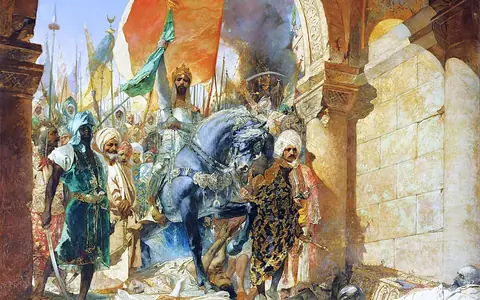
The other date in circulation is 20 July 1402, which Britannica gives, like Clavijo's Victorian translator Clements Markham and the Berlin museum's catalogue entry for the painting reproduced below.11
The numbers are just as uncertain, since Alexandrescu-Dersca thought Timur had at least 140,000 men and that the Ottoman army, Serbs included, did not much exceed 85,000. Halaçoğlu gives Timur 160,000 and Bayezid 70,000, the number in Timur's own letter of victory, or 90,000 according to the Ottoman chronicler Behişti. Yılmaz finds most Turkish historians agreeing on about 70,000 against 160,000 and calls the 120,000 against 800,000 of the Byzantine historian Chalkokondyles greatly exaggerated.12
Yazdi describes the Ottoman order of battle. Stefan Lazarević, the brother of Bayezid's Serbian wife, held the right with the armoured cavalry of Europe, Bayezid's son Süleyman the left with the Anatolian troops, and the sultan the centre with three more of his sons, while Mehmed commanded the rearguard. The Serbs fought, Yazdi concedes, with prodigious valour, and Yılmaz notes that their number is given as 5,000 by Doukas, 20,000 by Yazdi and about 10,000 by modern historians.13
The day was decided by men who changed sides. Ibn Arabshah writes that the Tatars, a third of Bayezid's army, went over to Timur, who had written to their chief beforehand, and Schiltberger saw some thirty thousand Tatars of the Ottoman vanguard cross to the enemy.14
The Tatars were not the only ones to leave, for Doukas names the troops of Aydın, Saruhan, Menteşe and Germiyan, the emirates Bayezid had annexed, who deserted to their old princes in Timur's camp, and Süleyman, as Ibn Arabshah tells it, left the field for Bursa with the best of the troops.15
Bayezid held a hill until evening with the men who stayed, a thousand horsemen in the account of Schiltberger, who fought on the Ottoman side, and ten thousand janissaries in Doukas. When he finally tried to break away his horse stumbled, Alexandrescu-Dersca writes, and he was taken by Mahmud, the titular Chaghatay khan in whose name Timur ruled.16

Captivity and death, 1402 to 1403
How Timur treated his prisoner depends on whom you read. Yazdi describes a courteous victor who met Bayezid at the door of his tent, seated him at his side, gave him a robe of honour and set up a royal pavilion for him. Ibn Arabshah describes a sultan brought in daily to be mocked and made to watch his own wives serve as cupbearers at a banquet.17
Doukas gives a third version, in which Timur swore that no one would harm the sultan and gave him three pavilions ringed by a trench and guards, but after Mehmed's miners failed in an attempt to tunnel him free, Bayezid was kept in iron collars and manacles at night.18
Bayezid died in March 1403, on the 8th according to Schiltberger's editors and on the 9th by Alexandrescu-Dersca's dating, who adds that the body rested at Akşehir before it was carried to his mosque in Bursa.19
The cause is as uncertain as the day. Yazdi says he died of apoplexy at Akşehir, attended by Timur's physicians, and that Timur wept. Doukas places the death at Karahisar and repeats a rumour that the sultan poisoned himself.20
Strategy: the plan for a whole war
The case for Bayezid
Bayezid's conquests followed a clear design, and in İnalcık's account he absorbed Aydın, Saruhan, Menteşe, Hamid and Germiyan in the winter of 1389 to 1390, crushed Karaman after the battle of Akçay in 1397 and then took Canik and the lands of Kadı Burhaneddin, while he held the Balkans and kept up the pressure on Constantinople, which Britannica says he blockaded from 1391 to 1398.21
The weakness lay inside the same plan. Every prince he dispossessed became a potential ally of the next enemy, and Ibn Arabshah names the emirs of Germiyan, Menteşe and Saruhan among the princes who had gone over to Timur. In 1402 Bayezid fought with the soldiers of those very emirates in his ranks, and Doukas describes how they deserted to their old princes.22
The case for Timur
Timur chose when and where to fight. After Sivas he left Bayezid unbeaten and turned on Syria and Baghdad. Over three decades his campaigns ran from the Golden Horde, whose khan Tokhtamysh he defeated in 1391 and again in 1395, to India, where he defeated the army of the sultan of Delhi in December 1398, Britannica records, and Jackson describes how he took Baghdad twice, in 1393 and in 1401.23
His critics ask what those wars were for. Manz opens her study of his legacy by asking why he found it necessary to pile conquest upon conquest, and in Anatolia, as Yılmaz notes, he did not stay to rule but restored the old emirates.24
Battlefield tactics
The case for Bayezid
Before Ankara, Bayezid had already destroyed a crusade. When King Sigismund's crusaders besieged Nicopolis on the Danube, Bayezid marched north and routed them on 25 September 1396, Britannica records. Schiltberger, a sixteen-year-old in the crusading army, watched the Serbian despot throw his men against Sigismund's banner.25
Even at Ankara his centre did not break when his wings dissolved. He held his hill until evening, and Britannica's figures put Timur's losses at about 15,000 against 30,000 Ottoman dead and wounded. Yet Alexandrescu-Dersca judged that he had left a strong position for a region completely without water.26
The case for Timur
Timur prepared Ankara long before it began. He chose ground where his enemy would have no water, he brought war elephants to the front of his line, and he worked on the loyalty of the other side, writing to the chief of Bayezid's Tatars to bring them over during the fight, as Ibn Arabshah records. Schiltberger remembered the elephants, thirty-two of them, sent in after midday.27
The case against him is that Ankara was won partly by desertion and that his own historian left the desertions out. Yazdi credits the victory to Timur's arms alone, while the Byzantine witnesses Yılmaz surveys describe the Ottoman contingents leaving one after another.28
Speed and logistics
The case for Bayezid
İnalcık writes that Bayezid earned the name Yıldırım, the Thunderbolt, at the battle of Frenk Yazısı in 1386 for his courage and dash, and he calls the conquests of the early 1390s sudden and rapid, so rapid that they alarmed Hungary and Venice into the crusade of 1396.29
Speed also cost him, because in 1402 his army had to march back across Anatolia in summer, and Ibn Arabshah describes men who reached Ankara exhausted after crossing desert while Timur had taken the fertile road and already held the water.30
The case for Timur
Timur moved huge armies across enormous distances. He left Samarkand for India in the spring of 1398 and was back on 29 April 1399, Aka records, after defeating the Tughluq sultan before Delhi. He kept campaigning into old age, although when the Castilian envoy Ruy González de Clavijo saw him outside Samarkand on 8 September 1404, Timur was so old that his eyelids had fallen and he could barely see, and Clavijo adds that he could no longer go on foot or on horseback, only in a litter. At the end of November he set out for China, and he died at Otrar in February 1405, on the 18th by Aka's dating.31
Leading men
The case for Bayezid
Bayezid built the core of a standing army bound to the throne. İnalcık credits him with organising the kul system, the sultan's household of slave soldiers and officials, and Doukas puts the janissaries who stayed with him on the hill at Ankara at about ten thousand.32
The troops raised from the newly annexed emirates did not. Alexandrescu-Dersca links their desertion to forced marches, unpaid wages and a ban on plunder, and Yılmaz, reading the Byzantine sources, lists the order in which they left, Aydın first with 500 men, then Saruhan, Karesi and Germiyan, then the Tatars.33
The case for Timur
Manz's study, as her Turkish reviewer Şükrü Özdemir summarises it, shows how Timur kept a turbulent army loyal. He drew his soldiers from the Chaghatay tribes, separated them from their own chiefs, placed them under a new elite of his own followers and kept them campaigning, so that the emirs had no room for politics.34
The price came due at his death. A system resting on loyalty to his person, the same review notes, left succession struggles and revolts by the emirs.35
Politics and war
The case for Bayezid
Bayezid was a builder of institutions as well as a soldier. İnalcık credits him with the first central administration of the Ottoman state, new customary law and law codes, and calls him extremely brave, active and able, a just administrator with a harsh temper. Britannica says he founded the first centralised Ottoman state.36
In Bursa, the first Ottoman capital, he raised one of the five sultans' complexes of mosque, school, bath, kitchen and tomb that UNESCO lists among the city's World Heritage monuments.37
His enemies in Byzantium drew another picture. Doukas describes him living idly and wantonly at Bursa while Timur's envoys were on the way, and the Byzantine authors Yılmaz surveys call him faithless.38
The case for Timur
Timur was a careful politician of legitimacy. He married a princess of Genghis Khan's line, which made him güregen, the khan's son-in-law, and he ruled in the name of a puppet khan, the same Mahmud Khan who would capture Bayezid. His diplomacy reached as far as Europe, for Clavijo writes that Henry III of Castile had two envoys present at Ankara and that Timur sent his own ambassador back with them, which led to Clavijo's embassy of 1403.39
But he left little government behind him in the lands he conquered. Alexandrescu-Dersca wrote that with his death the unity of government disappeared, and the Berlin museum's catalogue notes that his empire broke apart.40
What came after
The case for Bayezid
The state Bayezid built survived his catastrophe. His sons fought each other for eleven years, and Britannica dates the end of the interregnum to 1413, when Mehmed I took full control. Yılmaz writes that Byzantium owed Timur fifty more years of life, and Constantinople fell only in 1453 to Bayezid's great-grandson Mehmed II.41
The case for Timur
Timur's monument is Central Asia, and UNESCO describes Samarkand as the capital of the powerful Timurid realm, with the Gur-Emir ensemble among its monuments, and at Shakhrisyabz, near his birthplace, building on the Ak-Saray palace began in 1380 with artisans brought from conquered Khwarazm. Clavijo, passing through Kesh in August 1404, found Timur rebuilding his own tomb chapel there because he thought its door too low.42
Britannica writes that after the fighting among his heirs Shah Rukh reunited his lands and the dynasty survived in Central Asia for a century.43
How historians have judged them
The first judges were partisans, and Yazdi wrote as Timur's panegyrist and calls him our conqueror throughout. Ibn Arabshah, carried off from Damascus to Samarkand as a boy, kept, his translator writes, a lively hatred of the conqueror and calls him that lame one and that traitor, yet he praises Bayezid as just, pious and brave.44
The Byzantines judged both men harshly, and Chalkokondyles, as Yılmaz summarises him, called Timur a clumsy thief and the leader of a gang, while Archbishop Symeon of Thessaloniki called Bayezid a monster.45
No question about them has been argued longer than the iron cage. Ibn Arabshah writes that Bayezid was bound in fetters like a bird in a cage, which reads as a figure of speech, and Chalkokondyles, Yılmaz reports, has the sultan paraded around the camp in a cage-shaped box.46
The witness closest to the event is silent, for Schiltberger, who passed into Timur's hands after the battle, says nothing about a cage, and his editors in 1879 thought there was no truth in the story, while Markham, in his introduction to Clavijo, wrote that no early historian of Timur repeats it except Ibn Arabshah.47
Modern historians still disagree, since Alexandrescu-Dersca leaned towards accepting a cage carried on a camel, while in 2023 Valerii Zema traced the legend through Renaissance writers and linked it with the cult of Saint Leonard, the patron of prisoners.48
On the two men as rulers, modern scholars weigh them on different scales. For İnalcık, Bayezid was the ruler who first made a centralised Ottoman state work from the Danube to the Euphrates, even if that state did not last.49
For Manz, as Özdemir reads her, Timur was not the founder of a new order like Genghis Khan but a ruler who worked within the Turco-Mongol system he inherited. Aka sums up the double reputation of a great world conqueror who is heavily criticised for his cruelty, and whose role in spreading Islam among the nomads of Central Asia he calls undeniable.50
Battles on the site
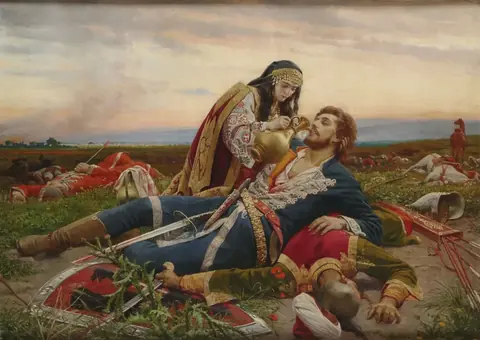 Bayezid takes the throne · 1389Battle of Kosovo
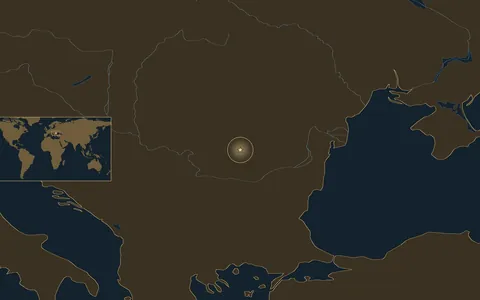 Bayezid in command · 1395Battle of Rovine
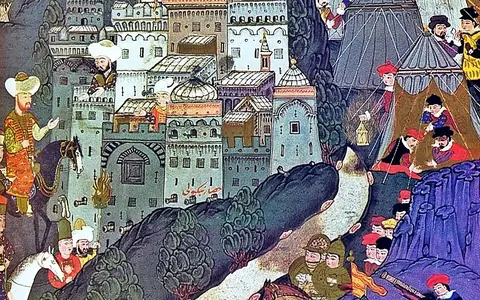 Bayezid in command · 1396Battle of Nicopolis
 Half a century later · 1453The Fall of Constantinople
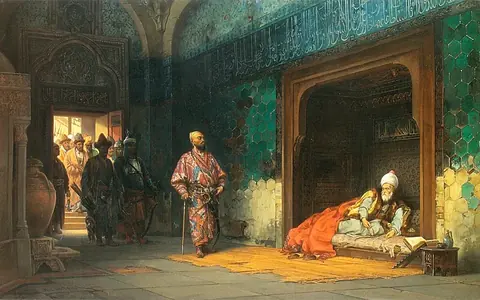 CommanderBayezid I
 CommanderMehmed II the Conqueror
RankingThe Greatest Ottoman Commanders
RankingThe Greatest Battles of the Ottoman Empire
 Guide · 1300 to 1922The Military History of the Ottoman Empire
QuizHow Well Do You Know Ottoman Battles?
Your verdict
For Bayezid
- Anatolia and the Balkans joined in one state in thirteen years
- The crusade of 1396 destroyed at Nicopolis
- A central government and household troops who held at Ankara
- A state that survived his capture and recovered within a generation
For Timur
- Campaigns won from the steppe of the Golden Horde to Delhi, Damascus and Baghdad
- The march to Ankara, which left his enemy without water
- An army that held together under him from 1370 to his death
- Samarkand and a dynasty that ruled Central Asia for a century
- Should one day at Ankara outweigh thirteen years of Bayezid's conquests, or thirty of Timur's?
- Was Ankara lost by Bayezid's march in the heat, or by soldiers whose loyalty he had never won?
- Does a conqueror deserve more credit for a state that outlives his defeat, or for a victory that leaves no state behind?
- How far can we trust a battle told mainly by Timur's panegyrist, Timur's enemy and two Christian witnesses?
- Should the massacres at Sivas, Delhi and Baghdad weigh in judging Timur as a commander, or only as a man?
Cast your vote below and see how other readers have judged them.





