
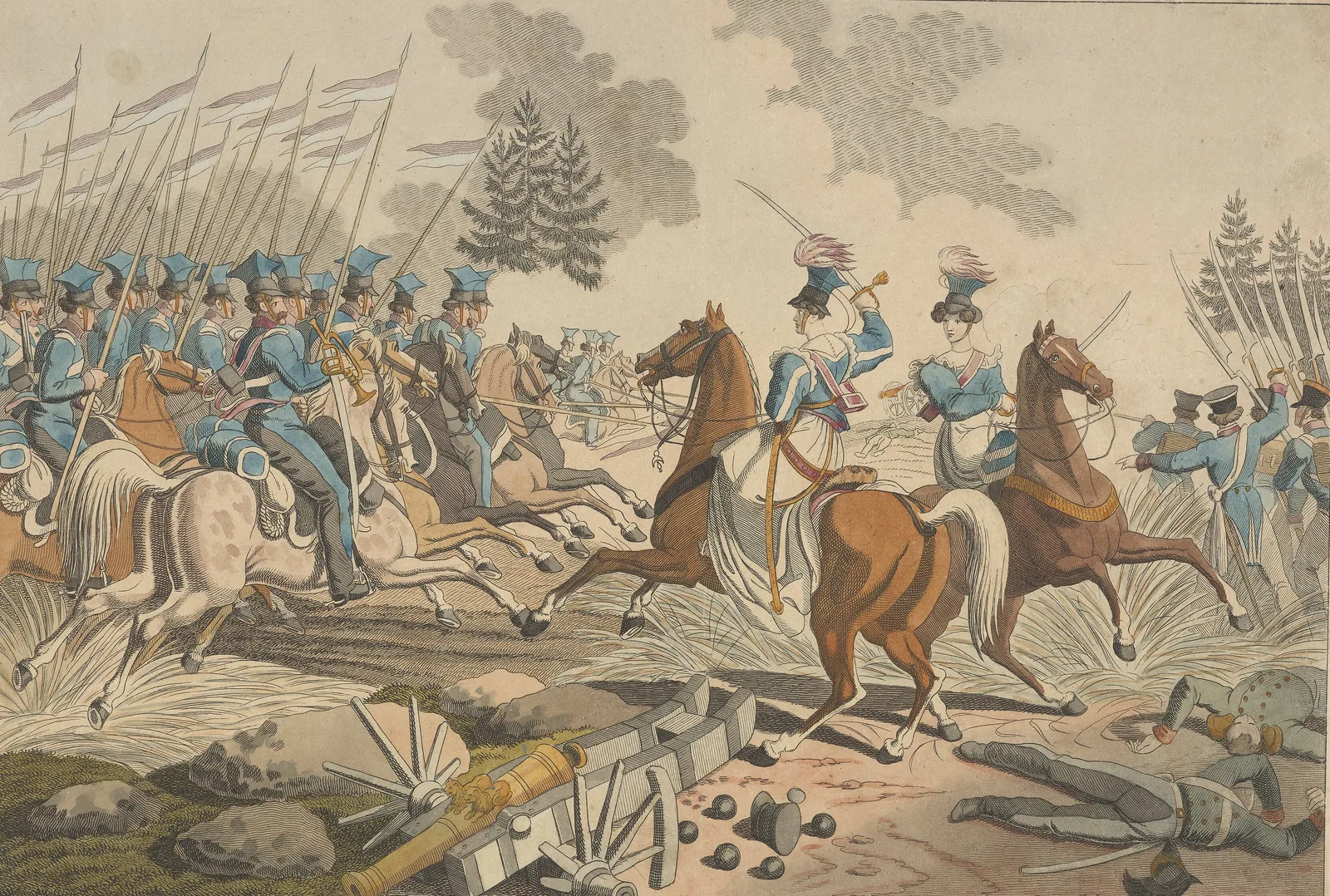
In the spring of 1831 a 24-year-old countess cut her hair, put on a uniform1 and led a band of insurgents against the Russian Empire. Emilia Plater died before the year was out, but she became one of the most celebrated heroines of the Polish struggle for independence.
A young noblewoman
Born in Vilnius in 1806 into the noble Plater family2, Emilia grew up reading about the heroes of Polish history and the women who had fought in earlier wars. She was raised in Livonia and Lithuania, then part of the Russian Empire.

Raising a unit
When the November Uprising broke out in Warsaw in 1830 and spread to Lithuania in 1831, Plater gathered a band of local volunteers, peasants and nobles3, and took part in actions against Russian forces in the region of Dyneburg2, today Daugavpils.

In the regular army
She then joined the Polish forces fighting in Lithuania under General Dezydery Chłapowski. She was given the rank of captain2 and attached to a company of the 25th Infantry Regiment, and fought in several engagements4.

The last march
When the Polish corps in Lithuania decided to cross into Prussia and lay down its arms3, Plater refused to surrender and tried to make her way to Warsaw to continue the fight5. Exhausted and ill, she died at a manor in Justianów at the end of December 18315.

A symbol
Adam Mickiewicz immortalised her in his poem The Death of the Colonel. Plater became a symbol of women in the fight for freedom, and many Polish schools, streets and military units, including a women's battalion in the Second World War6, have borne her name.
Sources and notes
Numbered notes in the text point to the works below.
- Józef Straszewicz, Émilie Plater, sa vie et sa mort, Paris, 1835; English translation: The Life of the Countess Emily Plater, New York, John F. Trow, 1842. ↩
- dzieje.pl (Muzeum Historii Polski), “Emilia Plater (1806-1831)” ↩ a b c
- Instytut Pamięci Narodowej (IPN), “„Jęliśmy się oręża w duchu jedności z Królestwem Polskim”. Powstanie Listopadowe na Litwie” ↩ a b
- Dioniza Wawrzykowska-Wierciochowa, Sercem i orężem Ojczyźnie służyły: Emilia Plater i inne uczestniczki powstania listopadowego 1830-1831 (Wydawnictwo Ministerstwa Obrony Narodowej, 1982). ↩
- dzieje.pl (Muzeum Historii Polski / PAP), “185. rocznica śmierci Emilii Plater” ↩ a b
- Instytut Pamięci Narodowej (IPN), “ul. 1 Batalionu Platerówek” ↩
- Wikipedia, “Emilia Plater”
- Wikipedia, “Emilia Plater”