
The most famous women warriors in history include Boudica, who led a British revolt against Rome in AD 60 or 61, Joan of Arc, who helped lift the siege of Orléans in 1429, Lakshmibai, the Rani of Jhansi, killed fighting the British in 1858, and the Soviet sniper Lyudmila Pavlichenko. Many more served as soldiers, pilots and couriers, often in disguise.
Women have always been part of war, as nurses, spies, couriers and, far too often, victims. Fewer carried weapons in plain sight, and those who did were often written out of the story or turned into legends. This guide gathers ten women warriors whose service can be checked, from a queen who burned Roman London to a Polish courier who crossed occupied Europe more than a hundred times.
We keep record and legend apart: where a story rests on a single chronicle, or a number cannot be verified, we say so.
1. Boudica, queen of the Iceni (AD 60 or 61)
When Prasutagus, king of the Iceni in what is now Norfolk, died around AD 60, Rome treated his kingdom as conquered land. According to Tacitus, his widow Boudica was flogged and her daughters raped. The Iceni rose, joined by their neighbours the Trinovantes, and the revolt burned three Roman towns: Camulodunum (Colchester), Londinium (London) and Verulamium (St Albans). Tacitus puts the dead in these towns at about 70,0001, a figure nobody can check. The governor Suetonius Paulinus finally faced the Britons with about 10,000 men1, at a site that has never been found, and his disciplined legions won. Tacitus says Boudica took poison; Cassius Dio says she fell ill and died.
2. Tomoe Gozen, the samurai of the Heike (1184, semi-legendary)
Almost everything we know about Tomoe comes from the Tale of the Heike, a war epic shaped by storytellers in the century after the Genpei War, so she stands between history and legend. In the tale she rides with Kiso no Yoshinaka, a Minamoto general who sent her out as a leading captain whenever battle was near2. At his last fight near Awazu in 1184 she is among the handful of riders still at his side. Yoshinaka orders her to go, so that no one can say he died with a woman beside him, and she leaves only after one final duel. No document from her own lifetime mentions her, and other versions of the epic tell her fate differently.

3. Joan of Arc, the Maid of Orléans (1429 to 1431)
The best documented woman warrior of the Middle Ages has her own page in our archive. A peasant girl from Domrémy who said the voices of saints had sent her, she joined the army sent to relieve Orléans in the spring of 1429, and within days the English siege was broken. In July she stood near Charles VII at his coronation in Reims. Captured at Compiègne in 1430, she was tried for heresy and burned at Rouen in 1431, aged about 19. The verdict was annulled in 1456 and she was canonised in 1920.
4. Nadezhda Durova, the cavalry maiden (1806 to 1816)
In 1806 Nadezhda Durova, an officer's daughter from the Urals, cut her hair, left home in men's clothes and enlisted in the Russian cavalry as a young nobleman. She fought against Napoleon in 1807 and won the soldier's Cross of St George for saving a wounded officer under fire3. When her secret reached the court, Tsar Alexander I received her in person, allowed her to stay, commissioned her and gave her a new name, Aleksandrov, after his own3. She served for about ten years, was at Borodino in 1812, and retired in 1816. Her memoir, The Cavalry Maiden, appeared in 1836 with help from Pushkin.

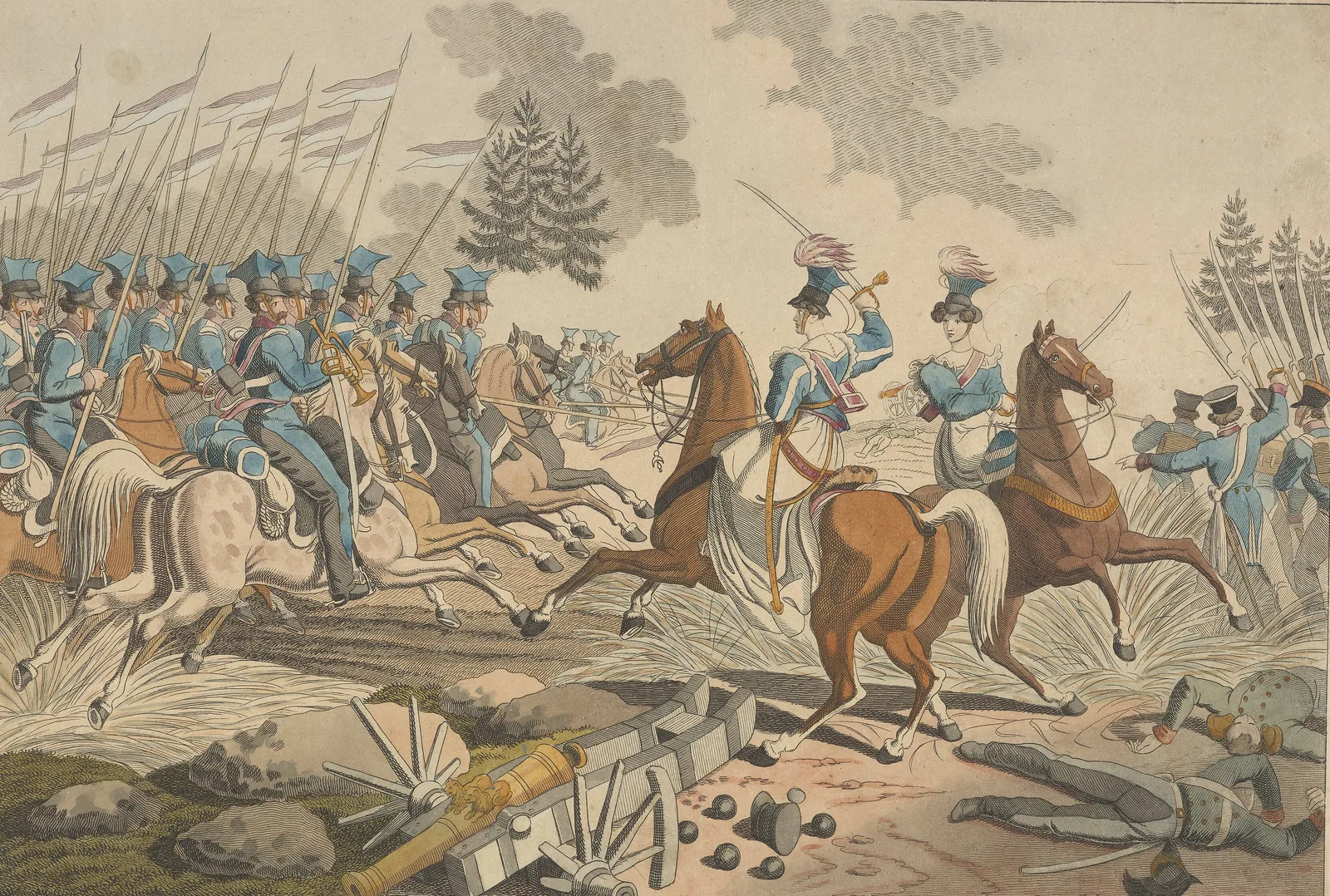
5. Emilia Plater, the countess captain (1831)
In 1831, as the November Uprising against Russia spread to Lithuania, a 24-year-old countess from Vilnius cut her hair, put on a uniform and raised a band of peasants and nobles. Emilia Plater fought near Dyneburg, today Daugavpils, then joined the regular Polish corps under General Dezydery Chłapowski, where she was given the rank of captain in the 25th Infantry Regiment. When the corps decided to cross into Prussia and lay down its arms, she refused to surrender and set out for Warsaw to keep fighting. Exhausted and ill, she died at a manor in Justianów in December 1831.
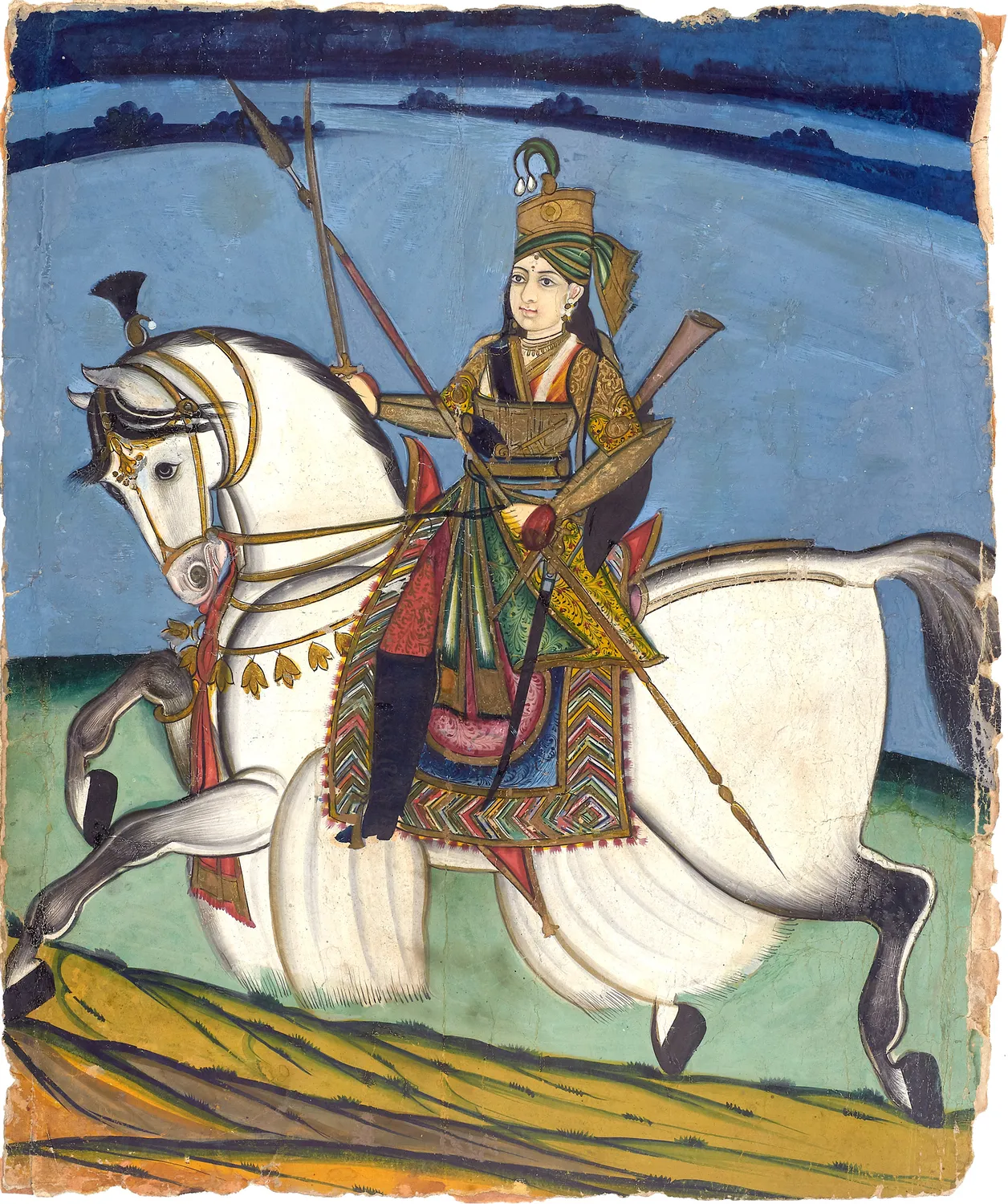
6. Lakshmibai, the Rani of Jhansi (1857 to 1858)
Lakshmibai, born in Varanasi around 1828 (some sources say 1835), became rani of the small state of Jhansi by marriage. After her husband died, the East India Company annexed Jhansi and refused to recognise her adopted son. When the great rising of 1857 spread across northern India, she took charge of Jhansi's defence. The British under Sir Hugh Rose bombarded the fort from 24 March 18584; when the city fell she broke out, fought on at Kalpi and then joined the rebel forces at Gwalior. There she was killed in battle in June 1858, on the 17th or 18th, as accounts differ. The image of her leaping from the walls on horseback with her son on her back is legend; her courage is not.
7. Flora Sandes, sergeant of the Serbian infantry (1915 to 1919)
Flora Sandes was a 38-year-old English vicar's daughter when she sailed for Serbia in August 1914 with a volunteer ambulance unit. During the Serbian army's terrible winter retreat of 1915 she drifted from nursing into the ranks of the 2nd Infantry Regiment, and she stayed. She fought as an ordinary soldier, was badly wounded by a grenade in close fighting in 19165, rose to sergeant major and in 1919 was commissioned as a captain. She is usually described as the only British woman to serve officially as a soldier5 in the First World War. In the next war, living in Belgrade, she survived a spell in a Gestapo prison.
8. Lyudmila Pavlichenko, the sniper of Sevastopol (1941 to 1942)
Lyudmila Pavlichenko was a 24-year-old history student from Kiev when Germany invaded in June 1941. She fought at Odessa and then through the long siege of Sevastopol. Soviet records credit her with 309 kills6, the highest tally of any woman sniper; like most wartime sniper scores it cannot be independently checked, and some historians treat it with caution. Wounded and withdrawn from the front, she was sent to the United States in 1942, became the first Soviet citizen received at the White House6, and toured the country with Eleanor Roosevelt. Asked whether Soviet women could wear make-up at the front, she answered: "who has time to think of her shiny nose6 when a battle is going on?"

9. The Night Witches, the 588th Night Bomber Regiment (1942 to 1945)
In October 1941 the famous aviator Marina Raskova won permission to form women's air regiments. The best known, the 588th Night Bomber Regiment, flew the Polikarpov Po-2, a slow wood-and-fabric biplane built as a trainer, with a pilot and a navigator in open cockpits. Its crews, many of them students, attacked German positions in the dark, often gliding in with the engine idling; the Germans called them the Nachthexen, the night witches. Crews flew from eight to 18 sorties a night7. In February 1943 the regiment became the 46th Guards, and 23 or 24 of its women, depending on the count7, were made Heroes of the Soviet Union.
10. Elżbieta Zawacka "Zo", the courier (1939 to 1945)
Elżbieta Zawacka, a mathematics teacher from Toruń, spent the war as a courier of the Polish underground and crossed frontiers illegally more than a hundred times with reports and money. In February 1943 she set out as an emissary of the Home Army command, through Germany, France, Andorra, Spain and Gibraltar, and reached London on 1 May 1943 to brief the government in exile. She then trained with the parachute commandos and on the night of 9 to 10 September 1943 jumped back into occupied Poland, the only woman among the Cichociemni8, the "Silent Unseen". She fought in the Warsaw Uprising, was jailed by the communist authorities from 1951 to 1955, and in 2006 was promoted to brigadier general. She died in 2009, aged 99.
Why they still matter
No single mould fits these women. Boudica and Lakshmibai led their people against an empire; Durova and Plater broke the rules to serve; Sandes and Zawacka simply refused to stay behind. What links them is that each had to prove, again and again, that she belonged where the fighting was, and that most of the women who did the same left no trace in the records at all.
A note on legend: Hua Mulan, the girl who took her father's place in the army, comes from a Chinese ballad, not from any record, and is best enjoyed as the poem it is. For more courage under fire, see the greatest last stands in history.