

What was the Pacific War?
The Pacific War was the part of World War II fought between the Empire of Japan and the Allies across the Pacific Ocean, East Asia and Southeast Asia from December 1941 to September 1945. Japan, already at war with China, attacked American, British and Dutch territories, conquered a vast area by June 1942, was checked at the Coral Sea and Midway, and was pushed back island by island until it accepted the Allied terms on 14 August 1945 and signed the surrender on 2 September.1
For Americans the war began at Pearl Harbor on the morning of Sunday 7 December 1941. On the other side of the International Date Line it was already 8 December when Japanese forces struck Wake Island, Guam, the Philippines, British Malaya and Hong Kong and invaded Thailand. The next day Canada, the Dutch government in exile, the United States and Britain declared war on Japan, and for almost four years the war was fought on land, at sea and in the air across a third of the globe.2
Causes: China, oil and a gamble on a short war
Japan had been at war with China since 1937, when fighting near Beijing grew into a full-scale Chinese resistance to Japanese expansion that had begun in Manchuria in 1931. Japanese armies took most of China's ports and great cities, but the Chinese did not yield, and the war dragged on far beyond Japan's expectations. By December 1941 Japan was fighting a war it could not end.3
The road to the wider war ran through Indochina. Japan occupied northern French Indochina in 1940 and in July 1941 announced a joint protectorate over the whole colony. The United States answered by freezing Japanese assets and embargoing oil, which left Tokyo with a hard choice: withdraw from Indochina, and perhaps China, or seize the oil fields of the Dutch East Indies. Talks with Washington failed in the autumn, and the government of General Tojo Hideki chose war.4
Japan's leaders did not expect to defeat the United States outright. In the reading of the U.S. Navy's historians they aimed at a negotiated end to the war on terms as favorable to Japan as possible, and Admiral Yamamoto Isoroku planned the strike on Pearl Harbor to cripple the Pacific Fleet and force Washington to talk. The plan was to seize the oil, rubber and other raw materials of Southeast Asia, ring them with a fortified perimeter of islands, and hold it. Officially the conquests were to form a "new order in East Asia" free of the old colonial masters, but Britannica notes that the slogan "East Asia for the Asiatics" came to mean East Asia for the Japanese.5
The sides
One side was the Empire of Japan. The other was not the United States alone but a coalition. The National Army Museum stresses the British, Indian and other Commonwealth troops who fought in Malaya, Burma and India, and the Imperial War Museums point out that Burma was the longest British land campaign of World War II. Filipino soldiers of the Philippine Commonwealth made up most of the force on Bataan. Australian troops, in the Australian War Memorial's words, bore the brunt of the fighting in Papua and New Guinea in 1942 and 1943. The Dutch fought for their East Indies colony, and NIOD, the Dutch war institute, counts 42,233 prisoners of war taken there. China's Nationalists under Chiang Kai-shek and the Chinese Communists, allied against Japan in a United Front, tied down Japanese armies throughout. The Soviet Union declared war on Japan only on 8 August 1945 and invaded Manchuria the next day.6
Command was divided too. In the spring of 1942 the U.S. Joint Chiefs split the Pacific into two theaters: General Douglas MacArthur became supreme commander of the Southwest Pacific Area, covering Australia, the Philippines, the Dutch East Indies and the Solomons, and Admiral Chester W. Nimitz commander in chief of the Pacific Ocean Areas, most of the rest. Japan's Combined Fleet was led by Yamamoto until 1943. Read more in our page on the commanders of the Pacific War.7
Japan's offensive, December 1941 to mid-1942
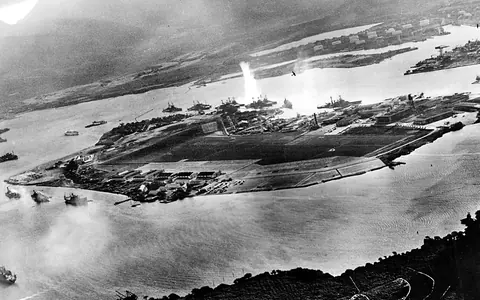
Just before 8 a.m. on 7 December, at 7.55 local time, aircraft from Japanese carriers fell on the U.S. Pacific Fleet at Pearl Harbor on Oahu. The Naval History and Heritage Command counts 2,403 Americans killed or missing (2,008 Navy, 109 Marine Corps, 218 Army and 68 civilians) against fewer than 100 Japanese men and 29 aircraft. Yet the attack missed its main prey: none of the fleet's three aircraft carriers was in harbor, and the fuel tanks were left intact. Read more in our article on the attack on Pearl Harbor.8

The other blows fell within hours. Japanese troops landed in Thailand and northern Malaya and drove down the peninsula; the outposts of Wake Island, Guam and Hong Kong were overwhelmed. On 15 February 1942 Lieutenant General Arthur Percival surrendered Singapore, Britain's main base in the region. The Imperial War Museums put his force at 85,000 men, defeated by about 35,000 Japanese, and the National Army Museum counts about 130,000 British, Indian and Commonwealth soldiers captured in Malaya and Singapore, the largest capitulation in British history in Churchill's words. Rangoon fell in early March, and so did the Dutch East Indies after the naval defeats in the Makassar Strait and the Java Sea.9
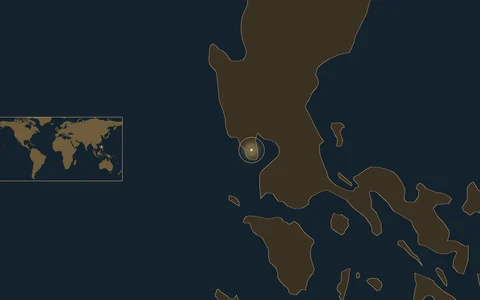
In the Philippines Filipino and American troops fell back to the Bataan peninsula and the island fortress of Corregidor. When Bataan surrendered on 9 April 1942, more than 70,000 men became prisoners, by PBS's count, while the exhibition of the Filipino veterans' project Duty to Country puts the number who began the march into captivity at 76,000, 64,000 of them Filipinos. On the Bataan Death March thirst, starvation, beatings and killings took thousands of lives: between 5,000 and 11,000 never reached Camp O'Donnell according to PBS, and between 7,000 and 10,000 died on the way according to Duty to Country. Corregidor held out until 6 May. See our articles on Bataan and Corregidor.10

Turning points, 1942 to 1943
By June 1942 Japan held a vast area of Southeast Asia and the western Pacific, but the Allies showed no interest in a negotiated peace, so Tokyo decided to push its perimeter further, toward Port Moresby in New Guinea and Midway. In the Battle of the Coral Sea in early May, the first fought entirely between carrier aircraft, U.S. planes sank the light carrier Shoho and crippled the Shokaku, while Japanese aircraft sank the USS Lexington and damaged the Yorktown. Both sides suffered heavy losses, but the invasion force bound for Port Moresby turned back: in the National WWII Museum's words, the U.S. Navy had checked a major Japanese offensive for the first time.11
A month later came the Battle of Midway. In early June 1942 U.S. carrier aircraft sank four Japanese fleet carriers, and with them Japan lost many of its best trained naval pilots. The National WWII Museum counts about 3,057 Japanese and 307 American dead. After Midway, Britannica notes, Japan's naval leaders secretly concluded that their chances of victory were poor; most historians treat the battle as the turning point of the war in the Pacific.12

On land the Japanese tried to take Port Moresby by another route. Their landing at Milne Bay was thrown back in August and September 1942, and their drive across the mountains on the Kokoda Trail was halted in desperate fighting by Australian troops; American and Australian forces then destroyed the Japanese beachheads at Buna and Gona by January 1943.13
The Allies' first major counterstroke came in the Solomon Islands. On 7 August 1942 U.S. Marines landed on Guadalcanal to seize an airfield site that threatened the supply route to Australia and New Zealand. The struggle for that airfield, Henderson Field, brought seven major naval battles, three major land battles (among them the Tenaru) and almost constant air combat, and lasted until the Japanese withdrew their last troops in February 1943. The National WWII Museum puts the cost of the Solomons campaign at about 7,100 Allied and 31,000 Japanese dead.14
The Allied advance, 1943 to 1944
After Guadalcanal the Allies did not storm every Japanese stronghold. Instead of invading the great base at Rabaul, they cut it off from the air and sea and seized lightly defended islands that could support the next advance, a method that became known as island hopping. Admiral William Halsey's forces moved up the Solomons while MacArthur's pushed along the coast of New Guinea, and in the central Pacific U.S. forces took the Gilbert Islands (Tarawa and Makin), the Marshalls (Kwajalein and Eniwetok) and the Marianas (Saipan, Guam and Tinian).15
The Marianas were decisive. The capture of Saipan in July 1944 put the Japanese home islands within range of the new B-29 bombers for the first time, and in Tokyo the fall of the island brought down the cabinet of General Tojo.16
On 20 October 1944, two and a half years after he had left Bataan, MacArthur returned to the Philippines at Leyte. The Japanese navy threw almost everything it had left against the landings, and in the Battle of Leyte Gulf of 23 to 26 October, which the National WWII Museum calls the largest naval battle in history, U.S. forces effectively destroyed the offensive power of the Combined Fleet. Leyte also saw the first organized kamikaze attacks, suicide flights that in the last months of the war claimed thousands of Allied lives. The campaign to retake the Philippines went on into 1945, through the ruinous fighting for Manila.17
On the Asian mainland the war went on in Burma. In March 1944 the Japanese 15th Army advanced into north-east India to forestall a British offensive; its defeat at Imphal and Kohima, in the National Army Museum's words, became the springboard for the reconquest of Burma, and Rangoon was retaken in early May 1945. Britannica calls Burma a peripheral theater of the Pacific War, where the Allies pressed their advantage in 1945.18
1945: Iwo Jima, Okinawa and the bombing of Japan
On 19 February 1945 U.S. Marines landed on Iwo Jima, a volcanic island halfway between the Marianas and Japan. Its more than 20,000 defenders under Lieutenant General Kuribayashi Tadamichi had built underground positions in natural caves and rough terrain, and the battle lasted 36 days, until the island was declared secure on 26 March. Only 216 Japanese were taken prisoner; the rest of the garrison died. American losses are counted differently by different institutions: the National WWII Museum gives 6,821 killed and 19,217 wounded among the landing forces, while the National Museum of the Marine Corps counts 5,931 Marines killed, died of wounds or missing, plus 209 Navy corpsmen and surgeons.19
From the Marianas the B-29s changed tactics, from high-altitude daylight raids to low-level night attacks with napalm firebombs. The first, on the night of 9 to 10 March 1945, burned out about a quarter of Tokyo's buildings; Britannica puts the dead at more than 80,000, the Naval History and Heritage Command at an estimated 100,000. Similar raids followed on Nagoya, Osaka, Kobe, Yokohama and other cities, and in the Imperial War Museums' summary Japan's cities suffered unprecedented destruction from conventional bombing.20
On 1 April 1945 U.S. Army troops and Marines landed on Okinawa, the largest amphibious operation the Americans mounted in the Pacific. Lieutenant General Ushijima Mitsuru let them ashore and fought inland, and organized resistance ended only after his suicide; the island was declared secure on 22 June. Taking it cost the Americans about 12,000 dead and 36,000 wounded in Britannica's figures (the National WWII Museum gives 12,520 killed or missing and 36,631 wounded). Some 110,000 Japanese soldiers and conscripted Okinawan defenders were killed. The toll among Okinawa's civilians cannot be known exactly: some estimates exceed 100,000, and the Naval History and Heritage Command blames the high civilian death rate on Japan's total mobilization, the coercion of the population and propaganda, which drove some to suicide.21

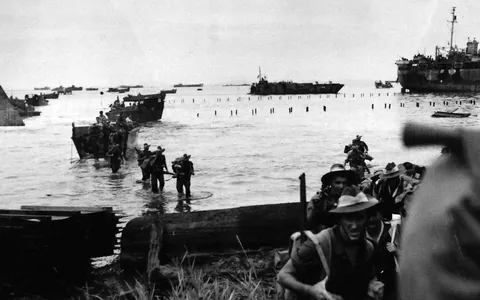
Australian troops fought the last campaigns in the south. On 1 May 1945 a brigade of the Australian 9th Division landed on Tarakan off Borneo, with a company of 140 Dutch colonial (KNIL) soldiers as scouts and interpreters, and further landings followed at Brunei Bay and Balikpapan. The Australian War Memorial notes that Australian forces were more heavily engaged in 1945 than in any other year of the war, though the value of these operations was debated even then.22

Surrender
On 26 July 1945 the Potsdam Declaration called again for Japan's unconditional surrender, with the loss of all territory outside the home islands, complete disarmament and Allied occupation; Japan rejected it. On 6 August a B-29 dropped an atomic bomb on Hiroshima: Britannica puts the number killed instantly at some 70,000, the Naval History and Heritage Command estimates 90,000 to 120,000 dead. On 8 August the Soviet Union declared war and the next day invaded Manchuria, and on 9 August a second bomb fell on Nagasaki, killing about 40,000 people instantly in Britannica's account, with tens of thousands more dying later of radiation.23
Even then Japan's Supreme Council could not agree. The deadlock was broken by Emperor Hirohito, who insisted on surrender once the Allies had agreed to respect the will of the Japanese people on the future of the throne. Japan accepted the Allied terms on 14 August (15 August in Japan), when the emperor's recorded broadcast told his subjects. The formal surrender was signed on 2 September 1945 aboard the battleship USS Missouri in Tokyo Bay: the Japanese delegates signed first, then General MacArthur as Supreme Commander for the Allied Powers, Fleet Admiral Nimitz for the United States and eight other officers for the Allies. The U.S. Navy's museum counts the Pacific War as having lasted 1,364 days, five hours and 44 minutes.24
Why Japan surrendered when it did is still argued. The U.S. Strategic Bombing Survey concluded in 1946 that Japan would have surrendered before the end of 1945, and in all probability before 1 November, even without the atomic bombs, the Soviet entry or an invasion, and Britannica notes that postwar investigators found neither the bombs nor the Soviet declaration central to the decision, though both probably advanced its date, while the submarine blockade had already brought economic defeat. Others point to the invasion that did not have to happen: planners projected perhaps a quarter of a million casualties or more for Operations Olympic and Coronet, according to the Naval History and Heritage Command, and the National WWII Museum cites predictions of well over 400,000.25
Prisoners, civilians and war crimes
Under Japanese occupation prisoners of war and enslaved civilians were forced to work for their captors in harsh and often inhuman conditions. Prisoners were moved by sea in unmarked transports known as hell ships: the historian Gregory Michno, cited by the National WWII Museum, estimates that more than 125,000 prisoners made such voyages and more than 21,000 died on them, some of them killed by Allied attacks on ships that did not show they carried prisoners.26
Civilians were interned too. The Imperial War Museums count more than 130,000 Allied civilians interned in East Asia, most of them Dutch from the Netherlands East Indies, of whom more than 14,000 died. NIOD, the Dutch institute for war studies, regards about 100,000 Dutch internees in the East Indies as the most reliable estimate, with deaths estimated at between 10,580 and 16,800. The Bataan Death March and other atrocities led to war crimes charges against Japanese officers after the war, and the Tokyo trials convicted leaders such as General Umezu Yoshijiro and Foreign Minister Togo Shigenori, both of whom died in prison.27
Key figures
Japan. Admiral Yamamoto Isoroku, commander in chief of the Combined Fleet, planned both Pearl Harbor and Midway. General Tojo Hideki led the government that went to war and fell after Saipan. Lieutenant General Kuribayashi Tadamichi defended Iwo Jima and Lieutenant General Ushijima Mitsuru Okinawa. Admiral Suzuki Kantaro, prime minister from April 1945, saw his task, in Britannica's phrase, as not whether to end the war but how; the Strategic Bombing Survey describes his government's mission as making peace.28
The Allies. Douglas MacArthur commanded in the Southwest Pacific and returned to the Philippines in 1944. Chester W. Nimitz led the Pacific Ocean Areas, and William Halsey the advance up the Solomons. Jonathan Wainwright took over in the Philippines when MacArthur left for Australia, surrendered Corregidor and spent the rest of the war as a prisoner. On the British side William Slim led the army that retook Burma.29
Outcome and legacy
The Allies won. Japan lost every territory outside its home islands and came under an American-led occupation, which in the Imperial War Museums' assessment transformed Japanese society. Its navy and merchant fleet had been destroyed; the U.S. Navy's historians count 334 of the 611 vessels of the Imperial Japanese Navy lost, and Britannica credits the submarine blockade with the economic defeat that cut Japan off from its new empire.30
The war is remembered very differently on each shore of the Pacific. In the United States the National Museum of the Pacific War stands in Fredericksburg, Texas, at the boyhood home of Fleet Admiral Nimitz, and presents itself as the country's most comprehensive account of World War II in the Asiatic-Pacific theater; its grounds include a Japanese Garden of Peace. Okinawa's dead, soldiers and civilians of every side, are counted at more than 240,000 by the National WWII Museum, and the debate over the atomic bombings, the invasion that never came and the treatment of prisoners has never closed.31
Battles of the Pacific War
Our articles on the battles of the Pacific War are listed below in date order, from Pearl Harbor and Hong Kong to Okinawa and Tarakan. For a ranked selection, see our greatest battles of the Pacific War.
- 1941The Attack on Pearl Harbor, 1941Empire of Japan vs United States
How a surprise strike on 7 December 1941 pulled the United States into the Second World War.
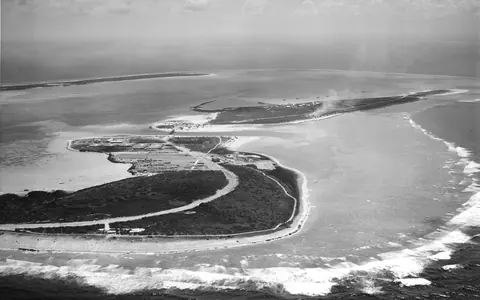
- 1941Battle of Wake Island, 1941United States vs Empire of Japan
In December 1941 Marines, sailors and civilians on Wake beat off a Japanese landing and sank two destroyers before a second assault took the atoll.
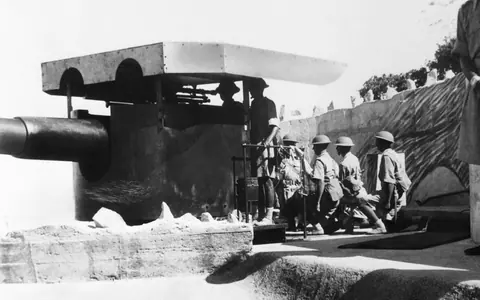
- 1941Battle of Hong Kong, 1941British Empire (British, Canadian, Indian and local Hong Kong forces) vs Empire of Japan
From 8 to 25 December 1941 British, Canadian, Indian and local troops held Hong Kong against Japan's 23rd Army, until the colony surrendered on Christmas Day.
- 1942Battle of Bataan, 1942United States and Philippine Commonwealth vs Empire of Japan
From January to April 1942 Filipino and American troops held the Bataan peninsula against Japan's 14th Army, until hunger and disease forced their surrender.
- 1942Battle of Makassar Strait, 1942ABDA naval force (Netherlands, United States) vs Empire of Japan
On 4 February 1942 Japanese bombers caught Doorman's Dutch and American cruisers on their way to the Makassar Strait. Marblehead was crippled, Houston lost a turret and the raid was called off.
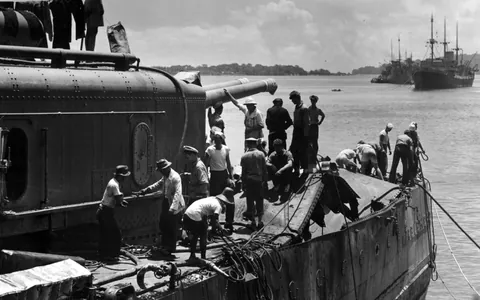
- 1942The Guadalcanal Campaign, 1942 to 1943Allies (United States, with Australia) vs Empire of Japan
Six months of land, sea and air battles for one jungle airfield turned the Pacific War.
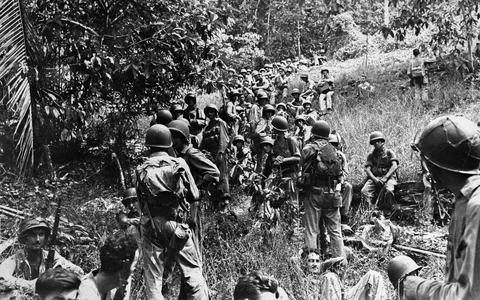
- 1942Battle of the Java Sea, 1942Empire of Japan vs ABDA Combined Striking Force
On 27 February 1942 Karel Doorman led a mixed Allied squadron out of Surabaya to stop the invasion of Java. By midnight he had lost two cruisers, three destroyers and his life, and the convoy sailed on.
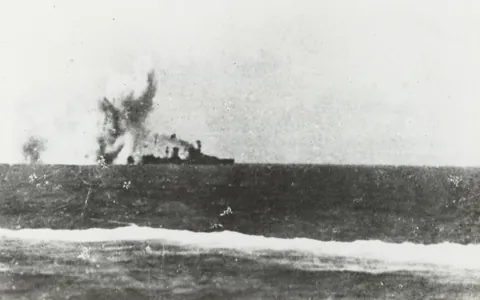
- 1942Second Battle of the Java Sea, 1942Empire of Japan vs United Kingdom and United States
On 1 March 1942 the crippled cruiser Exeter and two destroyers tried to escape from Java. Four Japanese heavy cruisers caught them north of the island, and by afternoon all three ships were gone.
- 1942Battle of Corregidor, 1942United States and Philippine Commonwealth vs Empire of Japan
In May 1942 Japanese troops stormed Corregidor, the fortress island at the mouth of Manila Bay, and Wainwright surrendered; Americans retook it in 1945.
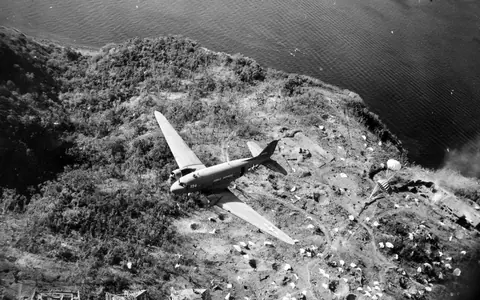
- 1942The Battle of the Coral Sea, 1942Allies (United States and Australia) vs Empire of Japan
The first carrier duel in history, fought entirely by aircraft over the horizon.
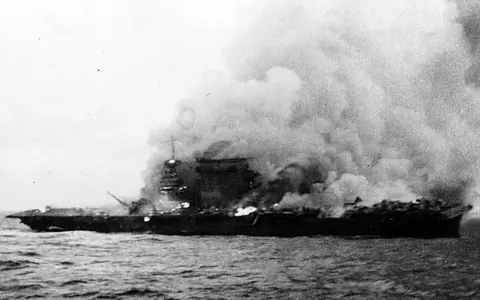
- 1942The Battle of Midway, 1942United States vs Empire of Japan
Broken codes, an ambush, and five minutes of dive bombers that sank four Japanese carriers and turned the Pacific.
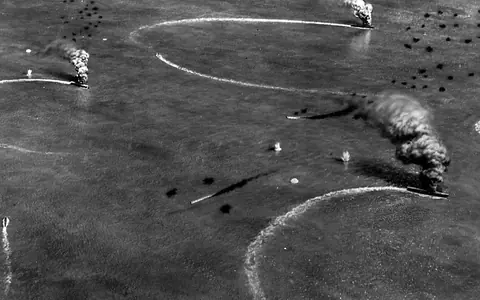
- 1942Battle of the Tenaru, 1942United States vs Empire of Japan
On 21 August 1942 Colonel Ichiki's detachment charged the Marine line at the mouth of the Ilu on Guadalcanal and was wiped out in a single day.
- 1942Carlson's Long Patrol, 1942United States Marine Corps vs Empire of Japan
From 6 November to 4 December 1942 Carlson's raiders hunted retreating Japanese through Guadalcanal's jungle: 150 miles, a dozen fights, and a heavy toll from disease.
- 1943Battle of the Komandorski Islands, 1943United States vs Empire of Japan
On 26 March 1943 a small US force fought Japan's Fifth Fleet for hours in the Bering Sea. Salt Lake City was stopped dead in the water, yet the Japanese turned away and took their convoy home.
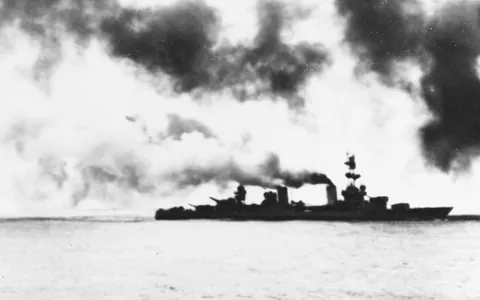
- 1943The Battle of Tarawa, 1943United States (Marines) vs Empire of Japan
Seventy-six hours on a tiny atoll, and the bloody schooling of amphibious war.
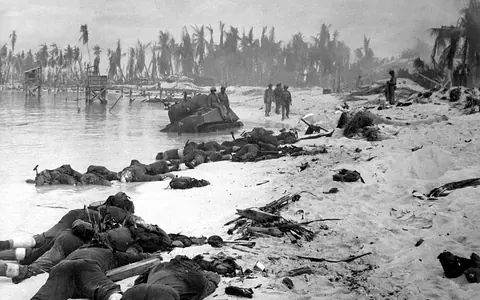
- 1944The Battle of Peleliu, 1944United States (Marines and Army) vs Empire of Japan
Promised as a three-day fight, Peleliu became two months of agony on Bloody Nose Ridge.
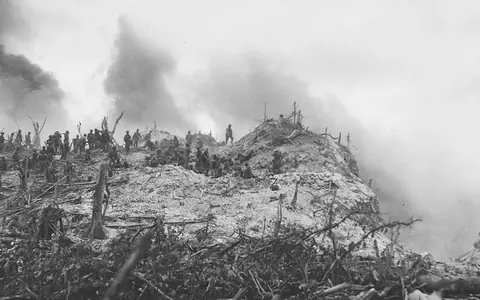
- 1944Battle of Leyte Gulf, 1944United States and Australia vs Empire of Japan
The largest naval battle in history, four huge actions off the Philippines that broke the Imperial Japanese Navy.
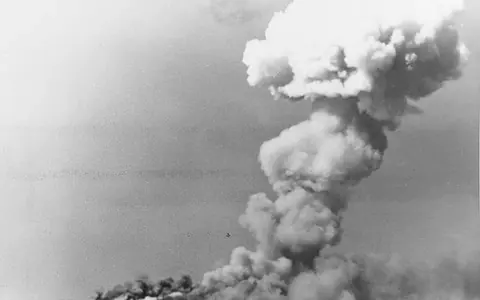
- 1945Battle of Manila, 1945United States and Philippine Commonwealth vs Empire of Japan
From 3 February to 3 March 1945 US and Filipino forces retook Manila from Iwabuchi's garrison. Intramuros was razed and about 100,000 civilians died.
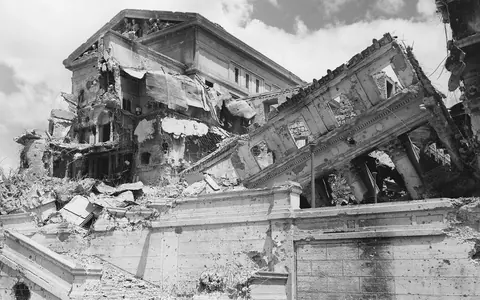
- 1945Battle of Iwo Jima, 1945United States vs Empire of Japan
How US Marines took Iwo Jima in 1945 in one of the Pacific war's bloodiest battles.
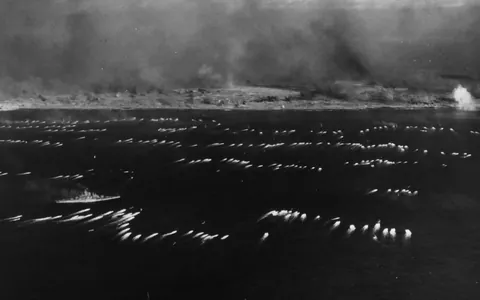
- 1945The Battle of Okinawa, 1945United States (with Allies) vs Empire of Japan
The bloodiest battle of the Pacific, and its cost shaped how the war with Japan ended.
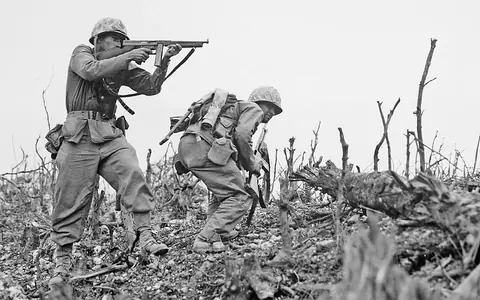
- 1945Battle of Tarakan, 1945Australia, with U.S. and Dutch forces vs Empire of Japan
On 1 May 1945 the 26th Australian Brigade landed on Tarakan to seize an airfield for the Borneo campaign. It took the island at a cost of 225 dead; the strip opened seven weeks late.
Timeline
- 1937Fighting near Beijing grows into full-scale war between Japan and China.32
- 1941In July Japan moves into southern Indochina; the United States freezes Japanese assets and embargoes oil.33
- 19417 December (8 December in East Asia): Japan attacks Pearl Harbor, Malaya, Hong Kong, Guam, Wake and the Philippines.34
- 194215 February: Singapore surrenders; Rangoon and the Dutch East Indies fall in early March.35
- 19429 April: Bataan surrenders and the Death March begins; Corregidor falls on 6 May.36
- 1942May: Battle of the Coral Sea; June: Japan loses four carriers at Midway.37
- 19427 August: U.S. Marines land on Guadalcanal; the Japanese withdraw in February 1943.38
- 1944July: Saipan falls and the B-29s come within range of Japan; October: Battle of Leyte Gulf.39
- 194519 February to 26 March: Iwo Jima; 9 to 10 March: firebombing of Tokyo.40
- 19451 April: landings on Okinawa, declared secure on 22 June; 1 May: Australians land on Tarakan.41
- 19456 and 9 August: atomic bombs on Hiroshima and Nagasaki; 8 August: the Soviet Union declares war.42
- 194514 August (15 August in Japan): Japan accepts the Allied terms; 2 September: surrender signed aboard USS Missouri.43
Where to read next
For the wider war, see our page on World War II and our ranking of the greatest battles of World War II. The Pacific has its own ranking of its greatest battles and a guide to its commanders; read also about the Doolittle Raid and the Aleutian Islands campaign, and test yourself with the World War II battles quiz.
Notes
A number in the text points to a note; each note names the works that paragraph draws on, listed in full under Sources.
- Imperial War Museums, “A guide to Japan's role in World War Two”; Encyclopaedia Britannica, “Japan”; The National WWII Museum, “The Pacific Strategy, 1941 to 1944”. ↩
- Encyclopaedia Britannica, “Timeline of World War II”; Imperial War Museums, “A guide to Japan's role in World War Two”; National Army Museum, “The Far East campaign”. ↩
- Encyclopaedia Britannica, “Second Sino-Japanese War”; National Army Museum, “The Far East campaign”; Imperial War Museums, “A guide to Japan's role in World War Two”. ↩
- Encyclopaedia Britannica, “Japan”; National Army Museum, “The Far East campaign”; Imperial War Museums, “A guide to Japan's role in World War Two”. ↩
- Naval History and Heritage Command, “H-Gram 053-2”; The National WWII Museum, “The Battle of Midway”; National Army Museum, “The Far East campaign”; Encyclopaedia Britannica, “Japan”. ↩
- National Army Museum, “The Far East campaign”; Imperial War Museums, “A guide to Japan's role in World War Two”; Duty to Country, “Bataan and Corregidor”; PBS, “The Siege of Bataan”; Australian War Memorial, “The Final Campaigns”; NIOD Institute for War, “The Japanese occupation and Pacific War (in numbers)”; Encyclopaedia Britannica, “Second Sino-Japanese War”; Encyclopaedia Britannica, “Japan”; Naval History and Heritage Command, “Japan's Surrender and Aftermath, August to October 1945”. ↩
- Encyclopaedia Britannica, “Pacific War”; The National WWII Museum, “The Pacific Strategy, 1941 to 1944”; The National WWII Museum, “Battle of Midway (topic page)”. ↩
- Imperial War Museums, “A guide to Japan's role in World War Two”; Naval History and Heritage Command, “Pearl Harbor Attack”; The National WWII Museum, “Pearl Harbor Attack, December 7, 1941”. ↩
- Encyclopaedia Britannica, “Timeline of World War II”; National Army Museum, “The Far East campaign”; Imperial War Museums, “A guide to Japan's role in World War Two”; Encyclopaedia Britannica, “Japan”. ↩
- PBS, “The Siege of Bataan”; Duty to Country, “Bataan and Corregidor”; EBSCO Research Starters, “Bataan Death March”; Encyclopaedia Britannica, “Japan”. ↩
- Imperial War Museums, “A guide to Japan's role in World War Two”; Encyclopaedia Britannica, “Pacific War”; Encyclopaedia Britannica, “Timeline of World War II”; The National WWII Museum, “The Pacific Strategy, 1941 to 1944”. ↩
- Encyclopaedia Britannica, “Timeline of World War II”; The National WWII Museum, “The Pacific Strategy, 1941 to 1944”; The National WWII Museum, “Battle of Midway (topic page)”; Encyclopaedia Britannica, “Japan”. ↩
- National Army Museum, “The Far East campaign”; Australian War Memorial, “The Final Campaigns”; The National WWII Museum, “The Pacific Strategy, 1941 to 1944”. ↩
- The National WWII Museum, “The Battle of Guadalcanal”; The National WWII Museum, “The Pacific Strategy, 1941 to 1944”; The National WWII Museum, “The Solomon Islands Campaign”; Encyclopaedia Britannica, “Japan”. ↩
- The National WWII Museum, “The Pacific Strategy, 1941 to 1944”; The National WWII Museum, “The Solomon Islands Campaign”. ↩
- The National WWII Museum, “How Long Will the War in the Pacific Last?”; Encyclopaedia Britannica, “Japan”; The National WWII Museum, “The Pacific Strategy, 1941 to 1944”. ↩
- The National WWII Museum, “How Long Will the War in the Pacific Last?”; Encyclopaedia Britannica, “Timeline of World War II”; The National WWII Museum, “The Battle of Leyte Gulf”; Imperial War Museums, “A guide to Japan's role in World War Two”; Encyclopaedia Britannica, “Pacific War”. ↩
- National Army Museum, “The Far East campaign”; Imperial War Museums, “A guide to Japan's role in World War Two”; Encyclopaedia Britannica, “Pacific War”. ↩
- Encyclopaedia Britannica, “World War II”; The National WWII Museum, “Battle of Iwo Jima”; National Museum of the Pacific War, “The Battle of Iwo Jima”; National Museum of the Marine Corps, “Battle of Iwo Jima”. ↩
- Encyclopaedia Britannica, “World War II”; Naval History and Heritage Command, “Japan's Surrender and Aftermath, August to October 1945”; Imperial War Museums, “A guide to Japan's role in World War Two”. ↩
- Encyclopaedia Britannica, “Timeline of World War II”; Encyclopaedia Britannica, “World War II”; The National WWII Museum, “Okinawa”; Naval History and Heritage Command, “Japan's Surrender and Aftermath, August to October 1945”. ↩
- Encyclopaedia Britannica, “Pacific War”; Australian War Memorial, “Allies in adversity”; Australian War Memorial, “The Final Campaigns”. ↩
- Naval History and Heritage Command, “Japan's Surrender and Aftermath, August to October 1945”; Encyclopaedia Britannica, “Japan”; Naval History and Heritage Command, “H-Gram 053-2”; Encyclopaedia Britannica, “Timeline of World War II”. ↩
- Encyclopaedia Britannica, “Japan”; Naval History and Heritage Command, “H-Gram 053-2”; Naval History and Heritage Command, “Homeward Bound”; National Museum of the U.S. Navy, “Formal Japanese Surrender”; National Museum of the U.S. Navy, “Japanese Surrender”; Encyclopaedia Britannica, “Timeline of World War II”. ↩
- United States Strategic Bombing Survey, “Japan's Struggle to End the War”; Encyclopaedia Britannica, “Japan”; Naval History and Heritage Command, “Homeward Bound”; The National WWII Museum, “How Long Will the War in the Pacific Last?”. ↩
- Imperial War Museums, “A guide to Japan's role in World War Two”; The National WWII Museum, “Japanese Hell Ships of World War II”. ↩
- Imperial War Museums, “A short history of civilian internment camps in the Far East”; NIOD Institute for War, “The Japanese occupation and Pacific War (in numbers)”; EBSCO Research Starters, “Bataan Death March”; Naval History and Heritage Command, “H-Gram 053-2”. ↩
- The National WWII Museum, “Battle of Midway (topic page)”; Naval History and Heritage Command, “H-Gram 053-2”; Encyclopaedia Britannica, “Japan”; Encyclopaedia Britannica, “World War II”; United States Strategic Bombing Survey, “Japan's Struggle to End the War”. ↩
- Encyclopaedia Britannica, “Pacific War”; The National WWII Museum, “The Pacific Strategy, 1941 to 1944”; PBS, “The Siege of Bataan”; Naval History and Heritage Command, “H-Gram 053-2”; National Army Museum, “The Far East campaign”. ↩
- Naval History and Heritage Command, “Japan's Surrender and Aftermath, August to October 1945”; Imperial War Museums, “A guide to Japan's role in World War Two”; Naval History and Heritage Command, “H-Gram 053-2”; Encyclopaedia Britannica, “Japan”. ↩
- National Museum of the Pacific War, “About”; National Geographic, “The best World War II museums”; The National WWII Museum, “Okinawa”; United States Strategic Bombing Survey, “Japan's Struggle to End the War”. ↩
- Encyclopaedia Britannica, “Second Sino-Japanese War”; National Army Museum, “The Far East campaign”. ↩
- Encyclopaedia Britannica, “Japan”; National Army Museum, “The Far East campaign”. ↩
- Encyclopaedia Britannica, “Timeline of World War II”; Imperial War Museums, “A guide to Japan's role in World War Two”. ↩
- Imperial War Museums, “A guide to Japan's role in World War Two”; Encyclopaedia Britannica, “Japan”; National Army Museum, “The Far East campaign”. ↩
- PBS, “The Siege of Bataan”; Duty to Country, “Bataan and Corregidor”. ↩
- Encyclopaedia Britannica, “Timeline of World War II”; The National WWII Museum, “The Pacific Strategy, 1941 to 1944”. ↩
- The National WWII Museum, “The Battle of Guadalcanal”; Encyclopaedia Britannica, “Japan”. ↩
- The National WWII Museum, “How Long Will the War in the Pacific Last?”; Encyclopaedia Britannica, “Timeline of World War II”. ↩
- The National WWII Museum, “Battle of Iwo Jima”; Encyclopaedia Britannica, “World War II”. ↩
- The National WWII Museum, “Okinawa”; Naval History and Heritage Command, “Japan's Surrender and Aftermath, August to October 1945”; Encyclopaedia Britannica, “Pacific War”. ↩
- Encyclopaedia Britannica, “Timeline of World War II”; Naval History and Heritage Command, “Japan's Surrender and Aftermath, August to October 1945”. ↩
- Encyclopaedia Britannica, “Japan”; National Museum of the U.S. Navy, “Formal Japanese Surrender”. ↩
Sources
- Imperial War Museums, “A guide to Japan's role in World War Two”.
- Encyclopaedia Britannica, “Japan: World War II and defeat”.
- The National WWII Museum, “The Pacific Strategy, 1941 to 1944”.
- Encyclopaedia Britannica, “Timeline of World War II”.
- National Army Museum (UK), “The Far East campaign”.
- Encyclopaedia Britannica, “Second Sino-Japanese War”.
- Naval History and Heritage Command, “H-Gram 053-2: The Surrender of Japan”.
- The National WWII Museum, “The Battle of Midway”.
- Duty to Country, Under One Flag exhibition, “Bataan and Corregidor”.
- PBS, American Experience, “The Siege of Bataan”.
- Australian War Memorial (Karl James), “The Final Campaigns”.
- NIOD Institute for War, Holocaust and Genocide Studies, “The Japanese occupation and Pacific War (in numbers)”.
- Naval History and Heritage Command, “Japan's Surrender and Aftermath, August to October 1945”.
- Encyclopaedia Britannica, “Pacific War: the expansion of the Japanese perimeter”.
- The National WWII Museum, “Battle of Midway (topic page)”.
- Naval History and Heritage Command, “Pearl Harbor Attack”.
- The National WWII Museum, “Pearl Harbor Attack, December 7, 1941”.
- EBSCO Research Starters, “Bataan Death March”.
- The National WWII Museum, “The Battle of Guadalcanal”.
- The National WWII Museum, “The Solomon Islands Campaign: Guadalcanal”.
- The National WWII Museum, “How Long Will the War in the Pacific Last?”.
- The National WWII Museum, “The Battle of Leyte Gulf”.
- Encyclopaedia Britannica, “Pacific War: the war against Japan, 1945”.
- Encyclopaedia Britannica, “World War II: the end of the Japanese war, February to September 1945”.
- The National WWII Museum, “Battle of Iwo Jima”.
- National Museum of the Pacific War, “The Battle of Iwo Jima”.
- National Museum of the Marine Corps, “Battle of Iwo Jima”.
- The National WWII Museum, “Okinawa: The Costs of Victory in the Last Battle”.
- Australian War Memorial, “Allies in adversity: Australia's OBOE operations”.
- Naval History and Heritage Command, “Homeward Bound: World War II Ends in the Pacific”.
- National Museum of the U.S. Navy, “Formal Japanese Surrender”.
- National Museum of the U.S. Navy, “Japanese Surrender”.
- United States Strategic Bombing Survey (1946), via Naval History and Heritage Command, “Japan's Struggle to End the War”.
- The National WWII Museum, “Japanese Hell Ships of World War II”.
- Imperial War Museums, “A short history of civilian internment camps in the Far East”.
- National Museum of the Pacific War, “About”.
- National Geographic, “The best World War II museums”.






