

What were the Anglo-Sikh Wars and who won?
The Anglo-Sikh Wars were two wars between the British East India Company and the Sikh Empire of the Punjab, in 1845 to 1846 and 1848 to 1849. The Company won both, after hard battles such as the Battle of Mudki and the Battle of Chillianwala, and annexed the Punjab in March 1849.1
The two wars removed one of the last Indian powers able to challenge British rule in the subcontinent. They pitted the Company's British-Indian armies, British regiments fighting beside Indian sepoys, against the Khalsa, the army that Maharaja Ranjit Singh had built into a formidable force. The National Army Museum calls it probably the most formidable opponent the British faced in the subcontinent, and the battlefields now lie on both sides of the border between India and Pakistan.2
This guide covers the causes, the two armies, every major battle from Mudki to the Battle of Gujrat, the treaties of 1846, the annexation of 1849 and what it meant for the Punjab and for Maharaja Duleep Singh. The wars were the last stage of the East India Company's wars in India; our guide to the battles of India gives the longer story.3
Causes of the Anglo-Sikh Wars
Ranjit Singh took Lahore in 1799 and proclaimed himself maharaja of the Punjab in 1801. After taking Multan, Kashmir and Peshawar, by 1820 he ruled the Punjab between the Sutlej and the Indus. His armies were Punjabi armies of Sikhs, Muslims and Hindus, and his commanders and ministers came from all three communities.4
The Treaty of Amritsar of 1809, made with the Company's envoy Charles Metcalfe, fixed the Sutlej as the frontier between the two powers and settled their relations for a generation. Ranjit Singh then turned his conquests north and west, and set out to make his army a match for the Company's.5

His death in June 1839 opened years of crisis. Short-lived rulers followed one another, several of them murdered, and by 1843 the throne passed to his youngest son, the child Duleep Singh, with his mother, Maharani Jind Kaur, as regent. Real power lay with the army and its elected regimental councils, the panchayats, which made and unmade governments.6
Across the Sutlej, the Company watched the disorder and prepared. It strengthened its garrison at Ferozepur and built supply depots toward the frontier. The National Army Museum notes that some British officials hoped for war, seeing the Sikhs as the last power that could threaten British rule in India, and the historian Amarpal Singh Sidhu writes that the Company saw both opportunity and pretext at Lahore. Relations were already strained because the Sikhs had refused passage to British troops during the First Anglo-Afghan War.7
Why the Khalsa crossed the Sutlej on 11 December 1845 is still argued over. Britannica says the Sikhs invaded under the pretext of forestalling a British attack. Sidhu argues that the Lahore court saw a war as useful either way, since a defeat would rid it of the army councils, and the National Army Museum says that court members who wanted to curb the Khalsa may have encouraged the crossing, while stressing that their motives remain disputed. The Encyclopaedia of Sikhism, published by Punjabi University, treats the claim that the regent and her ministers wanted to punish their own army as an English thesis.8
Who fought in the Anglo-Sikh Wars
The Sikh Empire. From 1820 Ranjit Singh hired European officers, many of them veterans of Napoleon's armies, along with Americans, to train his infantry and artillery. Regular battalions in red coats served beside traditional irregular cavalry and infantry. By 1839 his arsenal held more than 500 guns, siege pieces included, and the Sikh artillery was of a particularly high standard.9
Most soldiers of the Khalsa were Sikhs, but it also enrolled Hindu and Muslim Punjabis and Kashmiris; at Chillianwala, Punjabi Muslims fought and died beside their Sikh comrades. In the second war Afghan and frontier allies joined the Sikh side, hoping to win back Peshawar.10

The East India Company. The Company's armies were British-Indian forces: regiments of the British Army alongside the sepoy regiments of the Company's Bengal Army, under the Commander-in-Chief in India, General Sir Hugh Gough. The governor-general went on campaign too: Sir Henry Hardinge in the first war, Lord Dalhousie in the second.11
The First Anglo-Sikh War (1845 to 1846)
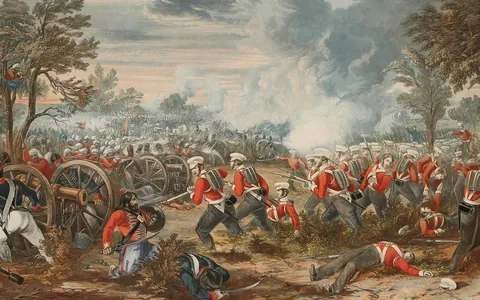
Once across the Sutlej, one Sikh army under Tej Singh moved on Ferozepur but did not attack it, while another under Lal Singh marched toward Mudki. There, on 18 December 1845, Gough's force fell on Lal Singh's army at sunset. A cavalry charge turned the Sikh left and the Sikhs withdrew in the night. The National Army Museum says the battle decided little, and the Wallace Collection calls it inconclusive. Our article on the Battle of Mudki tells the fight in full.12
Three days later Gough attacked the Sikh entrenchments at Ferozeshah, which Britannica calls Firoz Shah, with about 18,000 men. The assault of 21 December took only part of the lines, and that night the British faced likely defeat: Hardinge burned his private papers, expecting to surrender. The next morning a renewed attack drove the Sikhs out, and when Tej Singh's fresh army arrived it was ordered back. Britannica puts British losses at about 2,400 and Sikh losses at about 8,000.13

Why the Sikh commanders withdrew at Ferozeshah has never been settled. The National Army Museum suggests that they may have overestimated British strength, or that their generals betrayed them. Lal Singh and Tej Singh were later accused of helping the British, and Sidhu writes that both were willing to accept British control if it kept them in office. These remain accusations, and their motives are still disputed.14
In January 1846 a Sikh force under Ranjodh Singh Majithia crossed the river to threaten Ludhiana and the British supply lines. Sir Harry Smith marched against it and, at Aliwal on 28 January, rolled up the Sikh line; the Sikhs lost all their guns. The Wallace Collection counts Aliwal among the conclusive British victories of the war.15
The last battle came at Sobraon on 10 February 1846. The Sikhs held a fortified bridgehead on the British bank of the Sutlej, linked to the far bank by a bridge of boats. After a long artillery duel, British and Indian troops stormed the entrenchments, and when the bridge broke the retreat became a slaughter in the river. Britannica gives more than 10,000 Sikhs killed and 2,383 British killed or wounded. Whether the bridge failed under the crowd or Tej Singh, who had left the field early, had it cut loose is still debated.16

The Treaty of Lahore of 9 March 1846 took the Jullundur Doab between the Sutlej and the Beas, limited the Sikh army to 20,000 infantry and 12,000 cavalry, and placed a British force at Lahore. Kashmir and the hill country were detached and passed to Gulab Singh of Jammu, who had changed sides at the right moment, as maharaja of Jammu and Kashmir. Duleep Singh stayed on the throne.17
A second agreement, signed at Bhyrowal on 16 December 1846, went much further. Jind Kaur was removed as regent and pensioned off, and a British Resident, Henry Lawrence, was given control of the whole administration until Duleep Singh turned 16, with a council of regency of Sikh nobles holding office at his pleasure. The Encyclopaedia of Sikhism calls the result a virtual British protectorate. Lawrence then exiled Jind Kaur from Lahore, and in 1848 she was deported from the Punjab; the National Army Museum says her exile caused much resentment.18

The Second Anglo-Sikh War (1848 to 1849)
The second war began at Multan. In April 1848 the British-controlled Lahore government replaced its governor, Diwan Mulraj, and two British officers sent there, Patrick Vans Agnew and William Anderson, were killed by Mulraj's troops. The National Army Museum and the Encyclopaedia of Sikhism both doubt that Mulraj ordered the killings, but he was forced into open revolt.19
Dalhousie and Gough chose to wait for the cool season before marching. The Encyclopaedia of Sikhism, drawing on Dalhousie's own letters, argues that the delay let the revolt spread and that the governor-general had decided on annexation months before the war ended. In September 1848 the Sikh troops sent to help besiege Multan, under Sher Singh Attariwala, went over to the rebels, and a local revolt became a war across the Punjab.20
On 22 November 1848, at Ramnagar on the Chenab, British cavalry charged across the soft riverbed into concealed Sikh guns and fell back with heavy losses. The Sikhs counted it a victory. Multan, besieged again with heavy guns brought up the rivers, fell on 22 January 1849 after weeks of fighting.21
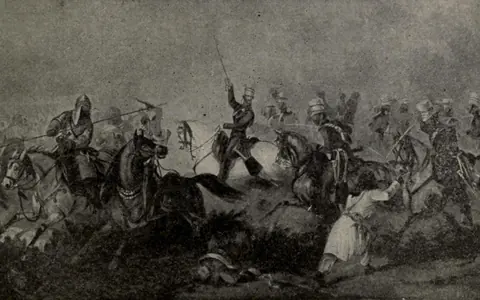
At Chillianwala on 13 January 1849, Gough attacked Sher Singh's entrenched army in dense scrub that hid the Sikh guns. The British 24th Foot took a battery and lost about half its men; the Company's losses came to about 2,300. Gough claimed a victory because the Sikhs later left their positions, but much of the British press called it a defeat, and the Sikhs carried off captured guns and colors. In our article on the Battle of Chillianwala both sides' claims are set out.22
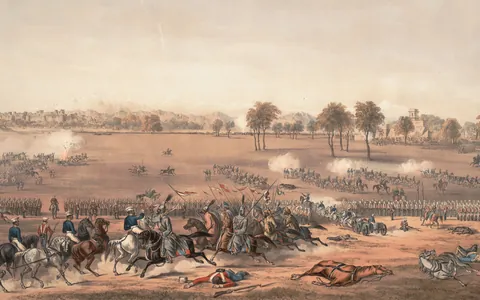
The decisive battle came at Gujrat on 21 February 1849. Reinforced by the troops and siege guns freed by the fall of Multan, Gough opened with a long artillery bombardment that silenced much of the Sikh artillery, then sent his infantry forward. The Sikh retreat became a rout, followed up by cavalry and horse artillery. Sher Singh surrendered in March, on 12 March in Britannica's account and 14 March at Rawalpindi in the National Army Museum's.23
Key commanders of the Anglo-Sikh Wars
Sir Hugh Gough, an Irish-born general, commanded the Company's forces in both wars. He was often criticized for his costly frontal attacks, his "Tipperary tactics", and after Chillianwala the Company's directors named Sir Charles Napier to replace him; Gujrat was won before Napier arrived and restored Gough's reputation. The Dictionary of Irish Biography notes that later writers judged the Sikh army so formidable that such losses were probably unavoidable.24
Hardinge and Dalhousie, the two governors-general, shaped the politics of the wars: Hardinge preferred a protectorate over the Punjab in 1846, while Dalhousie pressed for annexation from 1848.25
Lal Singh and Tej Singh led the Sikh armies in the first war; both were accused of treachery, a charge that remains disputed. Sher Singh Attariwala commanded the main Sikh army in the second war, fighting Gough to a standstill at Chillianwala before his defeat at Gujrat, with his father Chattar Singh leading the rising in the northwest.26
Who won the Anglo-Sikh Wars? The annexation of the Punjab
The Company won both wars. On 29 March 1849, at a durbar in the Lahore fort, the ten-year-old Duleep Singh was made to sign away his kingdom, and the Punjab became part of British India.27
The annexation was contested at the time. The Encyclopaedia of Sikhism records that Dalhousie acted without authority from London, that the council of regency signed under pressure with British troops in occupation of the country, and that the Resident, Henry Lawrence, called the deposition of the young maharaja unjust and impolitic. It quotes the critic John Sullivan: a guardian had punished his own ward for a rebellion provoked by the guardian's agents.28
The terms included the surrender of the Koh-i-Noor diamond, which Ranjit Singh had taken from the Afghan ruler Shah Shuja. It was presented to Queen Victoria and received at Buckingham Palace in 1850.29
Duleep Singh was deposed and given a British pension. He converted to Christianity in 1853, went into exile in Britain in 1854 and lived for years as a country gentleman in Suffolk. When he tried to return to India in 1886 he was stopped at Aden; he died in Paris in 1893.30
Legacy of the Anglo-Sikh Wars
After 1849 the British recruited Sikhs in large numbers. They classed them as a "martial race", a colonial recruiting category rather than a description of the Sikhs, and veterans of the Khalsa served the Company within a few years: in the Indian uprising of 1857 they played an important part on the British side.31
The heavy losses at battles such as Chillianwala dented the British army's reputation in India; the National Army Museum suggests that this emboldened some of those who rose in 1857. An obelisk still stands on the battlefield of Chillianwala, in present-day Pakistan, and the wars, long overlooked, have drawn new talks and seminars in Britain, including at the National Army Museum.32
Major battles of the Anglo-Sikh Wars
Our articles on the battles of the two wars are listed below in date order.
- 1845Battle of Mudki, 1845East India Company and British Army vs Sikh Empire (the Khalsa)
On 18 December 1845 Gough's tired army attacked Lal Singh's Sikhs at sunset. The fight ended in darkness, with two British generals dead and the Khalsa falling back.
- 1849Battle of Chillianwala, 1849East India Company vs Sikh Empire
On 13 January 1849 at Chillianwala in the Punjab, Gough's East India Company army attacked the Sikh Khalsa through dense scrub. Both sides claimed victory.
- 1849Battle of Gujrat, 1849East India Company and British Army vs Sikh Empire (Khalsa army) and Afghan allies
On 21 February 1849 Gough let his guns fight first. Two and a half hours of artillery fire broke the Sikh batteries at Gujrat, the infantry broke the line, and within weeks the Punjab was annexed.
Timeline of the Anglo-Sikh Wars
- 1799Ranjit Singh takes Lahore; in 1801 he proclaims himself maharaja of the Punjab.33
- 1809The Treaty of Amritsar fixes the Sutlej as the frontier with the Company.34
- 1839Death of Ranjit Singh; years of palace revolutions follow.35
- 1845The Khalsa crosses the Sutlej on 11 December; battles of Mudki (18 December) and Ferozeshah (21 to 22 December).36
- 1846Aliwal (28 January) and Sobraon (10 February); Treaty of Lahore (9 March); agreement of Bhyrowal (16 December).37
- 1848Revolt at Multan in April; Sher Singh's troops join the rebels in September; Ramnagar (22 November).38
- 1849Chillianwala (13 January); Multan falls (22 January); Gujrat (21 February); Sikh surrender in March; annexation of the Punjab (29 March).39
- 1850The Koh-i-Noor is received by Queen Victoria.40
- 1854Duleep Singh settles in Britain.41
Where to read next
The wars closed a century of conquest that began at Plassey in 1757; our hub on the East India Company's wars follows that story from the Mughals and the Marathas to the Sikhs. For the wider picture, read our guide to the battles of India and our hub on the military history of Britain, and see the industrial age era page.
Notes
A number in the text points to a note; each note names the works that paragraph draws on, listed in full under Sources.
- Encyclopaedia Britannica, “Sikh Wars”; The Wallace Collection, “Anglo-Sikh Wars”; National Army Museum, “Second Sikh War”. ↩
- National Army Museum, “First Sikh War”; National Army Museum, “Second Sikh War”; Encyclopaedia Britannica, “Sikh Wars”; Dictionary of Irish Biography, “Gough, Sir Hugh”. ↩
- Encyclopaedia Britannica, “Sikh Wars”; National Army Museum, “Second Sikh War”. ↩
- Encyclopaedia Britannica, “Ranjit Singh”; The Wallace Collection, “Anglo-Sikh Wars”. ↩
- Encyclopaedia Britannica, “Treaty of Amritsar”; Encyclopaedia Britannica, “Ranjit Singh”; Sikh Museum Initiative, “Sikh Museum Initiative presents the Anglo Sikh Treaties project”. ↩
- Encyclopaedia Britannica, “Sikh Wars”; National Army Museum, “First Sikh War”; The Wallace Collection, “Anglo-Sikh Wars”; Encyclopaedia Britannica, “Ranjit Singh”. ↩
- National Army Museum, “First Sikh War”; The Wallace Collection, “Anglo-Sikh Wars”; Encyclopaedia Britannica, “Sikh Wars”. ↩
- Encyclopaedia Britannica, “Sikh Wars”; National Army Museum, “First Sikh War”; The Wallace Collection, “Anglo-Sikh Wars”; The Encyclopaedia of Sikhism, “Annexation of the Punjab”. ↩
- Encyclopaedia Britannica, “Ranjit Singh”; The Wallace Collection, “Anglo-Sikh Wars”; National Army Museum, “First Sikh War”. ↩
- National Army Museum, “First Sikh War”; Encyclopedia.com, “Sikh Wars”; National Army Museum, “Second Sikh War”. ↩
- National Army Museum, “First Sikh War”; Encyclopaedia Britannica, “Battle of Gujrat”; Dictionary of Irish Biography, “Gough, Sir Hugh”. ↩
- National Army Museum, “First Sikh War”; The Wallace Collection, “Anglo-Sikh Wars”; Encyclopedia.com, “Sikh Wars”. ↩
- National Army Museum, “First Sikh War”; The Wallace Collection, “Anglo-Sikh Wars”; Encyclopaedia Britannica, “Battle of Firoz Shah”. ↩
- National Army Museum, “First Sikh War”; The Wallace Collection, “Anglo-Sikh Wars”. ↩
- National Army Museum, “Battle of Aliwal”; BritishBattles.com, “Battle of Aliwal”; The Wallace Collection, “Anglo-Sikh Wars”. ↩
- Encyclopaedia Britannica, “Battle of Sobraon”; National Army Museum, “First Sikh War”; Encyclopaedia Britannica, “Sikh Wars”. ↩
- Encyclopaedia Britannica, “Sikh Wars”; National Army Museum, “First Sikh War”; Sikh Museum Initiative, “Sikh Museum Initiative presents the Anglo Sikh Treaties project”; Encyclopaedia Britannica, “Gulab Singh”. ↩
- The Encyclopaedia of Sikhism, “Anglo-Sikh Treaty (Bhyrowal, December 1846)”; The Encyclopaedia of Sikhism, “Annexation of the Punjab”; National Army Museum, “Second Sikh War”; The Wallace Collection, “Anglo-Sikh Wars”. ↩
- National Army Museum, “Second Sikh War”; The Encyclopaedia of Sikhism, “Annexation of the Punjab”; World History Encyclopedia, “Battle of Chillianwala”. ↩
- The Encyclopaedia of Sikhism, “Annexation of the Punjab”; Encyclopaedia Britannica, “Sikh Wars”; National Army Museum, “Second Sikh War”. ↩
- National Army Museum, “Second Sikh War”; Encyclopaedia Britannica, “Sikh Wars”; World History Encyclopedia, “Battle of Chillianwala”. ↩
- National Army Museum, “Second Sikh War”; EBSCO Research Starters, “Battle of Chilianwala”; World History Encyclopedia, “Battle of Chillianwala”; Dawn, “Monument honours lives lost in battle 166 years ago”. ↩
- Encyclopaedia Britannica, “Battle of Gujrat”; National Army Museum, “Second Sikh War”; World History Encyclopedia, “Battle of Chillianwala”. ↩
- Dictionary of Irish Biography, “Gough, Sir Hugh”; National Army Museum, “General Hugh Viscount Gough GCB (1779-1869), 1856 (c)”; World History Encyclopedia, “Battle of Chillianwala”; Encyclopaedia Britannica, “Battle of Gujrat”. ↩
- The Encyclopaedia of Sikhism, “Annexation of the Punjab”; National Army Museum, “First Sikh War”; Encyclopaedia Britannica, “Battle of Gujrat”. ↩
- National Army Museum, “First Sikh War”; The Wallace Collection, “Anglo-Sikh Wars”; National Army Museum, “Second Sikh War”; EBSCO Research Starters, “Battle of Chilianwala”. ↩
- The Encyclopaedia of Sikhism, “Annexation of the Punjab”; National Army Museum, “Second Sikh War”; South Asian Britain: Connecting Histories, “Duleep Singh”. ↩
- The Encyclopaedia of Sikhism, “Annexation of the Punjab”; The Encyclopaedia of Sikhism, “Anglo-Sikh Treaty (Bhyrowal, December 1846)”. ↩
- South Asian Britain: Connecting Histories, “Duleep Singh”; Anglo Sikh Museum, “The Koh-i-Noor”; Encyclopaedia Britannica, “Ranjit Singh”. ↩
- National Army Museum, “Second Sikh War”; South Asian Britain: Connecting Histories, “Duleep Singh”. ↩
- National Army Museum, “Second Sikh War”; The Wallace Collection, “Anglo-Sikh Wars”. ↩
- National Army Museum, “Second Sikh War”; Dawn, “Monument honours lives lost in battle 166 years ago”; National Army Museum, “The Second Sikh War (talk by Amarpal Singh Sidhu)”; Sikh Museum Initiative, “Anglo Sikh Wars”. ↩
- Encyclopaedia Britannica, “Ranjit Singh”; The Wallace Collection, “Anglo-Sikh Wars”. ↩
- Encyclopaedia Britannica, “Treaty of Amritsar”; Encyclopaedia Britannica, “Ranjit Singh”. ↩
- Encyclopaedia Britannica, “Sikh Wars”; National Army Museum, “First Sikh War”. ↩
- National Army Museum, “First Sikh War”; The Wallace Collection, “Anglo-Sikh Wars”; Encyclopaedia Britannica, “Battle of Firoz Shah”. ↩
- National Army Museum, “Battle of Aliwal”; Encyclopaedia Britannica, “Battle of Sobraon”; Sikh Museum Initiative, “Sikh Museum Initiative presents the Anglo Sikh Treaties project”; The Encyclopaedia of Sikhism, “Anglo-Sikh Treaty (Bhyrowal, December 1846)”. ↩
- Encyclopaedia Britannica, “Sikh Wars”; National Army Museum, “Second Sikh War”. ↩
- National Army Museum, “Second Sikh War”; Encyclopaedia Britannica, “Sikh Wars”; Encyclopaedia Britannica, “Battle of Gujrat”; World History Encyclopedia, “Battle of Chillianwala”. ↩
- Anglo Sikh Museum, “The Koh-i-Noor”; South Asian Britain: Connecting Histories, “Duleep Singh”. ↩
- South Asian Britain: Connecting Histories, “Duleep Singh”; National Army Museum, “Second Sikh War”. ↩
Sources
- Encyclopaedia Britannica, “Sikh Wars”.
- The Wallace Collection (Amarpal Singh Sidhu), “Anglo-Sikh Wars”.
- National Army Museum, “Second Sikh War”.
- National Army Museum, “First Sikh War”.
- Dictionary of Irish Biography (Royal Irish Academy), “Gough, Sir Hugh”.
- Encyclopaedia Britannica (Khushwant Singh), “Ranjit Singh”.
- Encyclopaedia Britannica, “Treaty of Amritsar”.
- Sikh Museum Initiative, “Sikh Museum Initiative presents the Anglo Sikh Treaties project”.
- The Encyclopaedia of Sikhism (Punjabi University, Patiala), “Annexation of the Punjab”.
- Encyclopedia.com (World Encyclopedia; The Oxford Companion to British History), “Sikh Wars”.
- Encyclopaedia Britannica, “Battle of Gujrat”.
- Encyclopaedia Britannica, “Battle of Firoz Shah”.
- National Army Museum, “Battle of Aliwal”.
- BritishBattles.com, “Battle of Aliwal”.
- Encyclopaedia Britannica, “Battle of Sobraon”.
- Encyclopaedia Britannica, “Gulab Singh”.
- The Encyclopaedia of Sikhism (Punjabi University, Patiala), “Anglo-Sikh Treaty (Bhyrowal, December 1846)”.
- World History Encyclopedia (Mark Cartwright), “Battle of Chillianwala”.
- EBSCO Research Starters (Eric v. d. Luft), “Battle of Chilianwala”.
- Dawn (Shiraz Hassan), “Monument honours lives lost in battle 166 years ago”.
- National Army Museum, Online Collection, “General Hugh Viscount Gough GCB (1779-1869), 1856 (c)”.
- South Asian Britain: Connecting Histories, “Duleep Singh”.
- Anglo Sikh Museum (Sikh Museum Initiative), “The Koh-i-Noor”.
- National Army Museum, “The Second Sikh War (talk by Amarpal Singh Sidhu)”.
- Sikh Museum Initiative, “Anglo Sikh Wars: A Journey into relics, technology, generals and battlefields”.






