

What were the East India Company wars and who won?
They were the campaigns of 1757 to 1857 in which the East India Company, a British trading company whose armies were mostly Indian sepoys, conquered Bengal, Mysore, the Maratha states and the Punjab, from the Battle of Plassey to the Battle of Gujrat. The Company won the wars, but the rebellion of 1857 ended its rule.1
In 1757 the East India Company was a chartered trading company with forts on the coasts of India. A century later it governed about two thirds of the subcontinent, directly or through treaties with Indian rulers, and kept a large army of its own. It won that position in a long series of wars against Indian states: the Battle of Plassey and the Battle of Buxar in Bengal, four wars with Mysore, three with the Marathas, including the Battle of Assaye, and two with the Sikh Empire, fought at Chillianwala and Gujrat.2
This guide follows those wars from the side of the Company and from the side of the Indian states it fought, which had their own aims, armies and reforms. It also covers what the conquest cost: the revenue taken from Bengal, the famine of 1770, the debate over the economic drain, and the violence of 1857. For the longer story of warfare on the subcontinent, from antiquity to 1971, see our guide to the battles of India; the Sikh wars have their own hub, the Anglo-Sikh Wars.3
Causes of the East India Company wars
The Company was founded in London and incorporated by royal charter on 31 December 1600 to trade with Asia. Its charter gave it a monopoly of English trade with the East, and from the start trade was carried on with arms: the European companies sank each other's ships and fortified their trading posts. Madras, Bombay and Calcutta grew from those posts into the three presidencies of Bengal, Madras and Bombay.4
After the death of the emperor Aurangzeb in 1707, Mughal governors and great landholders built regional kingdoms, and Delhi could no longer act as an effective center. Bengal, one of the empire's richest provinces, became in practice independent under its own nawabs from 1717, while the Marathas carved out dominions from Mughal territory. Britannica and the National Army Museum both trace the Company's rise to its use of this fragmentation, intervening in the rivalries of the successor states.5
The second driver was the war with the French East India Company, which spread to India in the 1740s and was fought out in the Carnatic Wars and in India's share of the Seven Years' War; the Company's victories at Plassey (1757) and Wandiwash (1760) weakened the French company, which lost all its possessions in Bengal except Chandernagore. Behind both lay money. The National Army Museum lists personal ambition, commercial interest, security and the need for revenue among the motives for expansion, and the revenue of conquered land soon paid for the next war.6
Who fought in the East India Company wars
These were not simply wars of Britain against India. The Company's officers were British and some regiments were all European, but the great majority of its soldiers were Indian. Following the example of Mughal successor states such as Awadh and Banaras, which had begun to train peasant recruits as professional infantry, the Company built a sepoy army (from the word sipahi, soldier).7
The Company also fought with Indian allies. The Nizam of Hyderabad joined it against Mysore in 1766 and again in 1799, and in 1792 the Marathas, the Nizam and the Company together forced Tipu Sultan to terms. On the other side stood states with long histories of their own: the Nawabs of Bengal and Awadh and the Mughal emperor, the sultanate of Mysore under Hyder Ali and Tipu Sultan, the Maratha Confederacy and, in the Punjab, the Sikh Empire built by Maharaja Ranjit Singh.8

Bengal, 1757 to 1765: Plassey, Buxar and the diwani
In Bengal the quarrel was over trade privileges and fortifications. The nawabs Murshid Quli Khan, Alivardi Khan and Siraj-ud-Daulah refused the Company new concessions and accused it of evading duties; the Company complained that their demands ruined its trade. In 1756 Siraj-ud-Daulah, who had just become nawab, took Calcutta and its Fort William. Robert Clive was sent from Madras and retook the city early in 1757.9
At Plassey on 23 June 1757 Clive's army met the nawab's. Britannica and the National Army Museum put the Company force at about 3,000 men, 2,100 of them Indian sepoys, against about 50,000. The battle was decided before it began: Clive and the Jagat Seth banking family had won over Mir Jafar, one of the nawab's commanders, with the promise of the throne, and his troops never fought. Siraj-ud-Daulah fled, was captured and killed, and Mir Jafar became nawab.10
The Company soon found puppet nawabs harder to manage than it had hoped. It deposed Mir Jafar for Mir Qasim, and when Mir Qasim resisted, he joined the Nawab of Awadh and the Mughal emperor Shah Alam II. At Buxar in October 1764 a Company army under Hector Munro, mostly sepoys, defeated their combined forces. The Company army was far smaller than the allied one, although estimates of both armies vary.11
By the Treaty of Allahabad in 1765 Shah Alam II granted the Company the diwani, the right to collect the revenue of Bengal, Bihar and Orissa (World History Encyclopedia dates the grant to 12 August 1765). The NCERT textbook used in Indian schools explains what it meant: Indian revenue now paid for the textiles the Company exported, for its troops and for its forts, and the outflow of gold from Britain to buy Indian goods stopped. Clive's own phrase for the change was "We must indeed become nawabs ourselves".12

The Anglo-Mysore Wars: Hyder Ali and Tipu Sultan
In the south the Company met one of its most formidable opponents. Hyder Ali, a Muslim officer, made himself ruler of Mysore around 1761, and his son Tipu Sultan succeeded him in 1782. Mysore controlled the pepper and cardamom trade of the Malabar coast; in 1785 Tipu stopped the export of sandalwood, pepper and cardamom through his ports, barred his merchants from trading with the Company and worked with the French to modernize his army. Britannica credits him with a new land revenue system, new coins and a new calendar.13
Four wars followed: 1767 to 1769, 1780 to 1784, 1790 to 1792 and 1799. In the first, Hyder Ali appeared before Madras and dictated peace. In the second, allied with the Marathas, he devastated the Carnatic, and Mysore's armies beat Company forces in several battles; Britannica singles out Tipu's victory at Pollilur in 1780. The third war cost Tipu half his dominions, and two of his sons were taken as hostages.14

Mysore's soldiers fired iron-cased rockets. Britannica says Tipu redesigned the rockets his father had used and used them to far greater effect; the National Army Museum and the V&A describe them as part of an army that joined European methods to Indian weapons, and the Smithsonian notes that reports of their use at the sieges of Seringapatam in 1791 to 1792 and 1799 led William Congreve to develop his own rockets for the British. Britannica also records the harsher side of Tipu's rule: his wars against Coorg, Malabar and other neighbors, and forced conversions that historians explain differently.15
In 1799 Governor-General Lord Mornington (later Marquess Wellesley) went to war again, on the grounds that Tipu was seeking French help. Company and Hyderabad troops stormed Seringapatam after a siege of about a month, and Tipu was killed in the fighting on 4 May 1799. The army looted the city; the V&A, which now holds the mechanical tiger taken from Tipu's palace, notes that it became one of the most popular exhibits of the Company's new Indian Museum. Mysore was returned to the Wodeyar dynasty under a subsidiary alliance.16

The Anglo-Maratha Wars, 1775 to 1818
In the 18th century the Marathas pushed deep into Mughal territory in western, central and southern India. Their defeat by the Afghan ruler Ahmad Shah Durrani at the Third Battle of Panipat in 1761 checked their hopes of ruling from Delhi. Afterward the Confederacy was held together by the Peshwa at Pune, with great houses such as the Sindhia, Holkar, Gaikwad and Bhonsle ruling their own states; Mahadji Sindhia and Nana Phadnis were its leading soldier and statesman in the late 18th century.17
The first war (1775 to 1782) began with Company support for Raghunath Rao's claim to be Peshwa. The Marathas defeated a Company army at Wadgaon in 1779, and the Treaty of Salbai left no clear winner; the Company's only gain was Salsette island next to Bombay.18
The second war (1803 to 1805) followed the Treaty of Bassein of 1802, by which the Peshwa Baji Rao II accepted Company protection. The Sindhia and Bhonsle houses refused it. Arthur Wellesley, the Governor-General's brother and later Duke of Wellington, beat them at Assaye on 23 September 1803, his first major victory, and at Argaum; in the north Lord Lake won at Delhi and Laswari. The Company gained Orissa and the lands north of the Yamuna, Agra and Delhi among them.19
The third war grew out of Lord Hastings' campaign against the Pindari bands in 1817. The forces of the Peshwa, the Bhonsle and the Holkar rose against the Company and were quickly defeated; the Peshwa was pensioned off to Bithur near Kanpur and his lands annexed. Britannica dates the war 1817 to 1818, the NCERT textbook 1817 to 1819. Either way, it ended the Marathas as a rival power.20
Subsidiary alliances, paramountcy and the doctrine of lapse
Much of India was taken without a battle. After Buxar the Company placed Residents at Indian courts, and many rulers signed subsidiary alliances: they gave up independent armies, paid for Company troops stationed in their states, and lost territory if they fell behind with payments. In 1801 the Nawab of Awadh had to give up over half of his territory this way, and Hyderabad also ceded land. From the time of Lord Hastings (1813 to 1823) the Company claimed paramountcy, a right to annex or threaten any Indian state.21
The last wave came under Lord Dalhousie, Governor-General from 1848 to 1856. By the doctrine of lapse he claimed the right to refuse adoptions in dependent Hindu states and to annex those left without a natural heir: Satara, Sambalpur, Nagpur and Jhansi among them. In 1856 the Company annexed Awadh on the grounds of misgovernment. Britannica notes that these annexations alarmed the Indian princes and the old aristocracy and fed the discontent of 1857.22
The Anglo-Sikh Wars and the Punjab, 1845 to 1849
Maharaja Ranjit Singh, who ruled from 1801 to 1839, built the Punjab into a formidable state and modernized its army with the help of European officers. After his death the court at Lahore broke down in palace revolutions, and real power passed to the army and its committees. In December 1845 the Sikh army crossed the Sutlej.23
The first war opened at Mudki, which the Wallace Collection calls inconclusive, followed by Ferozeshah, where the British were close to defeat, and the Company victories of Aliwal and Sobraon. The peace took the lands east of the Sutlej and the Beas, detached Kashmir and Jammu, limited the Sikh army and placed a British Resident in Lahore.24
The second war began with a revolt at Multan in April 1848. At Chillianwala on 13 January 1849 Gough's army suffered about 2,300 casualties; he claimed a victory, Britannica calls the battle indecisive. At Gujrat on 21 February he won a decisive victory, and the Sikh army surrendered in March. The Punjab was annexed on 29 March 1849 and the young Maharaja Duleep Singh was deposed and later sent to England; the Koh-i-Noor diamond passed to the British. Our hub on the Anglo-Sikh Wars tells the story in full.25
Revenue, famine and the drain: the cost of Company rule
The diwani made the Company a government whose first business was revenue. Britannica's judgment is blunt: its trade and revenue policies "gradually drained first Bengal and then much of the subcontinent of its wealth", ruined crafts such as textile manufacturing, and its harsh revenue demands are "regarded as a direct cause" of the famine that devastated Bengal in 1770. Banglapedia, the national encyclopedia of Bangladesh, also holds the land revenue system and profiteering in the grain trade responsible for deepening the suffering, while the Company blamed nature alone.26
The rural crisis of the 1770s, with recurrent famine and falling output, led to the Permanent Settlement of 1793, which fixed the revenue that each zamindar of Bengal owed for ever. Estates that fell into arrears were auctioned; the NCERT textbook notes that over 75 per cent of the zamindaris changed hands after the settlement, and World History Encyclopedia that it sent tens of thousands into permanent debt.27
Individuals grew rich. Robert Clive and Warren Hastings were denounced in Britain as corrupt "nabobs" who had used their power to amass personal fortunes, and Hastings was impeached in a trial that lasted seven years. Parliament answered the scandals with the Regulating Act of 1773 and Pitt's India Act, which put the Company's politics under a board answerable to Parliament.28
A century later the Indian economist and politician Dadabhai Naoroji, the first Asian elected to the British Parliament, set out the "drain of wealth" theory, above all in Poverty and Un-British Rule in India (1901): British rule, he argued, had not brought prosperity but impoverished India through high taxation, and British policies had caused deadly famines. His colleague Romesh Dutt gave more weight to excessive land taxation, and Azim Premji University notes there was no consensus on the theory even within the Indian nationalist camp.29
Key commanders and rulers of the East India Company wars
The Company. Robert Clive won Plassey and secured the diwani as governor of Bengal. Hector Munro commanded at Buxar. Warren Hastings, the first Governor-General (1773 to 1785), reorganized its administration and courts; Lord Cornwallis fought the third Mysore war, and Richard Wellesley, Lord Mornington, the fourth Mysore war and the second Maratha war. His brother Arthur Wellesley won at Assaye, and Sir Hugh Gough commanded against the Sikhs. Lord Dalhousie presided over the annexations of 1848 to 1856.30
The Indian states. Siraj-ud-Daulah of Bengal, the Mughal emperor Shah Alam II and the nawabs of Awadh fought the Company in Bengal. Hyder Ali and Tipu Sultan of Mysore beat it in the field more than once; Britannica calls Tipu the last formidable opposition the Company faced in India. Mahadji Sindhia and Nana Phadnis led the Maratha Confederacy, and the armies of 1803 belonged to the Sindhia and Bhonsle houses. Ranjit Singh built the Sikh Empire, and Sher Singh Attariwala commanded its army at Chillianwala and Gujrat.31
Who won the East India Company wars? 1857 and the end of Company rule
Militarily the Company won. By 1857, the NCERT textbook calculates, it ruled about 63 per cent of the territory and 78 per cent of the population of the subcontinent directly, and influenced the rest; the National Army Museum says it governed two thirds of the subcontinent by the mid-1850s. The Punjab was, in the Museum's words, one of the last Indian powers able to challenge British control.32
Then the army it had built turned against it. On 10 May 1857 sepoys at Meerut rose against their officers, marched to Delhi and proclaimed the aged Mughal emperor Bahadur Shah II their leader. The trigger was the rumor that the cartridges of the new Enfield rifle were greased with cow and pig fat, but annexations such as Awadh, the treatment of the princes and the pace of change gave the revolt wide support: in Awadh, by one British estimate, three quarters of the adult men were in arms. Almost all the mutineers came from the Bengal Army; the Madras and Bombay armies were largely unaffected, and Sikh, Punjabi Muslim and Gurkha units fought for the British.33
Both sides killed civilians. Rebels shot their British officers and killed European civilians at Meerut, Delhi, Kanpur and elsewhere; at Kanpur about 400 British women and children were killed. British reprisals, Britannica says, "far outweighed the original excesses": sepoys were bayoneted or blown from cannon, and the UK Parliament's own history speaks of "excessively brutal action by the Company's army". At the Secundra Bagh in Lucknow, Colin Campbell's troops killed over 2,000 rebel sepoys.34

The British regained control in 1858, and peace was declared on 8 July 1859. The Government of India Act of 1858 took the Company's administration, possessions and armed forces under the Crown, with a Secretary of State for India in London and a viceroy in India. The Company's armies became the Indian Army. The uprising is still named differently: the Indian Mutiny or Sepoy Mutiny in older British writing, the Indian Rebellion, and in India the First War of Independence.35
Major battles of the East India Company wars
Our articles on the battles of the Company's wars in India, from Bengal to the Punjab, are listed below in date order.
- 1757The Battle of Plassey, 1757British East India Company vs Nawab of Bengal (with French gunners)
A few thousand Company troops won Bengal, and an empire, by rain and treachery.
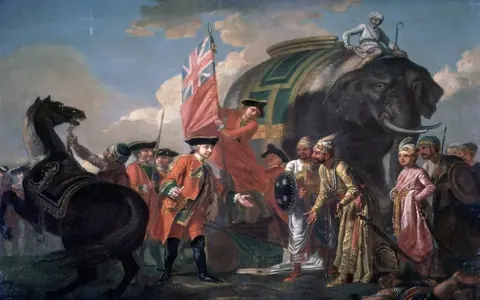
- 1764The Battle of Buxar, 1764British East India Company vs Mughal Empire, Awadh and Bengal
After Buxar, a trading company became the ruler of Bengal.
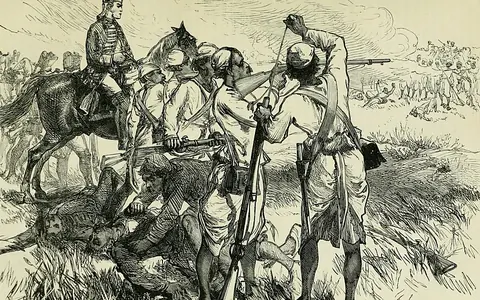
- 1803The Battle of Assaye, 1803East India Company and British troops vs Maratha Confederacy (Scindia and Berar)
Years before Waterloo, the future Wellington won the battle he valued most.
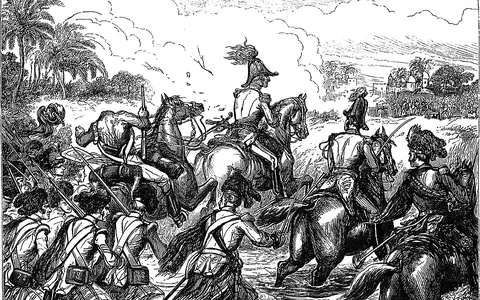
- 1845Battle of Mudki, 1845East India Company and British Army vs Sikh Empire (the Khalsa)
On 18 December 1845 Gough's tired army attacked Lal Singh's Sikhs at sunset. The fight ended in darkness, with two British generals dead and the Khalsa falling back.
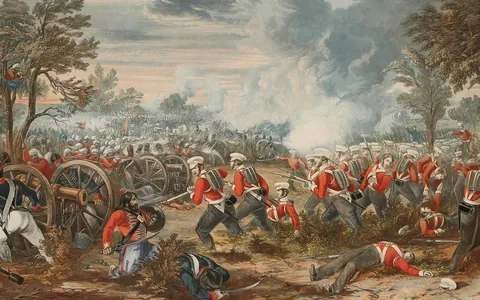
- 1849Battle of Chillianwala, 1849East India Company vs Sikh Empire
On 13 January 1849 at Chillianwala in the Punjab, Gough's East India Company army attacked the Sikh Khalsa through dense scrub. Both sides claimed victory.
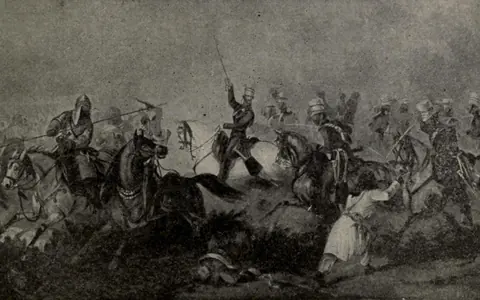
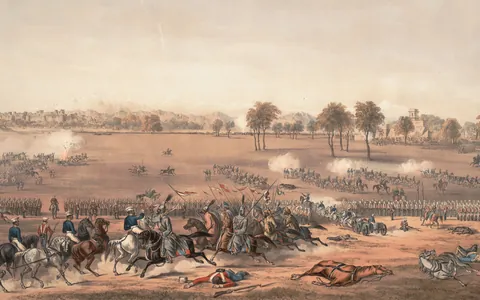
- 1849Battle of Gujrat, 1849East India Company and British Army vs Sikh Empire (Khalsa army) and Afghan allies
On 21 February 1849 Gough let his guns fight first. Two and a half hours of artillery fire broke the Sikh batteries at Gujrat, the infantry broke the line, and within weeks the Punjab was annexed.
Timeline of the East India Company wars
- 1600The East India Company is incorporated by royal charter on 31 December.36
- 1756Siraj-ud-Daulah, Nawab of Bengal, takes Calcutta.37
- 1757Battle of Plassey, 23 June: Clive defeats Siraj-ud-Daulah after Mir Jafar's defection.38
- 1764Battle of Buxar: the Company defeats Mir Qasim, Awadh and the Mughal emperor.39
- 1765Treaty of Allahabad: Shah Alam II grants the Company the diwani of Bengal, Bihar and Orissa.40
- 1767 to 1769First Anglo-Mysore War; Hyder Ali dictates peace before Madras.41
- 1770Famine in Bengal.42
- 1775 to 1782First Anglo-Maratha War, ended by the Treaty of Salbai.43
- 1780 to 1784Second Anglo-Mysore War; Tipu Sultan wins at Pollilur in 1780.44
- 1790 to 1792Third Anglo-Mysore War: Tipu cedes half his dominions.45
- 1793The Permanent Settlement fixes the land revenue of Bengal.46
- 1799Fourth Anglo-Mysore War: Seringapatam is stormed and Tipu Sultan killed on 4 May.47
- 1803Second Anglo-Maratha War: Wellesley wins at Assaye on 23 September; Lake at Delhi and Laswari.48
- 1817 to 1818Third Anglo-Maratha War; the Peshwa's lands are annexed.49
- 1845 to 1846First Anglo-Sikh War: Mudki, Ferozeshah, Aliwal and Sobraon.50
- 1849Chillianwala (13 January) and Gujrat (21 February); the Punjab is annexed on 29 March.51
- 1856The Company annexes Awadh.52
- 1857The rebellion begins at Meerut on 10 May and spreads across northern India.53
- 1858The Government of India Act transfers the Company's rule to the Crown.54
Where to read next
Read on with our guides to the Anglo-Sikh Wars, the Seven Years' War and the battles of India, our hubs on the military history of Britain and of France, the life of the Duke of Wellington, and the industrial age era page.
Notes
A number in the text points to a note; each note names the works that paragraph draws on, listed in full under Sources.
- Encyclopaedia Britannica, “East India Company”; National Army Museum, “Armies of the East India Company”; Encyclopaedia Britannica, “Indian Rebellion of 1857”. ↩
- Encyclopaedia Britannica, “East India Company”; National Army Museum, “Armies of the East India Company”; NCERT, Our Pasts III. ↩
- Encyclopaedia Britannica, “East India Company”; Banglapedia, “Famine”; Encyclopaedia Britannica, “Dadabhai Naoroji”. ↩
- Encyclopaedia Britannica, “East India Company”; NCERT, Our Pasts III. ↩
- Encyclopaedia Britannica, “East India Company”; National Army Museum, “Armies of the East India Company”; NCERT, Our Pasts III; Encyclopaedia Britannica, “Battle of Plassey”; Encyclopaedia Britannica, “Indian Rebellion of 1857”. ↩
- Encyclopaedia Britannica, “East India Company”; National Army Museum, “Armies of the East India Company”; Encyclopaedia Britannica, “Battle of Plassey”. ↩
- National Army Museum, “Armies of the East India Company”; NCERT, Our Pasts III. ↩
- NCERT, Our Pasts III; Encyclopaedia Britannica, “Mysore Wars”; National Army Museum, “Tipu Sultan’s war turban”; Encyclopaedia Britannica, “Sikh Wars”. ↩
- NCERT, Our Pasts III; Encyclopaedia Britannica, “Battle of Plassey”. ↩
- NCERT, Our Pasts III; Encyclopaedia Britannica, “Battle of Plassey”; National Army Museum, “Battle of Plassey”. ↩
- NCERT, Our Pasts III; Encyclopaedia Britannica, “Battle of Buxar”; World History Encyclopedia, “Battle of Buxar”. ↩
- NCERT, Our Pasts III; Encyclopaedia Britannica, “Battle of Buxar”; World History Encyclopedia, “East India Company”. ↩
- NCERT, Our Pasts III; Encyclopaedia Britannica, “Mysore Wars”; Encyclopaedia Britannica, “Tipu Sultan”. ↩
- NCERT, Our Pasts III; Encyclopaedia Britannica, “Mysore Wars”; Encyclopaedia Britannica, “Tipu Sultan”. ↩
- Encyclopaedia Britannica, “Tipu Sultan”; National Army Museum, “Tipu Sultan’s war turban”; Victoria and Albert Museum, “Tipu’s Tiger”; Smithsonian National Air and Space Museum, “Model, Rocket, War, Indian, Late 18th Century”. ↩
- NCERT, Our Pasts III; Encyclopaedia Britannica, “Mysore Wars”; Encyclopaedia Britannica, “Tipu Sultan”; National Army Museum, “Tipu Sultan’s war turban”; Victoria and Albert Museum, “Tipu’s Tiger”. ↩
- NCERT, Our Pasts III; World History Encyclopedia, “East India Company”; Encyclopaedia Britannica, “Battles of Panipat”. ↩
- NCERT, Our Pasts III; Encyclopaedia Britannica, “Maratha Wars”. ↩
- NCERT, Our Pasts III; Encyclopaedia Britannica, “Maratha Wars”; National Army Museum, “Wellington”. ↩
- NCERT, Our Pasts III; Encyclopaedia Britannica, “Maratha Wars”. ↩
- Encyclopaedia Britannica, “East India Company”; National Army Museum, “Armies of the East India Company”; NCERT, Our Pasts III. ↩
- NCERT, Our Pasts III; Encyclopaedia Britannica, “Doctrine of lapse”; National Army Museum, “Why did the Indian Rebellion happen?”. ↩
- Encyclopaedia Britannica, “Sikh Wars”; The Wallace Collection, “The Lahore Durbar”; World History Encyclopedia, “Second Anglo-Sikh War”. ↩
- Encyclopaedia Britannica, “Sikh Wars”; The Wallace Collection, “The Lahore Durbar”; World History Encyclopedia, “Second Anglo-Sikh War”. ↩
- Encyclopaedia Britannica, “Sikh Wars”; National Army Museum, “Second Sikh War”; The Wallace Collection, “The Lahore Durbar”; World History Encyclopedia, “Second Anglo-Sikh War”. ↩
- Encyclopaedia Britannica, “East India Company”; Banglapedia, “Famine”. ↩
- World History Encyclopedia, “East India Company”; NCERT, Themes in Indian History, Part III. ↩
- Encyclopaedia Britannica, “East India Company”; National Army Museum, “Armies of the East India Company”; NCERT, Our Pasts III. ↩
- Encyclopaedia Britannica, “Dadabhai Naoroji”; Azim Premji University, “Dadabhai Naoroji”. ↩
- National Army Museum, “Armies of the East India Company”; NCERT, Our Pasts III; Encyclopaedia Britannica, “Mysore Wars”; National Army Museum, “Wellington”; National Army Museum, “Second Sikh War”. ↩
- NCERT, Our Pasts III; Encyclopaedia Britannica, “Tipu Sultan”; Encyclopaedia Britannica, “Maratha Wars”; World History Encyclopedia, “Second Anglo-Sikh War”. ↩
- National Army Museum, “Armies of the East India Company”; NCERT, Our Pasts III; National Army Museum, “Second Sikh War”. ↩
- Encyclopaedia Britannica, “Indian Rebellion of 1857”; National Army Museum, “Why did the Indian Rebellion happen?”; NCERT, Themes in Indian History, Part III. ↩
- Encyclopaedia Britannica, “Indian Rebellion of 1857”; National Army Museum, “Why did the Indian Rebellion happen?”; NCERT, Themes in Indian History, Part III; UK Parliament, “East India Company and Raj 1785-1858”. ↩
- National Army Museum, “Armies of the East India Company”; World History Encyclopedia, “East India Company”; Encyclopaedia Britannica, “Indian Rebellion of 1857”; UK Parliament, “East India Company and Raj 1785-1858”. ↩
- Encyclopaedia Britannica, “East India Company”; NCERT, Our Pasts III. ↩
- NCERT, Our Pasts III; Encyclopaedia Britannica, “Battle of Plassey”. ↩
- NCERT, Our Pasts III; Encyclopaedia Britannica, “Battle of Plassey”. ↩
- NCERT, Our Pasts III; Encyclopaedia Britannica, “Battle of Buxar”. ↩
- Encyclopaedia Britannica, “Battle of Buxar”; World History Encyclopedia, “East India Company”. ↩
- NCERT, Our Pasts III; Encyclopaedia Britannica, “Mysore Wars”. ↩
- Encyclopaedia Britannica, “East India Company”; Banglapedia, “Famine”. ↩
- NCERT, Our Pasts III; Encyclopaedia Britannica, “Maratha Wars”. ↩
- Encyclopaedia Britannica, “Mysore Wars”; Encyclopaedia Britannica, “Tipu Sultan”. ↩
- NCERT, Our Pasts III; Encyclopaedia Britannica, “Mysore Wars”. ↩
- World History Encyclopedia, “East India Company”; NCERT, Themes in Indian History, Part III. ↩
- Encyclopaedia Britannica, “Mysore Wars”; Encyclopaedia Britannica, “Tipu Sultan”; National Army Museum, “Tipu Sultan’s war turban”. ↩
- Encyclopaedia Britannica, “Maratha Wars”; National Army Museum, “Wellington”. ↩
- NCERT, Our Pasts III; Encyclopaedia Britannica, “Maratha Wars”. ↩
- Encyclopaedia Britannica, “Sikh Wars”; The Wallace Collection, “The Lahore Durbar”. ↩
- Encyclopaedia Britannica, “Sikh Wars”; National Army Museum, “Second Sikh War”; The Wallace Collection, “The Lahore Durbar”. ↩
- NCERT, Our Pasts III; National Army Museum, “Why did the Indian Rebellion happen?”. ↩
- Encyclopaedia Britannica, “Indian Rebellion of 1857”; National Army Museum, “Why did the Indian Rebellion happen?”. ↩
- World History Encyclopedia, “East India Company”; UK Parliament, “East India Company and Raj 1785-1858”. ↩
Sources
- Encyclopaedia Britannica, “East India Company”.
- National Army Museum, “Armies of the East India Company”.
- Encyclopaedia Britannica, “Indian Rebellion of 1857”.
- NCERT, Our Pasts III, chapter 2, “From Trade to Territory: The Company Establishes Power”.
- Banglapedia, National Encyclopedia of Bangladesh (Asiatic Society of Bangladesh), “Famine”.
- Encyclopaedia Britannica, “Dadabhai Naoroji”.
- Encyclopaedia Britannica, “Battle of Plassey”.
- Encyclopaedia Britannica, “Mysore Wars”.
- National Army Museum, “Tipu Sultan’s war turban”.
- Encyclopaedia Britannica, “Sikh Wars”.
- National Army Museum, “Battle of Plassey”.
- Encyclopaedia Britannica, “Battle of Buxar”.
- World History Encyclopedia, “Battle of Buxar”.
- World History Encyclopedia, “East India Company”.
- Encyclopaedia Britannica, “Tipu Sultan”.
- Victoria and Albert Museum, “Tipu’s Tiger”.
- Smithsonian National Air and Space Museum, “Model, Rocket, War, Indian, Late 18th Century”.
- Encyclopaedia Britannica, “Battles of Panipat”.
- Encyclopaedia Britannica, “Maratha Wars”.
- National Army Museum, “Wellington: The Iron Duke”.
- Encyclopaedia Britannica, “Doctrine of lapse”.
- National Army Museum, “Why did the Indian Rebellion happen?”.
- The Wallace Collection, “The Lahore Durbar: Anglo-Sikh Wars”.
- World History Encyclopedia, “Second Anglo-Sikh War”.
- National Army Museum, “Second Sikh War”.
- NCERT, Themes in Indian History, Part III, “Colonialism and the Countryside: Exploring Official Archives”.
- Azim Premji University, “Dadabhai Naoroji”.
- NCERT, Themes in Indian History, Part III, “Rebels and the Raj: The Revolt of 1857 and its Representations”.
- UK Parliament, “East India Company and Raj 1785-1858”.






