

What is the military history of Scotland?
It is the story of the wars of the Kingdom of Scotland, which grew out of the kingdom of Alba in the ninth century and stayed independent until the union with England in 1707: the Wars of Independence against Edward I and Edward III, the alliance with France, disasters such as Flodden, the civil wars of the 17th century and the Jacobite risings that ended at Culloden in 1746. After 1707 Scottish soldiers fought in the British Army, in Scottish regiments, across the empire and in two world wars.1
Seen from Scotland, much of this history is not "Britain at war" but a smaller kingdom defending itself against a larger neighbor, fighting beside France, and repeatedly fighting itself. Several of its best-known battles, from Killiecrankie to Culloden, were fought between Scots. This page follows the kingdom from its origins to the union of 1707, then the Scottish soldiers who served the British state, and how Scotland remembers its wars. The wars of England and, after 1707, of Great Britain are on our page on the military history of Britain.2
The kingdom of Scotland
The Scottish kingdom grew out of the union of the Gaels of Dál Riata and the Picts under Kenneth mac Alpin, traditionally dated to about 843, although the sources disagree on the exact year. The new kingdom was called Alba, the forerunner of medieval Scotland; Kenneth died at Forteviot in 858.3
In the 13th century the kingdom pushed its western frontier against Norway. On 2 October 1263 the forces of Alexander III fought King Haakon IV's expedition at Largs, a Scottish success whose details are poorly known. By the Treaty of Perth, signed on 2 July 1266, Norway gave up the Western Isles and the Isle of Man to Scotland, while keeping Orkney and Shetland.4

The Wars of Independence, 1296 to 1357
The succession crisis. Alexander III died after a fall from his horse near Kinghorn in 1286, and his heir, his young granddaughter Margaret, the Maid of Norway, died in 1290. Edward I of England was asked to judge between fourteen claimants. The court chose John Balliol on 17 November 1292, and Edward used the process to press his claim to overlordship of Scotland.5
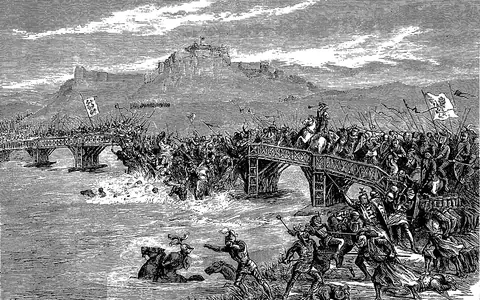
Invasion and resistance. When the Scots allied with France, Edward invaded in March 1296, sacked Berwick and defeated the Scottish army at Dunbar on 27 April. Balliol was taken south and the Stone of Destiny removed to England. The next year the rising led by Andrew Moray and William Wallace destroyed an English army under the Earl of Surrey as it crossed the narrow bridge over the Forth at Stirling Bridge on 11 September 1297. Moray died of his wounds within months, and Wallace became Guardian in Balliol's name.6
Edward came back and destroyed Wallace's army at Falkirk on 22 July 1298. Wallace was captured near Glasgow in 1305 and executed in London. Robert Bruce, who had killed his rival John Comyn at Dumfries in February 1306, was made king at Scone on 25 March 1306. After early defeats he fought a largely guerrilla war, taking English-held castles until by 1314 only Berwick and Stirling held out.7
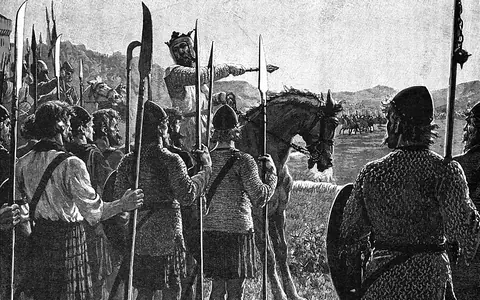
Bannockburn and Arbroath. On 23 and 24 June 1314, near Stirling, Robert I defeated the much larger army of Edward II at Bannockburn, and Edward escaped by boat. The victory secured Bruce in Scotland but did not end the war, which went on for another fourteen years. In 1320 the barons and "community of the realm" sent the letter known as the Declaration of Arbroath to Pope John XXII, asking him to recognize Scotland's independence and Robert as its king. Historians still debate whether it was a diplomatic letter or an early statement that a king ruled with the consent of his people. In 1328 the Treaty of Edinburgh-Northampton recognized Scotland as an independent kingdom.8

The second war. After Robert's death, Edward Balliol and the "Disinherited", quietly backed by Edward III, routed a far larger Scottish army at Dupplin Moor in August 1332. Edward III himself won at Halidon Hill on 19 July 1333, and Berwick fell. The young David II was sent to France for safety; after his return he invaded England and was defeated and captured at Neville's Cross near Durham on 17 October 1346. He was released in 1357 under the Treaty of Berwick, for a ransom of 100,000 merks.9
The Auld Alliance and Scots in France
The alliance with France, later called the Auld Alliance, is conventionally dated to 1295, when the Scottish government of John Balliol's reign sought French support against Edward I.10
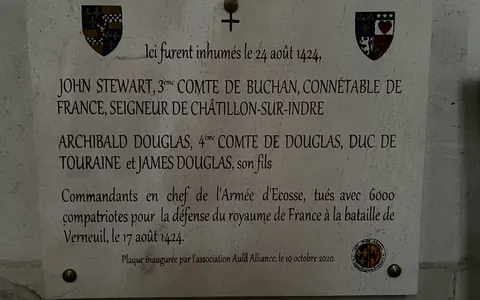
Its high point came in the Hundred Years' War. Between 1419 and 1424 well over ten thousand Scots went to France to fight for the dauphin, later Charles VII. In March 1421 a Franco-Scottish army defeated the English at Baugé and killed Thomas, Duke of Clarence, Henry V's brother. At Verneuil on 17 August 1424 the Duke of Bedford's English army destroyed the Scottish contingent, and Archibald, Earl of Douglas, was killed. Scots went on serving the French kings, above all in their bodyguard, the Garde Écossaise, and the alliance faded only after the Scottish Reformation of 1560. The wider war is told on our Hundred Years' War page.11
Flodden and the Rough Wooing
In 1513, when Henry VIII invaded France, Louis XII asked James IV to invade England, and James honored the alliance. On 9 September 1513 the Earl of Surrey's English army met him near Branxton in Northumberland. Flodden was a catastrophe for Scotland: James IV, the last reigning monarch in Britain to die in battle, was killed with a large part of the Scottish nobility. Scottish dead are usually put at about 10,000, within estimates that range from 5,000 to 17,000, and decades of instability followed under a child king.12

A generation later a large Scottish force was routed at Solway Moss on 24 November 1542, and James V died within weeks, leaving his infant daughter Mary as queen. Henry VIII then tried to force her marriage to his son Edward by invasion, the campaigns known as the Rough Wooing. At Pinkie near Musselburgh on 10 September 1547 the Duke of Somerset's army heavily defeated the Scots, in the last major battle between the separate kingdoms. The result was the opposite of England's aim: Mary was sent to France in 1548 and the French alliance grew stronger.13
Covenanters and civil wars, 1638 to 1692
In 1603 James VI of Scotland inherited the English throne, and the two kingdoms shared a monarch while keeping their own parliaments, laws and churches. When Charles I tried to impose a new prayer book on the Scottish Kirk, the National Covenant, first signed at Greyfriars Kirk in Edinburgh in 1638, demanded a free parliament and a General Assembly free of royal control.14
Scotland in the wars of the three kingdoms. In the Bishops' Wars of 1639 and 1640 the Covenanter army under Alexander Leslie defeated the king's forces at Newburn on 28 August 1640 and occupied Newcastle, which forced Charles to recall the English Parliament. By the Solemn League and Covenant of 1643 the Covenanters allied with that Parliament, and their army fought beside it at Marston Moor on 2 July 1644, a victory that English accounts credited mainly to Cromwell.15
Inside Scotland the war was also a civil war. The royalist Marquis of Montrose, with an army in which Irish troops were a large part, won a run of victories from Tippermuir on 1 September 1644 to Kilsyth in August 1645, until David Leslie's cavalry surprised him at Philiphaugh on 13 September 1645, where many Irish prisoners were killed after they surrendered.16
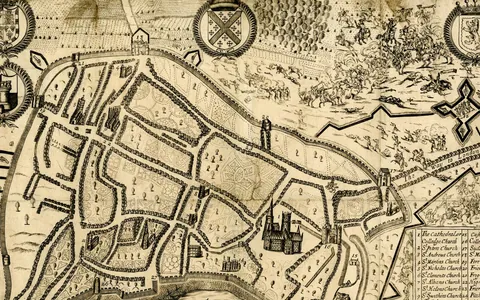
Defeat and occupation. In 1648 the Engagers, Scots who had made a deal with Charles I, invaded England and were crushed by Cromwell at Preston. After the king's execution the Scots proclaimed his son Charles II, and Cromwell invaded. At Dunbar on 3 September 1650 about 3,000 Scots were killed and some 10,000 captured; many of the prisoners were marched to Durham. The largely Scottish royalist army that followed Charles II into England was destroyed at Worcester on 3 September 1651. Scotland was then occupied, its parliament abolished and its towns held by new forts such as Ayr, Inverness and Perth.17
After the Restoration, Presbyterian dissenters who held illegal field services rose in 1679 and were crushed at Bothwell Bridge on 22 June, where about 1,200 were taken prisoner and many shipped to the colonies. After the revolution of 1688 the Scottish Convention declared that James VII had forfeited the crown. His supporters, the first Jacobites, won at Killiecrankie on 27 July 1689, but their leader, Viscount Dundee, was killed and the rising collapsed. On 13 February 1692 government soldiers billeted with the MacDonalds of Glencoe killed 38 of them, and others died of exposure in the snow.18
The union of 1707
The 1690s were hard years, and the failure of the Company of Scotland's colony at Darien in Panama cost the country a large share of its capital. The Scottish Parliament approved the Treaty of Union on 16 January 1707, by 110 votes to 67, amid protest in many parts of the country. On 1 May 1707 the two kingdoms became the Kingdom of Great Britain, with one parliament at Westminster, where Scotland had 45 MPs and 16 representative peers.19
Scotland kept its own legal system, its Presbyterian established church and its education system. The union remained unpopular for decades: in 1713 a motion in the House of Lords to dissolve it failed by only four votes. From then on Scotland had no army or foreign policy of its own, and its soldiers fought in the British Army.20
The Jacobite risings
The Jacobites supported the exiled James VII and II and his descendants, and in Scotland repeal of the union became one of their causes. Jacobitism was never a national movement, however, and many Scots opposed it. A French landing failed in 1708. In 1715 the Earl of Mar raised the Stuart standard at Braemar and gathered an army mainly from the Highland clans and the Episcopalian north-east, but the battle with the Duke of Argyll's smaller army at Sheriffmuir on 13 November 1715 was indecisive and the rising faded. A Spanish-backed landing ended at Glen Shiel on 10 June 1719.21
The Forty-Five. Charles Edward Stuart landed in the Hebrides in July 1745 and raised his standard at Glenfinnan on 19 August, where Cameron of Lochiel brought several hundred men. At Prestonpans on 21 September the Jacobites routed Sir John Cope's government army. The army marched into England and reached Derby on 4 December, but few English Jacobites joined it and no French landing came, so it turned back. It won its last victory at Falkirk Muir on 17 January 1746.22
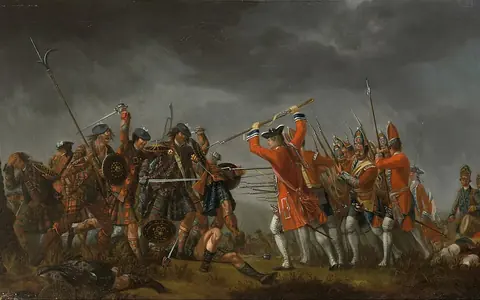
Culloden. On 16 April 1746, on Drumossie Moor east of Inverness, the Duke of Cumberland's army destroyed the exhausted Jacobite army in less than an hour. Between about 1,200 and 1,500 Jacobites were killed; the government's official return gave 50 killed and 259 wounded. Culloden was the last pitched battle fought on British soil, and it was not Scotland against England: the Jacobite army included Lowland Scots and Scottish and Irish regulars in French service, the government army included Scottish regiments and militia, and the National Army Museum concludes that more Scots ended up in arms against Charles than for him.23
The aftermath fell on the Highlands. Only the soldiers in French service were treated as prisoners of war; the rest were treated as rebels, and government troops burned homes and drove off cattle. The Act of Proscription of 1746 banned civilians from carrying arms and wearing Highland dress, and the heritable jurisdictions that underpinned the clan chiefs' power were abolished. Charles escaped to France with the help of Flora MacDonald and died in Rome in 1788.24
Scots in British service after 1707
After the union the soldiers were Scottish but the wars were Britain's. The Black Watch began as independent companies raised from clans loyal to the government to police the Highlands; in 1739 George II ordered them formed into a regular regiment, which fought its first major battle at Fontenoy in 1745. Within about ten years of Culloden the government was raising Highland regiments on a large scale for the Seven Years' War, regardless of the recruits' families' Jacobite past.25
Scottish regiments fought in nearly every British war that followed, including the wars of empire, which for the conquered peoples meant the loss of land and independence. At Waterloo on 18 June 1815 the Royal Scots Greys charged with the Union Brigade, and Sergeant Charles Ewart captured the eagle of the French 45th Line before the British heavy cavalry rode too far and suffered heavily. At Balaklava on 25 October 1854 the 93rd (Sutherland) Highlanders, drawn up two deep instead of the usual four, turned back Russian cavalry; the journalist William Howard Russell's phrase for them became "the thin red line".26

The cost of the 20th century was heavy. The Scottish National War Memorial commemorates nearly 135,000 Scottish dead of World War I and more than 50,000 of World War II; its rolls include Scots who served in other countries' forces and men of Scottish regiments, so counts of Scottish dead vary with the definition. In June 1940 the 51st (Highland) Division, cut off on the coast of Normandy, surrendered at Saint-Valery-en-Caux to Rommel's 7th Panzer Division; a re-formed 51st Highland Division fought at El Alamein in 1942 and then in Sicily.27
Memory and commemoration
Scotland's memory of its wars was largely built in the 19th and 20th centuries. The National Wallace Monument on the Abbey Craig, above the Stirling Bridge battlefield, was begun in 1861 and completed in 1869 to a design by John Thomas Rochead. At Bannockburn, now cared for by the National Trust for Scotland, Charles d'Orville Pilkington Jackson's equestrian statue of Robert the Bruce dates from 1964. On Piper's Hill above Branxton a granite cross put up in 1910 remembers the dead of both nations at Flodden.28
Culloden is remembered as a grave as much as a battlefield. The memorial cairn and the clan grave markers were put up in 1881 by the landowner, Duncan Forbes, and the Irish and French soldiers who fought there are remembered by a separate plaque. The Glenfinnan Monument, built in 1814 and 1815, marks the start of the Forty-Five. The Scottish National War Memorial, designed by Sir Robert Lorimer inside Edinburgh Castle, was opened on 14 July 1927, and the names of the dead are kept there in books on permanent display.29
For more, read the military history of Britain, which covers England before 1707 and the British state after it, the military history of Ireland, the Hundred Years' War and the military history of France, or browse the eras: the Middle Ages and the early modern era.
Battles of Scotland on this site
Every battle we cover in which the Kingdom of Scotland, Scottish forces or the Jacobites fought, in date order, victories and defeats alike.
The Middle Ages 476 to 1500 · 3
- 1297Battle of Stirling Bridge, 1297Kingdom of Scotland vs Kingdom of England
How William Wallace destroyed an English army at Stirling Bridge in 1297.
- 1314Battle of Bannockburn, 1314Kingdom of Scotland vs Kingdom of England
How Robert the Bruce's Scots routed a much larger English army at Bannockburn in 1314.
- 1424Battle of Verneuil, 1424Kingdom of England vs Dauphin's France and the Army of Scotland
On 17 August 1424 Bedford's English army crushed the Dauphin's French, Scots and Lombards outside Verneuil, killing the earls of Douglas and Buchan.
The early modern era 1492 to 1789 · 4
- 1513Battle of Flodden, 1513Kingdom of Scotland vs Kingdom of England
- 1651Battle of Worcester, 1651English Parliament (New Model Army and militia) vs Charles II, Scots Covenanters and English Royalists
On 3 September 1651 Cromwell bridged the Severn and the Teme with boats and destroyed Charles II's army at Worcester; the king fled to France.
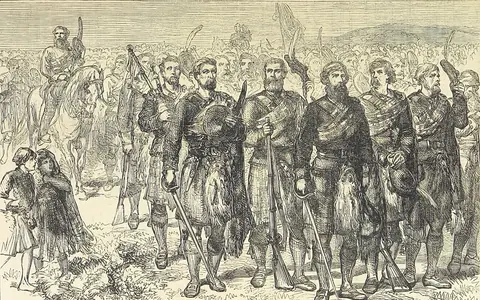
- 1745Battle of Prestonpans, 1745Jacobites vs Great Britain
How a dawn Highland charge shattered a government army in about fifteen minutes, the high point of the 1745 rising.
- 1746Battle of Culloden, 1746Great Britain vs Jacobites
How the Jacobite cause died in under an hour on a bleak Highland moor, the last pitched battle on British soil.
Timeline
- 843Kenneth mac Alpin rules Picts and Gaels together, the traditional start of the kingdom of Alba.30
- 1266By the Treaty of Perth, Norway gives up the Western Isles to Scotland.31
- 1297Moray and Wallace defeat an English army at Stirling Bridge.32
- 1314Robert I defeats Edward II at Bannockburn.33
- 1320The Declaration of Arbroath is sent to the pope.34
- 1424
- 1513
- 1603James VI inherits the English crown: the union of the crowns.37
- 1638The National Covenant is signed in Edinburgh.38
- 1651
- 1707The union with England comes into effect on 1 May.40
- 1745The Jacobites rout a government army at Prestonpans.41
- 1746
- 1927The Scottish National War Memorial opens in Edinburgh Castle.43
Notes
A number in the text points to a note; each note names the works that paragraph draws on, listed in full under Sources.
- The Royal Household, “Kenneth I (r. 843-858)”; BBC History, “Wars of Independence”; The Scottish Parliament, “The Scottish Parliament Past and Present (timeline)”. ↩
- BBC History, “The Union”; National Army Museum, “Battle of Culloden”. ↩
- The Royal Household, “Kenneth I (r. 843-858)”; BBC History, “Dark Ages”. ↩
- The Battlefields Trust, “Battle of Largs”; The Royal Household, “Alexander III (r. 1249-1286)”; Gazetteer for Scotland, “Treaty of Perth”. ↩
- BBC History, “Wars of Independence”; Historic Environment Scotland, “Battle of Stirling Bridge (BTL28)”. ↩
- Historic Environment Scotland, “Battle of Dunbar I (BTL31)”; Historic Environment Scotland, “Battle of Stirling Bridge (BTL28)”; The Battlefields Trust, “Battle of Stirling Bridge”; BBC History, “William Wallace”. ↩
- The Battlefields Trust, “Battle of Falkirk I”; The Royal Household, “Edward I 'Longshanks'”; National Trust for Scotland, “Robert the Bruce”; The Battlefields Trust, “Battle of Bannockburn”. ↩
- Historic Environment Scotland, “Battle of Bannockburn (BTL4)”; The Battlefields Trust, “Battle of Bannockburn”; The Royal Household, “Robert I (r. 1306-1329)”; National Records of Scotland, “The Declaration of Arbroath”; BBC History, “Declaration of Arbroath”; Historic Environment Scotland, “Battle of Stirling Bridge (BTL28)”. ↩
- Historic Environment Scotland, “Battle of Dupplin Moor (BTL8)”; The Battlefields Trust, “Battle of Halidon Hill”; The Royal Household, “David II (r. 1329-1371)”; The Battlefields Trust, “Battle of Neville's Cross”. ↩
- BBC History, “The Auld Alliance”; The Royal Household, “Edward I 'Longshanks'”. ↩
- BBC History, “The Auld Alliance”; B. G. H. Ditcham, “The employment of foreign mercenary troops in the French royal armies, 1415-1470”; Encyclopaedia Britannica, “Archibald Douglas, 4th earl of Douglas”. ↩
- Historic England, “Flodden 1513 (list entry 1000011)”; The Royal Household, “James IV (r. 1488-1513)”; The Battlefields Trust, “Battle of Flodden”; English Heritage, “History of Etal Castle”. ↩
- The Battlefields Trust, “Battle of Solway Moss”; Historic Environment Scotland, “Battle of Pinkie (BTL15)”; The Battlefields Trust, “Battle of Pinkie”. ↩
- UK Parliament, “Union of the Crowns”; The Scottish Parliament, “The Scottish Parliament Past and Present (timeline)”; BBC History, “The Covenanters”. ↩
- National Army Museum, “British Civil Wars”; The Battlefields Trust, “Battle of Newburn Ford”; The Battlefields Trust, “Battle of Marston Moor”; University of St Andrews, “Leslie, Alexander (SSNE 1)”. ↩
- Historic Environment Scotland, “Battle of Tippermuir (BTL39)”; The Battlefields Trust, “Battle of Kilsyth”; Historic Environment Scotland, “Battle of Philiphaugh (BTL14)”. ↩
- National Army Museum, “Oliver Cromwell”; The Battlefields Trust, “Battle of Winwick”; Historic Environment Scotland, “Battle of Dunbar II (BTL7)”; The Battlefields Trust, “Battle of Dunbar II”; The Battlefields Trust, “Battle of Worcester”; University of St Andrews, “Leslie, David (SSNE 2920)”; BBC History, “The Restoration”; The Scottish Parliament, “The Scottish Parliament Past and Present (timeline)”. ↩
- Historic Environment Scotland, “Battle of Bothwell Bridge (BTL5)”; The Battlefields Trust, “Battle of Bothwell Bridge”; BBC History, “The Restoration”; BBC History, “The Union”; Historic Environment Scotland, “Battle of Killiecrankie (BTL12)”; National Library of Scotland, “Jacobites”; National Trust for Scotland, “Glencoe”. ↩
- BBC History, “The Union”; UK Parliament, “Ratification, October 1706 - March 1707”; The Scottish Parliament, “The Scottish Parliament Past and Present (timeline)”; House of Commons Library, “Scottish independence referendum”. ↩
- The Royal Household, “Anne (r. 1702-1714)”; House of Commons Library, “Scottish independence referendum”; The Scottish Parliament, “The Scottish Parliament Past and Present (timeline)”; BBC History, “Jacobites”. ↩
- National Library of Scotland, “Jacobites”; UK Parliament, “The 1715 rebellion”; Historic Environment Scotland, “Battle of Sheriffmuir (BTL17)”; The Battlefields Trust, “Battle of Sheriffmuir”; Historic Environment Scotland, “Battle of Glenshiel (BTL10)”. ↩
- National Trust for Scotland, “Glenfinnan Monument”; National Army Museum, “Jacobite Risings”; Historic Environment Scotland, “Battle of Prestonpans (BTL16)”; The Battlefields Trust, “Battle of Prestonpans”; National Library of Scotland, “Jacobites”; Historic Environment Scotland, “Battle of Falkirk II (BTL9)”. ↩
- Historic Environment Scotland, “Battle of Culloden (BTL6)”; National Army Museum, “Battle of Culloden”; National Trust for Scotland, “Culloden”. ↩
- Historic Environment Scotland, “Battle of Culloden (BTL6)”; National Army Museum, “Battle of Culloden”; National Library of Scotland, “Jacobites”; UK Parliament, “The 1745 rebellion”. ↩
- National Army Museum, “The Black Watch (Royal Highlanders)”; The Black Watch Castle and Museum, “The History of The Black Watch Regiment”; National Army Museum, “Battle of Culloden”; National Trust for Scotland, “War stories of Culloden”. ↩
- National Army Museum, “Famous cavalry charges”; The Royal Scots Dragoon Guards, “Waterloo”; National Army Museum, “93rd (Sutherland Highlanders) Regiment of Foot”; Argyll and Sutherland Highlanders Museum, “Remembering the Argylls”. ↩
- Scottish National War Memorial, “History”; Historic Environment Scotland, “Edinburgh Castle, Scottish National War Memorial (LB48229)”; Imperial War Museums, “The British Expeditionary Force (BEF) in France 1939-1940 (photograph)”; National Army Museum, “The Gordon Highlanders”; Imperial War Museums, “51st Highland Division”; The Black Watch Castle and Museum, “The History of The Black Watch Regiment”. ↩
- Historic Environment Scotland, “Wallace Monument, Abbey Craig (LB41118)”; National Wallace Monument, “Our Story”; Historic Environment Scotland, “Battle of Bannockburn (BTL4)”; National Trust for Scotland, “Bannockburn”; Imperial War Museums, “Battle of Flodden”; Historic England, “Flodden 1513 (list entry 1000011)”. ↩
- National Trust for Scotland, “Culloden”; Historic Environment Scotland, “Battle of Culloden (BTL6)”; National Trust for Scotland, “Glenfinnan Monument”; Historic Environment Scotland, “Edinburgh Castle, Scottish National War Memorial (LB48229)”; Imperial War Museums, “Scottish National War Memorial”; Scottish National War Memorial, “History”. ↩
- The Royal Household, “Kenneth I (r. 843-858)”; BBC History, “Dark Ages”. ↩
- Gazetteer for Scotland, “Treaty of Perth”; The Royal Household, “Alexander III (r. 1249-1286)”. ↩
- Historic Environment Scotland, “Battle of Stirling Bridge (BTL28)”; The Battlefields Trust, “Battle of Stirling Bridge”. ↩
- Historic Environment Scotland, “Battle of Bannockburn (BTL4)”; The Battlefields Trust, “Battle of Bannockburn”. ↩
- National Records of Scotland, “The Declaration of Arbroath”; BBC History, “Declaration of Arbroath”. ↩
- BBC History, “The Auld Alliance”; B. G. H. Ditcham, “The employment of foreign mercenary troops in the French royal armies, 1415-1470”. ↩
- Historic England, “Flodden 1513 (list entry 1000011)”; The Battlefields Trust, “Battle of Flodden”. ↩
- UK Parliament, “Union of the Crowns”; The Scottish Parliament, “The Scottish Parliament Past and Present (timeline)”. ↩
- BBC History, “The Covenanters”; The Scottish Parliament, “The Scottish Parliament Past and Present (timeline)”. ↩
- The Battlefields Trust, “Battle of Worcester”; University of St Andrews, “Leslie, David (SSNE 2920)”. ↩
- The Scottish Parliament, “The Scottish Parliament Past and Present (timeline)”; National Library of Scotland, “Jacobites”. ↩
- Historic Environment Scotland, “Battle of Prestonpans (BTL16)”; The Battlefields Trust, “Battle of Prestonpans”. ↩
- Historic Environment Scotland, “Battle of Culloden (BTL6)”; National Trust for Scotland, “Culloden”. ↩
- Historic Environment Scotland, “Edinburgh Castle, Scottish National War Memorial (LB48229)”; Imperial War Museums, “Scottish National War Memorial”. ↩
Sources
- The Royal Household, “Kenneth I (r. 843-858)”.
- BBC History, Scottish History, “Wars of Independence: introduction”.
- The Scottish Parliament, “The Scottish Parliament Past and Present (timeline)”.
- BBC History, Scottish History, “The Union: introduction”.
- National Army Museum, “Battle of Culloden”.
- BBC History, Scottish History, “Dark Ages: introduction”.
- The Battlefields Trust, Battlefields Hub, “Battle of Largs”.
- The Royal Household, “Alexander III (r. 1249-1286)”.
- Gazetteer for Scotland (University of Edinburgh and Royal Scottish Geographical Society), “Treaty of Perth”.
- Historic Environment Scotland, Inventory of Historic Battlefields, “Battle of Stirling Bridge (BTL28)”.
- Historic Environment Scotland, Inventory of Historic Battlefields, “Battle of Dunbar I (BTL31)”.
- The Battlefields Trust, Battlefields Hub, “Battle of Stirling Bridge”.
- BBC History, Scottish History, “William Wallace”.
- The Battlefields Trust, Battlefields Hub, “Battle of Falkirk I”.
- The Royal Household, “Edward I 'Longshanks'”.
- National Trust for Scotland, “Robert the Bruce”.
- The Battlefields Trust, Battlefields Hub, “Battle of Bannockburn”.
- Historic Environment Scotland, Inventory of Historic Battlefields, “Battle of Bannockburn (BTL4)”.
- The Royal Household, “Robert I (r. 1306-1329)”.
- National Records of Scotland, Open Book blog, “The Declaration of Arbroath: HES and NRS education resources”.
- BBC History, Scottish History, “Declaration of Arbroath”.
- Historic Environment Scotland, Inventory of Historic Battlefields, “Battle of Dupplin Moor (BTL8)”.
- The Battlefields Trust, Battlefields Hub, “Battle of Halidon Hill”.
- The Royal Household, “David II (r. 1329-1371)”.
- The Battlefields Trust, Battlefields Hub, “Battle of Neville's Cross”.
- BBC History, Scottish History, “The Auld Alliance”.
- B. G. H. Ditcham, Edinburgh Research Archive (University of Edinburgh), “The employment of foreign mercenary troops in the French royal armies, 1415-1470” (PhD thesis, 1978).
- Encyclopaedia Britannica, “Archibald Douglas, 4th earl of Douglas”.
- Historic England, National Heritage List for England, “Flodden 1513 (list entry 1000011)”.
- The Royal Household, “James IV (r. 1488-1513)”.
- The Battlefields Trust, Battlefields Hub, “Battle of Flodden”.
- English Heritage, “History of Etal Castle”.
- The Battlefields Trust, Battlefields Hub, “Battle of Solway Moss”.
- Historic Environment Scotland, Inventory of Historic Battlefields, “Battle of Pinkie (BTL15)”.
- The Battlefields Trust, Battlefields Hub, “Battle of Pinkie”.
- UK Parliament, Living Heritage, “Union of the Crowns”.
- BBC History, Scottish History, “The Covenanters”.
- National Army Museum, “British Civil Wars”.
- The Battlefields Trust, Battlefields Hub, “Battle of Newburn Ford”.
- The Battlefields Trust, Battlefields Hub, “Battle of Marston Moor”.
- University of St Andrews, Scotland, Scandinavia and Northern European Biographical Database, “Leslie, Alexander (SSNE 1)”.
- Historic Environment Scotland, Inventory of Historic Battlefields, “Battle of Tippermuir (BTL39)”.
- The Battlefields Trust, Battlefields Hub, “Battle of Kilsyth”.
- Historic Environment Scotland, Inventory of Historic Battlefields, “Battle of Philiphaugh (BTL14)”.
- National Army Museum, “Oliver Cromwell: Lord Protector”.
- The Battlefields Trust, Battlefields Hub, “Battle of Winwick”.
- Historic Environment Scotland, Inventory of Historic Battlefields, “Battle of Dunbar II (BTL7)”.
- The Battlefields Trust, Battlefields Hub, “Battle of Dunbar II”.
- The Battlefields Trust, Battlefields Hub, “Battle of Worcester”.
- University of St Andrews, Scotland, Scandinavia and Northern European Biographical Database, “Leslie, David (SSNE 2920)”.
- BBC History, Scottish History, “The Restoration”.
- Historic Environment Scotland, Inventory of Historic Battlefields, “Battle of Bothwell Bridge (BTL5)”.
- The Battlefields Trust, Battlefields Hub, “Battle of Bothwell Bridge”.
- Historic Environment Scotland, Inventory of Historic Battlefields, “Battle of Killiecrankie (BTL12)”.
- National Library of Scotland, “Jacobites: a timeline”.
- National Trust for Scotland, “Glencoe”.
- UK Parliament, Living Heritage, “Ratification, October 1706 - March 1707”.
- House of Commons Library, “Scottish independence referendum: legal issues (CBP-9104)”.
- The Royal Household, “Anne (r. 1702-1714)”.
- BBC History, Scottish History, “Jacobites”.
- UK Parliament, Living Heritage, “The 1715 rebellion”.
- Historic Environment Scotland, Inventory of Historic Battlefields, “Battle of Sheriffmuir (BTL17)”.
- The Battlefields Trust, Battlefields Hub, “Battle of Sheriffmuir”.
- Historic Environment Scotland, Inventory of Historic Battlefields, “Battle of Glenshiel (BTL10)”.
- National Trust for Scotland, “Glenfinnan Monument: 1745 Rising”.
- National Army Museum, “Jacobite Risings”.
- Historic Environment Scotland, Inventory of Historic Battlefields, “Battle of Prestonpans (BTL16)”.
- The Battlefields Trust, Battlefields Hub, “Battle of Prestonpans”.
- Historic Environment Scotland, Inventory of Historic Battlefields, “Battle of Falkirk II (BTL9)”.
- Historic Environment Scotland, Inventory of Historic Battlefields, “Battle of Culloden (BTL6)”.
- National Trust for Scotland, “Culloden”.
- UK Parliament, Living Heritage, “The 1745 rebellion”.
- National Army Museum, “The Black Watch (Royal Highlanders)”.
- The Black Watch Castle and Museum, “The History of The Black Watch Regiment”.
- National Trust for Scotland, “War stories of Culloden: a series of short talks”.
- National Army Museum, “Famous cavalry charges”.
- The Royal Scots Dragoon Guards, “Waterloo”.
- National Army Museum, “93rd (Sutherland Highlanders) Regiment of Foot”.
- Argyll and Sutherland Highlanders Museum, “Remembering the Argylls”.
- Scottish National War Memorial, “History”.
- Historic Environment Scotland, listed building record, “Edinburgh Castle, Scottish National War Memorial (LB48229)”.
- Imperial War Museums, “The British Expeditionary Force (BEF) in France 1939-1940 (photograph)”.
- National Army Museum, “The Gordon Highlanders”.
- Imperial War Museums, War Memorials Register, “51st Highland Division”.
- Historic Environment Scotland, listed building record, “Wallace Monument, Abbey Craig (LB41118)”.
- National Wallace Monument, “Our Story”.
- National Trust for Scotland, “Bannockburn: commemorative monuments”.
- Imperial War Museums, War Memorials Register, “Battle of Flodden”.
- National Trust for Scotland, “Culloden: memorials”.
- Imperial War Museums, War Memorials Register, “Scottish National War Memorial”.






