

What was the Crimean War?
The Crimean War (1853 to 1856) was fought between the Russian Empire and a coalition of the Ottoman Empire, France, Britain and Sardinia-Piedmont. It began over Russian claims in the Ottoman Empire, centered on the siege of Sevastopol, and ended in allied victory with the Treaty of Paris in March 1856. Disease killed most of its dead.1
British memory of the war is dominated by the Battle of Balaklava, the Light Brigade and Florence Nightingale. The Ottoman Empire started the fighting, lost a squadron at the Battle of Sinop and fought on the Danube and in the Caucasus; France sent the largest allied army and took the decisive Malakhov fort; the Russian defense in the siege of Sevastopol lasted eleven months; and allied fleets fought as far away as the Baltic, the White Sea and Kamchatka. Crimea, then part of the Russian Empire, is today internationally recognized as part of Ukraine.2
Causes of the Crimean War
The immediate quarrel was religious and diplomatic. Britannica names two causes: Russian demands to protect the Orthodox Christian subjects of the Ottoman sultan, and a dispute between Russia and France over the rights of the Orthodox and Catholic churches at the Holy Places in Palestine, then Ottoman territory. In 1853 Tsar Nicholas I sent Prince Menshikov to Constantinople to demand a Russian protectorate over the empire's Orthodox Christians; backed by the British ambassador, Sultan Abdülmecid I refused.3
Behind the quarrel lay the future of the Ottoman Empire, which Nicholas I called the “sick man”. Historians point to long-term Russian ambitions toward the Ottoman lands and the Straits, which Britain resisted as a matter of policy; Britain and France both wanted to keep the Ottoman Empire intact as a barrier to Russian expansion, and Napoleon III also sought to raise France's standing.4
In July 1853 Russian troops occupied the Danubian principalities of Moldavia and Wallachia (in modern Romania), then under Ottoman suzerainty. When mediation failed, the Ottoman Empire declared war on Russia on 4 October 1853 and opened an offensive on the Danube the same month. The Ottomans started the shooting war; Britain and France joined it only months later.5
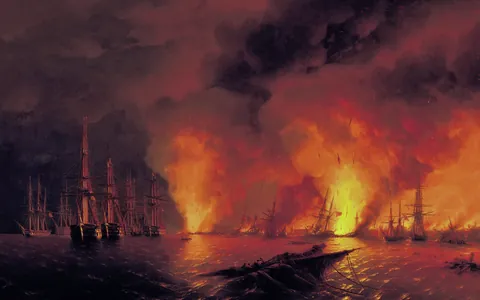
On 30 November 1853 a Russian squadron under Vice Admiral Pavel Nakhimov destroyed an Ottoman squadron in the harbor of Sinop. British and French fleets entered the Black Sea in early January 1854, and on 28 March 1854 Britain and France declared war on Russia.6
Who fought in the Crimean War
The war was fought by a coalition. The Ottoman army fought from first to last, on the Danube, in the Caucasus and in the Crimea. France provided the largest allied army in the Crimea: Andrew Lambert, a naval historian, writes that the French, “with far larger military resources”, gradually took control of the siege. Britain's army was small but backed by the strongest navy of the age.7
Sardinia-Piedmont entered the war on 26 January 1855 and sent 10,000 troops. Its prime minister, Cavour, sought allied goodwill against Austria.8
Austria never fought, but it shaped the war. In 1854 it demanded that Russia leave the Danubian principalities; Russia withdrew and Austria occupied them in August 1854. In late 1855 an Austrian threat to join the allies pushed Russia toward peace.9
Polish exiles saw the war as a chance against Russia, one of the powers that had partitioned Poland. Michał Czajkowski, a veteran of the November Uprising who had converted to Islam and taken the name Mehmet Sadyk Pasha, commanded a formation in Ottoman service. The poet Adam Mickiewicz, sent to Constantinople by Prince Adam Czartoryski in 1855 to help organize a Polish legion, spent weeks in Sadyk Pasha's camp and died in Constantinople on 26 November 1855.10
How the Crimean War unfolded
The Danube, 1853 to 1854. After the Ottoman offensive of October 1853, the Russians crossed the Danube in March 1854 and besieged Silistra. The Ottoman garrison held, and under Austrian pressure Russia left the principalities. Allied troops gathered at Varna found no enemy, only cholera.11
The Crimea, 1854. The allies chose to attack Sevastopol, the base of the Russian Black Sea Fleet. About 60,000 French, British and Ottoman troops landed at Calamita Bay on the west coast of the Crimea on 14 September 1854. They beat the Russian army at the Alma on 20 September but did not march straight into the city. Instead they went round to besiege it from the south, which gave the Russians time to fortify it.12

The siege and the first winter. The siege of Sevastopol began with a bombardment on 17 October 1854, which the defenses withstood. The Russians struck back at Balaklava on 25 October and at Inkerman on 5 November. On 14 November a great storm wrecked the allied camps and sank supply ships, and the earth road from Balaklava to the siege lines dissolved into mud. The allied armies, whose commanders had made almost no provision for a winter campaign, suffered terribly from cold, hunger and disease.13
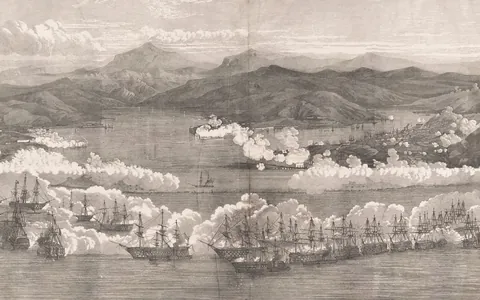
1855: the fall of Sevastopol. In February 1855 an Ottoman garrison beat off a Russian attack on Eupatoria. A joint assault on the Malakhov and the Great Redan failed on 18 June; a Russian attempt to break the siege at the Chernaya (Tchernaya) river failed on 16 August. On 8 September French troops stormed and held the Malakhov while the British attack on the Redan failed again, and by 11 September the Russians had blown up the forts, sunk the last ships and left the south side of the city.14
The Caucasus. In eastern Anatolia the Russians had the better of the Ottomans. The fortress of Kars, whose defense was led by the British commissioner William Fenwick Williams, beat off a Russian assault on 29 September 1855, but hunger, cold and cholera forced its surrender in late November (on 25 or 26 November, depending on the source). Kars gave Russia a bargaining counter at the peace talks.15
The other seas. British and French fleets entered the Baltic in 1854, bombarded and took the fortress of Bomarsund in the Åland Islands, and in August 1855 bombarded Sveaborg (Viapori, now Suomenlinna) outside Helsinki for two days.16
A small British squadron entered the White Sea in 1854 and bombarded the fortified Solovetsky Monastery. In the Pacific, an Anglo-French squadron attacked Petropavlovsk in Kamchatka in late August and early September 1854 and was beaten off after two failed landings, a Russian success celebrated at the time.17
Major battles of the Crimean War
Sinop, 30 November 1853 (18 November in the Russian Old Style calendar, 12 days behind). Nakhimov's six ships of the line and two frigates attacked an Ottoman squadron sheltering in the harbor; shell guns set the wooden Ottoman ships on fire. Ottoman losses were about 3,000 men; the Russians lost 37 killed.18

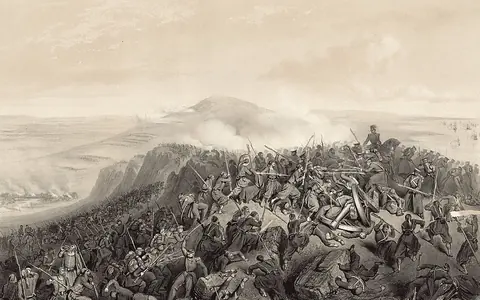
The Alma, 20 September 1854. The first major battle of the Crimean campaign. French troops turned the Russian left along the coast while the British stormed the main position. Prince Menshikov's army retreated with about 5,000 to 5,700 casualties; the allies lost about 3,000 to 3,300.19
Balaklava, 25 October 1854 (13 October Old Style). Russian forces under General Pavel Liprandi took redoubts held by Ottoman troops on the heights above the British base; British officers later blamed those troops, though they were outnumbered and isolated. The Russian cavalry was then stopped by the 93rd Highlanders, the “thin red line” of Scotland's regiments, and driven back by the Heavy Brigade.20
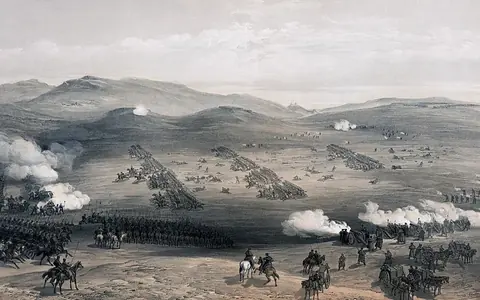
Then came the charge of the Light Brigade. Lord Raglan's loosely worded order to stop the Russians “carrying away the guns” did not say which guns; the cavalry commanders, Lucan and Cardigan, could see only a battery at the end of a valley covered from three sides, and Cardigan led about 670 men down it. The National Army Museum gives 247 to about 260 killed or wounded, Britannica about 270; French Chasseurs d'Afrique covered the survivors' retreat. The Russians kept the heights and the road but not Balaklava, and counted the day a victory.21
Inkerman, 5 November 1854. A Russian surprise attack at dawn, in thick fog, on the British positions. Small British units held until French reinforcements arrived, and the Russians withdrew with heavy losses.22
Eupatoria, 17 February 1855. A Russian force under General Khrulev attacked the Ottoman-held port in western Crimea and withdrew when it could not break in, an Ottoman defensive victory.23
The Malakhov, 8 September 1855. French Zouaves under General MacMahon stormed the Malakhov. With the Malakhov lost, the Russians abandoned the south side of Sevastopol.24
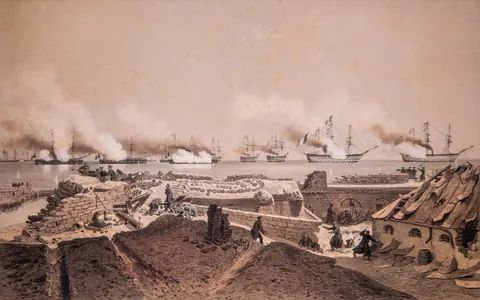
Kinburn, 17 October 1855. Three French armored floating batteries led an Anglo-French bombardment of the Russian forts at the mouth of the Dnieper and Bug, which surrendered within hours. It was the first combat use of ironclad warships.25
How many died: disease, nursing and casualties
Disease, not battle, killed most of the soldiers who died. Cholera, dysentery, typhus and exposure swept the camps, trenches and hospitals. The British supply system collapsed in the first winter; the French army suffered most in the second winter, when the British were by then well clothed and housed.26

No precise total exists. Britannica estimates about 250,000 casualties on each side; The Gazette gives about 250,000 allied dead and around half a million Russian dead; Goldfrank puts Russia's losses at 400,000 to 500,000 casualties. For the French army, the 1865 report of the army doctor Jean-Charles Chenu counted over 95,000 dead, about 75,000 of them from disease. British deaths were about 21,000, of whom roughly 16,000 died of disease.27
Florence Nightingale, appointed to lead the female nurses in the British military hospitals in the East, reached the hospital at Scutari (Üsküdar), across the Bosporus from Constantinople, in early November 1854 with 38 nurses. She kept statistics and later used diagrams to show that disease had killed far more soldiers than wounds.28
The legend needs care. Deaths at Scutari kept rising after she arrived, to 42 percent of patients by February 1855 according to the National Army Museum, and fell only after a government sanitary commission repaired the sewers and ventilation in the spring; Historic England notes that this fall was wrongly credited to her nursing. Her lasting achievement was the reform of nursing and hospitals: the Nightingale Training School opened at St Thomas' Hospital in London in 1860.29
Mary Seacole, a Jamaican-born healer, offered to serve as an army nurse and was turned down; she attributed the refusal to racial prejudice. She paid her own way to the Crimea and opened the British Hotel near Balaklava, a store and canteen from which she sold supplies and treated sick and wounded men. She returned home bankrupt, published a best-selling memoir in 1857, then fell into obscurity after her death; in 2004 she came first in a British poll of 100 Great Black Britons.30
Key figures of the Crimean War
Allied commanders. Field Marshal Lord Raglan led the British army from 1854 until his death during the siege in 1855. Marshal Saint-Arnaud led the French army at the Alma but was dying of cholera and was replaced by General Canrobert; Canrobert resigned in May 1855 and Aimable Pélissier, the last French commander in chief, took the Malakhov and was made duc de Malakoff.31
The defenders of Sevastopol. Prince Aleksandr Menshikov commanded the Russian army at the Alma and at Sevastopol. The engineer Eduard Totleben built the city's earthworks and batteries, using guns taken from the scuttled fleet. Vice Admiral Pavel Nakhimov, the victor of Sinop, directed the defense of the south side and was mortally wounded on the Malakhov on 10 July 1855 (28 June Old Style).32
Who won the Crimean War: the Treaty of Paris
After the fall of Sevastopol and the loss of Kinburn, and with Austria threatening to join the allies, Russia accepted preliminary peace terms on 1 February 1856. The Congress of Paris drew up the settlement, and the Treaty of Paris was signed on 30 March 1856.33
The powers guaranteed the independence and territorial integrity of the Ottoman Empire. Russia gave up southern Bessarabia at the mouth of the Danube, the Danube was opened to the ships of all nations, and the Black Sea was neutralized: closed to warships. Russia repudiated the Black Sea clauses in 1870, and Sevastopol was fortified again after 1871.34
For the Russian Empire the defeat exposed its technological and structural backwardness. Britannica says it awakened the new tsar, Alexander II, to the need to modernize; Goldfrank calls it a major catalyst of the Great Reforms, including the emancipation of the serfs in 1861.35
Crimea's own people paid a price too. Britannica records that many Crimean Tatars were forcibly dispersed after the war, and the German Federal Agency for Civic Education estimates that about 300,000 left for Ottoman lands between 1859 and 1865, after which Tatars became a minority in Crimea for the first time.36
Legacy of the Crimean War
The Crimean War was the first major war covered on the spot by civilian journalists and photographers. William Howard Russell's reports in The Times on the army's shortcomings caused an outcry that helped bring down Lord Aberdeen's government in early 1855, and Roger Fenton and James Robertson photographed the camps and the battlefields.37

It also brought new technology to war. A submarine telegraph cable from Balaklava to Varna, laid in April 1855, put London and Paris within a day's contact with their commanders; a railway was built at Balaklava to supply the siege; and the French ironclad batteries at Kinburn pointed to the end of the wooden battle fleet.38
Britain created the Victoria Cross by royal warrant on 29 January 1856 to reward gallantry in this war, open to all ranks. Alfred Tennyson's poem “The Charge of the Light Brigade”, first published in The Examiner on 9 December 1854, fixed the charge in British memory, and towns across Britain named streets after Alma, Inkerman, Balaclava and Sebastopol.39

In France the war left its mark on the map of Paris, from the Pont de l'Alma to the Boulevard de Sébastopol and the town of Malakoff. In Russia the defense of Sevastopol became a national epic: Leo Tolstoy, who served there as a young officer, wrote three Sevastopol Sketches (1855 to 1856), and Nakhimov became a naval hero, honored by a Soviet order in 1944 and by an annual day of military glory for Sinop.40
Battles of the Crimean War
Our articles on the battles of the war are listed below in date order.
- 1853Battle of Sinop, 1853Russian Empire (Black Sea Fleet) vs Ottoman Empire
On 30 November 1853 Nakhimov's Russian squadron came out of the fog at Sinop and burned the Ottoman squadron at anchor; the outcry helped bring Britain into the war.
- 1854Siege of Sevastopol, 1854Britain, France and the Ottoman Empire vs Russian Empire
On 17 October 1854 the Allies opened their first bombardment of Sevastopol. Two magazines exploded, Admiral Kornilov was killed, and the Crimean War became an eleven-month siege.
- 1854Battle of the Alma, 1854Britain and France (with Ottoman allies) vs Russian Empire
How the British and French stormed the Russian heights above the Alma in the first great battle of the Crimean War.
- 1854The Battle of Balaclava, 1854Britain, France and the Ottomans vs Russian Empire
The Crimean War clash of 25 October 1854 that gave history the Thin Red Line and the tragic Charge of the Light Brigade, immortalized by Tennyson.
- 1855Battle of Eupatoria, 1855Ottoman Empire, with a French detachment and British, French and Ottoman warships vs Russian Empire
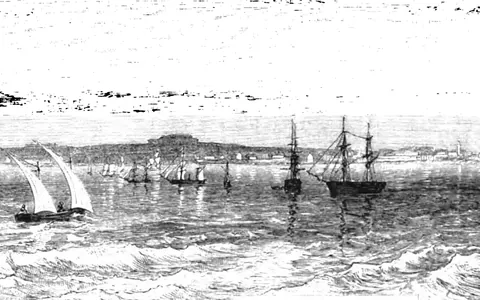
At daybreak on 17 February 1855 a Russian army with eighty guns struck the Ottoman garrison of Eupatoria. Behind half-finished earthworks, with warships firing from the bay, Omer Pasha's troops beat off three assaults.
- 1855Battle of Kinburn, 1855France and Britain vs Russian Empire
On 17 October 1855 three French armored floating batteries shot the Russian fort at Kinburn to pieces and barely took a scratch: the first battle of the ironclad age.
Timeline of the Crimean War
- 1853
- 1854Britain and France declare war on Russia on 28 March.42
- 1854
- 1854The siege of Sevastopol begins on 17 October; Balaklava follows on 25 October and Inkerman on 5 November.44
- 1855The French take the Malakhov on 8 September and the Russians leave Sevastopol.45
- 1855
- 1856The Treaty of Paris is signed on 30 March.47
Where to read next
See also our rankings of the greatest battles of the industrial age, the greatest sieges in history, the greatest battles of the Ottoman Empire and the greatest cavalry charges; the military history of Britain, the military history of France and the military history of Scotland; our biography of Florence Nightingale; the industrial age; and the industrial age battles quiz and the British battles quiz.
Notes
A number in the text points to a note; each note names the works that paragraph draws on, listed in full under Sources.
- Encyclopaedia Britannica, “Crimean War”; National Army Museum, “Crimean War”; The Gazette, “This month in history”. ↩
- Encyclopaedia Britannica, “Crimean War”; Encyclopedia.com (David M. Goldfrank in the, Encyclopedia of Russian History; National Army Museum, “Crimean War”; EBSCO Research Starters, “Siege of Sevastopol”. ↩
- Encyclopaedia Britannica, “Crimean War”; The Gazette, “This month in history”; Historic UK, “Timeline of the Crimean War”. ↩
- Encyclopedia.com (David M. Goldfrank in the, Encyclopedia of Russian History; National Army Museum, “Crimean War”; The Gazette, “This month in history”. ↩
- Encyclopaedia Britannica, “Crimean War”; Historic UK, “Timeline of the Crimean War”; Encyclopedia.com (David M. Goldfrank in the, Encyclopedia of Russian History. ↩
- Encyclopaedia Britannica, “Crimean War”; Historic UK, “Timeline of the Crimean War”; The Gazette, “This month in history”. ↩
- National Army Museum, “Crimean War”; Encyclopedia.com (David M. Goldfrank in the, Encyclopedia of Russian History; Historic UK, “Timeline of the Crimean War”. ↩
- Encyclopaedia Britannica, “Crimean War”; Historic UK, “Timeline of the Crimean War”; The Gazette, “This month in history”; Herodote.net, “Guerre de Crimée (1854 à 1856): Français et Anglais côte à côte”. ↩
- Encyclopaedia Britannica, “Crimean War”; National Army Museum, “Crimean War”; Historic UK, “Timeline of the Crimean War”. ↩
- Dzieje.pl, “Tajemnica śmierci Mickiewicza”; University of Łódź Repository, “Transgresja jako znak stałości”. ↩
- National Army Museum, “Crimean War”; Encyclopedia.com (David M. Goldfrank in the, Encyclopedia of Russian History; The Victorian Web, “The Crimean War”. ↩
- National Army Museum, “Crimean War”; Encyclopedia.com (David M. Goldfrank in the, Encyclopedia of Russian History; Encyclopaedia Britannica, “Battle of Balaklava”; The Victorian Web, “The Crimean War”. ↩
- Encyclopaedia Britannica, “Siege of Sevastopol”; National Army Museum, “Crimean War”; Encyclopedia.com (David M. Goldfrank in the, Encyclopedia of Russian History. ↩
- Historic UK, “Timeline of the Crimean War”; Encyclopedia.com (David M. Goldfrank in the, Encyclopedia of Russian History; Encyclopaedia Britannica, “Siege of Sevastopol”; National Army Museum, “Crimean War”; Encyclopaedia Britannica, “Aimable-Jean-Jacques Pélissier, duc de Malakoff”. ↩
- Dictionary of Canadian Biography, “Williams, Sir William Fenwick”; Historic UK, “Timeline of the Crimean War”; Encyclopedia.com (David M. Goldfrank in the, Encyclopedia of Russian History. ↩
- National Army Museum, “Crimean War”; Encyclopedia.com (David M. Goldfrank in the, Encyclopedia of Russian History; Governing Body of Suomenlinna, “History of the Fortress”; National Army Museum, “Victoria Cross”. ↩
- Royal Museums Greenwich, “Translation of an account of the attack on Solovetski monastery by British naval forces under Captain Erasmus Ommanney”; European History Online, “The Attack of the English on the Solovets Monastery, 1854”; Royal Museums Greenwich, “The Anglo-French bombardment of Avacha Bay during the Crimean War”; Presidential Library, “Anglo-French squadron’s attack against Petropavlovsk-Kamchatsky during the Crimean War repulsed”. ↩
- Encyclopedia.com (John C. K. Daly in the, Encyclopedia of Russian History; Presidential Library, “Birthday anniversary of Russian naval commander Admiral Pavel Nakhimov”; Historic UK, “Timeline of the Crimean War”. ↩
- National Army Museum, “Crimean War”; Encyclopaedia Britannica, “Battle of Balaklava”; Encyclopedia.com (David M. Goldfrank in the, Encyclopedia of Russian History. ↩
- National Army Museum, “Battle of Balaklava”; Encyclopaedia Britannica, “Battle of Balaklava”; National Army Museum, “Crimean War”. ↩
- National Army Museum, “Crimean War”; National Army Museum, “Battle of Balaklava”; Encyclopaedia Britannica, “Battle of Balaklava”; Encyclopaedia Britannica, “Charge of the Light Brigade”; The Victorian Web, “The Crimean War”. ↩
- National Army Museum, “Crimean War”; Historic UK, “Timeline of the Crimean War”; Encyclopedia.com (David M. Goldfrank in the, Encyclopedia of Russian History. ↩
- Historic UK, “Timeline of the Crimean War”; Encyclopedia.com (David M. Goldfrank in the, Encyclopedia of Russian History. ↩
- Herodote.net, “Guerre de Crimée (1854 à 1856): Français et Anglais côte à côte”; Slate.fr, “Crimée, une guerre pour mémoire”; Encyclopaedia Britannica, “Siege of Sevastopol”; National Army Museum, “Crimean War”. ↩
- U.S. Naval Institute, Naval History; WarHistory.org, “Battle of Kinburn”; National Army Museum, “Crimean War”. ↩
- Encyclopaedia Britannica, “Crimean War”; National Army Museum, “Crimean War”; Herodote.net, “Guerre de Crimée (1854 à 1856): Français et Anglais côte à côte”. ↩
- Encyclopaedia Britannica, “Crimean War”; The Gazette, “This month in history”; Encyclopedia.com (David M. Goldfrank in the, Encyclopedia of Russian History; Histoire, économie & société; Herodote.net, “Guerre de Crimée (1854 à 1856): Français et Anglais côte à côte”; Manchester and Lancashire Family History Society, “Deaths at Scutari Hospital”. ↩
- National Army Museum, “Florence Nightingale”; Historic England, “The Life and Legacy of Florence Nightingale”; University of Alabama at Birmingham Libraries, “The Life of Florence Nightingale”. ↩
- National Army Museum, “Florence Nightingale”; Historic England, “The Life and Legacy of Florence Nightingale”; National Army Museum, “Crimean War”. ↩
- National Army Museum, “Crimean War”; Encyclopaedia Britannica, “Mary Seacole”; Encyclopaedia Britannica, “Crimean War”. ↩
- EBSCO Research Starters, “Siege of Sevastopol”; Encyclopedia.com (David M. Goldfrank in the, Encyclopedia of Russian History; Herodote.net, “Guerre de Crimée (1854 à 1856): Français et Anglais côte à côte”; Encyclopaedia Britannica, “Aimable-Jean-Jacques Pélissier, duc de Malakoff”. ↩
- Encyclopaedia Britannica, “Siege of Sevastopol”; EBSCO Research Starters, “Siege of Sevastopol”; Encyclopedia.com (, Encyclopedia of Russian History; Presidential Library, “Birthday anniversary of Russian naval commander Admiral Pavel Nakhimov”. ↩
- Encyclopaedia Britannica, “Crimean War”; National Army Museum, “Crimean War”; Historic UK, “Timeline of the Crimean War”. ↩
- Encyclopaedia Britannica, “Treaty of Paris (1856)”; The Gazette, “This month in history”; National Army Museum, “Crimean War”; Encyclopedia.com, “Sevastopol”. ↩
- Encyclopaedia Britannica, “Crimean War”; Encyclopedia.com (David M. Goldfrank in the, Encyclopedia of Russian History. ↩
- Encyclopaedia Britannica, “Crimea”; Federal Agency for Civic Education, “Crimean Tatar and Ukrainian diaspora groups in Türkiye”. ↩
- Encyclopaedia Britannica, “Crimean War facts”; National Army Museum, “Crimean War”; Historic UK, “Timeline of the Crimean War”; Historic England, “The Life and Legacy of Florence Nightingale”. ↩
- National Army Museum, “Field telegraph wire used during the Crimean War, 1855”; Encyclopedia.com (David M. Goldfrank in the, Encyclopedia of Russian History; National Army Museum, “Crimean War”; U.S. Naval Institute, Naval History. ↩
- National Army Museum, “Victoria Cross”; The Gazette, “This month in history”; Literature Cambridge, “Alfred Tennyson, The Charge of the Light Brigade (1854)”; Texas A&M University, Victorian Poetry and Poetics; Historic UK, “Timeline of the Crimean War”. ↩
- Slate.fr, “Crimée, une guerre pour mémoire”; Herodote.net, “Guerre de Crimée (1854 à 1856): Français et Anglais côte à côte”; Encyclopaedia Britannica, “Leo Tolstoy”; Encyclopedia.com, “Sevastopol”; Encyclopedia.com (, Encyclopedia of Russian History; Presidential Library, “Birthday anniversary of Russian naval commander Admiral Pavel Nakhimov”. ↩
- Encyclopedia.com (John C. K. Daly in the, Encyclopedia of Russian History; Historic UK, “Timeline of the Crimean War”. ↩
- Encyclopaedia Britannica, “Crimean War”; Historic UK, “Timeline of the Crimean War”. ↩
- National Army Museum, “Crimean War”; Encyclopaedia Britannica, “Battle of Balaklava”. ↩
- Encyclopaedia Britannica, “Siege of Sevastopol”; National Army Museum, “Crimean War”. ↩
- Encyclopaedia Britannica, “Siege of Sevastopol”; National Army Museum, “Crimean War”. ↩
- WarHistory.org, “Battle of Kinburn”; National Army Museum, “Crimean War”; Dictionary of Canadian Biography, “Williams, Sir William Fenwick”; Historic UK, “Timeline of the Crimean War”. ↩
- Encyclopaedia Britannica, “Crimean War”; The Gazette, “This month in history”. ↩
Sources
- Encyclopaedia Britannica, “Crimean War”.
- National Army Museum, “Crimean War”.
- The Gazette (The National Archives), “This month in history: The Crimean War and the 1856 Treaty of Paris”.
- Encyclopedia.com (David M. Goldfrank in the Encyclopedia of Russian History; Andrew Lambert in the Encyclopedia of Modern Europe: Europe 1789 to 1914; Stephen Badsey in The Oxford Companion to British History), “Crimean War”.
- EBSCO Research Starters, “Siege of Sevastopol”.
- Historic UK, Jessica Brain, “Timeline of the Crimean War”.
- Herodote.net, “Guerre de Crimée (1854 à 1856): Français et Anglais côte à côte”.
- Dzieje.pl (Muzeum Historii Polski), “Tajemnica śmierci Mickiewicza: wśród podejrzanych cholera, Rosjanie i... rodacy”.
- University of Łódź Repository, “Transgresja jako znak stałości: casus Michała Czajkowskiego, Sadyka Paszy”.
- The Victorian Web, Marjie Bloy, “The Crimean War: Britain in Blunderland, part 2”.
- Encyclopaedia Britannica, “Battle of Balaklava”.
- Encyclopaedia Britannica, “Siege of Sevastopol”.
- Encyclopaedia Britannica, “Aimable-Jean-Jacques Pélissier, duc de Malakoff”.
- Dictionary of Canadian Biography, “Williams, Sir William Fenwick”.
- Governing Body of Suomenlinna, “History of the Fortress”.
- National Army Museum, “Victoria Cross”.
- Royal Museums Greenwich, “Translation of an account of the attack on Solovetski monastery by British naval forces under Captain Erasmus Ommanney”.
- European History Online (EGO), Leibniz Institute of European History, “The Attack of the English on the Solovets Monastery, 1854”.
- Royal Museums Greenwich, “The Anglo-French bombardment of Avacha Bay during the Crimean War”.
- Presidential Library (Russia), “Anglo-French squadron’s attack against Petropavlovsk-Kamchatsky during the Crimean War repulsed”.
- Encyclopedia.com (John C. K. Daly in the Encyclopedia of Russian History), “Sinope, Battle of”.
- Presidential Library (Russia), “Birthday anniversary of Russian naval commander Admiral Pavel Nakhimov”.
- National Army Museum, “Battle of Balaklava”.
- Encyclopaedia Britannica, “Charge of the Light Brigade”.
- Slate.fr, “Crimée, une guerre pour mémoire”.
- U.S. Naval Institute, Naval History, Michael Carroll Dooling, “The Thin Iron Line: The Crimean War Transforms Naval Power”.
- WarHistory.org, “Battle of Kinburn”.
- Histoire, économie & société (Armand Colin), “Compter les morts de Crimée: un tournant sur l’identité professionnelle des médecins de l’armée française (1865 à 1882)”.
- Manchester and Lancashire Family History Society, “Deaths at Scutari Hospital”.
- National Army Museum, “Florence Nightingale: The Lady with the Lamp”.
- Historic England, “The Life and Legacy of Florence Nightingale”.
- University of Alabama at Birmingham Libraries, “The Life of Florence Nightingale”.
- Encyclopaedia Britannica, “Mary Seacole”.
- Encyclopedia.com (Encyclopedia of Russian History), “Nakhimov, Pavel Stepanovich”.
- Encyclopaedia Britannica, “Treaty of Paris (1856)”.
- Encyclopedia.com, “Sevastopol”.
- Encyclopaedia Britannica, “Crimea: History”.
- Federal Agency for Civic Education (bpb), “Crimean Tatar and Ukrainian diaspora groups in Türkiye”.
- Encyclopaedia Britannica, “Crimean War facts”.
- National Army Museum, “Field telegraph wire used during the Crimean War, 1855”.
- Literature Cambridge, “Alfred Tennyson, The Charge of the Light Brigade (1854)”.
- Texas A&M University, Victorian Poetry and Poetics, “The Charge of the Light Brigade (1854)”.
- Encyclopaedia Britannica, “Leo Tolstoy”.






