

What were the Crusades and who won?
The Crusades were wars that Latin Christians fought with papal backing for Jerusalem and the Holy Land from 1095 to 1291. The First Crusade took Jerusalem in 1099, but Saladin won it back after the Battle of Hattin in 1187, and in 1291 the Mamluks took Acre, the last crusader city. The Muslim powers won.1
For almost two centuries, armies from Latin Christian Europe fought the Muslim powers of the Middle East for Jerusalem and the lands around it. The struggle also drew in the Byzantine Empire, struck the Jewish communities of Europe and the Holy Land, and spread to Iberia and the Baltic. Our battle guides follow the war in the East from the destruction of the People's Crusade at the Battle of Civetot in 1096, through Saladin's victory at the Battle of Hattin and his siege of Jerusalem in 1187, to Richard the Lionheart's win at the Battle of Arsuf in 1191. Below: why the Crusades began, who fought them and who won.2
Causes of the Crusades
It began with the Seljuk Turks. In 1071 a Seljuk army under Sultan Alp Arslan defeated the Byzantine emperor Romanos IV Diogenes at the Battle of Manzikert, in Armenia, and over the next two decades the empire lost most of Asia Minor to Turkish rulers. Seljuk forces also took Jerusalem from the Fatimid caliphs of Cairo, Shiite rivals of the Sunni Seljuks, and reports reaching the West told of Christian pilgrims being harassed or barred from the holy places.3
The Byzantine emperor Alexios I Komnenos saw a chance to win back lost ground with Western soldiers and asked the Latin Church for military help. Pope Urban II answered at the Council of Clermont on 27 November 1095. He called on knights to stop fighting one another and go east to help their fellow Christians and free the holy places, above all the Church of the Holy Sepulcher in Jerusalem, which was said to hold the tomb of Christ.4
Motives were mixed. Urban promised those who took the cross the remission of the penance owed for their confessed sins, which many understood as a way to wash away sin itself, and the Church protected their property while they were away. Many crusaders also hoped for land, wealth and fame in the East, and Urban, a reforming pope, wanted to strengthen the papacy's leadership of Western Christendom. The New Catholic Encyclopedia warns against seeing the crusade as a mere reflex to the Byzantine appeal: it grew out of the knightly piety and Church reform of eleventh century Europe.5
Who fought in the Crusades
On one side stood the crusaders, Latin Christians from across Western Europe: lords and knights, but also, in the first expeditions, poor men and women. After the First Crusade four crusader states held the coast of Syria and Palestine and its hinterland: the Kingdom of Jerusalem, the County of Edessa, the Principality of Antioch and the County of Tripoli, together called Outremer, the land across the sea. Military orders of knights living under monastic vows, such as the Templars and the Hospitallers, garrisoned castles, guarded pilgrims and became the backbone of the crusader armies.6
On the other side there was no single Muslim enemy. In the 1090s the Seljuk lands were split among rival emirs and military governors, and the Fatimid caliphate of Cairo was itself at war with the Seljuks. The Muslim chronicler Ibn al-Athir later blamed the Frankish success on exactly this: the kings of Islam were busy fighting each other. Over the twelfth century the Turkish ruler Zangi, his son Nur al-Din and the Kurdish Saladin, founder of the Ayyubid dynasty, built a united front; in the thirteenth century the Mamluk sultans took their place.7
The Byzantine Empire was a third party with aims of its own. Alexios wanted Western soldiers to help him recover Asia Minor, but his relations with the crusade leaders soon turned tense, and cooperation between Byzantines and crusaders at times gave way to open hostility. The Jews of Europe and the Holy Land were not a side at all, yet they became repeated victims of crusading violence.8
The First Crusade (1096 to 1099)
Urban's appeal drew a far bigger response than anyone expected. The New Catholic Encyclopedia suggests that perhaps as many as 120,000 men and women took the cross, while World History Encyclopedia counts about 60,000 soldiers and at least half as many again of non-combatants. The first to leave were popular bands, among them the followers of the preacher Peter the Hermit.9
In 1096 some of these bands turned on the Jewish communities of the Rhineland. Crusaders led by Count Emicho of Leiningen and others attacked the Jews of Speyer, Worms, Mainz, Cologne and Trier. Bishops who tried to protect them often could not, and many Jews were killed or forced to convert, while many others chose death rather than baptism. The Encyclopaedia Judaica sees these massacres as the start of a long period of recurring persecution in European Jewish history.10
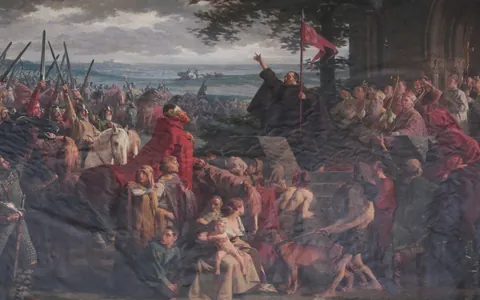
Peter's followers reached Constantinople, and Alexios had them ferried across the Bosporus to a camp at Civetot. On 21 October 1096 most of them marched toward Nicaea, walked into a Seljuk trap and were destroyed; see our guide to the Battle of Civetot.11
The armies of the princes, among them those of Godfrey of Bouillon and the Norman Bohemond, followed in 1096 and 1097. With Byzantine support they crossed Seljuk-held Asia Minor and laid siege to Antioch, which they took in 1098 after a siege of many months. They were then besieged in the city by a larger Muslim relief army, which they defeated.12

The survivors reached Jerusalem in June 1099. After a siege of about five weeks they stormed the city on 15 July, and a massacre of its Muslim and Jewish inhabitants followed. As one Christian writer put it, the slaughter was so great that the crusaders waded in blood up to their ankles. The victors set up the Kingdom of Jerusalem; the capture of Tripoli in 1109 completed the four crusader states. Always short of fighting men, they depended on Muslim disunity.13
Zangi, Nur al-Din and the Second Crusade
The Muslim counterattack began in northern Syria. In 1144 Zangi took Edessa, the first crusader state to be founded and the first to fall. Pope Eugenius III called a new crusade, preached above all by the Cistercian abbot Bernard of Clairvaux, and two kings took the cross: Louis VII of France and Conrad III of Germany.14
The Second Crusade (1147 to 1149) failed in the East. Turkish forces beat Conrad's German army in Asia Minor in 1147, and in July 1148 the combined crusader armies gave up a siege of Damascus. Crusaders who went by sea did better in Iberia, where in 1147 they helped the king of Portugal take Lisbon from the Muslims.15

Zangi was murdered in 1146, but his son Nur al-Din carried on his war. He framed it in the language of jihad, holy war, and worked to bind Muslim Syria together against the Franks. When the crusaders invaded Egypt in the 1160s, he sent an army there under the Kurdish general Shirkuh, who took his young nephew Saladin with him.16
Saladin, the Battle of Hattin and the fall of Jerusalem (1187)
Saladin took control of Egypt in 1169. After Nur al-Din died in 1174 he turned on his former master's heirs, took Damascus the same year and over the following decade brought most of Syria under his rule as sultan of Egypt and Syria.17
The truce between Saladin and the Kingdom of Jerusalem broke down after Raynald of Châtillon, one of the kingdom's most powerful lords, attacked a Muslim caravan. In July 1187 Saladin besieged Tiberias, and King Guy of Lusignan marched to relieve it with the kingdom's whole field army, carrying the relic of the True Cross. Modern estimates differ: EBSCO's Research Starters give about 20,000 crusaders against 30,000 for Saladin, while World History Encyclopedia counts over 16,000 Latin soldiers against 18,000 to 24,000 in Saladin's army.18
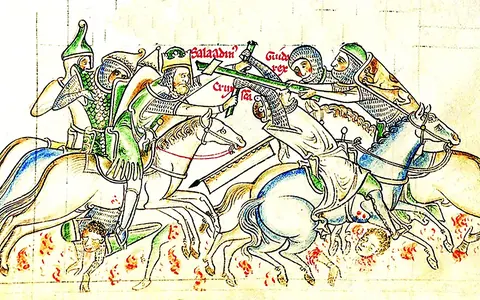
Guy's army had to cross the dry hills of Galilee in the July heat, harried all the way by Saladin's mounted archers. Cut off from water, it was surrounded on 4 July 1187 near the twin hill known as the Horns of Hattin. The Muslims captured the True Cross, and most of the crusader army was killed or forced to surrender; read the full account in our guide to the Battle of Hattin.19
Saladin's treatment of the prisoners shows both sides of his reputation. He spared King Guy, but he killed Raynald, the breaker of the truce, striking the first blow himself, and he had the captured Templars and Hospitallers beheaded. The historian William Hamblin explains that Saladin saw the military orders as the most dangerous and least compromising of his enemies.20
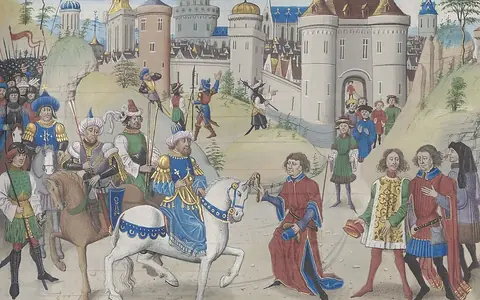
With the field army gone, town after town surrendered, until the crusaders held only a few castles and coastal cities. Balian of Ibelin, a baron who had escaped from Hattin, led the defense of Jerusalem and, when resistance became hopeless, negotiated its surrender. Under the terms read out on 2 October 1187, each man was to pay ten gold pieces for his freedom, each woman five and each child one, and those who could not pay were to be enslaved. Read the full story in our guide to the siege of Jerusalem in 1187.21
The Third Crusade: Richard the Lionheart against Saladin
The loss of Jerusalem set off one of the greatest crusading efforts of all. The pope called a new crusade, and three of the most powerful rulers in Europe took the cross: Emperor Frederick I Barbarossa, King Philip II of France and King Richard I of England. Frederick never reached the Holy Land: he drowned in a river in Asia Minor in June 1190.22
Richard took Cyprus on his way east, then joined the siege of Acre, which the crusaders retook in 1191. After the city fell he had the Muslim prisoners killed: World History Encyclopedia puts their number at 2,500 to 3,000, and William Hamblin at 2,700. Philip went home soon afterward, leaving Richard in command.23
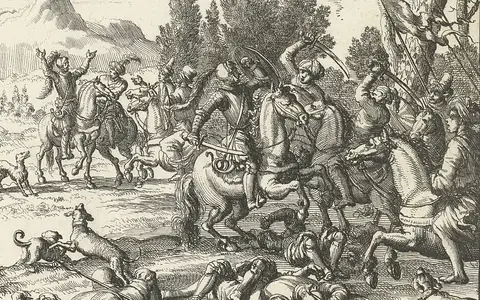
As Richard marched south toward Jaffa, the port that served Jerusalem, Saladin attacked his column near Arsuf on 7 September 1191. After hours of arrows the crusader knights counterattacked and drove Saladin's men from the field, but the sultan's army survived. The historian Andrew Latham judges Arsuf a clear tactical victory but far from decisive in strategic terms; see our guide to the Battle of Arsuf.24
Richard never retook Jerusalem. In 1192 he and Saladin made a truce at Jaffa: the crusaders kept most of the coastal cities, and Christian pilgrims were free to visit Jerusalem, which stayed in Muslim hands. Richard sailed home that year, and Saladin died in 1193. Compare the two men in Saladin vs Richard the Lionheart.25
The Fourth Crusade and the sack of Constantinople (1204)
Pope Innocent III called the Fourth Crusade to strike at the Ayyubids through Egypt. Gathered at Venice in 1202, the crusaders could not pay for their fleet, so the Venetians had them attack Zara, a Christian city on the Dalmatian coast, in part payment. Then a Byzantine prince, Alexios IV Angelos, offered money, soldiers and the union of the Greek and Latin churches if they would restore his deposed father, Isaac II, to the throne of Constantinople.26
The crusaders put Isaac and his son on the throne in 1203, but the new emperors could not pay what they had promised and were overthrown and killed in a rising in the city. In 1204 the crusaders and the Venetians stormed Constantinople and pillaged it. Relics and works of art were carried west, many to Venice, and Count Baldwin of Flanders was crowned the first Latin emperor. Innocent III, who disapproved of attacking Christian cities, accepted the conquest only reluctantly.27

For Byzantium the damage was lasting. The Latin Empire of Constantinople held the city until 1261, when the Byzantines retook it, but by then the empire had broken into rival successor states and it never regained its old strength. The historian Dawn Marie Hayes writes that the sack left wounds in Orthodox memory that have yet to heal.28
The later Crusades and the fall of Acre (1291)
In the thirteenth century the crusaders tried to win Jerusalem by attacking Egypt, the heart of Ayyubid power. The Fifth Crusade took the port of Damietta in 1219 and turned down an offer from the Ayyubid sultan al-Kamil to trade it for Jerusalem. Bogged down in the Nile delta and caught by its floods, the crusaders were forced out of Egypt in 1221.29
Then came a crusade without a battle. Emperor Frederick II, excommunicated for delaying his departure, negotiated with al-Kamil, and the Treaty of Jaffa of 1229 returned Jerusalem to the Christians while Muslims kept free access to their holy places in the city. The Christians lost Jerusalem again in 1244, when Khwarazmian horsemen sacked it.30
King Louis IX of France, whom the New Catholic Encyclopedia calls more committed to the crusade than any other medieval ruler, took Damietta in June 1249, but in 1250 his army was defeated at Mansurah and he was captured, and to go free he had to pay a large ransom. He stayed in the Holy Land until 1254 strengthening its defenses, and on a second crusade, in 1270, he died outside Tunis.31

Louis's war had an unintended result: in 1250 the Bahri mamluks, slave soldiers of the late sultan al-Salih, murdered his heir Turanshah and took power in Egypt. A decade later they faced the Mongols, who had taken Baghdad in 1258 and then Damascus. At the Battle of Ain Jalut, in September 1260, the Mamluk army defeated the Mongols and ended their attempt to conquer Syria, and Baybars, one of the Mamluk commanders, made himself sultan the same year.32
Baybars then turned on the crusader states, taking Antioch in 1268 and many castles. His successors finished the work: in 1291 a Mamluk army besieged and took Acre, the last great crusader city, and the few crusaders left on the coast abandoned their remaining towns. The Kingdom of Jerusalem lived on only as a refuge on Cyprus.33

Key commanders of the Crusades
The best-known crusade leaders were Godfrey of Bouillon and Bohemond, Louis VII and Conrad III, Richard the Lionheart, Philip II, Frederick Barbarossa, Emperor Frederick II and Louis IX. Their opponents included Zangi, Nur al-Din, Saladin, the sultan al-Kamil and the Mamluk Baybars, while the Byzantine emperor Alexios I Komnenos set the First Crusade in motion.34
Who won the Crusades, and why did the crusaders lose?
In the Holy Land the Muslim powers won. The First Crusade took Jerusalem and created four crusader states, but Edessa fell in 1144, Jerusalem in 1187 and again in 1244, and by 1291 the Mamluks held the whole coast. Jerusalem and the coastal cities stayed under Muslim rule until the twentieth century.35
The crusader states had won when their enemies were divided, and they lost once Zangi, Nur al-Din, Saladin and then the Mamluks united Syria and Egypt against them. They were always short of fighting men, their nobles quarreled, and help from Europe came in bursts rather than steadily. After the thirteenth century the rulers of Europe would not cooperate or pay for the enormous effort a recovery of the Holy Land would have needed.36
Elsewhere crusading had lasting results. Crusaders helped the Christian kings of Iberia in the reconquest of the peninsula from the Muslims, and in the Baltic the Teutonic Knights and other crusaders conquered and converted Prussia and the lands of the eastern Baltic. Crusades were also turned against heretics and the popes' political enemies. The crusade as an institution faded only in the sixteenth century, after the Reformation, and late crusades against the Ottoman Turks ended in defeats such as Nicopolis in 1396.37
The traditional count lists eight major crusades to the Holy Land, though some historians count seven; the numbering is a later convention that leaves out many smaller expeditions and the crusades on other fronts.38
How the Crusades are remembered
For Jewish communities the crusades became a byword for persecution. Besides the massacres of 1096, the Second Crusade brought new attacks on the Jews of the Rhineland, which Bernard of Clairvaux, the crusade's own preacher, worked to stop, and the coronation of Richard I in 1189 was followed by riots against the Jews of several English towns.39
Medieval Muslims saw the wars against the Franks as one long struggle among many, and the Arabic terms for the crusades came into use only in the nineteenth century. Today the crusades carry new weight: Warren Schultz notes that they are often presented as a forerunner of European colonialism, and that Saladin's victory at Hattin is invoked in political speeches.40
In Britain, opinion has swung over the centuries. The philosopher David Hume called the crusades “the most signal and durable monument to human folly”, and Sir Steven Runciman closed his three-volume history by condemning the Holy War as an act of intolerance committed in God's name. Richard the Lionheart became an English national hero, which S. D. Lloyd finds incongruous, since Richard was not English.41
Major battles of the Crusades
Our guides to the battles of the Crusades in the East are listed below in date order. For the Seljuk victory that set the movement in motion, see the Battle of Manzikert (1071); for crusades fought on other fronts, Las Navas de Tolosa (1212) in Iberia, the Battle of Lake Peipus (1242) in the Baltic lands and the Battle of Nicopolis (1396) against the Ottomans; and for the Mamluk victory over the Mongols, the Battle of Ain Jalut (1260).42
- 1096Battle of Civetot, 1096People's Crusade vs Seljuk Sultanate of Rum
On 21 October 1096 the People's Crusade marched out of its camp at Civetot toward Nicaea and into a Seljuk ambush. Almost the whole host was killed or enslaved.
- 1187The Battle of Hattin, 1187Ayyubid Sultanate vs Kingdom of Jerusalem (Crusaders)
How thirst, heat and Saladin's patience shattered the Crusader army at Hattin in 1187 and doomed the Kingdom of Jerusalem.
- 1187The Siege of Jerusalem, 1187Ayyubid Sultanate vs Kingdom of Jerusalem
How Saladin took Jerusalem on terms in 1187, and why the massacre of 1099 was not repeated.
- 1191Battle of Arsuf, 1191Third Crusade: England, France and Jerusalem vs Ayyubid Sultanate
How Richard the Lionheart held his march together and beat Saladin in the open field.
Timeline of the Crusades
- 1071The Seljuks defeat the Byzantine emperor Romanos IV at Manzikert.43
- 1095Pope Urban II calls the First Crusade at Clermont on 27 November.44
- 1096Crusaders massacre Jews in the Rhineland; the People's Crusade is destroyed near Nicaea on 21 October.45
- 1098The crusaders take Antioch after a long siege.46
- 1099The crusaders storm Jerusalem on 15 July and massacre its inhabitants.47
- 1144Zangi takes Edessa.48
- 1148The Second Crusade abandons the siege of Damascus.49
- 1169Saladin takes control of Egypt.50
- 1187Saladin destroys the crusader army at Hattin on 4 July; Jerusalem surrenders on 2 October.51
- 1191The crusaders retake Acre; Richard I defeats Saladin at Arsuf on 7 September.52
- 1192Richard and Saladin agree a truce at Jaffa; pilgrims may visit Jerusalem.53
- 1204The Fourth Crusade sacks Constantinople.54
- 1229Frederick II regains Jerusalem by treaty with al-Kamil.55
- 1244Jerusalem is lost again.56
- 1250Louis IX is defeated and captured at Mansurah; the Mamluks seize power in Egypt.57
- 1260The Mamluks defeat the Mongols at Ain Jalut.58
- 1268Baybars takes Antioch.59
- 1270Louis IX dies outside Tunis on his second crusade.60
- 1291The Mamluks take Acre, the last great crusader city.61
Where to read next
The Crusades belong to the Middle Ages. Read the lives of Saladin and Richard the Lionheart, see where Hattin and Arsuf rank among the greatest medieval battles and the greatest battles of the Byzantine Empire, follow England's wars in our military history of Britain, and test yourself with the medieval battles quiz.
Notes
A number in the text points to a note; each note names the works that paragraph draws on, listed in full under Sources.
- Dawn Marie Hayes, “Crusades”; Warren C. Schultz, “Crusades”; The Metropolitan Museum of Art, “The Crusades (1095 to 1291)”. ↩
- Christoph T. Maier, “Crusades”; Dawn Marie Hayes, “Crusades”; The Crusades Reference Library, “Peter the Hermit”; Warren C. Schultz, “Crusades”; Andrew Latham, “A Decisive Battle? Richard the Lionheart vs Saladin at Arsuf”. ↩
- Mark Cartwright, “Battle of Manzikert”; Dawn Marie Hayes, “Crusades”; Mark Cartwright, “First Crusade”; Simon R. Schwarzfuchs, “Crusades”. ↩
- Christoph T. Maier, “Crusades”; Simon R. Schwarzfuchs, “Crusades”; Mark Cartwright, “First Crusade”; The Metropolitan Museum of Art, “The Crusades (1095 to 1291)”; Dawn Marie Hayes, “Crusades”. ↩
- Christoph T. Maier, “Crusades”; The Metropolitan Museum of Art, “The Crusades (1095 to 1291)”; Rachel Rooney with Andrew Miller, “The Crusades”; Dawn Marie Hayes, “Crusades”; Mark Cartwright, “Crusades”; Warren C. Schultz, “Crusades”. ↩
- Christoph T. Maier, “Crusades”; The Metropolitan Museum of Art, “The Crusades (1095 to 1291)”; Warren C. Schultz, “Crusades”; Mark Cartwright, “Crusader States”; Mark Cartwright, “Crusades”; Mark Cartwright, “Knights Templar”; William J. Hamblin, “Muslim Perspectives on the Military Orders during the Crusades”. ↩
- Warren C. Schultz, “Crusades”; Mark Cartwright, “First Crusade”; Mark Cartwright, “Crusades”; Mark Cartwright, “Saladin”. ↩
- Mark Cartwright, “First Crusade”; Christoph T. Maier, “Crusades”; Dawn Marie Hayes, “Crusades”; Simon R. Schwarzfuchs, “Crusades”. ↩
- Christoph T. Maier, “Crusades”; Mark Cartwright, “First Crusade”; Simon R. Schwarzfuchs, “Crusades”; The Crusades Reference Library, “Peter the Hermit”. ↩
- Simon R. Schwarzfuchs, “Crusades”; Dawn Marie Hayes, “Crusades”; Mark Cartwright, “First Crusade”; Christoph T. Maier, “Crusades”. ↩
- The Crusades Reference Library, “Peter the Hermit”; Mark Cartwright, “First Crusade”. ↩
- Mark Cartwright, “First Crusade”; Warren C. Schultz, “Crusades”; The Metropolitan Museum of Art, “The Crusades (1095 to 1291)”; Simon R. Schwarzfuchs, “Crusades”. ↩
- The Metropolitan Museum of Art, “The Crusades (1095 to 1291)”; Simon R. Schwarzfuchs, “Crusades”; Dawn Marie Hayes, “Crusades”; Mark Cartwright, “First Crusade”; Warren C. Schultz, “Crusades”; Mark Cartwright, “Crusader States”; Mark Cartwright, “Battle of Hattin”. ↩
- Warren C. Schultz, “Crusades”; Dawn Marie Hayes, “Crusades”; Christoph T. Maier, “Crusades”; The Metropolitan Museum of Art, “The Crusades (1095 to 1291)”. ↩
- Dawn Marie Hayes, “Crusades”; Warren C. Schultz, “Crusades”; Christoph T. Maier, “Crusades”; The Metropolitan Museum of Art, “The Crusades (1095 to 1291)”; Mark Cartwright, “Second Crusade”. ↩
- Warren C. Schultz, “Crusades”; Mark Cartwright, “Second Crusade”; William J. Hamblin, “Muslim Perspectives on the Military Orders during the Crusades”; Mark Cartwright, “Crusades”; Mark Cartwright, “Saladin”. ↩
- Warren C. Schultz, “Crusades”; Mark Cartwright, “Saladin”. ↩
- HistoryNet, “Crushed on the Horns of Hattin”; Syed Muhammad Khan, “Saladin's Conquest of Jerusalem (1187 CE)”; Mark Cartwright, “Battle of Hattin”; EBSCO Research Starters, “Battle of Hattin”; The Columbia Encyclopedia, “Hattin, battle of”. ↩
- EBSCO Research Starters, “Battle of Hattin”; The Columbia Encyclopedia, “Hattin, battle of”; Mark Cartwright, “Battle of Hattin”; HistoryNet, “Crushed on the Horns of Hattin”; Benjamin Z. Kedar, “The Battle of Hattin Revisited”. ↩
- The Columbia Encyclopedia, “Hattin, battle of”; Mark Cartwright, “Battle of Hattin”; HistoryNet, “Crushed on the Horns of Hattin”; William J. Hamblin, “Muslim Perspectives on the Military Orders during the Crusades”. ↩
- Warren C. Schultz, “Crusades”; Mark Cartwright, “Battle of Hattin”; Syed Muhammad Khan, “Saladin's Conquest of Jerusalem (1187 CE)”; HistoryNet, “Crushed on the Horns of Hattin”; Internet Medieval Sourcebook, “De Expugnatione Terrae Sanctae per Saladinum”. ↩
- Christoph T. Maier, “Crusades”; Warren C. Schultz, “Crusades”; Dawn Marie Hayes, “Crusades”; Mark Cartwright, “Third Crusade”. ↩
- Mark Cartwright, “Third Crusade”; The Metropolitan Museum of Art, “The Crusades (1095 to 1291)”; Christoph T. Maier, “Crusades”; Mark Cartwright, “Richard I of England”; William J. Hamblin, “Muslim Perspectives on the Military Orders during the Crusades”; Warren C. Schultz, “Crusades”. ↩
- Mark Cartwright, “Third Crusade”; Andrew Latham, “A Decisive Battle? Richard the Lionheart vs Saladin at Arsuf”. ↩
- Christoph T. Maier, “Crusades”; Dawn Marie Hayes, “Crusades”; Mark Cartwright, “Richard I of England”; The Metropolitan Museum of Art, “The Crusades (1095 to 1291)”; Warren C. Schultz, “Crusades”; Mark Cartwright, “Saladin”. ↩
- Christoph T. Maier, “Crusades”; Dawn Marie Hayes, “Crusades”; The Metropolitan Museum of Art, “The Crusades (1095 to 1291)”; Mark Cartwright, “Fourth Crusade”. ↩
- Dawn Marie Hayes, “Crusades”; Christoph T. Maier, “Crusades”; The Metropolitan Museum of Art, “The Crusades (1095 to 1291)”; Mark Cartwright, “Fourth Crusade”; The Metropolitan Museum of Art, “Byzantium (ca. 330 to 1453)”. ↩
- The Metropolitan Museum of Art, “Byzantium (ca. 330 to 1453)”; Dawn Marie Hayes, “Crusades”; The Metropolitan Museum of Art, “The Crusades (1095 to 1291)”; Christoph T. Maier, “Crusades”. ↩
- Dawn Marie Hayes, “Crusades”; Warren C. Schultz, “Crusades”; Mark Cartwright, “Fifth Crusade”; Christoph T. Maier, “Crusades”. ↩
- Warren C. Schultz, “Crusades”; Medievalists.net, “Contrasting Crusader Kings”; Christoph T. Maier, “Crusades”; Mark Cartwright, “Crusades”; Mark Cartwright, “Seventh Crusade”. ↩
- Christoph T. Maier, “Crusades”; Dawn Marie Hayes, “Crusades”; Warren C. Schultz, “Crusades”; Medievalists.net, “Contrasting Crusader Kings”; The Metropolitan Museum of Art, “The Crusades (1095 to 1291)”. ↩
- Warren C. Schultz, “Crusades”; Mark Cartwright, “Seventh Crusade”; Gilmar E. Visoni, “Battle of Ain Jālūt”. ↩
- Warren C. Schultz, “Crusades”; Mark Cartwright, “Crusader States”; The Metropolitan Museum of Art, “The Crusades (1095 to 1291)”; Dawn Marie Hayes, “Crusades”; Christoph T. Maier, “Crusades”. ↩
- Mark Cartwright, “First Crusade”; Christoph T. Maier, “Crusades”; Dawn Marie Hayes, “Crusades”; Warren C. Schultz, “Crusades”; Mark Cartwright, “Crusades”. ↩
- Dawn Marie Hayes, “Crusades”; Rachel Rooney with Andrew Miller, “The Crusades”; Warren C. Schultz, “Crusades”; Mark Cartwright, “Crusades”. ↩
- Warren C. Schultz, “Crusades”; Rachel Rooney with Andrew Miller, “The Crusades”; Mark Cartwright, “Crusader States”; Christoph T. Maier, “Crusades”. ↩
- Christoph T. Maier, “Crusades”; S. D. Lloyd, “crusades”; Mark Cartwright, “Crusades”. ↩
- John Bowker, “Crusades”; Dawn Marie Hayes, “Crusades”; Warren C. Schultz, “Crusades”; Mark Cartwright, “Crusades”. ↩
- Simon R. Schwarzfuchs, “Crusades”; Dawn Marie Hayes, “Crusades”. ↩
- Dawn Marie Hayes, “Crusades”; Warren C. Schultz, “Crusades”. ↩
- S. D. Lloyd, “crusades”. ↩
- Mark Cartwright, “Battle of Manzikert”; Christoph T. Maier, “Crusades”; Gilmar E. Visoni, “Battle of Ain Jālūt”. ↩
- Mark Cartwright, “Battle of Manzikert”; Dawn Marie Hayes, “Crusades”. ↩
- Christoph T. Maier, “Crusades”; Simon R. Schwarzfuchs, “Crusades”. ↩
- Simon R. Schwarzfuchs, “Crusades”; Dawn Marie Hayes, “Crusades”; The Crusades Reference Library, “Peter the Hermit”; Mark Cartwright, “First Crusade”. ↩
- Mark Cartwright, “First Crusade”; Warren C. Schultz, “Crusades”. ↩
- The Metropolitan Museum of Art, “The Crusades (1095 to 1291)”; Simon R. Schwarzfuchs, “Crusades”. ↩
- Warren C. Schultz, “Crusades”; Dawn Marie Hayes, “Crusades”. ↩
- Warren C. Schultz, “Crusades”; The Metropolitan Museum of Art, “The Crusades (1095 to 1291)”. ↩
- Warren C. Schultz, “Crusades”; Mark Cartwright, “Saladin”. ↩
- EBSCO Research Starters, “Battle of Hattin”; The Columbia Encyclopedia, “Hattin, battle of”; Internet Medieval Sourcebook, “De Expugnatione Terrae Sanctae per Saladinum”; Syed Muhammad Khan, “Saladin's Conquest of Jerusalem (1187 CE)”. ↩
- Christoph T. Maier, “Crusades”; Mark Cartwright, “Third Crusade”; Andrew Latham, “A Decisive Battle? Richard the Lionheart vs Saladin at Arsuf”. ↩
- Dawn Marie Hayes, “Crusades”; The Metropolitan Museum of Art, “The Crusades (1095 to 1291)”. ↩
- Dawn Marie Hayes, “Crusades”; The Metropolitan Museum of Art, “The Crusades (1095 to 1291)”. ↩
- Medievalists.net, “Contrasting Crusader Kings”; Warren C. Schultz, “Crusades”. ↩
- Warren C. Schultz, “Crusades”; Christoph T. Maier, “Crusades”. ↩
- Dawn Marie Hayes, “Crusades”; Warren C. Schultz, “Crusades”. ↩
- Gilmar E. Visoni, “Battle of Ain Jālūt”; Mark Cartwright, “Seventh Crusade”. ↩
- Warren C. Schultz, “Crusades”; Mark Cartwright, “Crusader States”. ↩
- Christoph T. Maier, “Crusades”; The Metropolitan Museum of Art, “The Crusades (1095 to 1291)”. ↩
- Dawn Marie Hayes, “Crusades”; The Metropolitan Museum of Art, “The Crusades (1095 to 1291)”. ↩
Sources
- Dawn Marie Hayes, Encyclopedia of Genocide and Crimes Against Humanity (Macmillan Reference), via Encyclopedia.com, “Crusades”.
- Warren C. Schultz, Encyclopedia of Islam and the Muslim World (Macmillan Reference), via Encyclopedia.com, “Crusades”.
- The Metropolitan Museum of Art, Heilbrunn Timeline of Art History, “The Crusades (1095 to 1291)”.
- Christoph T. Maier, New Catholic Encyclopedia (Gale), via Encyclopedia.com, “Crusades”.
- The Crusades Reference Library (Gale), via Encyclopedia.com, “Peter the Hermit”.
- Andrew Latham, Medievalists.net, “A Decisive Battle? Richard the Lionheart vs Saladin at Arsuf”.
- Mark Cartwright, World History Encyclopedia, “Battle of Manzikert”.
- Mark Cartwright, World History Encyclopedia, “First Crusade”.
- Simon R. Schwarzfuchs, Encyclopaedia Judaica, via Encyclopedia.com, “Crusades”.
- Rachel Rooney with Andrew Miller, Newberry Library, Digital Collections for the Classroom, “The Crusades: Motivations, Administration, and Cultural Influence”.
- Mark Cartwright, World History Encyclopedia, “Crusades”.
- Mark Cartwright, World History Encyclopedia, “Crusader States”.
- Mark Cartwright, World History Encyclopedia, “Knights Templar”.
- William J. Hamblin, BYU Studies 40:4, “Muslim Perspectives on the Military Orders during the Crusades”.
- Mark Cartwright, World History Encyclopedia, “Saladin”.
- Mark Cartwright, World History Encyclopedia, “Battle of Hattin”.
- Mark Cartwright, World History Encyclopedia, “Second Crusade”.
- HistoryNet (Military History magazine, April 2008), “Crushed on the Horns of Hattin”.
- Syed Muhammad Khan, World History Encyclopedia, “Saladin's Conquest of Jerusalem (1187 CE)”.
- EBSCO Research Starters, “Battle of Hattin”.
- The Columbia Encyclopedia, via Encyclopedia.com, “Hattin, battle of”.
- Benjamin Z. Kedar, De Re Militari, “The Battle of Hattin Revisited”.
- Internet Medieval Sourcebook (Fordham University), “De Expugnatione Terrae Sanctae per Saladinum: the capture of Jerusalem, 1187”, trans. James Brundage.
- Mark Cartwright, World History Encyclopedia, “Third Crusade”.
- Mark Cartwright, World History Encyclopedia, “Richard I of England”.
- Mark Cartwright, World History Encyclopedia, “Fourth Crusade”.
- The Metropolitan Museum of Art, Heilbrunn Timeline of Art History, “Byzantium (ca. 330 to 1453)”.
- Mark Cartwright, World History Encyclopedia, “Fifth Crusade”.
- Medievalists.net, “Contrasting Crusader Kings: Frederick II vs. Louis IX in Arabic Accounts”.
- Mark Cartwright, World History Encyclopedia, “Seventh Crusade”.
- Gilmar E. Visoni, EBSCO Research Starters, “Battle of Ain Jālūt”.
- S. D. Lloyd, The Oxford Companion to British History, via Encyclopedia.com, “crusades”.
- John Bowker, The Concise Oxford Dictionary of World Religions, via Encyclopedia.com, “Crusades”.





