

Lee or Meade: what does the evidence say?
Robert E. Lee (1807 to 1870) commanded the Confederate Army of Northern Virginia, George G. Meade (1815 to 1872) the Union Army of the Potomac from 28 June 1863 to the end of the war. Three days after taking command, Meade met Lee at Gettysburg and beat him. He then let Lee's army escape across the Potomac, fought him to a standstill in the autumn of 1863 and served under Grant in 1864 and 1865. Freeman, Lee's biographer, traced the causes of Gettysburg mainly to Lee's subordinates. Coddington's 1968 study defends Meade in detail, and Rafuse finds him still underappreciated. This page sets out the evidence for each and leaves the final verdict to you.
Meade had fought Lee's army as a brigade, division and corps commander long before he led an army against it. Lee knew the cost of Gettysburg at once. When Pickett's Charge had failed, the British observer Arthur Fremantle heard him tell one of his brigadiers: all this has been my fault, it is I that have lost this fight.1
This is not a ranking. Below are the two careers side by side, the battles and campaigns in which they actually met, and six questions on which a general can be judged, each with the strongest evidence for Lee and for Meade, their own letters and the views of the historians who have weighed them. At the end the decision is yours.
Side by side
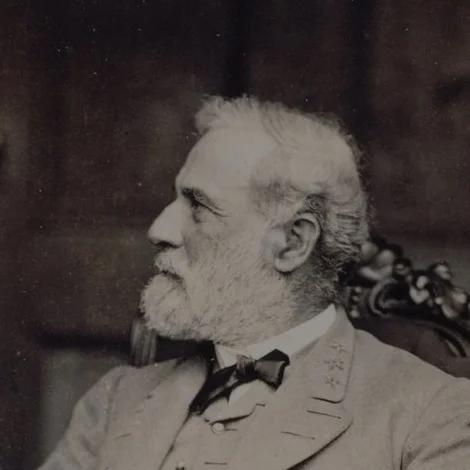
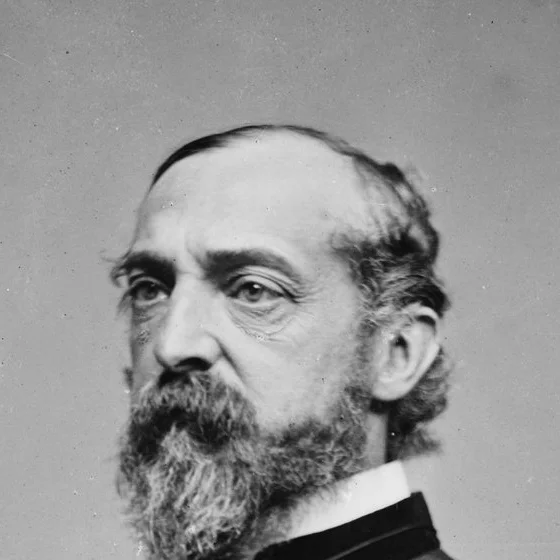
- Lived
- 19 January 1807 to 12 October 1870
- 31 December 1815 to 6 November 1872
- Origin
- Stratford Hall, Virginia, son of Light-Horse Harry Lee
- Cadiz, Spain, where his family lived during the Napoleonic Wars
- West Point
- Class of 1829, second
- Class of 1835, 19th of 56
- Before the war
- Regular army officer, on Winfield Scott's staff in Mexico
- Civil engineer until 1842, then an officer of the topographical engineers who built breakwaters and lighthouses, present at Palo Alto, Resaca de la Palma and Monterey in Mexico but in no major combat
- Army command
- Army of Northern Virginia, June 1862 to April 1865
- Army of the Potomac, 28 June 1863 to the end of the war
- Battles named here
- Fredericksburg, Chancellorsville, Gettysburg, Bristoe Station, Mine Run
- Fredericksburg, Gettysburg, Bristoe Station, Mine Run, Cold Harbor
- Death
- Lexington, Virginia
- Pennsylvania
Dates, origins and commands from Encyclopedia Virginia and the American Battlefield Trust. No source we read gives a win and loss total for either man, so we give none.2
Where they met
Before Gettysburg: Meade as a subordinate
At Fredericksburg on 13 December 1862, the National Park Service writes, Meade's division of just 4,500 men found a 600 yard gap that Jackson had left in his line, rolled forward and gained the crest of the heights deep inside his defences. Jackson's counterattack drove them out again, back across the railway and the fields to the Richmond Stage Road, until Union artillery stopped the Confederate rush.3

Gettysburg, 1 to 3 July 1863
Meade was given the army on 28 June. The strengths at Gettysburg are counted differently: the American Battlefield Trust gives 93,921 Union and 71,699 Confederate soldiers, the National Park Service 83,289 and 75,054. On the losses they agree closely: about 23,000 Union and 28,000 Confederate in the Park Service's round figures, 23,049 and 28,063 in the Trust's.4
After two days of attacks on both Union flanks, Lee sent about 12,500 men against Meade's centre on 3 July, in the assault known as Pickett's Charge. The Park Service writes that it momentarily pierced the Union line before it was driven back with severe losses, and the Trust puts the attackers' casualties at approaching 60 per cent. When Lee told Pickett to reform his men, Pickett is said to have answered that he had no division. On 4 July Lee began to withdraw towards Williamsport on the Potomac, with a train of wounded more than fourteen miles long.5

Williamsport, July 1863
The flooded Potomac trapped Lee for days. His engineers laid out what his biographer Douglas Southall Freeman calls an admirable defensive line from Downsville to Williamsport. Meade followed but did not attack, and Lee got across. On 14 July Halleck telegraphed Meade that the escape of Lee's army without another battle had created great dissatisfaction in the mind of the President. Meade asked the same day to be immediately relieved from command. Halleck replied that the message was not meant as a censure but as a stimulus to an active pursuit.6
Lincoln wrote Meade a letter that day which he never sent. I do not believe you appreciate the magnitude of the misfortune involved in Lee's escape, it says, your golden opportunity is gone, and I am distressed immeasurably because of it. He filed it away marked never sent, or signed.7
Bristoe Station and Mine Run, autumn 1863
In October Lee moved round Meade's right and the Union army fell back to Centreville. At Bristoe Station on 14 October A. P. Hill's corps stumbled on two Union corps and attacked Warren's Second Corps, posted behind the embankment of the Orange and Alexandria Railroad, and lost 1,380 men to Warren's 540, the Park Service records. Lee angrily told Hill to bury his dead and say no more about it. Meade wrote to his wife on 21 October that this was a deep game, and I am free to admit that in the playing of it he has got the advantage of me.8
In late November Meade crossed the Rapidan to turn Lee's right with three corps under Warren, French and Sykes, a move that rain-swollen fords and a wrong turn by French's corps slowed down, Singel writes. Lee fell back to entrenchments along Mine Run, and Meade ordered an assault for 30 November. Warren, who was to lead it, looked at the works and called it off just ten minutes before the hour, and Meade agreed. On 2 December he wrote to his wife that he would rather be ignominiously dismissed, and suffer anything, than knowingly have thousands of brave men slaughtered for nothing. The Park Service gives losses of 1,633 Union and 795 Confederate for the main battle. Kati Singel, in Encyclopedia Virginia, counts 2,094 and 2,826 for the whole campaign from 7 November.9
1864 and 1865: Meade under Grant
From May 1864 Grant travelled with the Army of the Potomac and, as he wrote, gave all orders for its movements to Meade to have them executed. Meade had offered to step aside so that Grant could bring in a general of his own, and Grant kept him, writing that it is men who wait to be selected, and not those who seek, from whom we may always expect the most efficient service. So it went through the Wilderness, Spotsylvania, Cold Harbor and Petersburg. The details are in our comparison of Grant and Lee.10
Strategy
The case for Lee
James McPherson argues that Lee was the only Confederate commander whose victories had some potential for winning the war. He also notes that Pickett's Charge cost the Confederates about 7,000 men in less than an hour, the same as Grant's assault at Cold Harbor a year later, and that one is remembered as heroic and the other as callous.11
In the autumn after Gettysburg, outnumbered, he still forced Meade back to Centreville, as Meade himself admitted. Only supply stopped him: he wrote to the secretary of war that nothing prevented him from continuing in Meade's front but the destitute condition of his men. When Meade advanced again in November, Lee's son wrote, Lee was more surprised at his retreat than he had been at his advance, and Lee himself wrote to his wife that we pursued to the Rapidan, but he was over.12
The case for Meade
Meade beat Lee's army within a week of taking command. In the autumn he kept Lee from gaining anything lasting from his advance, and in 1864 he looked back on Williamsport and Mine Run as proof of his sound judgment. In every instance that we have attacked the enemy in an entrenched position we have failed, he wrote to his wife on 5 June. He was modest about Gettysburg itself. Four days after the battle he wrote that he claimed no extraordinary merit for it.13
Gettysburg: the battle itself
The case for Lee
Lee attacked for three days with an army smaller than Meade's, and on 3 July his assault reached the Union centre. Freeman lists five reasons for the defeat: the absence of Stuart's cavalry, which by pushing on in the face of resistance violated orders and deprived Lee of his services when most needed, Ewell's failure to take Cemetery Hill, a line too thin, Longstreet's reluctance together with Lee's own overconfidence, and above all the lack of co-ordination in attack of an army reorganised after Jackson's death.14
Freeman also records what Lee said that day. He told Pickett that this has been my fight and upon my shoulders rests the blame, and to others that the fault was entirely his own.15
Fremantle, who watched him rally the broken brigades, saw him show no sign of disappointment and heard him say that we can't expect always to gain victories. He watched Lee calmly check a rider who was whipping a frightened horse, and urge wounded men to take up a musket again.16
The case for Meade
Meade was new to the army and lost John Reynolds on the first day, yet the Trust's biography records that he held off Lee's attacks and broke the Confederate army on the third. Grant later wrote that Meade saw clearly and distinctly the position of the enemy and the ground in front of his own.17
After the battle: retreat and pursuit
The case for Lee
Lee brought his army, its trains and a column of wounded fourteen miles long back to the Potomac and across it. The escape that Lincoln lamented in his unsent letter is, seen from the other side, Lee's achievement.18
The case for Meade
Meade's failure to attack at Williamsport is the strongest charge against him, and Lincoln made it himself in the letter he never sent. The Trust's biography calls it his greatest mistake, made in the same encounter as his greatest victory. Edwin Coddington, in his study of the campaign, takes the other side. Louis Morton, reviewing the book in 1968, wrote that even the Union general's decision not to pursue is defended persuasively.19
Subordinates
The case for Lee
Lee's army in 1863 had lost Jackson and been reorganised, and Freeman places much of Gettysburg on that change and on the absence of Stuart. At Bristoe Station the fault was Hill's, who stumbled into Warren's corps, and Lee told him so. In December Lee wrote to his wife that he was greatly disappointed at Meade getting off with so little damage, and Singel notes his concern at the performance of Early and Hill in that campaign.20
The case for Meade
Meade listened to his corps commanders, which was both his strength and his weakness. At Mine Run he accepted Warren's judgment, writing that this lost him another day.21
Grant described a temper that would get beyond his control at times, yet called him, in spite of this defect, a most valuable officer.22
Generals and governments
The case for Lee
Lee took the blame for Gettysburg in public and in private. After the battle he wrote to Jefferson Davis asking to be replaced: a younger and abler man than myself can readily be obtained, he wrote, and he asked the president in all sincerity to take measures to supply his place. Lee kept the army until the end.23
The case for Meade
Meade served a government that watched every move. After Williamsport he asked to be relieved and was refused, and at Mine Run he knew, as he wrote, that his failure to attack meant certain personal ruin, and still did not order it. Singel records that he suffered politically for that caution, and that Lincoln and Halleck were among the dissatisfied.24
Record and reputation
The case for Lee
Lee's earlier record against the Army of the Potomac, with Meade in its ranks, includes Chancellorsville, which the American Battlefield Trust calls his masterful victory. Elizabeth Brown Pryor writes that his admirers credit him with bold tactical manoeuvres and inspiring leadership. His critics, she adds, question his strategic judgment and his waste of lives in needless battles. After the war he served as president of Washington College in Lexington until his death.25

The case for Meade
Meade won at Gettysburg and kept his army in the field to the end of the war, under Grant's shadow. Grant himself, in his memoirs, wrote that Meade deserves a high place in the annals of his country, and recalled that he had never served with troops until he was over forty six, having spent his early career as an engineer.26
How historians have judged them
Freeman, Lee's great biographer, looked for the causes of Gettysburg mainly in Lee's subordinates and the state of his army, while recording Lee's own repeated statement that the fault was his. On Meade he passed little judgment, noting that critics complained he did not pursue vigorously, and that Lee was no more prepared to admit a crushing defeat than Meade was to claim one.27
Edwin Coddington's study of the Gettysburg campaign, published in 1968, is a detailed defence of Meade. Morton judged that Meade comes off better than Lee in his account, and that the major decisions are judged after careful and judicious examination.28
Tom Huntington's life of Meade appeared in 2013. Ethan Rafuse, himself the author of a study of Meade, writes in his review that Meade remains underappreciated, but calls Huntington a decided Meade and Union partisan.29
McPherson, reviewing Alan Nolan's critique of Lee, called it a useful corrective to the Lee legend, while disagreeing that the Confederate cause was hopeless before Lincoln's re-election.30
Battles on the site
Every battle page on the site that involves either man, with the guides that set them in context.
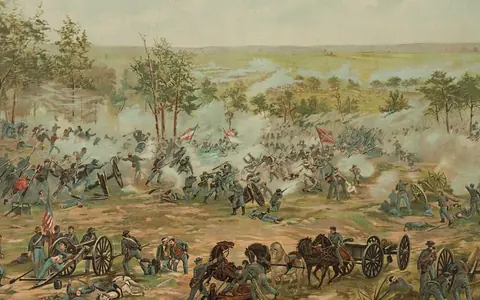 Both in command · 1863Battle of Gettysburg
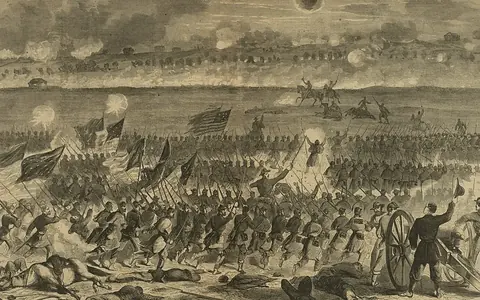 Lee in command, Meade a division · 1862Battle of Fredericksburg
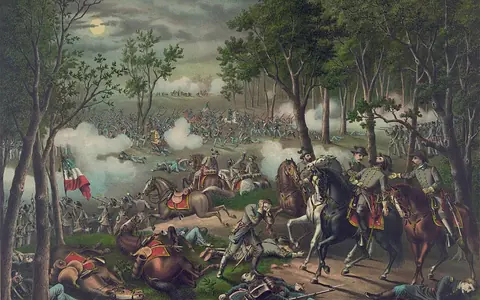 Lee in command, Meade a corps · 1863Battle of Chancellorsville
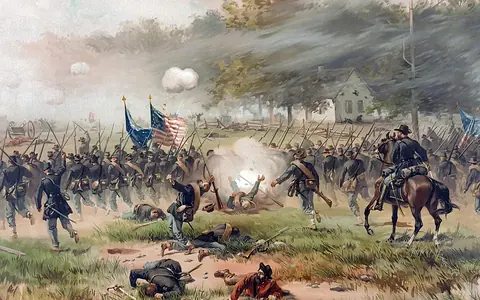 Lee in command, Meade a division · 1862Battle of Antietam
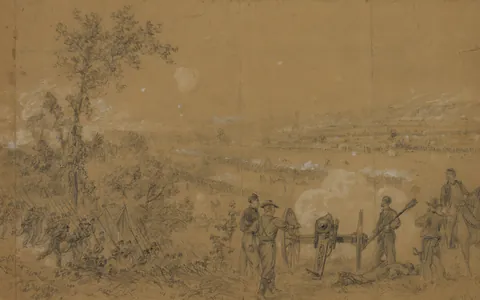 Lee in command, Meade a brigade · 1862The Seven Days Battles
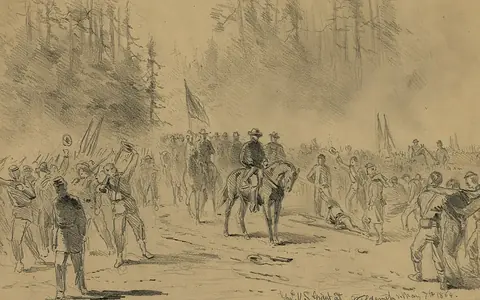 Both, Grant directing · 1864Battle of the Wilderness
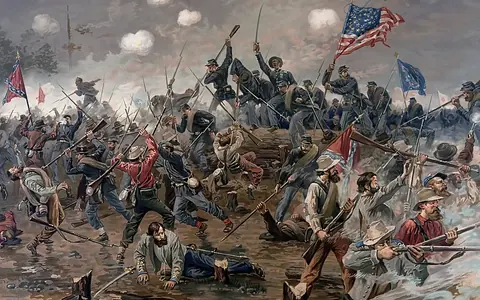 Both, Grant directing · 1864Battle of Spotsylvania Court House
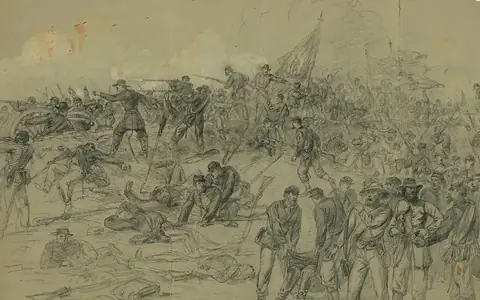 Both, Grant directing · 1864Battle of Cold Harbor
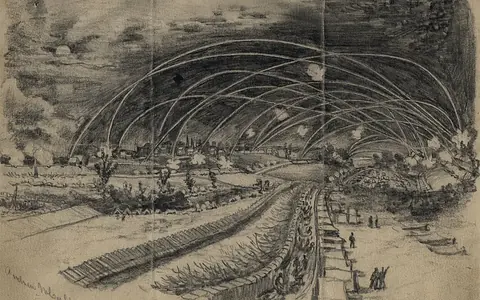 Both, Grant directing · 1864 to 1865Siege of Petersburg
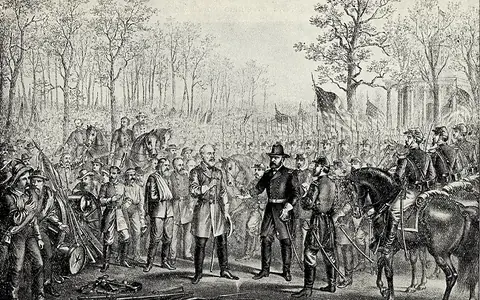 The end · 1865Appomattox Court House
 After the battle · 1863The Gettysburg Address
CommanderRobert E. Lee
 GuideThe Eastern Theater
 Guide · 1861 to 1865The American Civil War
 RankingThe Greatest American Commanders
Williamsport, Bristoe Station and Mine Run have no page of their own yet.
Your verdict
We do not pick a winner. Here are the two cases at their strongest, and the questions that decide between them.
For Lee
- Chancellorsville, a victory over the army Meade served in
- An attack at Gettysburg that reached the Union centre
- A safe retreat across a flooded Potomac
- He turned Meade's flank in October 1863
- He took the blame for defeat and offered to resign
For Meade
- He won Gettysburg three days after taking command
- He beat Hill at Bristoe Station
- At Mine Run he refused a hopeless assault at the cost of his career
- Coddington's careful defence of his decisions
- He kept the army to the end of the war, under Grant
Questions to weigh before you decide:
- Is one defensive victory worth more than a series of offensive ones?
- Should Meade be judged by Gettysburg or by Williamsport?
- Was Mine Run moral courage or lost nerve?
- How much of Gettysburg belongs to Lee's subordinates, and how much to Lee?
- Does Meade's record after May 1864 belong to Meade or to Grant?
- Does taking the blame for a defeat count in a general's favour?
Cast your vote below and see how other readers have judged them.





