

What was the English Civil War?
The English Civil War of 1642 to 1646, now called the First Civil War, was fought in England and Wales between the Royalists of King Charles I and the armies of Parliament. Parliament won, allied from 1644 with the Scots: its New Model Army crushed the king at Naseby in 1645, and Oxford surrendered in 1646.1
This guide covers the war in the Kingdom of England, from the raising of the royal standard at Nottingham in August 1642 to the fall of Oxford in 1646. It was part of a wider conflict in all three of Charles I's kingdoms, from the Scottish crisis of 1638 to the conquest of Ireland in 1653, also called the British Civil Wars or the Wars of the Three Kingdoms. Our battle articles cover the Battle of Edgehill, the Battle of Hopton Heath and the Second Battle of Newbury.2
Wales had been joined to the Kingdom of England by the Acts of 1536 and 1543, so the Welsh counties were part of this war from the start, most of them on the king's side.3
Causes of the English Civil War
From 1629 to 1640 Charles I ruled without calling Parliament, the period known as the Personal Rule. He raised money by unpopular measures such as ship money, a naval levy widely seen as a tax without Parliament's consent. Religion deepened the distrust: the king had a Catholic queen, Henrietta Maria of France, and Archbishop William Laud's church reforms struck many Protestants as "popish".4
The crisis began in Scotland, where a new prayer book imposed in 1637 provoked riots and the National Covenant of 1638; in the Bishops' Wars of 1639 and 1640 the Scots beat Charles twice, and he had to recall Parliament. The Long Parliament, which met in November 1640, declared ship money illegal, abolished the prerogative courts and passed a law for regular Parliaments.5
In October 1641 a Catholic rising broke out in Ireland, and greatly exaggerated reports of atrocities against Protestants spread through England. Both sides agreed an army was needed for Ireland, but neither trusted the other to command it: the king's critics feared he would turn it on them, and Charles would not give up a power that had always belonged to the crown. On 4 January 1642 he entered the Commons with soldiers to arrest five opposition leaders, who had already fled; the breach of privilege badly damaged his cause. He left London, in March Parliament took over the militia by ordinance, and on 22 August Charles raised his standard at Nottingham.6
Who fought: Royalists and Parliamentarians
There was no typical Royalist or Parliamentarian. Religion, mistrust of royal power, local rivalry, economic grievance and loyalty to king, landlord, family or friends all shaped allegiance, and the war divided families. Parliament's leaders claimed to defend the law, Parliament's privileges and the Protestant faith against arbitrary rule and "popery". Many who joined the king defended the crown's lawful powers and the established Church of England, alarmed by Parliament's claim to command the armed forces and by radical sects. Many ordinary soldiers simply followed their landlord or the local gentry.7
Parliament held most of the richer south and east, with London, most ports and the navy. The king's support centered on the north and west of England and on Wales. Most fighting took place in the contested areas between. To win, Charles needed to take London, and he never did.8

The two sides soon had nicknames. "Roundhead" was a Royalist insult for Parliament's supporters, after the close-cropped hair of some Puritans; "Cavalier", from a Spanish word for an armed horseman, was the Parliamentarian insult for the king's men. This guide uses Royalists and Parliamentarians. In fact both armies looked much alike, and soldiers relied on sashes, field signs and passwords to tell friend from foe.9
England had no standing army in 1642. Both sides raised men from the county trained bands, volunteers and later conscripts, with officers schooled in the Thirty Years' War. By the end of 1642 each side had between 60,000 and 70,000 men under arms, most of them in local garrisons; the main field armies were far smaller, roughly 12,000 to 15,000 men each at Edgehill.10
1642: the Battle of Edgehill
In September 1642 the Earl of Essex, Parliament's lord general, marched into the Midlands, while Charles recruited around Shrewsbury and on the Welsh border. As the king marched on London, Essex caught him at Edgehill in Warwickshire on 23 October. Prince Rupert's cavalry swept the Parliamentarian horse from the field but rode on too far, and Essex's infantry pushed back the king's foot; the royal standard bearer, Sir Edmund Verney, was killed and the standard taken, then recaptured. The fighting ended at dusk in a draw that both sides claimed as a victory.11
Essex reached London first, and on 13 November his army, reinforced by the London trained bands and twice the king's strength, stood at Turnham Green; Charles withdrew without a battle. He made Oxford his capital and military headquarters for the rest of the war.12
1643: the Royalist high tide
County forces fought their own war for towns and strongholds. At Hopton Heath near Stafford on 19 March 1643, about 1,200 Royalists, nearly all mounted, under the Earl of Northampton met the Parliamentarians of Sir John Gell and Sir William Brereton. The Royalist horse routed the opposing cavalry but Northampton was killed; at nightfall the Parliamentarians withdrew, and Stafford was saved for the king in what the Staffordshire archive calls an inconclusive Royalist victory.13
The summer was the king's best season of the war. In the north the Earl of Newcastle beat Lord Fairfax and his son Sir Thomas at Adwalton Moor on 30 June, leaving the Royalists masters of all Yorkshire except Hull. In the west Royalist cavalry routed Sir William Waller's army at Roundway Down near Devizes on 13 July, and on 26 July Prince Rupert stormed Bristol, the high-water mark of Royalist fortunes.14
Gloucester did not fall. The king besieged it in August, and Essex marched from London to relieve it. On his way back the Royalists blocked his road at Newbury, and the First Battle of Newbury on 20 September ended after a day's fighting with neither side beaten; Essex got through to London. In October the army of Parliament's Eastern Association won at Winceby in Lincolnshire, where Oliver Cromwell and Sir Thomas Fairfax led its cavalry.15
1644: Marston Moor and the Second Battle of Newbury
Royalist success pushed Parliament toward Scotland. By the Solemn League and Covenant, signed by both Houses and the Scottish commissioners on 25 September 1643, the Covenanters agreed to send an army into England in return for a reform of the English church that they understood as Presbyterian. The army that crossed the border in January 1644 numbered over 20,000 (Britannica gives 21,000 as the promised strength). The king made a ceasefire with the Irish Confederates in September 1643 and brought over troops from Ireland, never on the Scottish scale, at a cost to his reputation in England. The Scottish side is in our military history of Scotland.16
The Scots' arrival put the king on the defensive. By spring the Marquess of Newcastle's army was besieged in York by the Scots under the Earl of Leven, Manchester's Eastern Association and Lord Fairfax's Yorkshiremen. Prince Rupert relieved the city and on 2 July 1644 offered battle on Marston Moor with about 18,000 men against about 28,000. The allies attacked in the evening; their right wing was beaten, but on the left Cromwell's cavalry, with Scottish horse beside it, routed Rupert's wing and then crossed the field to break the rest. Newcastle's army ceased to exist and the king lost the north.17

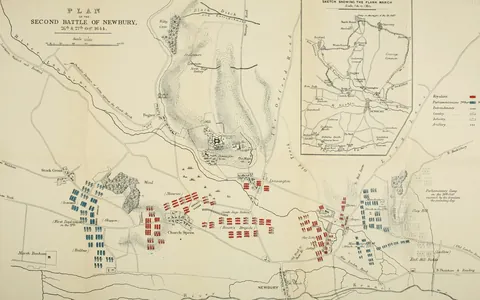
In Cornwall the king trapped Essex's army near Lostwithiel; Essex escaped by boat and on 2 September his infantry surrendered. On 27 October 1644, north of Newbury, the combined armies of Essex, Waller and Manchester, about twice the king's strength, tried to destroy him at the Second Battle of Newbury. They attacked from west and east, but Manchester's assaults on Shaw House were driven back, darkness ended an effective draw, and the king's army slipped away to Oxford.18
The New Model Army
After Newbury Cromwell publicly attacked Manchester's conduct of the war, and Parliament's "war party" pressed for radical change. The Self-Denying Ordinance, passed by both Houses on 3 April 1645 after the Lords had thrown out a first version, required members of either House to give up their commands: Essex, Manchester and Waller left the army, but Cromwell was exempted because his military skill was thought indispensable.19
Parliament had already voted early in 1645 for a "New Model" army formed from the remains of the armies of Essex, Waller and Manchester. Planned at 11 regiments of horse, 12 of foot and 1,000 dragoons, it was paid by the center, tied to no region and officered by ability rather than birth. Sir Thomas Fairfax, appointed its commander at the age of 32, organized and trained it, and Cromwell became his lieutenant general of horse just before Naseby.20

1645 to 1646: the Battle of Naseby and the king's surrender
On 31 May 1645 the Royalists stormed Leicester, which drew Fairfax away from a siege of Oxford, and on 14 June the two armies met near Naseby in Northamptonshire. Estimates give the king about 7,500 to 10,000 men and Fairfax 12,000 to almost 14,000. Rupert's horse broke the Parliamentarian left and rode on to the baggage train, but Cromwell's cavalry routed the Royalist left and turned on the king's infantry, which Fairfax's reserves overwhelmed. About 1,000 Royalists were killed and up to 5,000 captured, with the army's guns and baggage. The king's captured letters showed the queen seeking help from Catholic powers abroad.21

Naseby decided the war: the king had lost the infantry of his main field army, and he could never replace it. Fairfax marched into the West Country and on 10 July beat George Goring's army, the largest the king had left, at Langport in Somerset; its morale collapsed and many of its men deserted. Another Royalist force was beaten at Rowton Heath near Chester on 24 September.22
By the spring of 1646 Oxford was surrounded. Charles left the city in disguise late in April and on 5 May gave himself up to the Scottish army at Newark rather than to the English Parliament. Oxford surrendered on 24 June 1646, which is usually taken as the end of the First Civil War.23
Sieges, and how many died in the English Civil War
Sieges and skirmishes, not pitched battles, dominated the war, as garrisons fought for towns, castles and fortified houses; many soldiers never left their own county. Newark was besieged three times, and Donnington Castle near Newbury held out for the king from 1644 to 1646; many of the ruined castles of England were damaged in sieges of the civil wars or deliberately destroyed afterwards.24

No reliable death toll exists for 1642 to 1646 alone. Britannica, using modern estimates for all the wars of 1642 to 1651, gives about 85,000 combat deaths in England and Wales and some 127,000 other deaths, including about 40,000 civilians. For the three kingdoms English Heritage gives up to 200,000 dead, 4.5 per cent of the population, while Britannica's nearly 200,000 equals about 2.5 per cent. The historian Charles Carlton argued in Going to the Wars that even in England a higher share of the population died than in World War I, a case David Underdown, reviewing the book, found plausible.25
Key figures of the English Civil War
- Charles I (1600 to 1649) led his army in person at Edgehill and Naseby; Britannica calls him a brave man but no general.26
- Prince Rupert of the Rhine (1619 to 1682), the king's nephew, led the Royalist cavalry with experience gained in Europe. He took Bristol, lost at Marston Moor and advised against fighting at Naseby.27
- William Cavendish, Marquess of Newcastle, the king's northern commander, won at Adwalton Moor, lost his army at Marston Moor and went into exile.28
- Robert Devereux, 3rd Earl of Essex, was Parliament's lord general from July 1642. He relieved Gloucester in 1643, lost his infantry in Cornwall in 1644 and resigned under the Self-Denying Ordinance.29
- Sir Thomas Fairfax (1612 to 1671), from a Yorkshire gentry family, fought in the north in 1643 and 1644 and commanded the New Model Army at Naseby and Langport.30
- Oliver Cromwell (1599 to 1658), an MP who first soldiered past 40, led the Eastern Association horse at Marston Moor and was Fairfax's second in command, not the commander, at Naseby.31
Who won the English Civil War, and what came next
Parliament won, but not alone: Britannica doubts it could have won without the Scots, whose troops were critical at Marston Moor. No settlement followed. In January 1647 the Scots handed Charles over to Parliament and went home, in June the army seized him, and in December 1647 he made a secret agreement with Scottish supporters.32
That agreement led to the second civil war of 1648: Royalist risings in Kent, Essex and south Wales, among them the battle at St Fagans, and a Scottish invasion that was destroyed at Preston in August. Charles was tried by a specially constituted court and executed on 30 January 1649, and England was declared a Commonwealth. Cromwell's conquest of Ireland and the third war against Charles II and the Scots, which ended at Worcester in 1651, are covered in our hub on the Wars of the Three Kingdoms.33
Legacy of the English Civil War
The war decided at Naseby ensured that no later monarch would be supreme in British politics. The monarchy came back in 1660, but on a conditional footing, and the absolutist path of some Continental monarchies was closed. The New Model Army, England's first national standing army, is called by the National Army Museum the immediate predecessor of today's British Army, while its role in the politics of the 1650s left a lasting distrust of standing armies.34
Major battles of the English Civil War
Our battle articles, in date order.
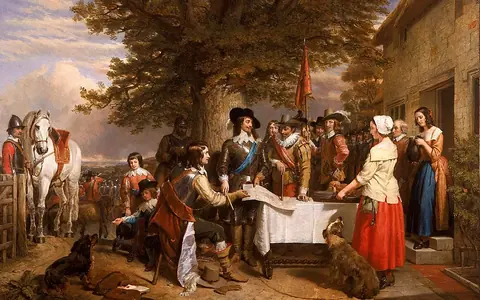
- 1642Battle of Edgehill, 1642Royalists vs Parliamentarians
How the first pitched battle of the English Civil War ended in a bloody draw.
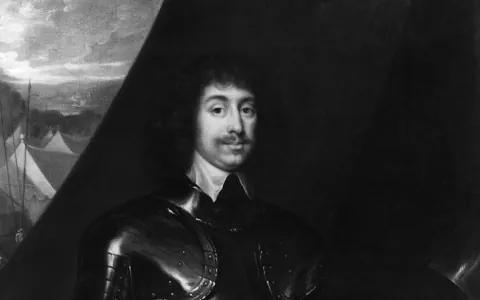
- 1643Battle of Hopton Heath, 1643Royalists vs Parliamentarians
On 19 March 1643 the Royalist horse charged the Parliamentarians on Hopton Heath outside Stafford and took their guns, but the Earl of Northampton rode too far and was killed.
- 1644Second Battle of Newbury, 1644Royalists vs Parliament
On 27 October 1644 Parliament's armies attacked Charles I at Speen and Shaw House by Newbury but let him escape. How the battle was fought and why it led to the New Model Army.
Timeline of the English Civil War
- 22 Aug 1642Charles raises his royal standard at Nottingham.35
- 23 Oct 1642Battle of Edgehill, a draw claimed by both sides.36
- 19 Mar 1643Battle of Hopton Heath: the Earl of Northampton is killed; Stafford stays Royalist.37
- 25 Sep 1643Parliament and the Scots sign the Solemn League and Covenant.38
- 2 Jul 1644Parliamentarians and Scots win at Marston Moor; the king loses the north.39
- 27 Oct 1644Second Battle of Newbury, a draw; the outnumbered king escapes.40
- Feb to Apr 1645The New Model Army is created and the Self-Denying Ordinance passed.41
- 14 Jun 1645Battle of Naseby: the New Model Army destroys the king's main army.42
- 10 Jul 1645Fairfax defeats Goring at Langport.43
- 5 May 1646Charles surrenders to the Scottish army at Newark.44
- 24 Jun 1646Oxford surrenders; the First Civil War ends.45
Where to read next
For the whole conflict, including the second and third civil wars, read our hub on the Wars of the Three Kingdoms, and see the military history of Britain, the military history of Scotland and the military history of Ireland. See also the rankings of the greatest early modern battles and the greatest battles in British history, the greatest British commanders, the early modern era, or try the early modern battles quiz or the British battles quiz.
Notes
A number in the text points to a note; each note names the works that paragraph draws on, listed in full under Sources.
- National Army Museum, “British Civil Wars”; Encyclopaedia Britannica, “English Civil Wars”; Encyclopaedia Britannica, “Charles I”. ↩
- Encyclopaedia Britannica, “English Civil Wars”; National Army Museum, “British Civil Wars”; UK Parliament, “Revolution and civil war”. ↩
- Senedd Research, “The Constitution”; Encyclopaedia Britannica, “Wales”; National Army Museum, “British Civil Wars”. ↩
- National Army Museum, “British Civil Wars”; Encyclopaedia Britannica, “English Civil Wars”. ↩
- Encyclopaedia Britannica, “English Civil Wars”; National Army Museum, “British Civil Wars”; BCW Project, “The Grand Remonstrance, 1641”. ↩
- National Army Museum, “British Civil Wars”; Encyclopaedia Britannica, “English Civil Wars”; BCW Project, “The Militia Ordinance, 1642”; BCW Project, “The Five Members”. ↩
- National Army Museum, “British Civil Wars”; BCW Project, “The Grand Remonstrance, 1641”; EBSCO Research Starters, “English Civil Wars”. ↩
- National Army Museum, “British Civil Wars”; Encyclopaedia Britannica, “English Civil Wars”; EBSCO Research Starters, “English Civil Wars”. ↩
- Newcastle University and National Civil War Centre, “Choosing Sides”; World History Encyclopedia, “English Civil Wars”; National Army Museum, “British Civil Wars”. ↩
- National Army Museum, “British Civil Wars”; Encyclopaedia Britannica, “English Civil Wars”; Newcastle University and National Civil War Centre, “The Battle of Edgehill”. ↩
- Encyclopaedia Britannica, “Charles I”; Encyclopaedia Britannica, “Battle of Edgehill”; Newcastle University and National Civil War Centre, “The Battle of Edgehill”. ↩
- Encyclopaedia Britannica, “Battle of Edgehill”; National Army Museum, “British Civil Wars”; EBSCO Research Starters, “English Civil Wars”. ↩
- Historic England, “English Heritage Battlefield Report”; Staffordshire and Stoke on Trent Archive Service, “Hopton Heath”. ↩
- National Army Museum, “British Civil Wars”; Historic England, “English Heritage Battlefield Report”; Newcastle University and National Civil War Centre, “The Battle of Adwalton Moor”; Historic England, “English Heritage Battlefield Report”; Newcastle University and National Civil War Centre, “The Battle of Roundway Down”. ↩
- Newcastle University and National Civil War Centre, “The First Battle of Newbury”; Historic England, “English Heritage Battlefield Report”; National Army Museum, “British Civil Wars”; National Army Museum, “Thomas Fairfax”; EBSCO Research Starters, “English Civil Wars”. ↩
- Encyclopaedia Britannica, “English Civil Wars”; BCW Project, “The Solemn League & Covenant”; Historic England, “English Heritage Battlefield Report”; UK Parliament, “Revolution and civil war”. ↩
- Historic England, “English Heritage Battlefield Report”; Newcastle University and National Civil War Centre, “The Battle of Marston Moor”; Encyclopaedia Britannica, “Charles I”; National Army Museum, “Oliver Cromwell”. ↩
- Newcastle University and National Civil War Centre, “The Battle of Lostwithiel”; National Army Museum, “British Civil Wars”; Battlefields Trust, “Battle of Newbury II, 27th October 1644”; Newcastle University and National Civil War Centre, “The Second Battle of Newbury”; Peter Gaunt, “The Second Battle of Newbury, 27th October 1644”. ↩
- Battlefields Trust, “Battle of Newbury II, 27th October 1644”; BCW Project, “The Self-Denying Ordinance, 1645”; Encyclopaedia Britannica, “New Model Army”. ↩
- Encyclopaedia Britannica, “New Model Army”; National Army Museum, “British Civil Wars”; National Army Museum, “Thomas Fairfax”; National Army Museum, “Battle of Naseby”. ↩
- Historic England, “English Heritage Battlefield Report”; National Army Museum, “Battle of Naseby”; Newcastle University and National Civil War Centre, “The Battle of Naseby”; National Army Museum, “British Civil Wars”. ↩
- Historic England, “English Heritage Battlefield Report”; Historic England, “English Heritage Battlefield Report”; National Army Museum, “Thomas Fairfax”; EBSCO Research Starters, “English Civil Wars”; Encyclopaedia Britannica, “English Civil Wars”; Historic England, “Battle of Rowton Heath 1645”. ↩
- Encyclopaedia Britannica, “Charles I”; National Army Museum, “British Civil Wars”; EBSCO Research Starters, “English Civil Wars”. ↩
- Encyclopaedia Britannica, “English Civil Wars”; National Army Museum, “British Civil Wars”; Newcastle University and National Civil War Centre, “Battles & Sieges”; Battlefields Trust, “Battle of Newbury II, 27th October 1644”; English Heritage, “The English Civil Wars”. ↩
- Encyclopaedia Britannica, “English Civil Wars”; English Heritage, “The English Civil Wars”; London Review of Books, “Praising God”. ↩
- Encyclopaedia Britannica, “Charles I”; Encyclopaedia Britannica, “Battle of Edgehill”; National Army Museum, “Battle of Naseby”. ↩
- National Army Museum, “Battle of Naseby”; National Army Museum, “British Civil Wars”; Historic England, “English Heritage Battlefield Report”. ↩
- Historic England, “English Heritage Battlefield Report”; Historic England, “English Heritage Battlefield Report”; Newcastle University and National Civil War Centre, “The Battle of Marston Moor”. ↩
- National Army Museum, “British Civil Wars”; Newcastle University and National Civil War Centre, “The First Battle of Newbury”; Newcastle University and National Civil War Centre, “The Battle of Lostwithiel”; BCW Project, “The Self-Denying Ordinance, 1645”. ↩
- National Army Museum, “Thomas Fairfax”; Encyclopaedia Britannica, “New Model Army”. ↩
- National Army Museum, “Oliver Cromwell”; Encyclopaedia Britannica, “Charles I”. ↩
- Encyclopaedia Britannica, “English Civil Wars”; National Army Museum, “British Civil Wars”; Encyclopaedia Britannica, “Charles I”. ↩
- National Army Museum, “British Civil Wars”; Encyclopaedia Britannica, “Charles I”; UK Parliament, “Revolution and civil war”. ↩
- National Army Museum, “Battle of Naseby”; Historic England, “English Heritage Battlefield Report”; National Army Museum, “British Civil Wars”; English Heritage, “The English Civil Wars”; Encyclopaedia Britannica, “English Civil Wars”. ↩
- National Army Museum, “British Civil Wars”; Encyclopaedia Britannica, “English Civil Wars”. ↩
- Encyclopaedia Britannica, “Battle of Edgehill”; Newcastle University and National Civil War Centre, “The Battle of Edgehill”. ↩
- Historic England, “English Heritage Battlefield Report”; Staffordshire and Stoke on Trent Archive Service, “Hopton Heath”. ↩
- BCW Project, “The Solemn League & Covenant”; Encyclopaedia Britannica, “English Civil Wars”. ↩
- Historic England, “English Heritage Battlefield Report”; Newcastle University and National Civil War Centre, “The Battle of Marston Moor”. ↩
- Newcastle University and National Civil War Centre, “The Second Battle of Newbury”; Peter Gaunt, “The Second Battle of Newbury, 27th October 1644”. ↩
- Encyclopaedia Britannica, “New Model Army”; BCW Project, “The Self-Denying Ordinance, 1645”. ↩
- National Army Museum, “Battle of Naseby”; Historic England, “English Heritage Battlefield Report”. ↩
- Historic England, “English Heritage Battlefield Report”; National Army Museum, “Thomas Fairfax”. ↩
- National Army Museum, “British Civil Wars”; Encyclopaedia Britannica, “Charles I”. ↩
- National Army Museum, “British Civil Wars”; EBSCO Research Starters, “English Civil Wars”. ↩
Sources
- National Army Museum, “British Civil Wars”.
- Encyclopaedia Britannica, Jane H. Ohlmeyer, “English Civil Wars: The first English Civil War”.
- Encyclopaedia Britannica, Maurice Ashley, “Charles I: Civil War”.
- Encyclopaedia Britannica, Jane H. Ohlmeyer, “English Civil Wars”.
- UK Parliament, “Revolution and civil war”.
- Senedd Research (Welsh Parliament), “The Constitution: Wales in the United Kingdom (quick guide)”.
- Encyclopaedia Britannica, “Wales”.
- BCW Project (David Plant), “The Grand Remonstrance, 1641”.
- BCW Project (David Plant), “The Militia Ordinance, 1642”.
- BCW Project (David Plant), “The Five Members”.
- EBSCO Research Starters, “English Civil Wars”.
- Newcastle University and National Civil War Centre, “Choosing Sides”.
- World History Encyclopedia, Mark Cartwright, “English Civil Wars”.
- Newcastle University and National Civil War Centre, “The Battle of Edgehill”.
- Encyclopaedia Britannica, N. Geoffrey Parker, “Battle of Edgehill”.
- Historic England, “English Heritage Battlefield Report: Hopton Heath 1643”.
- Staffordshire and Stoke on Trent Archive Service, Staffordshire Past Track, “Hopton Heath”.
- Historic England, “English Heritage Battlefield Report: Adwalton Moor 1643”.
- Newcastle University and National Civil War Centre, “The Battle of Adwalton Moor”.
- Historic England, “English Heritage Battlefield Report: Roundway Down 1643”.
- Newcastle University and National Civil War Centre, “The Battle of Roundway Down”.
- Newcastle University and National Civil War Centre, “The First Battle of Newbury”.
- National Army Museum, “Thomas Fairfax: A man of honour”.
- BCW Project (David Plant), “The Solemn League & Covenant”.
- Historic England, “English Heritage Battlefield Report: Marston Moor 1644”.
- Newcastle University and National Civil War Centre, “The Battle of Marston Moor”.
- National Army Museum, “Oliver Cromwell: Lord Protector”.
- Newcastle University and National Civil War Centre, “The Battle of Lostwithiel”.
- Battlefields Trust, “Battle of Newbury II, 27th October 1644”.
- Newcastle University and National Civil War Centre, “The Second Battle of Newbury”.
- Peter Gaunt (University of Chester), World Turned Upside Down, “The Second Battle of Newbury, 27th October 1644”.
- BCW Project (David Plant), “The Self-Denying Ordinance, 1645”.
- Encyclopaedia Britannica, “New Model Army”.
- National Army Museum, “Battle of Naseby”.
- Historic England, “English Heritage Battlefield Report: Naseby 1645”.
- Newcastle University and National Civil War Centre, “The Battle of Naseby”.
- Historic England, “English Heritage Battlefield Report: Langport 1645”.
- Historic England, “Battle of Rowton Heath 1645”.
- Newcastle University and National Civil War Centre, “Battles & Sieges”.
- English Heritage, “The English Civil Wars: History and Stories”.
- London Review of Books, David Underdown, “Praising God” (review of Charles Carlton, Going to the Wars).






