

Genghis Khan or Caesar: what does the evidence say?
Julius Caesar (100 or 102 to 44 BC) and Genghis Khan (born 1162 or 1167, died 1227) lived twelve centuries apart and never met. Rome never fought a Mongol army, but it did meet steppe-style horse archers, at Carrhae in 53 BC, and Caesar died preparing a war against them. Historians have not settled who was the greater conqueror. Jomini ranked Caesar among the conquerors whose wars proved prosperous, but called Genghis Khan the author of a crime against humanity. Liddell Hart wrote that the Mongol empire made Rome's look almost insignificant, though he meant size, not skill. This page sets out the evidence for each and leaves the final verdict to you.
One was a patrician of the old Julian family who used Roman magistracies, the conquest of Gaul and a civil war to make himself master of Rome. The other was the son of a minor Mongol chief who united the tribes of the steppe and then broke northern China and Khwarazm. Treccani calls Caesar a general, triumvir and dictator, and Genghis Khan a great destroyer but also a great general and the organiser of the nomad world.1
This is not a ranking. Below you will find the two careers side by side, the nearest thing to a meeting between Roman legions and steppe horse archers, and seven questions on which a conqueror can be judged, from strategy to the price paid by the conquered. Under each we give the strongest evidence for Genghis Khan and the strongest for Caesar, with the period writers and modern historians who argue each case. At the end the decision is yours.
Side by side
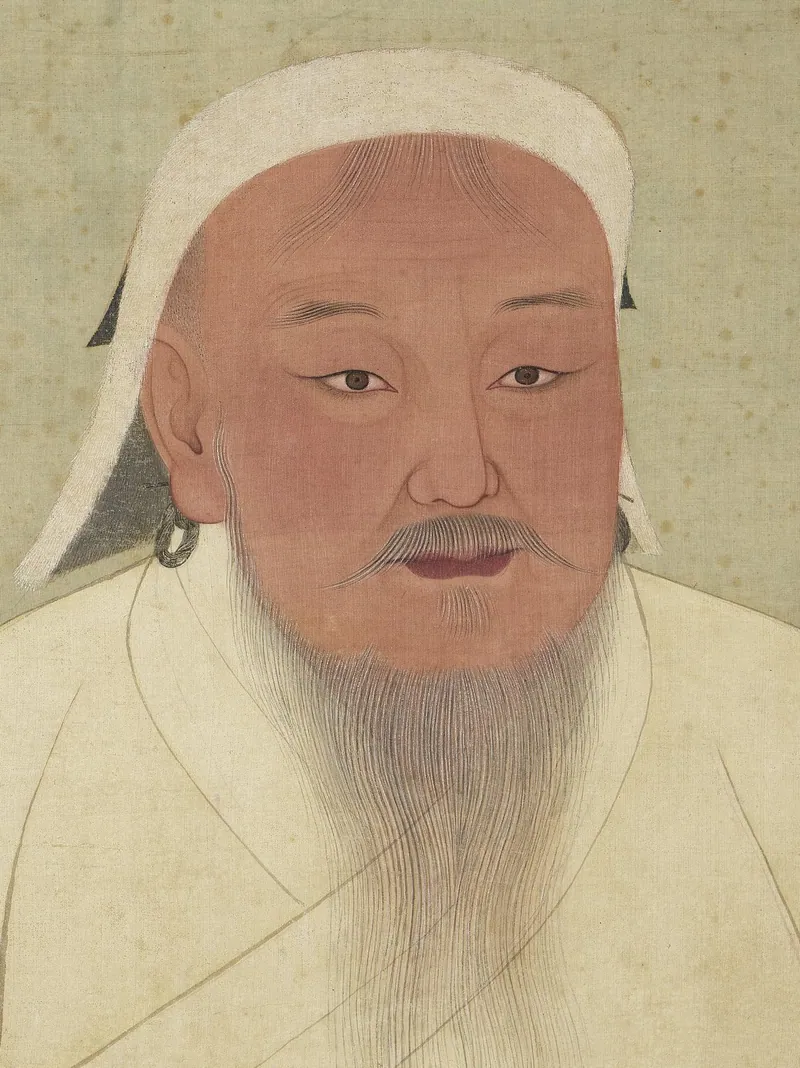
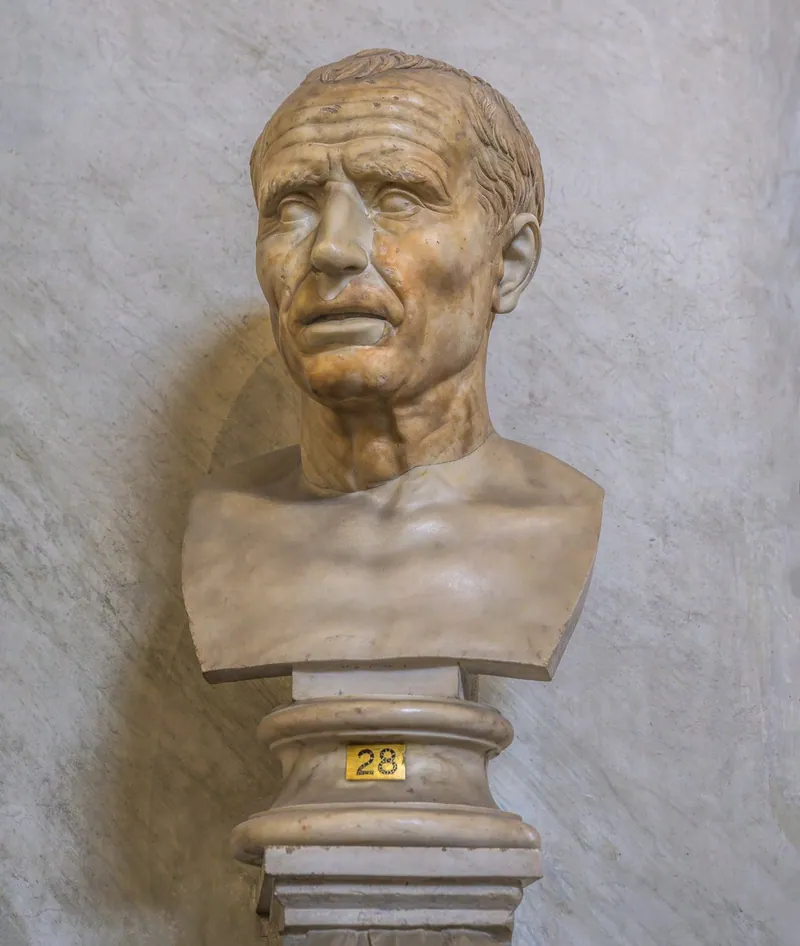
- Lived
- Born 1162 or 1167 (the year is uncertain), died 1227
- Born 100 or 102 BC (the year is uncertain), died 44 BC
- Origin
- Son of Yesügei, a minor Mongol chief killed by the Tatars
- The noble Roman family of the Julii
- Route to power
- Steppe wars, then proclaimed khan at the assembly of 1206
- Quaestor, praetor, consul in 59 BC, the conquest of Gaul, civil war, dictator
- Army
- Cavalry archers in units of tens, hundreds and thousands
- Legions of heavy infantry, with native cavalry and bowmen
- Main wars
- The steppe tribes, Xi Xia from 1205, the Jin from 1211, Khwarazm from 1219, Xi Xia again 1226 to 1227
- Gaul in the 50s BC, then the civil war, with Pharsalus in 48, Thapsus in 46 and Munda in 45
- Battles named here
- The Juyong pass 1211, Bukhara 1220, Parwan and the Indus 1221 (no page yet)
- Alesia, Pharsalus, Zela, Munda
- Death
- On campaign against the Tanguts, 1227, cause unknown
- Killed by conspirators in Rome on 15 March 44 BC, while preparing a war in the East
Dates and careers as given by the Library of Congress country study of Mongolia, the Secret History and Treccani's entry on Caesar, with Dodge on Caesar's army. We give no win and loss totals because no source counts their battles the same way.2
They never met: Rome and the horse archers
No Roman army ever met the Mongols. The nearest real test of legions against an army built like Genghis Khan's is Carrhae, where in 53 BC Caesar's partner in the triumvirate, Marcus Crassus, led seven legions, Plutarch says, into Mesopotamia against the Parthians. Caesar himself never fought them, but he was planning to when he was killed, and Napoleon, on St Helena, asked how that war would have gone.3
Carrhae, 53 BC
Plutarch's account reads like a description of Mongol tactics. Crassus formed his men in a hollow square, and the Parthian horsemen, while seeming to break up and scatter, surrounded it. The Parthians shot as they fled, Plutarch writes, and next to the Scythians they do this most effectively. When the Romans saw camels laden with arrows bringing fresh supplies to the archers, Crassus began to lose heart. Twenty thousand Romans, Plutarch says, are said to have been killed and ten thousand taken alive.4
Cassius Dio describes the trap the Romans were caught in. If they locked shields against the arrows, the armoured lancers charged them, and if they spread out to meet the lancers, they were shot down. While a man was guarding against arrows or pulling one out, Dio writes, he received more wounds, one after another. The full story is in our article on the Battle of Carrhae.5

The war Caesar never fought
At his death, Plutarch writes, Caesar had planned and prepared an expedition against the Parthians. Suetonius adds that he meant to go by way of Lesser Armenia and not to risk a battle until he had first tested their mettle. Treccani confirms that he was killed while preparing a military expedition to the East. The question of Caesar against horse archers was never answered in the field.6
Napoleon's answer
Napoleon thought about it on St Helena. The Parthians' arrows, he dictated, pierced the shields of the legionaries, and they did not wait for the shock of heavy troops but overwhelmed them from a distance. He believed Caesar would probably have answered with large numbers of archers and slingers from Crete, the Balearic Islands, Spain and Africa, a flotilla on the Euphrates and Tigris, and camels carrying waterskins across the desert. None of these obstacles, Napoleon wrote, was beyond Caesar's genius, provided fortune stayed faithful to him.7
The Mongols perfected exactly what beat Crassus. Columbia University's Asia for Educators names the feigned withdrawal as a tactic Genghis Khan particularly liked: troops pretend to be beaten and pull back, and the pursuers find fresh detachments falling on them.8
Morris Rossabi writes that each rider normally had three or four horses, and that the battle of the Kalka in 1223, where a Mongol detachment lured a larger Rus' army into a week-long pursuit before turning on it, resembled the general plan of most of Genghis Khan's campaigns.9
Strategy
The case for Genghis Khan
The war against Khwarazm in 1219 to 1220 is the clearest example. While his sons cleared the line of the Syr Darya, Basil Liddell Hart writes, Genghis Khan took a reserve of 40,000 to 50,000 men across the Kyzyl Kum desert and appeared at Bukhara in the shah's rear. Rarely, if ever, he wrote, has the principle of surprise been so dramatically or completely fulfilled.10
The case for Caesar
Caesar's civil war is the Roman counterpart. It had taken but sixty days, Theodore Ayrault Dodge wrote, for Caesar to make himself master of all Italy, and within six weeks of reaching Spain he had neutralised Pompey's army there without a battle. Dodge calls the whole civil war the best example in history of the proper use of central lines on a gigantic scale, though he adds that Caesar made repeated errors of haste at Dyrrachium, Alexandria, in Pontus and in Africa.11
Suetonius tells the speed of the sequence: from Alexandria to Syria and on to Pontus, where he beat Pharnaces within five days of his arrival and four hours after first sighting him.12
The army
The case for Genghis Khan
Genghis Khan built his army from nothing. In 1206, the Secret History says, he formed units of a thousand and named their commanders, ninety-five of them outside the forest peoples. Asia for Educators notes that he broke up the tribes that joined him and scattered their men through his units, so that loyalty went to him and not to a tribal chief.13
Carpini, a papal envoy who saw the Mongol armies two decades later, describes the collective discipline that held the units together: if one of ten was taken and his fellows did not rescue him, they were put to death. Timothy May's study, as its De Re Militari review summarises it, describes units answerable for one another's conduct and booty shared only after the battle.14
The case for Caesar
Caesar's legions were his own creation too, in a different sense. Pompey's men could not compare with them, Dodge wrote, because Pompey had made his soldiers and Caesar had made his. Suetonius records that throughout the civil war not one of them deserted, and that many who were captured refused to save their lives by serving against him.15
Speed
The case for Genghis Khan
Mongol speed came from the horse. Rossabi calls the Mongol horses the intercontinental ballistic missiles of the thirteenth century. The Secret History shows Jebe in 1211 marching through the night, each soldier leading a spare horse by hand, to take a town by surprise, and Carpini noted that a horse the Mongols rode one day was not ridden again for three or four days.16
The case for Caesar
Caesar moved at a speed his enemies could not believe. He covered great distances, Suetonius says, making a hundred miles a day in a hired carriage with little baggage, swimming rivers or crossing them on inflated skins, and very often arriving before the messengers sent to announce him.17
Engineering and sieges
The case for Genghis Khan
The Mongols began as an army that could not take walled cities. The Library of Congress study of Mongolia notes that against the Jin they won in the field but were frustrated by the walls, until, with the help of Chinese engineers, they developed the techniques that made them among the most successful besiegers in history. The Jin capital, today's Beijing, was taken in 1215.18
The case for Caesar
Caesar's legions were builders. His bridge across the Rhine, he writes in the Gallic War, was completed in ten days from the day the timber began to be collected, and the army was taken across. At Alesia in 52 BC, Plutarch writes, caught between the besieged city and a relief army of all Gaul, he built two walls, one facing the town and one facing outward, and beat the relief army without the defenders inside even knowing.19

Setbacks
The case for Genghis Khan
Genghis Khan's armies were not unbeaten. In 1221 Jalal al-Din, son of the Khwarazm-shah, defeated a Mongol army under Shigi Qutuqu at Parwan, as the Secret History and the Encyclopaedia Iranica both record, and then escaped Genghis Khan on the Indus by riding his horse across the river. Yet Khwarazm was broken, and Treccani notes that the empire he founded covered for half a century almost all of Asia north of the Himalaya.20
The case for Caesar
Caesar's record has its scares, and his admirers do not hide them. Dodge thought the first expedition to Britain so poorly prepared that Caesar owed it to simple fortune that he ever returned to Gaul. After Munda in 45 BC, Plutarch writes, Caesar told his friends that he had often striven for victory, but now for the first time for his life.21
Politics and legacy
The case for Genghis Khan
Asia for Educators notes that many think the unification of the Mongols, rather than the conquests, was Genghis Khan's greatest achievement, and dates to 1204 the written Mongolian language he had made from the Uighur script. Morgan credits him with the nucleus of an imperial administration that served his successors well, and calls the empire he founded the most extensive land empire known to history.22
His weakness was the succession. Asia for Educators notes that he left no orderly system of succession and an empire held together by personal loyalty to the khan.23
Whether he left a written law code is disputed: Juvaini describes a Great Book of Yasas, while Morgan doubts that a written code can be ascribed to him.24
The case for Caesar
Caesar turned Gaul into a province, Suetonius writes, and imposed on it a yearly tribute of 40,000,000 sesterces. As dictator he planned to reduce the civil law to a limited number of volumes, to open public libraries of Greek and Latin books and to drain the Pomptine marshes, among other projects Suetonius lists. Treccani adds that he was also an excellent writer, guided only by his own genius.25
His weakness was the same as Genghis Khan's: everything rested on one man, and in March 44 BC conspirators killed him in the senate with, Suetonius writes, twenty-three wounds. Dodge still called him the greatest, though not the most admirable, man who ever lived.26

The price of conquest
The case for Genghis Khan
The Mongol conquests killed on a scale the chroniclers could not count. Juvaini reports more than 1,300,000 dead at Merv, and Morgan cites 1,747,000 at Nishapur and 1.6 or 2.4 million at Herat from other chroniclers, while warning that such figures should not be taken too literally and that it may be doubted anyone was counting. The destruction, he writes, was beyond anything contemporaries had known. Jomini called Genghis Khan's war of invasion a crime against humanity.27
The case for Caesar
Caesar's critics have their own figures. Plutarch writes that in less than ten years in Gaul he took more than eight hundred cities by storm, subdued three hundred nations and fought three million men, of whom he killed a million and took as many prisoners. Tanusius, as Plutarch reports him, says that Cato proposed handing Caesar over to the barbarians after one of his victories, to purge Rome of a broken truce.28
Dodge wrote that in the Gallic War Caesar exhibited a singularly blunted conscience, and that peoples were mere stepping-stones to his progress. Kurt Raaflaub, in 2021, began from the charge that Caesar stands accused of genocide, and set his acts against the customs of Roman and ancient imperial warfare without condoning them.29
How historians have judged them
Caesar's place among the great captains was settled early. Napoleon told officers to read again and again the campaigns of Alexander, Hannibal and Caesar among others, and on St Helena dictated a whole book on Caesar's wars. Jomini put Caesar beside Alexander and Napoleon as conquerors whose wars proved prosperous, and Crassus among the Parthians as a bloody proof that wars of conquest have limits. Genghis Khan he called the author of a crime against humanity.30
Liddell Hart, in 1927, tried to rescue Genghis Khan and his general Subutai from neglect, and wrote that the Mongol empire made the empires of Rome and Alexander appear almost insignificant in comparison. He meant size, not skill, and he compared their strategy to Napoleon's rather than Caesar's.31
Modern work weighs both men's cost more heavily. Morgan warns that the Mongol achievement was hardly positive from the point of view of Persia. Raaflaub asks how teachers should present a Caesar accused of genocide. Treccani gives Genghis Khan both labels at once, destroyer and great general.32
Battles on the site
None of Genghis Khan's own battles has a page here yet. Below are Caesar's battles, Carrhae, the Mongol battles fought by Genghis Khan's generals and grandsons, and the guides that set both men in context.
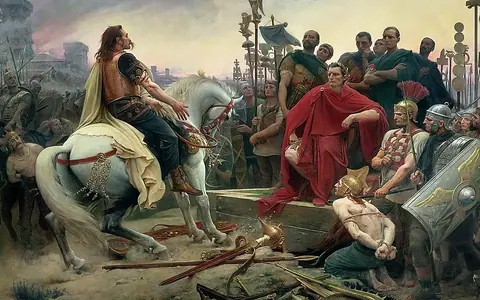 Caesar in command · 52 BCBattle of Alesia
 Caesar in command · 48 BCBattle of Dyrrachium
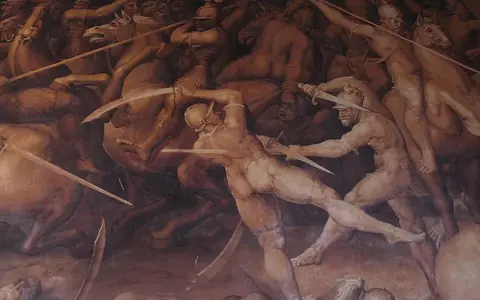 Caesar in command · 48 BCBattle of Pharsalus
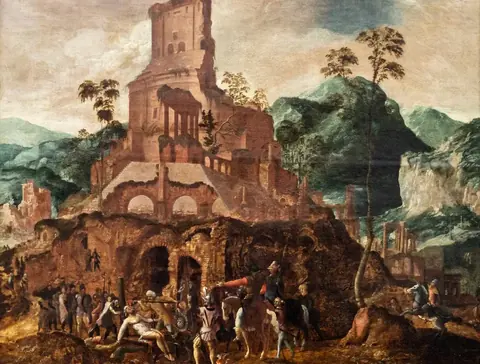 Rome against horse archers · 53 BCBattle of Carrhae
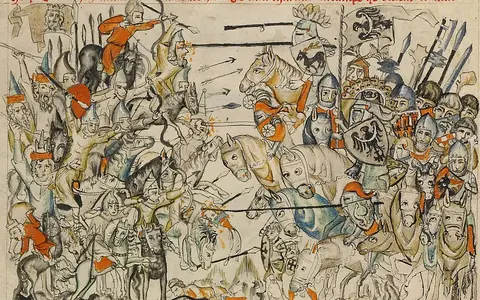 His heirs · 1241Battle of Legnica
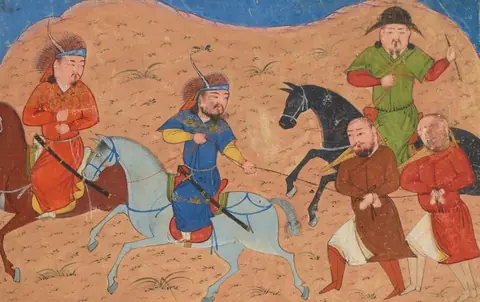 Subutai and Batu · 1241Battle of Mohi
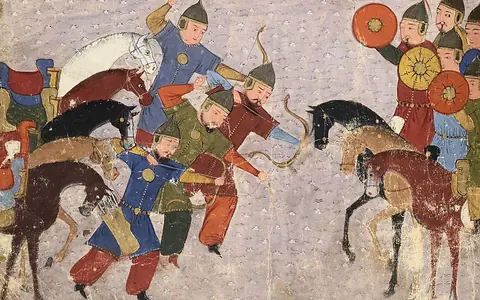 Mongols defeated · 1260Battle of Ain Jalut
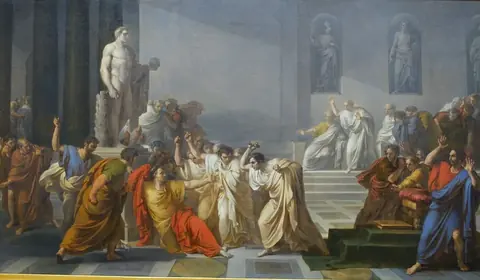 Guide · 88 BC to AD 324The Roman Civil Wars
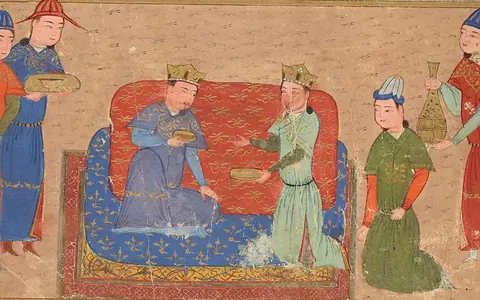 CommanderGenghis Khan
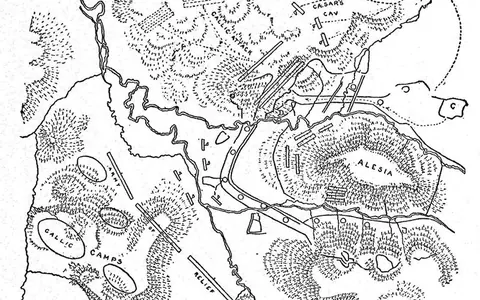 CommanderJulius Caesar
CommanderSubutai
 CommanderPompey the Great
ExplainerHorse Archers
 ExplainerHow the Roman Legion Worked
RankingThe Greatest Commanders of Ancient Rome
RankingGreatest Mongol Generals
 RankingThe Greatest Military Commanders
Your verdict
We do not pick a winner. Here are the two cases at their strongest, and the questions that decide which one you find more convincing.
For Genghis Khan
- An army built from feuding tribes into one disciplined force
- The desert march to Bukhara and the fall of Khwarazm
- Horse archers who used the methods that broke Crassus at Carrhae
- A siege craft learned in war, from China to Persia
- An empire that kept growing for half a century after him
For Caesar
- Gaul conquered, with Alesia and its double ring of walls
- Italy taken in sixty days and a civil war won on central lines
- Legions who never deserted him
- Speed his enemies could not match, from Rome to Zela
- Gaul made a tax-paying province, and great plans as dictator
Questions to weigh before you decide:
- Does conquering settled states from the outside compare with seizing a civilisation's own heartland from within?
- Carrhae suggests legions struggled against horse archers. Does that tell us anything about Caesar, who never fought them?
- Should a conqueror be judged by the land he took, or by the political order he left?
- Both are accused of mass killing on a scale their contemporaries recorded. How should that change the comparison?
- How far can we trust medieval chroniclers' numbers, and Caesar's own account of his wars?
Cast your vote below and see how other readers have judged them.






