
Saladin or Baldwin IV: what does the evidence say?
Saladin (1138 to 1193), sultan of Egypt and Syria, and Baldwin IV (1161 to 1185), the leper king of Jerusalem, faced each other across one frontier for eleven years without either of them ending the war. A Frankish army that marched out with the sixteen-year-old king routed Saladin at Montgisard on 25 November 1177, and Saladin answered in 1179 with victories at Marj Ayyun and at Jacob's Ford. He besieged Kerak in 1183 and again in 1184 and withdrew both times, so the kingdom was still whole when Baldwin died in 1185. Bernard Hamilton argues that the reign showed no signs of decline, against an older reading that sees it in the shadow of Hattin. This page sets out the evidence for each man and leaves the verdict to you.
When Baldwin was crowned on 15 July 1174, aged thirteen, Saladin already ruled Egypt, and that October he marched into Damascus, so the boy inherited a kingdom that the sultan was closing in on from two sides. Years earlier, as Piers Mitchell retells from the chronicle, Baldwin's tutor William of Tyre had noticed that the prince felt nothing when other boys pinched his right arm, and the disease grew worse for the rest of his life.1
We do not rank the two men here, and instead set out the evidence: the careers side by side, the fighting from Montgisard to Kerak, and six questions on which a commander can be judged. One thread runs through all of it, the question of who actually led the Frankish army on a given day, since a sick king who spared himself no effort still had to hand command to his barons in the end.2
Side by side
- Lived
- 1138 to 4 March 1193
- 1161 to 1185, aged 24 at his death by Piers Mitchell's count
- Origin
- Born at Tikrit to a Kurdish family whose forebears came from Dvin
- Son of King Amalric I of Jerusalem and Agnes of Courtenay
- Came to power
- Vizier of Egypt in 1169, master of Damascus from 1174, of Aleppo from 1183
- Crowned on 15 July 1174 at the age of thirteen
- Men at his side
- His nephews Farrukh Shah and Taqi al-Din, his brother al-Adil
- Raynald of Châtillon, Raymond of Tripoli, Humphrey of Toron, the Ibelins, later Guy of Lusignan
- Fights named here
- Montgisard, lost. Marj Ayyun and Jacob's Ford, won. Kerak, given up twice
- Montgisard, won. Marj Ayyun, lost. Jacob's Ford, relief too late. Kerak 1183, relieved
- Death
- At Damascus, six years after Hattin
- Of leprosy, first noticed when he was about nine, in the spring of 1185
Dates from the Treccani encyclopedia, Encyclopaedia Iranica and Piers Mitchell's study of the king's illness. We show no portraits, since every picture of the two men in this article was made long after their deaths, and we give no win and loss totals because no source counts their encounters the same way.3
Where they met: from Montgisard to Kerak
Montgisard, November 1177
In the autumn of 1177 much of the kingdom's army had gone north with Philip of Flanders and Raymond of Tripoli, and the master of the Temple had taken eighty knights to hold Gaza. Saladin crossed the desert from Egypt, and Lane-Poole describes his men burning Ramla and Lydda, so sure of themselves that they let the king slip into Ascalon and the Templars of Gaza join him.4
The numbers are the most disputed thing about the day. William of Tyre, who says he questioned many witnesses, counts scarcely 375 men of every rank with the king, against 26,000 light horsemen brought by Saladin. The Old French chronicle attributed to Ernoul gives the Christians 500 knights and the Saracens 60,000, or 40,000 in some manuscripts, and credits the help of St George.5
Ibn Shaddad records Saladin's own explanation: his flanks were moving to put a hill near Ramla at their back when the Franks charged and routed them. Lane-Poole writes that the sultan's bodyguard was cut to pieces round him and that he escaped on a swift camel, while his army fled through the night towards Egypt. Ibn Shaddad called it a great reverse that God repaired only at Hattin.6
Who led the charge is less clear than the result. Ibn Shaddad calls Prince Arnat, his name for Raynald of Châtillon, the leader of the Franks, and Ernoul writes that Raynald did the greatest deeds of arms that day, while Baldwin of Ramla asked the king for the first blow because the battle was fought on his own land. The full story is in our article on the Battle of Montgisard.7

Banias and Marj Ayyun, 1179
Saladin answered in the north, near Banias. In April 1179, Lane-Poole writes, Farrukh Shah caught the king with a small following in a rocky gorge, and only the constable Humphrey of Toron saved him from capture, at the cost of his own life. Ibn al-Athir gives Farrukh Shah fewer than a thousand horsemen and says that Muslims used Humphrey's name as a proverb for courage.9
In June the king marched to Marj Ayyun with the relic of the Cross, and his men first beat Saladin's raiders before the sultan rallied his fleeing troops and fell on Franks who thought the day was won. On Baldwin's own part the sources differ in tone: William says he escaped unharmed with the help of some faithful men, while Ibn al-Athir writes that their king fled alone. The master of the Temple was taken and died in prison.10
Jacob's Ford, August 1179
The castle that provoked the fighting stood at Jacob's Ford on the upper Jordan. Kate Raphael's excavation report dates the start of building to October 1178, and Ernoul tells how the Templars wanted it while the king objected that no castle could be built during a truce, until they talked him round.11

Saladin first tried to buy it away. Ibn al-Athir says he offered 60,000 dinars to have it pulled down, and the account of Abu Shama, translated in Raphael's report, adds a later offer of 100,000. In August his sappers mined a wall that Ibn al-Athir puts at nine cubits thick, put out the first fire when the wall held, dug deeper and fired the mine again, and the wall fell on 30 August 1179 by Ibn al-Athir's date.12
Baldwin himself was not at the castle, and Ernoul says the king gathered his army at Tiberias, about five leagues away, and did not dare to try the relief, and that Saladin beheaded every Templar he took. The bones of five defenders studied by Piers Mitchell and his colleagues show sword and arrow wounds and bodies stripped of armour and dumped with dead horses.13
Truce and Le Forbelet, 1180 to 1182
In the late spring of 1180 Baldwin asked for a two-year truce, and Hamilton notes that both sides accepted it without the tribute Muslim rulers usually paid. It broke down in 1182, and in that year Saladin met the Frankish army near Le Forbelet. William puts his force at about 20,000 and the Frankish knights at barely 700, without placing the king in the fighting line, and Hamilton counts the day as a decisive defeat for Saladin.14
Ain Jalut and Kerak, 1183
By the autumn of 1183 Baldwin had lost his sight and the use of his hands and feet, William writes, and after a violent fever at Nazareth he made Guy of Lusignan, his sister's husband, regent, keeping the royal title and Jerusalem. On 20 November, after Guy's failure in the field, the barons crowned the king's five-year-old nephew Baldwin as co-king.15
Guy's army, about 1,300 knights and more than 15,000 foot by William's count, faced Saladin at the spring of Tubania for eight days by William's reckoning, five by Lane-Poole's, and no battle came. Ibn Shaddad says the Franks kept their ranks closed and would not be drawn out, until Saladin's men, short of supplies, advised him to go home.16

Saladin then besieged Kerak, Raynald's castle east of the Dead Sea, while Raynald's stepson Humphrey was marrying the king's half-sister Isabella there, and William describes jugglers and musicians crowding a castle battered by eight engines. Ernoul says the groom's mother sent Saladin food from the feast and that he spared the couple's tower. William gives the siege a month and Ernoul eight weeks, and Lane-Poole moves the wedding to the siege of 1184.17
This time the king came himself, and William says that Baldwin took the relic of the Cross, marched with the whole army to the Dead Sea and there named Raymond of Tripoli its commander, and that Saladin broke off the siege when he heard the count was leading it. The Treccani entry notes that Baldwin joined the relief at the very end of his strength.18
The last regency and the road to Hattin, 1184 to 1187
In 1184 Saladin besieged Kerak again, and when the Franks marched to its relief, Ibn Shaddad records, he sent his troops to sack Nablus instead and went back to Damascus, the siege ending on 4 September by Conder's date. Guy shut the gates of Ascalon against the king, and the regency passed to Raymond of Tripoli at about the point where William of Tyre laid down his pen.19
Ernoul sets out the arrangement the dying king accepted: Raymond would be regent for ten years, the boy's great-uncle Joscelin would guard him, and if the child died the pope, the emperor and the kings of France and England would choose between the king's two sisters. Ibn al-Athir says simply that the leper king left the kingdom to his sister's young son and the count took over its government.20
Mitchell dates the king's death to 16 March 1185, while Lane-Poole speaks of the winter of 1184 to 1185. Raymond then made a truce with Saladin that the Old French continuation says was to last four years, as Hamilton notes.21
The boy king died at Acre in 1186, and Sibylla was crowned with Guy beside her while the barons gathered at Nablus refused to attend. Raynald then seized a caravan of pilgrims from Mecca near Montreal, and on 1 May 1187 the masters of the military orders were beaten near Cresson.22
Guy's army left the springs of Sephoria on the morning of 3 July, as Benjamin Kedar reconstructs the march, and on 4 July it was destroyed on the Horns of Hattin.23
Strategy: the long contest for the frontier
The case for Saladin
Saladin's plan was to unite the Muslim lands round the kingdom before trying to destroy it. Humphreys, in Encyclopaedia Iranica, describes how he took Syria piece by piece after 1174, occupied Aleppo in 1183 and by 1186 had made Mosul a client.24
Raphael argues that after Montgisard he concluded that attacks on the kingdom should come from Damascus, a route far shorter and safer than the desert road from Cairo. The cost was time, and every year spent in the north was a year in which the kingdom survived.25
The case for Baldwin
Baldwin's answer was to strike first and to fortify. Conder notes raids early in the reign into the lands of Damascus and from Sidon towards Baalbek, and the castle at Jacob's Ford followed in 1178. Hamilton argues that for some six years the Franks under Baldwin frustrated Saladin's plan to take over Nur ad-Din's empire and encircle them, while the Treccani entry of 1930 judges that the Christians could no longer make good their steady loss of men.26
On the battlefield
The case for Saladin
At Marj Ayyun Saladin did what a good commander does with a beaten vanguard, and Lane-Poole describes him rallying his fleeing troops and charging Franks weighed down with spoils. His record against Baldwin's army in open battle is still mixed: at Montgisard his army was routed, and in October 1183, as Kedar describes the standoff in the Jezreel valley, he could not provoke the Franks into battle.27
The case for Baldwin
Montgisard is the strongest evidence for him, since the king left the safety of Ascalon rather than watch his country burn, and Lane-Poole stresses that Saladin's men were surprised before they could form up. The weak points are just as clear, since near Banias the king was caught in a gorge with a small following, and at Marj Ayyun, Ibn al-Athir says, the master of the Hospital and the lord of Tiberias were taken as well as the master of the Temple.28
Castles and sieges
The case for Saladin
Jacob's Ford was Saladin's best siege against Baldwin. Raphael shows him gathering intelligence, paying a dinar to every man who brought water to put out the failed mine, breaking the wall within five days and razing the castle. Kerak was his worst, since Ibn Shaddad and Conder both record that each siege ended with his withdrawal once a Frankish army approached.29
The case for Baldwin
The castle at Jacob's Ford was a bold move, and Ibn al-Athir explains why Saladin feared it: the Franks believed that once it was finished it would let them seize much of the Muslim lands. The same castle is the strongest charge against the king, because Raphael found it unfinished, with no towers or wall walks, and Ernoul says the army at Tiberias lacked the courage to try to save it.30
Who commanded: leading men, and leading through others
The case for Saladin
Saladin ran his wars as a family enterprise, which Humphreys describes as a confederation of the leading men of the dynasty, each with his own province. It gave him able commanders, Farrukh Shah at Banias and Marj Ayyun and Taqi al-Din, who Ibn al-Athir says beat an army of twenty thousand with a thousand horsemen in the year of Jacob's Ford. The same system, Humphreys adds, could be coordinated only by a senior ruler who held a preponderance of force or a father's authority over the other princes.31
The case for Baldwin
Baldwin led from the front while his body allowed it, at Montgisard, near Banias and at Marj Ayyun. Piers Mitchell observes that he beat Saladin on the battlefield on several occasions and kept his throne despite a disease his age feared and shunned. When he could no longer lead, he chose who would, first Guy and then Raymond, and the Treccani entry calls Guy incapable of any military initiative.32
Truces and diplomacy
The case for Saladin
Saladin used truces to choose his wars. Hamilton explains that he welcomed the truce of 1180 so that he could campaign in northern Syria against Kilij Arslan of Konya, and the truce of 1185 so that he could return to Iraq. He also punished a broken truce, and Ibn Shaddad records that he swore to kill Raynald with his own hand after Raynald seized a caravan, and kept the oath after Hattin.33
The case for Baldwin
The truce of 1180 was Baldwin's initiative, and Hamilton links it to the divisions in his kingdom and to his need to reassure the Byzantine emperor Manuel, to whom he sent his closest kinsman, Joscelin of Courtenay. The weakness lay with his own vassals, since Conder records that it was Raynald who broke the truce in 1182 while Saladin was away in the east.34
What came after
The case for Saladin
Saladin outlived his rival by eight years and won the war that Baldwin had held off. He destroyed the Frankish army at Hattin on 4 July 1187, the day Kedar reconstructs.35
On 2 October, the Treccani entry notes, he entered Jerusalem, which had been in Christian hands for about a century. His later contest with Richard is told in our comparison of Saladin and Richard the Lionheart.36
The case for Baldwin
Hamilton notes that neither of Saladin's real successes against Baldwin cost the Franks any territory, and Kedar suggests that Guy marched out of Sephoria in 1187 partly because his cautious stand of 1183 had cost him his office. Against that stands what the kingdom lacked in 1185: a healthy adult heir and barons who trusted one another.37

How historians have judged them
The writers of the time judged the reign by its great blows. Ibn Shaddad, who served Saladin, calls Ramla a severe defeat, and William of Tyre, Baldwin's tutor and chancellor, writes of a king weak in body but strong in spirit who strained beyond his strength to hide his illness and carry the burden of rule.38
Modern judgement long followed the shadow of Hattin. Hamilton writes that the defeat has darkened the reign in the minds of historians ever since Ernoul, and that the society of the Latin East under Baldwin appeared vigorous and self-confident.39
Piers Mitchell concludes from William's description that the king had the lepromatous form of leprosy, and in a later chapter he calls him a successful ruler despite it.40
Battles on the site
Every page on Echoes of Battle about the fighting between the two men, and the guides that set it in context.
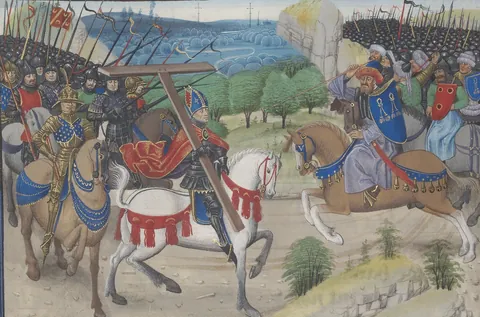 Both armies · 1177Battle of Montgisard
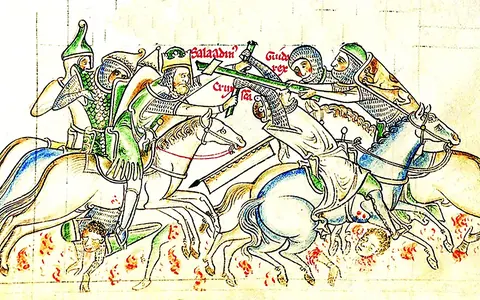 Saladin, after Baldwin · 1187Battle of Hattin
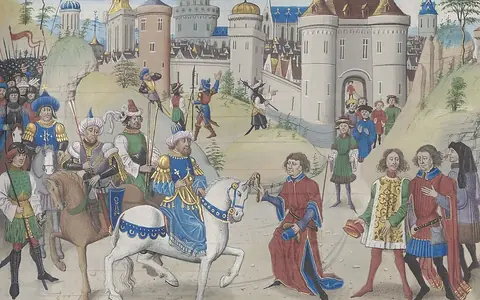 Saladin · 1187Siege of Jerusalem
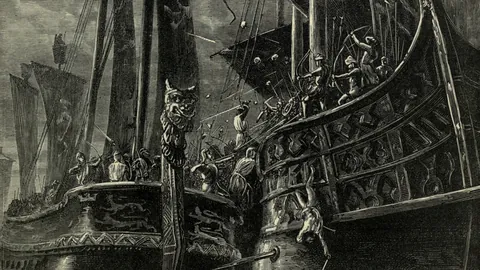 Saladin · 1189 to 1191Siege of Acre
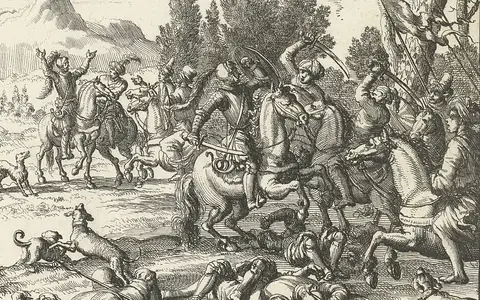 Saladin · 1191Battle of Arsuf
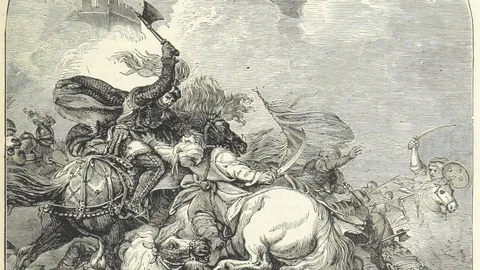 Saladin · 1192Battle of Jaffa
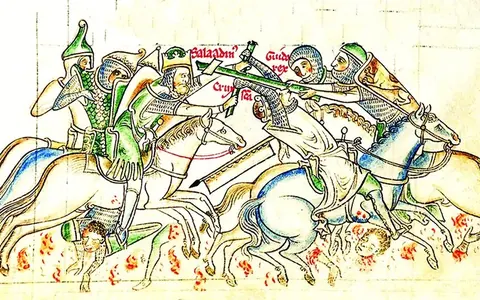 CommanderSaladin
Head to headSaladin vs Richard the Lionheart
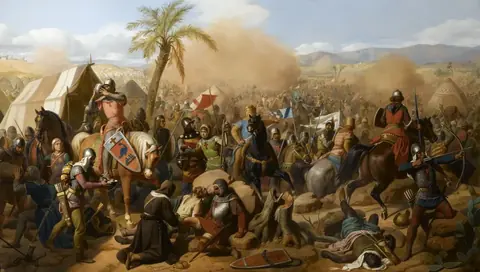 Guide · 1095 to 1291The Crusades
 RankingThe Greatest Battles of the Middle Ages
 QuizHow Well Do You Know Medieval Battles?
Your verdict
We do not pick a winner, and instead set out the two cases at their strongest, followed by the questions that decide which one you find more convincing.
For Saladin
- Egypt, Damascus and Aleppo united under one ruler by 1183
- The rally at Marj Ayyun that turned a beaten vanguard into a victory
- Jacob's Ford taken and razed before the relief army could move
- Truces used to pick his moment and his front
- Hattin and Jerusalem in 1187, two years after Baldwin's death
For Baldwin IV
- Montgisard, won by a much smaller army when he was sixteen
- A kingdom that lost no territory to Saladin while he lived
- Two sieges of Kerak that ended with Saladin withdrawing
- The truce of 1180, made without tribute on either side
- Eleven years of rule through a disease that left him blind and crippled
Here are the questions to weigh before you decide:
- Should Montgisard count for Baldwin if Raynald of Châtillon or the Ibelins led the decisive charge?
- Was Saladin's slow unification of Syria wise patience, or years that gave the Franks time?
- Does a king who hands command to others at the right moment deserve credit for the result?
- Should Hattin, fought two years after Baldwin's death, weigh on his record at all?
- Was the castle at Jacob's Ford a bold strategy, or a risk the kingdom could not afford?
- How far can we trust numbers like 375 against 26,000, written by men who saw a miracle in the result?
Cast your vote below and see how other readers have judged them.






