

What was the war at sea in World War I and who won?
It was the 1914 to 1918 struggle for the oceans between Britain and its allies and the German Empire. Germany won at Coronel and sank more ships at Jutland, but Britain kept command of the sea, its blockade and, with convoys, beat the U-boats. Britain and its allies won.1
The Imperial War Museums call it a struggle on which the prosperity of Britain and its Empire depended, and Royal Museums Greenwich note that much of it went unseen. While armies were deadlocked on the Western Front, the navies of World War I fought for the sea lanes that fed both sides. This guide follows that war from the cruiser battles of 1914, the Battle of Coronel and the Battle of the Falkland Islands, through the Battle of Dogger Bank and Jutland, to the U-boat war, the Zeebrugge Raid and the scuttling of the German fleet at Scapa Flow.2
Causes of the naval war: the arms race and the blockade
From the start of the twentieth century Britain and Germany were locked in a bitter rivalry to build bigger and better warships. In 1906 Britain launched HMS Dreadnought, faster, better armored and more heavily gunned than anything afloat, and both the British and the German battle fleets were suddenly out of date. Germany answered with dreadnoughts of its own, and the Imperial War Museums count this naval arms race as a major cause of the war between the two countries in 1914.3
Britain stayed ahead. When war came in August 1914 the History Press counts 28 British dreadnoughts and nine battlecruisers against 16 German dreadnoughts and five battlecruisers; the Maritime Archaeology Trust gives 28 modern British capital ships against 18 German. The gap mattered because Britain lived by the sea: its trade and communications, its food and raw materials, and the supply of its armies overseas all depended on control of the oceans.4
Britain's strategy was blockade. Instead of a close watch off the German ports, the Royal Navy shut the two exits from the North Sea: the Dover Patrol closed the English Channel, and the Grand Fleet at Scapa Flow in Orkney covered the gap to Norway. Ships bound for Germany were stopped and their cargoes of raw materials and food seized, and the German High Seas Fleet was in effect penned in the North Sea.5
Germany had aims of its own. Outnumbered, the High Seas Fleet tried to draw out parts of the British fleet and destroy them piece by piece until the two sides were equal, and only then risk a full battle. When that failed, Germany turned to the submarine to blockade Britain in its turn, and the U-boats became its main weapon against British trade.6
Who fought the war at sea in World War I?
The main fleets were the Royal Navy's Grand Fleet and the Imperial German Navy's High Seas Fleet, and most of the big actions were fought between them in the North Sea. Beyond them stood the merchant seamen of the British merchant fleet, whose ships carried the food, raw materials and reinforcements that the Royal Navy was there to protect.7
The war at sea was a world war. Australian and New Zealand ships were part of it: the Australian cruiser HMAS Sydney ended the cruise of the German raider Emden, and the battlecruiser HMS New Zealand fought at Heligoland Bight and Dogger Bank. The Russian Empire and France lost warships to the same raider at Penang. The Ottoman Empire, Germany's ally, defended the Dardanelles against the British and French fleets, and the United States joined the Allies in April 1917.8
1914: Heligoland Bight, Coronel, the Falklands and the raiders
The first major naval action of the war was fought on 28 August 1914 in the Heligoland Bight, off the north German coast and ended in a British victory, and the Maritime Archaeology Trust sees it as the moment Britain established its dominance in the North Sea.9
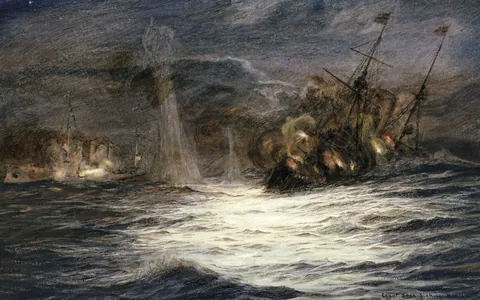
Far from home, the German East Asia Squadron under Vice Admiral Maximilian Graf von Spee was steaming across the Pacific toward South America. On 1 November 1914, off Coronel on the coast of Chile, it met the weaker British squadron of Rear Admiral Sir Christopher Cradock. Two British armored cruisers were sunk and Cradock died with his men. The Australian War Memorial puts the British dead at over 1,500, the Imperial War Museums at 1,600 and Pen and Sword at over 1,660. It was Britain's worst naval defeat in more than a century.10
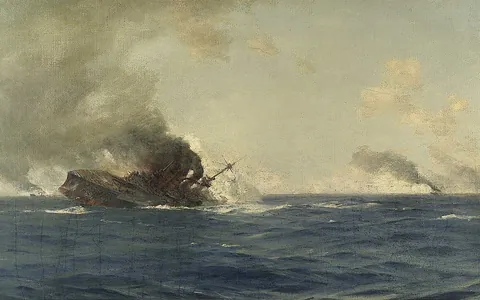
The Admiralty answered with overwhelming force. Vice Admiral Sir Doveton Sturdee took the battlecruisers Invincible and Inflexible to the South Atlantic, and on 8 December 1914, when von Spee's squadron arrived off the Falkland Islands, Sturdee's ships came out of Port Stanley after it. In the Battle of the Falkland Islands four German cruisers were sunk and von Spee and his two sons were killed; only the light cruiser Dresden escaped. The Royal Navy commemorates 1,871 German dead, while Pen and Sword gives 2,094.11
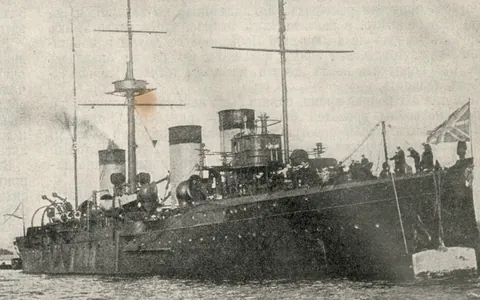
One cruiser of von Spee's squadron had been detached to raid commerce. In a few months the light cruiser Emden under Captain Karl von Müller sank or captured some two dozen merchant ships in the Indian Ocean. On 28 October 1914, disguised with a dummy fourth funnel, she slipped into Penang harbor, torpedoed the Russian cruiser Zhemchug and then sank the French destroyer Mousquet, stopping to pick her survivors out of the water. On 9 November the Australian cruiser Sydney caught Emden at the Cocos Islands and drove her ashore on North Keeling Island.12
1915: Dogger Bank and the Dardanelles
Germany carried the war to the British coast. In 1914 German warships bombarded Great Yarmouth, Scarborough and Hartlepool, raids meant to draw British forces out where they could be destroyed piecemeal. Britain had an advantage the Germans did not suspect: a team of codebreakers in London, known as Room 40, could read German naval signals.13
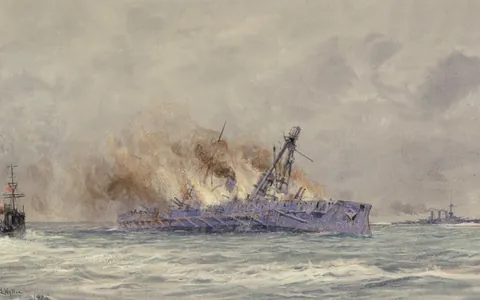
Decoded signals warned the Admiralty of the next sortie, and on 24 January 1915 Sir David Beatty's battlecruisers intercepted Franz Hipper's squadron near the Dogger Bank in the North Sea. The armored cruiser Blücher was sunk and no British ship was lost, but Beatty's flagship Lion was badly damaged, and in the confusion that followed the rest of the German squadron got home. The New Zealand naval museum calls it a badly conducted battle on the British side.14
In the Mediterranean the Allies tried to use sea power to knock the Ottoman Empire out of the war. From February 1915 British and French warships bombarded the forts of the Dardanelles, aiming to force the straits and reach Constantinople. The straits were defended by minefields and guns, and on 18 March the main attack ran into a minefield and the naval attack was called off. Troops would have to take the peninsula first, and the Gallipoli campaign followed.15
The Battle of Jutland (1916): the biggest naval battle of World War I
Jutland, fought on 31 May and 1 June 1916 in the North Sea off Denmark, was the largest naval battle of World War I and the only time the British and German dreadnought fleets met. About 250 warships and some 100,000 men took part. Reinhard Scheer, commander of the High Seas Fleet, planned to lure out Beatty's battlecruisers and destroy them before Admiral Sir John Jellicoe could arrive with the Grand Fleet. The codebreakers gave warning again, and both British forces were at sea before the Germans sailed.16

In the first clash Hipper's battlecruisers had the better of it. HMS Indefatigable and HMS Queen Mary blew up when German shells reached their magazines, and Beatty's flagship Lion was saved only because the mortally wounded Royal Marine Major Francis Harvey ordered its magazine flooded. Then Beatty sighted the whole High Seas Fleet and turned north, drawing it onto Jellicoe.17
Jellicoe deployed his battleships across the German line of advance, the move called crossing the T, so that all his guns could bear while the leading German ships could reply only with their forward guns. In that phase HMS Invincible was hit and blew up, taking Rear Admiral Horace Hood with her. Facing the whole Grand Fleet, Scheer turned his fleet away into the mist, came back, and turned away again behind a torpedo attack. In the night the Germans broke through the rear of the British fleet and got home; the battlecruiser Lützow was scuttled and the old battleship Pommern sunk on the way.18
Among the British dead was 16-year-old Jack Cornwell of HMS Chester, who stayed at his gun though mortally wounded and was awarded a posthumous Victoria Cross. Britain lost 14 ships and Germany 11. Royal Museums Greenwich gives 6,094 British dead against 2,551 German; the Imperial War Museums say over 6,000 and over 2,500. Both sides claimed victory, and German newspapers announced a German win.19
U-boats and unrestricted submarine warfare
The British blockade drove Germany to strike back under the sea. On 4 February 1915 Germany declared the waters around Britain a war zone, in which merchant ships could be sunk without warning, a policy known as unrestricted submarine warfare. It angered neutral countries, above all the United States.20
On 7 May 1915 a German submarine torpedoed the Cunard liner Lusitania off the coast of Ireland. Nearly 1,200 people were killed, 128 of them Americans. Afraid that the United States would go to war, Germany ordered its U-boats to spare passenger ships, and on 1 September 1915 it abandoned the campaign, after American lives were also lost in the liner Arabic.21

After Jutland had shown that the High Seas Fleet could not break the blockade, Germany resumed unrestricted submarine warfare on 1 February 1917. Its leaders knew this might bring in the United States, but calculated that the U-boats could starve Britain out of the war before American troops arrived in strength. Instead the United States declared war on 6 April 1917.22
For a few months the gamble seemed to be working, and the Imperial War Museums say the U-boat campaign almost brought Britain to its knees in 1917. By then, according to the National WWI Museum and Memorial, U-boats had destroyed about 30 percent of the world's merchant ships, and the National Archives says that over the whole war they sank a third of Allied merchant shipping.23
The answer was the convoy. From 1917 merchant ships sailed in groups protected by warships, and losses began to fall sharply. Convoys were backed by aircraft and shore stations that hunted U-boats, depth charges, early underwater listening devices and dazzle camouflage paint. The U-boats had failed: the Imperial War Museums say the threat had been neutralized by the Armistice, and HISTORY calls the convoys the death of German hopes of starving Britain into submission.24

The British blockade of Germany
The blockade worked slowly and out of sight. Britain's control of the North Sea and the Channel cut the flow of war supplies, food and fuel to Germany and its allies. By the winter of 1916 to 1917 Germany was short of food, and its civilians were going hungry.25
How far the blockade itself was to blame has been argued ever since. German propaganda called it the hunger blockade and accused the Allies of making war on women and children, a charge the Allies denied, and the Imperial War Museums point to bad harvests and incompetent food distribution inside Germany. Economic historian Mary Elisabeth Cox, using the heights and weights of nearly 600,000 German schoolchildren, concludes that the blockade did cause severe malnutrition, worst among working-class children.26
What is not in doubt is the strategic effect. The Imperial War Museums say that by keeping Britain in command of the shipping lanes, Jutland let the blockade continue and so helped bring about Germany's defeat in 1918, and naval historian Andrew Lambert calls the blockade Britain's primary strategic weapon.27
1918 and after: Zeebrugge, mutiny and Scapa Flow
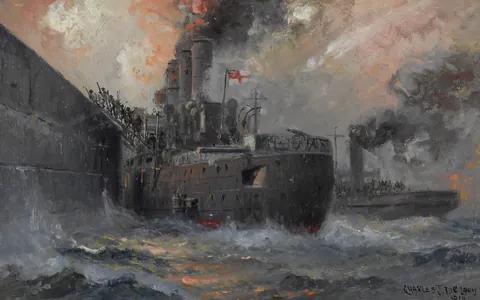
The U-boats based in occupied Belgium were the closest threat to the Channel. Vice Admiral Sir Roger Keyes of the Dover Patrol planned to seal them in by sinking old cruisers filled with concrete, blockships, in the canal entrance at Zeebrugge and the harbor mouth at Ostend. On the night of 23 April 1918 the cruiser Vindictive landed sailors and Royal Marines on the Zeebrugge Mole under heavy fire, while the submarine C3, packed with explosives, blew up the viaduct linking the Mole to the shore.28
At Zeebrugge the blockship Thetis grounded short of the canal, but Intrepid and Iphigenia were scuttled across its entrance; at Ostend both blockships sank short of their target. Eleven Victoria Crosses were awarded for the raids, and British casualties came to about 600 killed, wounded and missing, while German losses were light. The block was partial and temporary: the National Archives says the Germans dredged a channel for submarines within days, while Defense Media Network says the canal was closed to larger U-boats and destroyers for 50 of the 70 days after the raid.29

In the North Sea the British kept up the pressure: on 17 November 1917 they fought a second battle in the Heligoland Bight. By the autumn of 1918 the High Seas Fleet was breaking down. At the end of October its crews mutinied, and Andrew Lambert notes that the mutiny helped bring down Germany's imperial regime.30
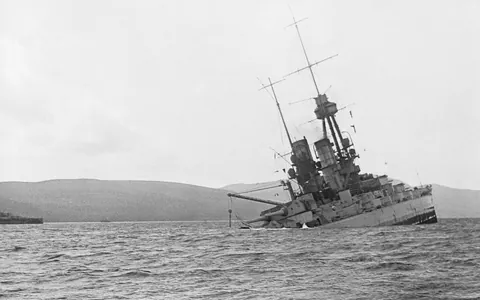
The Armistice that took effect on 11 November 1918 required Germany to hand over all its submarines and most of the High Seas Fleet. On 21 November the German fleet sailed into captivity and was interned at Scapa Flow, 74 ships under Rear Admiral Ludwig von Reuter. On 21 June 1919, believing that the peace talks were failing and determined that his ships should not be seized, von Reuter gave the signal to scuttle the fleet while the British guard squadron was at sea on exercises. Orkney Museums count 52 ships sunk; the Scapa Flow 1919 project gives 54.31
Key commanders of the war at sea
- Sir John Jellicoe (Britain): commander of the Grand Fleet at Jutland, who held his fleet together and kept British command of the North Sea.32
- Sir David Beatty (Britain): led the battlecruisers at Dogger Bank and Jutland, then commanded the Grand Fleet when the German fleet surrendered.33
- Reinhard Scheer (Germany): commander of the High Seas Fleet, who planned the operation that led to Jutland.34
- Franz Hipper (Germany): commander of the German battlecruisers at Dogger Bank and Jutland.35
- Maximilian von Spee (Germany): commander of the East Asia Squadron, victor of Coronel, killed at the Falklands.36
- Sir Christopher Cradock (Britain): commander of the squadron destroyed at Coronel, where he died.37
- Sir Doveton Sturdee (Britain): sent with the battlecruisers that destroyed von Spee's squadron at the Falklands.38
- Karl von Müller (Germany): captain of the raider Emden in the Indian Ocean.39
- Sir Roger Keyes (Britain): commander of the Dover Patrol, who planned the Zeebrugge and Ostend raids.40
- Ludwig von Reuter (Germany): commander of the interned fleet, who ordered the scuttling at Scapa Flow.41
Who won the war at sea in World War I?
Britain and its allies won the war at sea, though not in the way either navy expected in 1914. There was no single decisive battle. Germany had real successes: Coronel, the raiders, the heavier British losses at Jutland and a U-boat campaign that came close to starving Britain out of the war in 1917. But the Grand Fleet was ready for action again the day after Jutland, and the High Seas Fleet never again seriously challenged British control of the North Sea.42
Historians still weigh Jutland differently. The History Press, drawing on the National Museum of the Royal Navy, calls the British the clear strategic winners. Andrew Lambert of King's College London goes further: he argues that Jellicoe, who commanded Britain's only modern battle fleet, rightly refused to take great risks, that the British won the battle, and that the war as a whole was won by sea power. The Imperial War Museums, by contrast, stress that the answer about Jutland is not clear-cut.43
The cost was carried by sailors on every side and by civilians: the passengers of the Lusitania, the merchant seamen who kept supplies moving, and the German families who went hungry under the blockade.44
Major naval battles of World War I
Our articles on the battles of the war at sea, from the raid on Penang and the Battle of Coronel in 1914 to the Zeebrugge Raid in 1918 and the scuttling at Scapa Flow in 1919, are listed below in date order.
- 1914Battle of Penang, 1914German Empire vs Russian Empire and France
At dawn on 28 October 1914 the German cruiser Emden, disguised with a false funnel, sank the Russian cruiser Zhemchug and the French destroyer Mousquet at Penang.
- 1914Battle of Coronel, 1914German Empire vs British Empire
On 1 November 1914 von Spee's cruisers caught Cradock's squadron off Chile at sunset and sank the Good Hope and the Monmouth with every man aboard.
- 1914Battle of the Falkland Islands, 1914United Kingdom (Royal Navy) vs German Empire (East Asia Squadron)
On 8 December 1914 von Spee's squadron came to raid Port Stanley and found two British battlecruisers in harbor. By nightfall four of his five cruisers were sunk.
- 1915Battle of Dogger Bank, 1915United Kingdom vs German Empire
On 24 January 1915 codebreakers sent Beatty's battlecruisers after Hipper near the Dogger Bank. Blücher was sunk, but a crippled flagship and a misread signal let the rest escape.
- 1917Second Battle of Heligoland Bight, 1917United Kingdom (Grand Fleet) vs German Empire (High Seas Fleet)
On 17 November 1917 British cruisers raced into the Heligoland Bight after German minesweepers, lost them in smoke and minefields, and met German battleships.
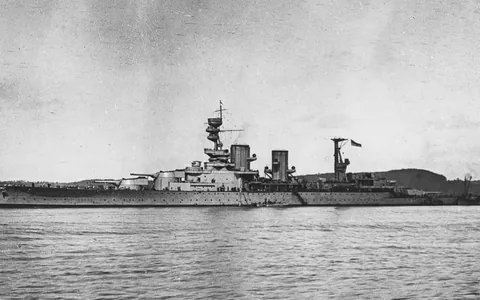
- 1918The Zeebrugge Raid, 1918United Kingdom (Royal Navy, Royal Marines) vs German Empire (Imperial German Navy)
On St George's Day 1918 the Royal Navy stormed the Zeebrugge Mole and sank concrete-filled cruisers in the Bruges canal to shut in the U-boats. Within days they were out again.
- 1919Scuttling at Scapa Flow, 1919German interned fleet vs Royal Navy at Scapa Flow
On 21 June 1919 the interned German High Seas Fleet sank itself at Scapa Flow in Orkney on Admiral von Reuter's signal, rather than be handed to the Allies.
Timeline of the war at sea in World War I
- 28 August 1914Battle of Heligoland Bight, the first major naval action of the war; a British victory.45
- 28 October 1914The German cruiser Emden raids Penang and sinks the Russian cruiser Zhemchug and the French destroyer Mousquet.46
- 1 November 1914Battle of Coronel: von Spee's squadron defeats Cradock off Chile.47
- 9 November 1914HMAS Sydney drives Emden ashore at the Cocos Islands.48
- 8 December 1914Battle of the Falkland Islands: Sturdee destroys most of von Spee's squadron.49
- 24 January 1915Battle of Dogger Bank: Blücher is sunk.50
- 4 February 1915Germany declares a war zone around Britain and begins unrestricted submarine warfare.51
- 18 March 1915The Allied naval attack on the Dardanelles fails in the minefields.52
- 7 May 1915A German submarine sinks the liner Lusitania; nearly 1,200 die.53
- 31 May to 1 June 1916Battle of Jutland, the only clash of the two battle fleets.54
- 1 February 1917Germany resumes unrestricted submarine warfare.55
- 6 April 1917The United States declares war on Germany.56
- 17 November 1917Second Battle of Heligoland Bight.57
- 23 April 1918Zeebrugge and Ostend raids.58
- Late October 1918Crews of the High Seas Fleet mutiny.59
- 21 November 1918The High Seas Fleet surrenders and sails into internment.60
- 21 June 1919The interned German fleet is scuttled at Scapa Flow.61
Where to read next
The war at sea was fought alongside the land war on the Western Front and at Gallipoli. For a wider ranking see the greatest naval battles in history and the greatest battles of World War I, read how World War I ended, or test yourself with the World War I battles quiz.
Notes
A number in the text points to a note; each note names the works that paragraph draws on, listed in full under Sources.
- Australian War Memorial, “Battle of Coronel”; Imperial War Museums, “Battle of Jutland”; Andrew Lambert, “Jutland”; Imperial War Museums, “The German U-Boat Campaign of WW1 That Almost Broke Britain”; HISTORY, “British naval convoy system introduced”. ↩
- Imperial War Museums, “War At Sea During The First World War”; Royal Museums Greenwich, “World War I at sea”. ↩
- Imperial War Museums, “War At Sea During The First World War”; Imperial War Museums, “Battle of Jutland”; The History Press, “The Battle of Jutland, 31 May 1916”. ↩
- The History Press, “The Battle of Jutland, 31 May 1916”; Maritime Archaeology Trust, “The War at Sea 1914 to 1918 (exhibition panel, PDF)”; Imperial War Museums, “War At Sea During The First World War”; Royal Museums Greenwich, “World War I at sea”. ↩
- Imperial War Museums, “Battle of Jutland”; Imperial War Museums, “The British Naval Blockade of the First World War”; Maritime Archaeology Trust, “The War at Sea 1914 to 1918 (exhibition panel, PDF)”. ↩
- Imperial War Museums, “Battle of Jutland”; The History Press, “The Battle of Jutland, 31 May 1916”; Maritime Archaeology Trust, “The War at Sea 1914 to 1918 (exhibition panel, PDF)”; National WWI Museum and Memorial, “Unrestricted U-boat Warfare”. ↩
- The History Press, “The Battle of Jutland, 31 May 1916”; Imperial War Museums, “Battle of Jutland”; Royal Museums Greenwich, “World War I at sea”. ↩
- Anzac Memorial, “Cocos Islands”; J. Rickard, “Penang Raid, 28 October 1914”; Imperial War Museums, “War At Sea During The First World War”; National Museum of the Royal New Zealand Navy, “Battle of Dogger Bank”; Naval Historical Society of Australia, “The Day the Emden Came A-Calling”; National Army Museum, “Gallipoli”; J. Rickard, “18 March 1915”; Imperial War Museums, “The German U-Boat Campaign of WW1 That Almost Broke Britain”; Maritime Archaeology Trust, “The War at Sea 1914 to 1918 (exhibition panel, PDF)”. ↩
- Imperial War Museums, “War At Sea During The First World War”; Maritime Archaeology Trust, “The War at Sea 1914 to 1918 (exhibition panel, PDF)”; National Museum of the Royal New Zealand Navy, “Battle of Dogger Bank”. ↩
- Australian War Memorial, “Battle of Coronel”; Pen and Sword Books, “Tragedy and Revenge”; Imperial War Museums, “War At Sea During The First World War”. ↩
- Royal Navy, “Forth sailors join WW1 commemorations in Falklands for first time”; Pen and Sword Books, “Tragedy and Revenge”; Imperial War Museums, “War At Sea During The First World War”; Australian War Memorial, “Battle of Coronel”. ↩
- Naval Historical Society of Australia, “The Day the Emden Came A-Calling”; Anzac Memorial, “Cocos Islands”; J. Rickard, “Penang Raid, 28 October 1914”. ↩
- Imperial War Museums, “Battle of Jutland”; Maritime Archaeology Trust, “The War at Sea 1914 to 1918 (exhibition panel, PDF)”; The History Press, “The Battle of Jutland, 31 May 1916”; National Museum of the Royal New Zealand Navy, “Battle of Dogger Bank”. ↩
- Imperial War Museums, “War At Sea During The First World War”; National Museum of the Royal New Zealand Navy, “Battle of Dogger Bank”. ↩
- National Army Museum, “Gallipoli”; J. Rickard, “18 March 1915”; Maritime Archaeology Trust, “The War at Sea 1914 to 1918 (exhibition panel, PDF)”. ↩
- Imperial War Museums, “Battle of Jutland”; The History Press, “The Battle of Jutland, 31 May 1916”; Andrew Lambert, “Jutland”. ↩
- Imperial War Museums, “Battle of Jutland”; The History Press, “The Battle of Jutland, 31 May 1916”; Royal Museums Greenwich, “Remembering Jutland”. ↩
- Imperial War Museums, “Battle of Jutland”; The History Press, “The Battle of Jutland, 31 May 1916”. ↩
- Imperial War Museums, “Battle of Jutland”; Royal Museums Greenwich, “Remembering Jutland”; The History Press, “The Battle of Jutland, 31 May 1916”; Andrew Lambert, “Jutland”. ↩
- Imperial War Museums, “The German U-Boat Campaign of WW1 That Almost Broke Britain”; Maritime Archaeology Trust, “The War at Sea 1914 to 1918 (exhibition panel, PDF)”; National WWI Museum and Memorial, “Unrestricted U-boat Warfare”. ↩
- National WWI Museum and Memorial, “Unrestricted U-boat Warfare”; HISTORY, “German submarine sinks Lusitania”; Imperial War Museums, “The German U-Boat Campaign of WW1 That Almost Broke Britain”; Maritime Archaeology Trust, “The War at Sea 1914 to 1918 (exhibition panel, PDF)”. ↩
- Imperial War Museums, “The German U-Boat Campaign of WW1 That Almost Broke Britain”; National WWI Museum and Memorial, “Unrestricted U-boat Warfare”; Imperial War Museums, “Battle of Jutland”; Maritime Archaeology Trust, “The War at Sea 1914 to 1918 (exhibition panel, PDF)”. ↩
- Imperial War Museums, “The German U-Boat Campaign of WW1 That Almost Broke Britain”; Maritime Archaeology Trust, “The War at Sea 1914 to 1918 (exhibition panel, PDF)”; National WWI Museum and Memorial, “Unrestricted U-boat Warfare”; The National Archives, “The raids on Zeebrugge and Ostend”. ↩
- HISTORY, “British naval convoy system introduced”; Imperial War Museums, “The German U-Boat Campaign of WW1 That Almost Broke Britain”; Defense Media Network, “Zeebrugge 1918”. ↩
- National WWI Museum and Memorial, “Unrestricted U-boat Warfare”; Imperial War Museums, “The British Naval Blockade of the First World War”. ↩
- Imperial War Museums, “The British Naval Blockade of the First World War”; Mary Elisabeth Cox, “Hunger games”. ↩
- Imperial War Museums, “Battle of Jutland”; Andrew Lambert, “Jutland”. ↩
- The National Archives, “The raids on Zeebrugge and Ostend”; Defense Media Network, “Zeebrugge 1918”. ↩
- The National Archives, “The raids on Zeebrugge and Ostend”; Defense Media Network, “Zeebrugge 1918”. ↩
- Maritime Archaeology Trust, “The War at Sea 1914 to 1918 (exhibition panel, PDF)”; The Strategist, “The Second Battle of Heligoland Bight, a centenary”; Andrew Lambert, “Jutland”; Orkney Museums, “World War I”. ↩
- Orkney Museums, “World War I”; Maritime Archaeology Trust, “The War at Sea 1914 to 1918 (exhibition panel, PDF)”; Scapa Flow 1919, “Midsummer Day 1919. Der Tag.”; Historic Environment Scotland, “Scapa Flow, wrecks of 3 battleships of German High Seas Fleet (SM9298)”. ↩
- Imperial War Museums, “Battle of Jutland”; Andrew Lambert, “Jutland”. ↩
- Imperial War Museums, “War At Sea During The First World War”; Imperial War Museums, “Battle of Jutland”; Orkney Museums, “World War I”. ↩
- The History Press, “The Battle of Jutland, 31 May 1916”; Imperial War Museums, “Battle of Jutland”. ↩
- National Museum of the Royal New Zealand Navy, “Battle of Dogger Bank”; The History Press, “The Battle of Jutland, 31 May 1916”. ↩
- Australian War Memorial, “Battle of Coronel”; Pen and Sword Books, “Tragedy and Revenge”. ↩
- Australian War Memorial, “Battle of Coronel”; Pen and Sword Books, “Tragedy and Revenge”. ↩
- Pen and Sword Books, “Tragedy and Revenge”; Royal Navy, “Forth sailors join WW1 commemorations in Falklands for first time”. ↩
- J. Rickard, “Penang Raid, 28 October 1914”; Naval Historical Society of Australia, “The Day the Emden Came A-Calling”. ↩
- The National Archives, “The raids on Zeebrugge and Ostend”; Defense Media Network, “Zeebrugge 1918”. ↩
- Orkney Museums, “World War I”; Scapa Flow 1919, “Midsummer Day 1919. Der Tag.”. ↩
- Imperial War Museums, “Battle of Jutland”; The History Press, “The Battle of Jutland, 31 May 1916”; Imperial War Museums, “The German U-Boat Campaign of WW1 That Almost Broke Britain”; Maritime Archaeology Trust, “The War at Sea 1914 to 1918 (exhibition panel, PDF)”. ↩
- The History Press, “The Battle of Jutland, 31 May 1916”; Andrew Lambert, “Jutland”; Imperial War Museums, “Battle of Jutland”. ↩
- National WWI Museum and Memorial, “Unrestricted U-boat Warfare”; Royal Museums Greenwich, “World War I at sea”; Mary Elisabeth Cox, “Hunger games”. ↩
- Imperial War Museums, “War At Sea During The First World War”; Maritime Archaeology Trust, “The War at Sea 1914 to 1918 (exhibition panel, PDF)”. ↩
- Naval Historical Society of Australia, “The Day the Emden Came A-Calling”; J. Rickard, “Penang Raid, 28 October 1914”. ↩
- Australian War Memorial, “Battle of Coronel”; Pen and Sword Books, “Tragedy and Revenge”. ↩
- Anzac Memorial, “Cocos Islands”; J. Rickard, “Penang Raid, 28 October 1914”. ↩
- Royal Navy, “Forth sailors join WW1 commemorations in Falklands for first time”; Pen and Sword Books, “Tragedy and Revenge”. ↩
- Imperial War Museums, “War At Sea During The First World War”; National Museum of the Royal New Zealand Navy, “Battle of Dogger Bank”. ↩
- Imperial War Museums, “The German U-Boat Campaign of WW1 That Almost Broke Britain”; Maritime Archaeology Trust, “The War at Sea 1914 to 1918 (exhibition panel, PDF)”. ↩
- J. Rickard, “18 March 1915”; National Army Museum, “Gallipoli”. ↩
- National WWI Museum and Memorial, “Unrestricted U-boat Warfare”; HISTORY, “German submarine sinks Lusitania”. ↩
- Imperial War Museums, “Battle of Jutland”; The History Press, “The Battle of Jutland, 31 May 1916”. ↩
- Imperial War Museums, “The German U-Boat Campaign of WW1 That Almost Broke Britain”; Maritime Archaeology Trust, “The War at Sea 1914 to 1918 (exhibition panel, PDF)”. ↩
- Imperial War Museums, “The German U-Boat Campaign of WW1 That Almost Broke Britain”; Maritime Archaeology Trust, “The War at Sea 1914 to 1918 (exhibition panel, PDF)”. ↩
- Maritime Archaeology Trust, “The War at Sea 1914 to 1918 (exhibition panel, PDF)”; The Strategist, “The Second Battle of Heligoland Bight, a centenary”. ↩
- The National Archives, “The raids on Zeebrugge and Ostend”; Defense Media Network, “Zeebrugge 1918”. ↩
- Maritime Archaeology Trust, “The War at Sea 1914 to 1918 (exhibition panel, PDF)”; Andrew Lambert, “Jutland”. ↩
- Orkney Museums, “World War I”; Maritime Archaeology Trust, “The War at Sea 1914 to 1918 (exhibition panel, PDF)”. ↩
- Orkney Museums, “World War I”; Scapa Flow 1919, “Midsummer Day 1919. Der Tag.”. ↩
Sources
- Australian War Memorial, “Battle of Coronel”.
- Imperial War Museums, “Battle of Jutland”.
- Andrew Lambert, The Conversation, “Jutland: Why World War I's only sea battle was so crucial to Britain's victory”.
- Imperial War Museums, “The German U-Boat Campaign of WW1 That Almost Broke Britain”.
- HISTORY (A&E Networks), “British naval convoy system introduced”.
- Imperial War Museums, “War At Sea During The First World War”.
- Royal Museums Greenwich, “World War I at sea”.
- The History Press (with the National Museum of the Royal Navy), “The Battle of Jutland, 31 May 1916”.
- Maritime Archaeology Trust, Forgotten Wrecks of the First World War, “The War at Sea 1914 to 1918 (exhibition panel, PDF)”.
- Imperial War Museums, “The British Naval Blockade of the First World War”.
- National WWI Museum and Memorial, “Unrestricted U-boat Warfare”.
- Anzac Memorial, Sydney, “Cocos Islands”.
- J. Rickard, History of War, “Penang Raid, 28 October 1914”.
- National Museum of the Royal New Zealand Navy, “Battle of Dogger Bank”.
- Naval Historical Society of Australia, “The Day the Emden Came A-Calling”.
- National Army Museum, “Gallipoli”.
- J. Rickard, History of War, “18 March 1915”.
- Pen and Sword Books, “Tragedy and Revenge: the Battles of Coronel and the Falklands, 1914”.
- Royal Navy, “Forth sailors join WW1 commemorations in Falklands for first time”.
- Royal Museums Greenwich, “Remembering Jutland”.
- HISTORY (A&E Networks), “German submarine sinks Lusitania”.
- The National Archives (UK), History of Government blog, “The raids on Zeebrugge and Ostend”.
- Defense Media Network, “Zeebrugge 1918”.
- Mary Elisabeth Cox, Economic History Society, “Hunger games: or how the Allied blockade in the First World War deprived German children of nutrition”.
- The Strategist (Australian Strategic Policy Institute), “The Second Battle of Heligoland Bight, a centenary”.
- Orkney Museums, “World War I: German Fleet Surrender and Scuttle”.
- Scapa Flow 1919 (Orkney Islands Council project), “Midsummer Day 1919. Der Tag.”.
- Historic Environment Scotland, “Scapa Flow, wrecks of 3 battleships of German High Seas Fleet (SM9298)”.





