

What was the War of the Austrian Succession and who won?
The War of the Austrian Succession (1740 to 1748) was fought over Maria Theresa's right to inherit the Habsburg lands. Prussia, France, Bavaria and Spain fought Austria, Britain and the Dutch Republic. No side won outright: the Treaty of Aix-la-Chapelle confirmed Maria Theresa, but Prussia kept Silesia, which Frederick II had seized.1
Britannica calls it a conglomeration of related wars: the struggle over the Habsburg inheritance, the two Silesian Wars between Prussia and Austria, and the rivalry of Britain and France overseas. It was fought from Silesia and Bohemia to the Austrian Netherlands and northern Italy, at sea and in North America and India. Our guide runs from the Battle of Mollwitz in 1741 to the Battle of Dettingen, the Battle of Kesselsdorf and the Battle of Rocoux.2
Causes of the War of the Austrian Succession
Emperor Charles VI, the last male Habsburg, died on 20 October 1740. His lands were a dynastic union rather than one state: the Austrian duchies, the kingdom of Bohemia with Silesia and Moravia, the kingdom of Hungary, the duchy of Milan and the southern Netherlands. By the Pragmatic Sanction of 19 April 1713 they were to pass undivided to his eldest daughter if he left no son. His only son died as a baby in 1716, so the heiress was Maria Theresa, born in 1717.3
Charles spent the rest of his reign buying guarantees of the Sanction from the Imperial Diet and the great powers, Britain, France, Russia, Spain, Prussia and the Dutch Republic among them. Britannica judges most of these promises acts of convenience, since nearly every power wanted some part of the Habsburg lands. The electors of Saxony and Bavaria also had family claims: both were married to daughters of Charles's elder brother, Emperor Joseph I.4
When Charles died, the Sanction was challenged at once. Charles Albert, Elector of Bavaria, claimed the succession and the imperial crown; Philip V of Spain and Augustus III of Saxony put forward claims too.5
The first to strike was Frederick II, king of Prussia for only a few months. On 16 December 1740 his army crossed into Silesia, one of the richest Habsburg provinces, rich in mines and textiles. Frederick revived an old Brandenburg claim to parts of it; Guy Rowlands, in Gale's encyclopedia of early modern Europe, notes that the claim had more justification than is sometimes conceded, but the invasion alarmed all Europe.6
France backed the Bavarian, Saxon and Spanish claims, and Charles Albert's bid for the imperial crown, in order to cripple Austria, its long-standing rival on the Continent. Britain supported Maria Theresa because it feared that French dominance in Europe would threaten its trade and colonies; it also wanted France kept out of the Austrian Netherlands and Hanover, the German electorate of King George II, protected.7
Who fought in the War of the Austrian Succession
The war set two shifting coalitions against each other. Prussia, France, Bavaria and Spain formed the core of the anti-Habsburg side, which at times also included Saxony, Sweden and Naples. Maria Theresa's Habsburg Monarchy was supported by Great Britain, Hanover and the Dutch Republic, and Russia also took her side. Sardinia-Savoy joined the Austrians in September 1743.8

Alliances changed during the war. Prussia twice made a separate peace and twice returned to the fight, and Saxony, whose elector Augustus III was also king of Poland, changed sides: by 1744 Saxon troops fought beside the Austrians against Prussia.9
Austria's allies pooled their troops in the Pragmatic Army, a name chosen to show that it fought only to uphold the Pragmatic Sanction. Its make-up changed: British, Hanoverian and Austrian troops at Dettingen in 1743 (Hessian and Dutch in other accounts), and British, Hanoverian, Dutch and Austrian units at Fontenoy in 1745.10
The Silesian Wars: Prussia against Austria, 1740 to 1745
Frederick overran almost all of Silesia within weeks. In spring 1741 an Austrian army under Wilhelm Reinhard von Neipperg marched to retake it, and on 10 April the armies met at Mollwitz, on a field covered in snow. The Austrian cavalry swept away the Prussian right, and Frederick, in his first battle, left the field on the advice of his veteran general Kurt Christoph von Schwerin. The Prussian infantry held and drove the Austrians off; Britannica remarks that the victory owed nothing to the king's leadership. Mollwitz, now Małujowice in Poland, is the subject of our article on the Battle of Mollwitz.11

Mollwitz convinced the other powers that the Habsburg Monarchy could not defend itself, and France's Marshal Belle-Isle built an alliance of France, Bavaria and Spain, later joined by Saxony and Prussia. By the Convention of Klein-Schnellendorf (9 October 1741) Maria Theresa let Frederick occupy Lower Silesia.12
Early in 1742 Frederick invaded Moravia, and on 17 May he beat Charles of Lorraine at Chotusitz, an incomplete victory with similar losses on both sides. By the Treaty of Breslau (11 June 1742, confirmed at Berlin in July) Maria Theresa ceded Silesia except Troppau, Teschen and Jägerndorf, ending the First Silesian War.13
Austria's recovery against France and Bavaria alarmed Frederick again. In August 1744 he invaded Bohemia and took Prague, opening the Second Silesian War, but an Austrian and Saxon army forced him back into Silesia, his army wasted by disease and hunger. In 1745 he beat the Austrians and Saxons at Hohenfriedberg on 4 June and at Soor on 30 September, then invaded Saxony.14

In mid-December 1745 Leopold I of Anhalt-Dessau, the "Old Dessauer", stormed the Saxon and Austrian lines at Kesselsdorf, west of Dresden, in the last battle of his career (15 December in the Royal Collection's map of the battle, 14 December in Britannica). See our article on the Battle of Kesselsdorf.15
The Treaty of Dresden of 25 December 1745 ended the Second Silesian War: Maria Theresa again ceded Silesia, and Prussia left the war.16
Bohemia, Bavaria and the imperial crown
Meanwhile a French and Bavarian army invaded Bohemia, and troops under Maurice de Saxe took Prague on 26 November 1741. In January 1742 Charles Albert was elected emperor and in February crowned as Charles VII, the first emperor in some three hundred years who was not a Habsburg.17
Maria Theresa refused to give way. Her appeal to the Hungarian Estates for a mass levy won her a European reputation, and an army drawn largely from loyal Hungarians cleared Upper Austria and took Munich, the new emperor's capital, just as he was elected. After the peace with Prussia the Austrians besieged Prague, and in December 1742 the French garrison broke out and retreated, leaving Bohemia to the Habsburgs.18
Charles VII died in January 1745. His son Maximilian III Joseph gave up the Bavarian claims and promised his vote to Francis Stephen in return for the restoration of Bavaria, and later that year Francis Stephen was elected emperor as Francis I.19
Dettingen, Fontenoy and the Austrian Netherlands
Britain entered the land war step by step. In 1742 it voted Maria Theresa a subsidy and sent 16,000 men to Flanders, while Britain and France, formally at peace, already fought each other in Germany and at sea. Critics accused George II and his minister Carteret of putting Hanover first.20
In June 1743 George II took personal command of the Pragmatic Army on the River Main. Outmaneuvered by the Duke of Noailles, he was trapped between the Spessart hills and the river, but when the French attacked at Dettingen on 27 June, steady British volleys broke them. French losses were about 4,000 to 5,000, allied losses about half that. The king did not pursue, and the National Army Museum judges that the victory had little strategic effect. It was the last time a reigning British monarch led his troops in battle; see our article on the Battle of Dettingen.21
In March 1744 a storm wrecked a French fleet gathered at Dunkirk to invade Britain for the Stuart claimant, Charles Edward Stuart. Louis XV then declared war on Britain, made Saxe a marshal and turned on the Austrian Netherlands.22
In spring 1745 Saxe besieged Tournai. The allied army of the Duke of Cumberland, George II's son, marched to relieve it and on 11 May attacked Saxe's entrenched position at Fontenoy, about 50,000 men against 52,000 in Britannica's figures. A British and Hanoverian column broke into the French lines but was driven out by artillery, cavalry and the Irish Brigade in French service. Cumberland lost about 7,500 men, the French about the same, and Tournai fell.23
Saxe went on to take Ghent, Bruges and Ostend in 1745, helped by the recall of most of the British army to face the Jacobite rising. Brussels fell in February 1746, then Antwerp, Mons and Namur, and on 11 October 1746 his victory at Rocoux near Liège completed the conquest of the Austrian Netherlands, as our article on the Battle of Rocoux describes.24
In 1747 Saxe invaded the Dutch Republic, beat Cumberland again at Lauffeld near Maastricht on 2 July and took Bergen op Zoom in September. Rowlands calls Lauffeld a pyrrhic victory, a sign of the exhaustion now setting in on all sides.25
Italy, the war at sea and King George's War
In Italy Spain tried from 1741 to take Lombardy, opposed by Charles Emmanuel III of Sardinia, who wanted Milan himself. The campaigns stayed indecisive until 1746, when the Austrians and Sardinians drove the French and Spanish out of northern Italy.26
At sea the war began early: Britain and Spain had fought since 1739 over trade with Spanish America, and that conflict merged into the wider war. In May 1747 George Anson's 14 ships of the line caught two French squadrons off Cape Finisterre, one bound for North America, the other escorting a convoy to India, and took four ships of the line, two frigates and seven merchantmen. The battle is dated 3 May (Old Style) or 14 May (New Style); see our article on the First Battle of Cape Finisterre.27

On 14 October 1747 (Old Style) Edward Hawke's 14 ships intercepted a French convoy for the West Indies in the Bay of Biscay and defeated its escort, and Hawke was made a Knight of the Bath. Gale's encyclopedia sums up: Britain gained control of the seas. See our article on the Second Battle of Cape Finisterre.28
In North America the war is known as King George's War. Its main success was the capture of the French fortress of Louisbourg on Cape Breton Island by a New England force under William Pepperell, with Royal Navy support, in June 1745.29

In India the French, with the help of a fleet under La Bourdonnais and the governor Joseph-François Dupleix, captured the British East India Company's base at Madras in September 1746.30
The Jacobite rising of 1745
In July 1745 Charles Edward Stuart, the "Young Pretender", landed in Scotland with a handful of followers and raised the Highland clans. On 21 September his army routed Sir John Cope's government troops at Prestonpans, near Edinburgh, as our article on the Battle of Prestonpans recounts; in November it entered England and marched as far as Derby before retreating to Scotland.31
The rising cost the allies dearly in Flanders, because most of the British army, with Cumberland, was recalled from the Continent to meet it. On 16 April 1746 Cumberland's army destroyed the Jacobite army at Culloden, near Inverness, the subject of our article on the Battle of Culloden.32
Key commanders of the War of the Austrian Succession
Habsburg Monarchy. Maria Theresa, 23 when the war began, refused to negotiate with Frederick, rallied Hungary and reformed her monarchy's army and finances. Against Prussia her generals failed: Neipperg lost at Mollwitz, her brother-in-law Charles of Lorraine at Chotusitz.33
Prussia. Frederick II won Silesia and kept it; his first victory owed more to Schwerin than to himself, but by 1745 he won in person at Hohenfriedberg and Soor. Leopold of Anhalt-Dessau, who had drilled the Prussian infantry for decades, won Kesselsdorf.34
France and Britain. Maurice de Saxe, an illegitimate son of Augustus II, elector of Saxony and king of Poland, took Prague in 1741 and won Fontenoy, Rocoux and Lauffeld for Louis XV. Cumberland lost to him twice but crushed the Jacobites at Culloden, and at sea George Anson and Edward Hawke won off Cape Finisterre.35
Who won the War of the Austrian Succession? The Treaty of Aix-la-Chapelle
The cost of the war finally pushed the powers to negotiate. The Treaty of Aix-la-Chapelle, signed on 18 October 1748, was worked out largely by Britain and France. Its core was the mutual return of conquests: France left the Austrian Netherlands and returned Madras, Britain returned Louisbourg, and the Dutch recovered their barrier fortresses.36
Maria Theresa's succession was guaranteed, the Pragmatic Sanction recognized and Francis I accepted as emperor. But Prussia kept Silesia, the duchies of Parma, Piacenza and Guastalla went to the Spanish Bourbon prince Don Philip, and the western part of the duchy of Milan to Sardinia.37
No power won outright. Prussia, which gained Silesia, came out best; Maria Theresa kept most of her inheritance but lost her richest province. France gave back everything Saxe had won, to the irritation of French opinion, and British colonists were disgusted to see Louisbourg returned. None of the colonial disputes between Britain and France was settled.38
Legacy: the road to the Seven Years' War
Aix-la-Chapelle proved more a truce than a settlement: Maria Theresa never accepted the loss of Silesia, and Britain and France fought on in India and North America.39
In 1756 came a reversal of alliances. Austria's chancellor, Wenzel Anton von Kaunitz, set out to recover Silesia; France allied with Austria, and Britain with Prussia to protect Hanover. This "diplomatic revolution" opened the Seven Years' War, in which Austria again failed to win Silesia back.40
The longest-lasting result was the rise of Prussia: by 1748, Britannica notes, Britain and France were both courting it as a significant power. Silesia stayed in Prussian and then German hands until 1945, and most of it now lies in Poland. Our hub on the military history of Germany follows the German states, and our guides to Britain and France the Anglo-French rivalry of which, in Britannica's view, this war was one phase.41
Major battles of the War of the Austrian Succession
Our articles on the battles of the war are listed below in date order.
- 1741Battle of Mollwitz, 1741Kingdom of Prussia vs Habsburg Monarchy
On 10 April 1741 the Austrian cavalry routed the Prussian right at Mollwitz and Frederick II rode away. His infantry stayed, held and won him his first battle.
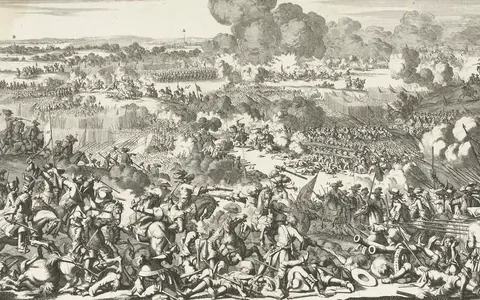
- 1743Battle of Dettingen, 1743Pragmatic Army (Britain, Hanover, Austria) vs Kingdom of France
On 27 June 1743 George II's Pragmatic Army, cut off on the river Main, beat off the French at Dettingen: the last battle led by a reigning British king.
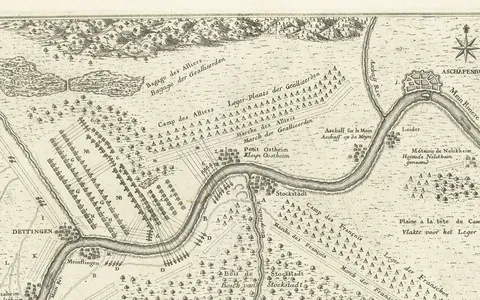
- 1745Battle of Kesselsdorf, 1745Kingdom of Prussia vs Electorate of Saxony and Austria
On 15 December 1745 the 69-year-old Prince Leopold of Anhalt-Dessau stormed the Saxon guns at Kesselsdorf near Dresden and ended the Second Silesian War.
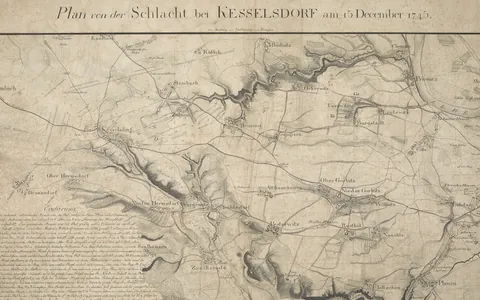
- 1746Battle of Rocoux, 1746France vs Pragmatic Army (Austria, Dutch Republic, Britain, Hanover, Hesse)
On 11 October 1746 Marshal Saxe stormed the villages outside Liège held by the Pragmatic Army; British dragoons covered the retreat as the allies crossed the Meuse at night.
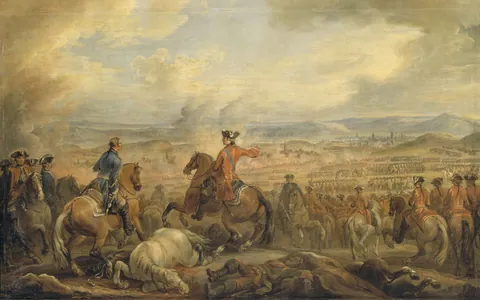
- 1747First Battle of Cape Finisterre, 1747Great Britain (Royal Navy) vs Kingdom of France (French Navy and Compagnie des Indes)
On 14 May 1747 Anson traded his line of battle for a general chase off Cape Finisterre and took every French warship that stood to fight, among them the 74 L'Invincible.
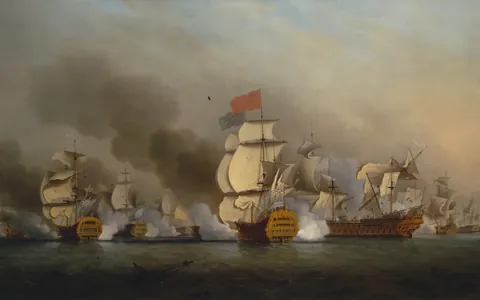
- 1747Second Battle of Cape Finisterre, 1747Kingdom of Great Britain vs Kingdom of France
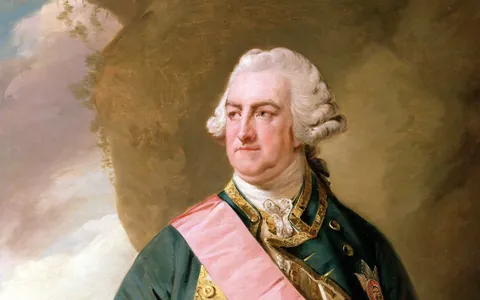
On 25 October 1747 (14 October, Old Style) Edward Hawke's fleet took six of eight French warships guarding a convoy off Cape Finisterre. What happened and who won.
Timeline of the War of the Austrian Succession
- 1713Charles VI issues the Pragmatic Sanction on 19 April.42
- 1740Charles VI dies on 20 October; Frederick II invades Silesia on 16 December.43
- 1741
- 1742Charles VII elected emperor in January; Chotusitz on 17 May; the Treaty of Breslau (11 June) ends the First Silesian War.45
- 1743
- 1744France declares war on Britain; Frederick invades Bohemia in August, opening the Second Silesian War.47
- 1745Fontenoy (11 May); Hohenfriedberg (4 June); Louisbourg taken in June; Prestonpans (21 September); Kesselsdorf and the Treaty of Dresden in December.48
- 1746
- 1747Anson wins off Cape Finisterre in May; Saxe wins at Lauffeld on 2 July; Hawke wins the second battle off Cape Finisterre in October.50
- 1748The Treaty of Aix-la-Chapelle is signed on 18 October.51
Where to read next
The story continues in our guide to the Seven Years' War. Several battles appear in our ranking of the greatest early modern battles, Frederick II among the greatest commanders by era; see also the early modern era page and the early modern battles quiz.
Notes
A number in the text points to a note; each note names the works that paragraph draws on, listed in full under Sources.
- Encyclopaedia Britannica, “War of the Austrian Succession”; Harrison W. Mark, “War of the Austrian Succession”; Encyclopaedia Britannica, “Treaty of Aix-la-Chapelle”. ↩
- Encyclopaedia Britannica, “War of the Austrian Succession”; Royal Collection Trust, “War of the Austrian Succession (1740 to 1748)”; Harrison W. Mark, “War of the Austrian Succession”. ↩
- Encyclopaedia Britannica, “War of the Austrian Succession”; Guy Rowlands, Europe, 1450 to 1789; Encyclopaedia Britannica, “Austria”; Encyclopaedia Britannica, “Pragmatic Sanction of Emperor Charles VI”. ↩
- Encyclopaedia Britannica, “Austria”; Encyclopaedia Britannica, “Pragmatic Sanction of Emperor Charles VI”; Encyclopaedia Britannica, “Maria Theresa”; Guy Rowlands, Europe, 1450 to 1789. ↩
- Encyclopaedia Britannica, “Pragmatic Sanction of Emperor Charles VI”; Royal Collection Trust, “War of the Austrian Succession (1740 to 1748)”; Guy Rowlands, Europe, 1450 to 1789; Harrison W. Mark, “War of the Austrian Succession”. ↩
- Encyclopaedia Britannica, “War of the Austrian Succession”; Encyclopaedia Britannica, “Silesian Wars”; Encyclopaedia Britannica, “Silesia”; Guy Rowlands, Europe, 1450 to 1789. ↩
- Encyclopaedia Britannica, “War of the Austrian Succession”; National Army Museum, “War of the Austrian Succession”; National Army Museum, “Battle of Dettingen”. ↩
- National Army Museum, “War of the Austrian Succession”; Royal Collection Trust, “War of the Austrian Succession (1740 to 1748)”; Harrison W. Mark, “War of the Austrian Succession”; Encyclopaedia Britannica, “War of the Austrian Succession”. ↩
- Encyclopaedia Britannica, “Augustus III”; Harrison W. Mark, “War of the Austrian Succession”; Encyclopaedia Britannica, “Frederick II, king of Prussia”. ↩
- National Army Museum, “Battle of Dettingen”; Harrison W. Mark, “War of the Austrian Succession”; Harold E. Selesky, Encyclopedia of the American Revolution; Encyclopaedia Britannica, “War of the Austrian Succession”; Encyclopaedia Britannica, “Battle of Fontenoy”. ↩
- Harrison W. Mark, “War of the Austrian Succession”; Jon Guttman, “What We Learned From... the Battle of Mollwitz, 1741”; John Rickard, “Battle of Mollwitz, 10 April 1741”; Encyclopaedia Britannica, “Frederick II, king of Prussia”; Royal Collection Trust, “Map of the Battle of Mollwitz, 1741 (Małujowice, Opole Voivodeship, Poland)”. ↩
- Encyclopaedia Britannica, “War of the Austrian Succession”; Guy Rowlands, Europe, 1450 to 1789; Encyclopaedia Britannica, “Silesian Wars”; Encyclopaedia Britannica, “Frederick II, king of Prussia”. ↩
- Encyclopaedia Britannica, “Frederick II, king of Prussia”; Harrison W. Mark, “War of the Austrian Succession”; John Rickard, “Battle of Chotusitz, 17 May 1742”; Encyclopaedia Britannica, “Silesian Wars”. ↩
- Encyclopaedia Britannica, “Frederick II, king of Prussia”; Harrison W. Mark, “War of the Austrian Succession”. ↩
- Encyclopaedia Britannica, “Leopold I, prince of Anhalt-Dessau”; Royal Collection Trust, “Map of the Battle of Kesselsdorf, 1745”. ↩
- Encyclopaedia Britannica, “Treaty of Dresden”; Encyclopaedia Britannica, “Silesian Wars”; Guy Rowlands, Europe, 1450 to 1789; Harold E. Selesky, Encyclopedia of the American Revolution; Harrison W. Mark, “War of the Austrian Succession”. ↩
- Encyclopaedia Britannica, “Maurice, count de Saxe”; Harrison W. Mark, “War of the Austrian Succession”; Guy Rowlands, Europe, 1450 to 1789; Encyclopaedia Britannica, “Charles VII, Holy Roman emperor”; Encyclopaedia Britannica, “Maria Theresa”. ↩
- Encyclopaedia Britannica, “Maria Theresa”; Guy Rowlands, Europe, 1450 to 1789; Harrison W. Mark, “War of the Austrian Succession”; Encyclopaedia Britannica, “War of the Austrian Succession”. ↩
- Encyclopaedia Britannica, “War of the Austrian Succession”; Harrison W. Mark, “War of the Austrian Succession”; Encyclopaedia Britannica, “Francis I, Holy Roman emperor”; Guy Rowlands, Europe, 1450 to 1789. ↩
- National Army Museum, “War of the Austrian Succession”; National Army Museum, “Battle of Dettingen”; Guy Rowlands, Europe, 1450 to 1789; Encyclopaedia Britannica, “George II, king of Great Britain”. ↩
- National Army Museum, “Battle of Dettingen”; National Army Museum, “War of the Austrian Succession”; Harrison W. Mark, “War of the Austrian Succession”; Encyclopaedia Britannica, “George II, king of Great Britain”; Royal Collection Trust, “War of the Austrian Succession (1740 to 1748)”. ↩
- Encyclopaedia Britannica, “Maurice, count de Saxe”; Encyclopaedia Britannica, “Charles Edward, the Young Pretender”; Harold E. Selesky, Encyclopedia of the American Revolution; Harrison W. Mark, “War of the Austrian Succession”. ↩
- Encyclopaedia Britannica, “Battle of Fontenoy”; National Army Museum, “War of the Austrian Succession”; Encyclopaedia Britannica, “Maurice, count de Saxe”; Harrison W. Mark, “War of the Austrian Succession”. ↩
- National Army Museum, “War of the Austrian Succession”; Encyclopaedia Britannica, “Maurice, count de Saxe”; Harrison W. Mark, “War of the Austrian Succession”; Guy Rowlands, Europe, 1450 to 1789. ↩
- Encyclopaedia Britannica, “Maurice, count de Saxe”; National Army Museum, “War of the Austrian Succession”; Encyclopaedia Britannica, “William Augustus, duke of Cumberland”; Guy Rowlands, Europe, 1450 to 1789. ↩
- Guy Rowlands, Europe, 1450 to 1789; Encyclopaedia Britannica, “Charles Emmanuel III”; Harold E. Selesky, Encyclopedia of the American Revolution; Harrison W. Mark, “War of the Austrian Succession”. ↩
- Guy Rowlands, Europe, 1450 to 1789; Harold E. Selesky, Encyclopedia of the American Revolution; Royal Museums Greenwich, “Lord Anson’s victory off Cape Finisterre, 3 May 1747”; Royal Collection Trust, “Naval battle at Cape Finisterre, 1747”; GlobalSecurity.org, “George Anson”. ↩
- Royal Museums Greenwich, “Sir Edward Hawke, Knight of the most Honourable Order of the Bath”; GlobalSecurity.org, “Baron Edward Hawke”; Harold E. Selesky, Encyclopedia of the American Revolution. ↩
- Encyclopaedia Britannica, “King George’s War”; Encyclopaedia Britannica, “Louisbourg”; Guy Rowlands, Europe, 1450 to 1789; National Army Museum, “War of the Austrian Succession”. ↩
- Encyclopaedia Britannica, “Bertrand-François Mahé, count de La Bourdonnais”; Encyclopaedia Britannica, “Joseph-François Dupleix”; Guy Rowlands, Europe, 1450 to 1789; National Army Museum, “War of the Austrian Succession”. ↩
- Encyclopaedia Britannica, “Charles Edward, the Young Pretender”; Encyclopaedia Britannica, “Forty-five Rebellion”; National Army Museum, “Battle of Culloden”. ↩
- National Army Museum, “War of the Austrian Succession”; Harold E. Selesky, Encyclopedia of the American Revolution; Encyclopaedia Britannica, “Battle of Culloden”; National Army Museum, “Battle of Culloden”; Encyclopaedia Britannica, “William Augustus, duke of Cumberland”. ↩
- Encyclopaedia Britannica, “Maria Theresa”; Guy Rowlands, Europe, 1450 to 1789; Harrison W. Mark, “War of the Austrian Succession”; John Rickard, “Battle of Chotusitz, 17 May 1742”. ↩
- Encyclopaedia Britannica, “Frederick II, king of Prussia”; Jon Guttman, “What We Learned From... the Battle of Mollwitz, 1741”; Harrison W. Mark, “War of the Austrian Succession”; Encyclopaedia Britannica, “Leopold I, prince of Anhalt-Dessau”. ↩
- Encyclopaedia Britannica, “Maurice, count de Saxe”; Encyclopaedia Britannica, “William Augustus, duke of Cumberland”; National Army Museum, “War of the Austrian Succession”; Royal Museums Greenwich, “Lord Anson’s victory off Cape Finisterre, 3 May 1747”; Royal Museums Greenwich, “Sir Edward Hawke, Knight of the most Honourable Order of the Bath”. ↩
- Encyclopaedia Britannica, “Treaty of Aix-la-Chapelle”; Encyclopaedia Britannica, “War of the Austrian Succession”; National Army Museum, “War of the Austrian Succession”; Harold E. Selesky, Encyclopedia of the American Revolution. ↩
- Encyclopaedia Britannica, “Treaty of Aix-la-Chapelle”; Encyclopaedia Britannica, “Pragmatic Sanction of Emperor Charles VI”; Guy Rowlands, Europe, 1450 to 1789; Harold E. Selesky, Encyclopedia of the American Revolution; Royal Collection Trust, “War of the Austrian Succession (1740 to 1748)”; Harrison W. Mark, “War of the Austrian Succession”. ↩
- Guy Rowlands, Europe, 1450 to 1789; Harold E. Selesky, Encyclopedia of the American Revolution; Encyclopaedia Britannica, “Treaty of Aix-la-Chapelle”; Encyclopaedia Britannica, “War of the Austrian Succession”; Encyclopaedia Britannica, “Silesia”. ↩
- Guy Rowlands, Europe, 1450 to 1789; National Army Museum, “War of the Austrian Succession”; Encyclopaedia Britannica, “Treaty of Aix-la-Chapelle”. ↩
- Encyclopaedia Britannica, “Diplomatic Revolution”; Encyclopaedia Britannica, “Maria Theresa”; Encyclopaedia Britannica, “Silesian Wars”. ↩
- Encyclopaedia Britannica, “Treaty of Aix-la-Chapelle”; Harrison W. Mark, “War of the Austrian Succession”; Encyclopaedia Britannica, “Silesia”; Encyclopaedia Britannica, “War of the Austrian Succession”. ↩
- Encyclopaedia Britannica, “Austria”; Encyclopaedia Britannica, “Pragmatic Sanction of Emperor Charles VI”. ↩
- Encyclopaedia Britannica, “War of the Austrian Succession”; Guy Rowlands, Europe, 1450 to 1789. ↩
- Harrison W. Mark, “War of the Austrian Succession”; Royal Collection Trust, “Map of the Battle of Mollwitz, 1741 (Małujowice, Opole Voivodeship, Poland)”; Encyclopaedia Britannica, “Maurice, count de Saxe”. ↩
- Guy Rowlands, Europe, 1450 to 1789; Harrison W. Mark, “War of the Austrian Succession”; Encyclopaedia Britannica, “Silesian Wars”; John Rickard, “Battle of Chotusitz, 17 May 1742”. ↩
- National Army Museum, “Battle of Dettingen”; Encyclopaedia Britannica, “War of the Austrian Succession”. ↩
- Harold E. Selesky, Encyclopedia of the American Revolution; Encyclopaedia Britannica, “Frederick II, king of Prussia”. ↩
- Encyclopaedia Britannica, “Battle of Fontenoy”; Encyclopaedia Britannica, “King George’s War”; Harrison W. Mark, “War of the Austrian Succession”; Encyclopaedia Britannica, “Forty-five Rebellion”; Royal Collection Trust, “Map of the Battle of Kesselsdorf, 1745”; Encyclopaedia Britannica, “Treaty of Dresden”. ↩
- National Army Museum, “War of the Austrian Succession”; Encyclopaedia Britannica, “Battle of Culloden”; Encyclopaedia Britannica, “Bertrand-François Mahé, count de La Bourdonnais”; Encyclopaedia Britannica, “Maurice, count de Saxe”. ↩
- Royal Museums Greenwich, “Lord Anson’s victory off Cape Finisterre, 3 May 1747”; Encyclopaedia Britannica, “Maurice, count de Saxe”; National Army Museum, “War of the Austrian Succession”; Royal Museums Greenwich, “Sir Edward Hawke, Knight of the most Honourable Order of the Bath”. ↩
- Encyclopaedia Britannica, “Treaty of Aix-la-Chapelle”; Royal Collection Trust, “War of the Austrian Succession (1740 to 1748)”. ↩
Sources
- Encyclopaedia Britannica, “War of the Austrian Succession”.
- Harrison W. Mark, World History Encyclopedia, “War of the Austrian Succession: How One Woman’s Right to Rule Plunged Europe into War”.
- Encyclopaedia Britannica, “Treaty of Aix-la-Chapelle”.
- Royal Collection Trust, Military Maps, “War of the Austrian Succession (1740 to 1748)”.
- Guy Rowlands, Europe, 1450 to 1789: Encyclopedia of the Early Modern World (Gale), via Encyclopedia.com, “Austrian Succession, War of the (1740 to 1748)”.
- Encyclopaedia Britannica, “Austria: the War of the Spanish Succession and the Pragmatic Sanction”.
- Encyclopaedia Britannica, “Pragmatic Sanction of Emperor Charles VI”.
- Encyclopaedia Britannica, “Maria Theresa”.
- Encyclopaedia Britannica, “Silesian Wars”.
- Encyclopaedia Britannica, “Silesia”.
- National Army Museum, “War of the Austrian Succession”.
- National Army Museum, “Battle of Dettingen”.
- Encyclopaedia Britannica, “Augustus III”.
- Encyclopaedia Britannica, “Frederick II, king of Prussia”.
- Harold E. Selesky (rev.), Encyclopedia of the American Revolution: Library of Military History (Gale), via Encyclopedia.com, “Austrian Succession, War of the”.
- Encyclopaedia Britannica, “Battle of Fontenoy”.
- Jon Guttman, HistoryNet, “What We Learned From... the Battle of Mollwitz, 1741”.
- John Rickard, HistoryOfWar.org, “Battle of Mollwitz, 10 April 1741”.
- Royal Collection Trust, Military Maps, “Map of the Battle of Mollwitz, 1741 (Małujowice, Opole Voivodeship, Poland)”.
- John Rickard, HistoryOfWar.org, “Battle of Chotusitz, 17 May 1742”.
- Encyclopaedia Britannica, “Leopold I, prince of Anhalt-Dessau”.
- Royal Collection Trust, Military Maps, “Map of the Battle of Kesselsdorf, 1745”.
- Encyclopaedia Britannica, “Treaty of Dresden”.
- Encyclopaedia Britannica, “Maurice, count de Saxe”.
- Encyclopaedia Britannica, “Charles VII, Holy Roman emperor”.
- Encyclopaedia Britannica, “Francis I, Holy Roman emperor”.
- Encyclopaedia Britannica, “George II, king of Great Britain”.
- Encyclopaedia Britannica, “Charles Edward, the Young Pretender”.
- Encyclopaedia Britannica, “William Augustus, duke of Cumberland”.
- Encyclopaedia Britannica, “Charles Emmanuel III”.
- Royal Museums Greenwich, “Lord Anson’s victory off Cape Finisterre, 3 May 1747”.
- Royal Collection Trust, Military Maps, “Naval battle at Cape Finisterre, 1747”.
- GlobalSecurity.org, “George Anson”.
- Royal Museums Greenwich, “Sir Edward Hawke, Knight of the most Honourable Order of the Bath”.
- GlobalSecurity.org, “Baron Edward Hawke”.
- Encyclopaedia Britannica, “King George’s War”.
- Encyclopaedia Britannica, “Louisbourg”.
- Encyclopaedia Britannica, “Bertrand-François Mahé, count de La Bourdonnais”.
- Encyclopaedia Britannica, “Joseph-François Dupleix”.
- Encyclopaedia Britannica, “Forty-five Rebellion”.
- National Army Museum, “Battle of Culloden”.
- Encyclopaedia Britannica, “Battle of Culloden”.
- Encyclopaedia Britannica, “Diplomatic Revolution”.






