

Nelson or Napoleon: what does the evidence say?
Horatio Nelson (1758 to 1805) commanded at sea, Napoleon Bonaparte (1769 to 1821) on land. They never fought each other in person. Their wars touched twice: at the Nile in 1798, when Nelson destroyed the fleet that had carried Napoleon's army to Egypt, and at Trafalgar in 1805, where Nelson was killed winning while Napoleon was campaigning in Germany. Whether an admiral and a general can be ranked on one scale is still open. French historians Masson and Battesti are hard on Napoleon's war at sea, and Battesti credits Nelson's daring. Andrew Roberts calls Napoleon's sixty battles an extraordinary record. This page sets out the evidence for each and leaves the final verdict to you.
Their careers ran side by side for seven years, and their wars crossed more than once. In 1798 Nelson hunted the fleet that had carried Napoleon's army across the Mediterranean and destroyed it at anchor in Aboukir Bay, while its general was ashore in Egypt.1
This is not a ranking. Below are the two careers side by side, the places where their wars met, and six questions on which a commander can be judged, each with the strongest evidence for Nelson and for Napoleon, their own words and those of the historians who still argue about them. At the end the decision is yours.
Side by side
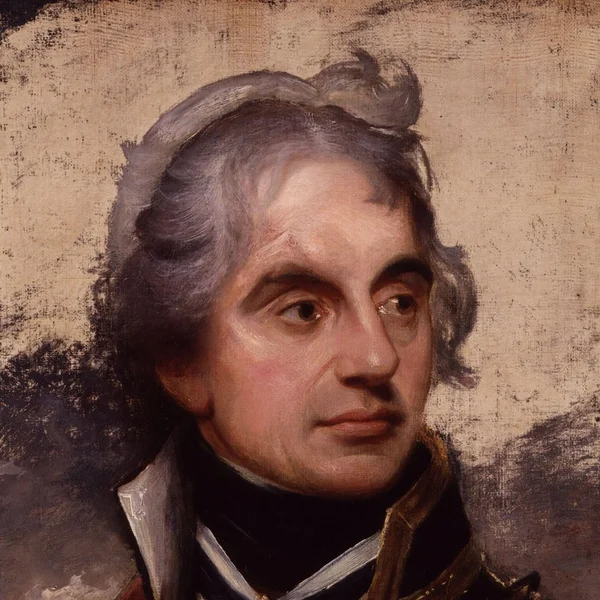
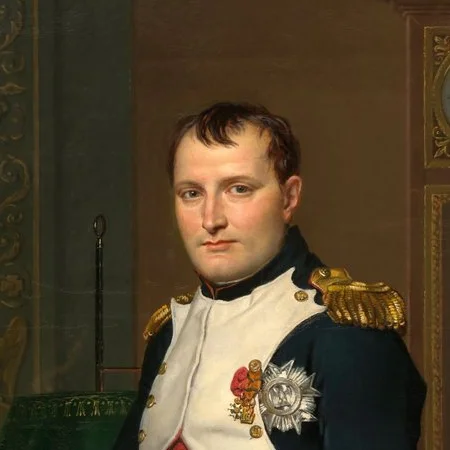
- Lived
- 29 September 1758 to 21 October 1805
- 15 August 1769 to 5 May 1821
- Origin
- Burnham Thorpe, Norfolk, son of the rector, Edmund Nelson
- Ajaccio, Corsica
- First command
- 1779, post-captain, with the Hinchinbroke, aged 20
- 1796, commander in chief of the Army of Italy, aged 26
- Highest rank
- Vice-admiral, from 1 January 1801
- Emperor of the French, from 18 May 1804
- Wars in command
- The French Revolutionary and Napoleonic Wars at sea, 1793 to 1805
- Italy 1796 to 1797, Egypt and Syria 1798 to 1799, the wars of the Consulate and the Empire to 1815
- Battle count
- No published count we could verify
- Sixty battles, seven lost, in Andrew Roberts's count
- Battles named here
- Cape St Vincent, Santa Cruz, the Nile, Copenhagen, Trafalgar
- Toulon, the Pyramids, Acre, Austerlitz, Waterloo
- Death
- Killed in action on board Victory at Trafalgar
- A prisoner at Longwood on St Helena
Dates, origins and ranks from Royal Museums Greenwich, the Oxford Dictionary of National Biography, the Larousse encyclopedia and the Fondation Napoléon. Roberts's is the only battle count we found, for either man.2
Where their wars met
Toulon, 1793: the same siege, a few days apart
In September 1793 Napoleon, aged 24, was put in charge of the guns of the republican army besieging Toulon, where the royalists had let in a British fleet. His plan, constant fire on the British ships in the roadstead, was adopted on 25 November, the British left on 18 December and four days later he was a brigadier general, the Fondation Napoléon's chronology records. Peter Hicks adds that before leaving, Lord Hood and Sidney Smith took and partly destroyed the French fleet in the port.3
Nelson, then a captain in the British fleet, was in Toulon only briefly. On 7 October he wrote to his wife that he had come two days before and would sail on a cruise the next day, and on the 12th that he had only been a spectator. No source we read says that either man knew of the other at the time. Their paths crossed, but they did not meet.4
The chase of 1798 and the Nile
Napoleon's expedition sailed from Toulon on 19 May 1798, took Malta in June and landed near Alexandria on 1 July. Nelson, short of frigates to scout for him, overtook the French on the way and reached Alexandria before them, the Fondation Napoléon notes, then left to search elsewhere. On 20 June he wrote that he deeply regretted his want of frigates.5

He found the fleet on 1 August at anchor in Aboukir Bay. Admiral Brueys had thirteen ships of the line, Michèle Battesti writes, against Nelson's thirteen 74s and the 50 gun Leander. The French flagship L'Orient, of 120 guns, blew up at about ten at night, killing Brueys and most of her crew, and the National Maritime Museum notes that both sides were so shaken that for some minutes the firing stopped.6
Nelson's dispatch begins plainly: he attacked at sunset on the 1st of August, off the mouth of the Nile. By his own list, nine French ships of the line were taken, L'Orient and two others burnt, a frigate sunk, and only two ships of the line and two frigates escaped.7
The losses depend on the source. Nelson's return gives 218 British killed and 677 wounded, and Battesti 678 wounded. For the French, Battesti counts some 1,700 killed, Brueys among them, about 1,500 wounded and more than 3,000 prisoners. Masson gives 1,500 killed, as many prisoners and 3,000 wounded. The full story is in our article on the Battle of the Nile.8

Egypt after the Nile
The Turks declared war on France on 4 September 1798. In 1799 Napoleon marched into Syria and besieged Acre from 19 March, and Peter Hicks notes that it was a British officer, Sir Sidney Smith, not Nelson, whose bombardment forced him to lift the siege. On 23 August 1799 Napoleon sailed for France and left his army in Egypt.9
1805: Boulogne and Trafalgar
By 1805 Napoleon had gathered on the Channel coast an invasion flotilla of more than two thousand vessels, Philippe Masson writes, with a plan that counted on drawing the Royal Navy away from the Channel. On 30 March Villeneuve slipped out of Toulon with eleven ships. Nelson, still haunted by Egypt in Masson's phrase, first covered Sicily, then followed Villeneuve across the Atlantic and back.10
The army of the coast had sworn its oath to the emperor at Boulogne on 16 August 1804, as a commemorative medal in the National Maritime Museum records. José Muracciole notes that Napoleon was at Boulogne from early August 1805, and Masson that he then dictated to Daru the plan that led to his victory over Austria at Ulm.11

The fleets met off Cape Trafalgar on 21 October 1805. Collingwood wrote the next day that the enemy had thirty-three sail of the line against twenty-seven British, and that seventeen of the enemy had surrendered and one was burnt. Larousse gives Nelson 27 ships of the line and four frigates against 33, fifteen of them Spanish, and seven frigates. Nelson was killed on board the Victory. See our article on the Battle of Trafalgar.12
The casualty figures differ. Masson counts 2,177 killed and 4,700 wounded in the combined fleet and 402 British killed and 1,139 wounded. José Muracciole gives nearly 6,000 French and Spanish killed and wounded against a little over 1,500 British, and adds that seven French and twelve Spanish ships struck their colours and that the British kept only one of them.13
Strategy: what each did to the other's war
The case for Nelson
The Nile undid Napoleon's Egyptian venture. Battesti, writing on its strategic consequences, says it left the general a prisoner of his conquest and paralysed the French navy: the second wave of the expedition never left Toulon. Nelson saw it at once. In a letter of 9 August 1798 he wrote that he believed the victory would, in its consequence, destroy this army.14
Trafalgar, in the words of the Larousse encyclopedia, wiped out Napoleon's naval force and decided him on the Continental Blockade.15
The historian Andrew Lambert goes further and argues, as Roger Morriss reports in his review of the Nelson biographies of 2004 and 2005, that Nelson also influenced the strategy with which the French Revolutionary and Napoleonic Wars were fought. Morriss himself notes that Lambert gives no evidence that Nelson's views shaped the decisions of the Cabinet.16
The case for Napoleon
Napoleon got his army to Egypt past a hunting British squadron and, in 1799, home again. After Trafalgar he did not need the sea to win his next campaign: Larousse records that on 2 December 1805, six weeks later, the Austro-Russian armies were scattered at Austerlitz. His war went on for ten more years.17
His critics point to how he treated the fleet. Battesti writes that Bonaparte handled the navy lightly, and that his written orders of 3 July 1798 to Brueys, to enter the old port of Alexandria or sail for Corfu, survive only in a copy that was probably concocted afterwards to shift the blame onto the dead admiral. Masson calls the 1805 plan, which counted on scattering the Royal Navy, an enormous misreading, and argues that the invasion was by then too late in any case.18
Battle
The case for Nelson
Peter Hicks puts the British victory at Cape St Vincent in 1797 down to the courage of the captains and Nelson's genius for improvisation, and the National Archives speaks of his outstanding naval prowess, from the Nile and Copenhagen to Trafalgar.19
Masson places him in a younger generation of British commanders who preferred the massed attack and the close fight, and Muracciole writes that Trafalgar consecrated the genius of Nelson and the skill of his captains.20

His record also has failures. In 1797 he led an assault on Tenerife and was hit by a musket ball just above the elbow, the National Archives records, and his right arm was amputated. Roger Morriss writes that his conduct as squadron commander at Santa Cruz gave grounds for criticism.21
The case for Napoleon
Napoleon fought on land on a far larger scale. Andrew Roberts, in his biography of 2014, counts sixty battles and only seven defeats, and calls it an extraordinary record for any general of any age. In Egypt he won the battle of the Pyramids on 21 July 1798, three weeks after landing, the Fondation Napoléon records. Acre is the setback on his side of the sea, a siege he had to lift in May 1799.22
The chase: finding the enemy
The case for Nelson
In 1798 Nelson had to find a fleet somewhere in the Mediterranean with no frigates to scout. He wrote to Sir William Hamilton on 23 July that the want of frigates might yet be blamed for the loss of the French fleet. When he found the French at Aboukir he attacked the same evening, his dispatch shows. Battesti credits him with rare audacity, calls him a remarkable leader and stresses that throughout the campaign he aimed at one thing, finding and destroying the French fleet.23
The case for Napoleon
The Fondation Napoléon notes that for most of June and July 1798 Nelson had absolutely no idea where the French fleet was. In 1805, as told above, he first went to cover Sicily while Villeneuve made for the Atlantic, and Morriss adds that Nelson's biographers resist giving the Admiralty its share of credit for the chase to the West Indies.24
Leading men
The case for Nelson
Nelson's captains followed him with unusual loyalty. John Sugden, as Morriss reports, suggests that it rested on something that went beyond empathy, duty and symbiosis. He went to sea in November 1770 as a midshipman under his uncle, Captain Maurice Suckling, and had his first command, the Hinchinbroke, at twenty, the Royal Museums Greenwich guide records. There is a darker side in the same review: contemporaries spoke of his irritable and uneven temper, and as captain of the Boreas between 1784 and 1787 Nelson had about 26 per cent of his crew flogged, well above the average on that station.25
The case for Napoleon
Napoleon's army followed him to Egypt and won there, and Battesti describes how, after the Nile, he hid his disappointment behind frantic activity to keep it going. The same army is also the case against him. He left it behind in Egypt when he sailed for France in 1799, and Battesti shows him blaming Brueys for a disaster that his own light treatment of the fleet had helped to cause.26
Command and politics
The case for Nelson
Nelson served the Admiralty and the government and never held political power. Larousse notes that he was made Duke of Bronte after the Nile, and that in 1801 he neutralised the Danish fleet at Copenhagen, a battle Hicks lists among the British victories of the war.27
Politics is also where his reputation suffered most. Roger Knight, Morriss reports, describes Nelson's handling of the confused situation at Naples in 1799 as apparently hasty and inconsistent.28
The case for Napoleon
Napoleon combined command with power. Larousse dates his proclamation as emperor to 18 May 1804 and his two abdications to 6 April 1814 and 22 June 1815. He could decide to invade Britain, then to march against Austria, without asking anyone, as he did in the summer of 1805.29
The price of that power was that no one could stop his mistakes. After Trafalgar, as Hicks reports, Napoleon wrote only that storms had caused the loss of a few ships after a battle imprudently engaged. Muracciole observes that he did not order his admirals to give battle at all costs to destroy the enemy, which was not the line of his usual strategy.30
What came after
The case for Nelson
Nelson died at the moment of his greatest victory. The Royal Museums Greenwich guide puts his death in the cockpit of the Victory at about half past four in the afternoon, while the National Archives reads the ship's log as recording it shortly after 3.40, after he had been told of the victory. He lay in state in the Painted Hall at Greenwich and was buried beneath the dome of St Paul's on 9 January 1806.31
Marianne Czisnik argues, Morriss writes, that he became a media personality without engineering his fame.32

The case for Napoleon
Napoleon lived another fifteen years after Trafalgar and spent ten of them at war. He lost at Waterloo on 18 June 1815, Larousse records, and died a prisoner at Longwood on St Helena on 5 May 1821, at 5.49 in the evening, according to the Fondation Napoléon.33
How historians have judged them
The French historians who have studied the two men's clash at sea are hard on Napoleon. Masson argues that the invasion of 1805 was never feasible on the terms Napoleon set and that by 1804 the project was at an impasse. Battesti blames Bonaparte's light treatment of the fleet for the Nile and doubts the orders he later produced. Battesti credits Nelson's daring, Masson his aggressive style of fighting.34
British historians of Nelson disagree about how far his reach went. Morriss calls Roger Knight's life of 2005 the nearest we yet have to the definitive biography. Lambert gives Nelson a share in the strategy of the whole war, which Morriss doubts. Knight is critical of Naples, and Morriss would give the Admiralty more credit for 1805.35
On the other side, Andrew Roberts calls Napoleon's sixty battles an extraordinary record, and the reviewer of his biography for Kirkus Reviews adds that the campaigns went well until he overreached in Spain and Russia.36
Battles on the site
Every battle page on the site that involves either man, with the guides that set them in context.
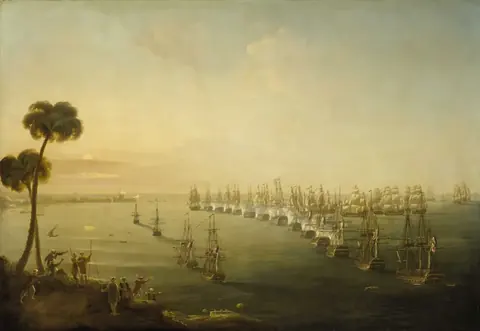 Nearest encounter · 1798Battle of the Nile
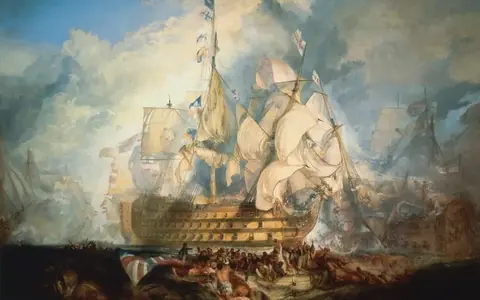
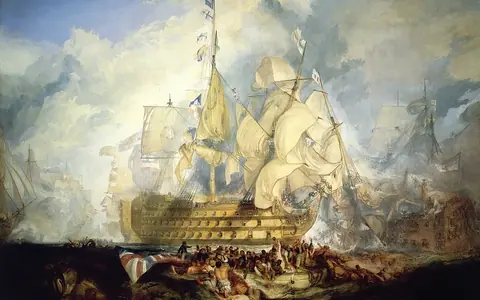 Nelson in command · 1805Battle of Trafalgar
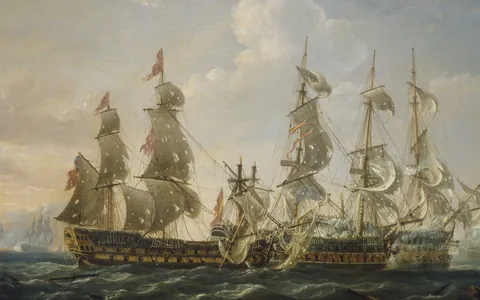 Nelson in action · 1797Battle of Cape St Vincent
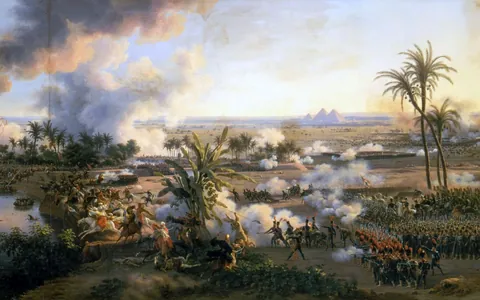 Napoleon in command · 1798Battle of the Pyramids
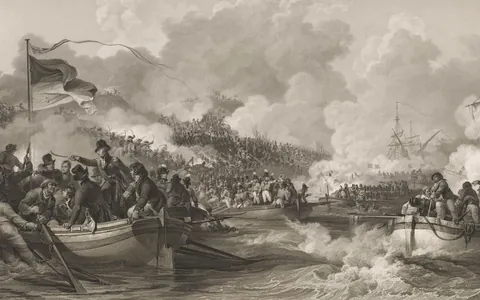 End of the Egyptian venture · 1801Battle of Abukir, 1801
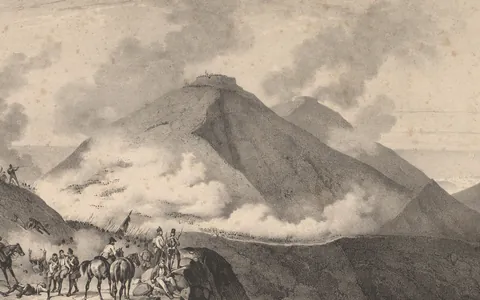 Napoleon in command · 1796Battle of Montenotte
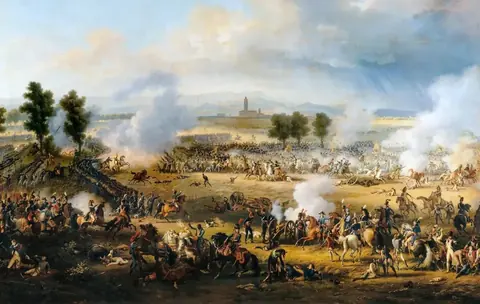
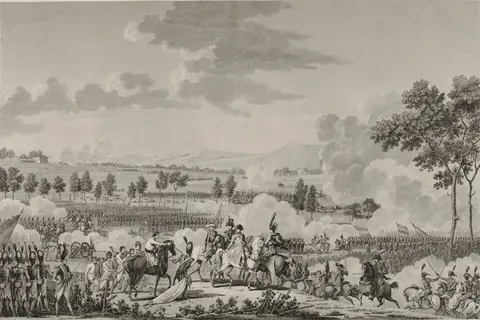 Napoleon in command · 1800Battle of Marengo
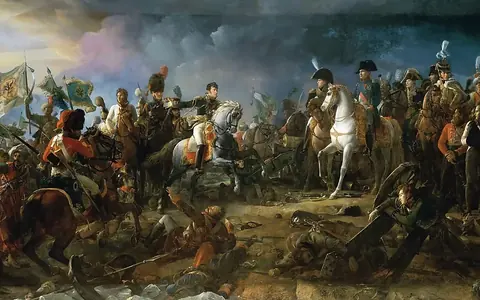 Napoleon in command · 1805Battle of Austerlitz
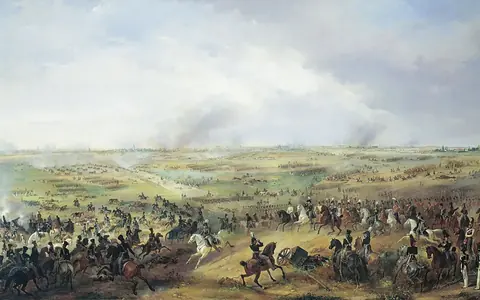 Napoleon in command · 1813Battle of Leipzig
 Napoleon in command · 1815Battle of Waterloo
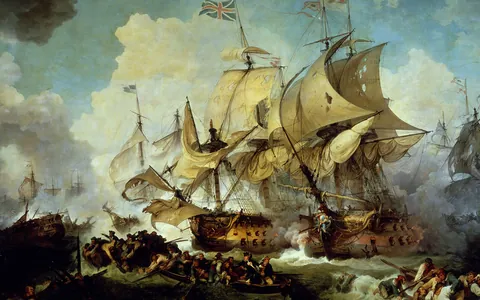 Naval war, context · 1794The Glorious First of June
 Guide · 1792 to 1802The French Revolutionary Wars
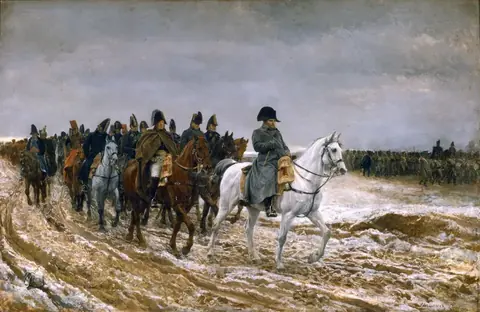 Guide · 1803 to 1815The Napoleonic Wars
 CommanderHoratio Nelson
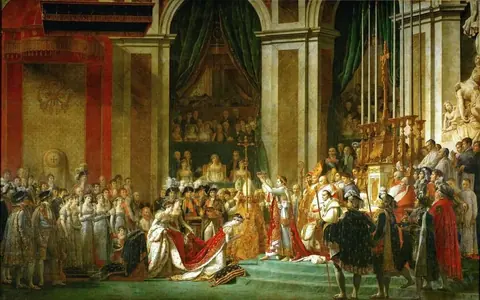 CommanderNapoleon Bonaparte
RankingThe Greatest Naval Battles
 RankingThe 15 Greatest Napoleonic Battles
QuizHow Well Do You Know Napoleonic Battles?
Toulon 1793, Santa Cruz 1797, Acre 1799 and Copenhagen 1801 have no page of their own yet. For both men among their peers, see the greatest British commanders and the greatest commanders of France.
Your verdict
We do not pick a winner. Here are the two cases at their strongest, and the questions that decide between them.
For Nelson
- The Nile, which trapped Napoleon's army in Egypt
- Trafalgar, which ended Napoleon's naval power for good
- Annihilating victories at sea, where draws were the rule
- A daring that French historians themselves acknowledge
- Captains who followed him with rare loyalty
For Napoleon
- Sixty battles and seven defeats, in Andrew Roberts's count
- Toulon at 24, Italy at 26, Austerlitz at 36
- He reached Egypt and came home past the British fleet
- After Trafalgar his land war went on for ten years
- He ran a state and an army at once
Questions to weigh before you decide:
- Can a sea commander and a land commander be ranked on one scale at all?
- Does destroying the fleet that carried an army count as defeating its general?
- Trafalgar came after Napoleon had turned towards Ulm: how much did it change his plans?
- Is Nelson's handful of decisive battles comparable with Napoleon's sixty?
- How much weight should Santa Cruz and Acre carry against each man?
- Does dying at the moment of victory make a reputation easier to judge, or harder?
Cast your vote below and see how other readers have judged them.





