

Napoleon or Alexander: what does the evidence say?
Napoleon Bonaparte (1769 to 1821) and Alexander the Great (356 to 323 BC) lived more than two thousand years apart. Alexander won all four of his great pitched battles and conquered the Persian Empire before he died at 32. Napoleon won most of his battles over twenty years, ruled much of Europe and lost it all in his last campaigns. Both led armies in Egypt. Historians have not settled who was the greater commander. Livy and Plutarch tell that Hannibal named Alexander the greatest captain. Dodge put Alexander first in the qualities that compel good fortune, but thought Napoleon at his best close to the greatest of the captains. This page sets out the evidence for each and leaves the final verdict to you.
Napoleon set Alexander at the head of his own reading list. In the maxims later collected from his sayings he tells officers to read again and again the campaigns of Alexander, Hannibal, Caesar, Gustavus Adolphus, Turenne, Eugene and Frederick, because this is the only way to become a great captain. Alexander comes first. Hannibal, too, is said to have named Alexander the greatest of all generals, as Livy and Plutarch both report.1
This is not a ranking. Below you will find the two careers side by side, the ground where their stories cross, and six questions on which a general can be judged, from strategy to what he left behind. Under each we give the strongest evidence for Napoleon and the strongest for Alexander, with the weak points of each, and the writers and historians who argue each case. At the end the decision is yours.
Side by side
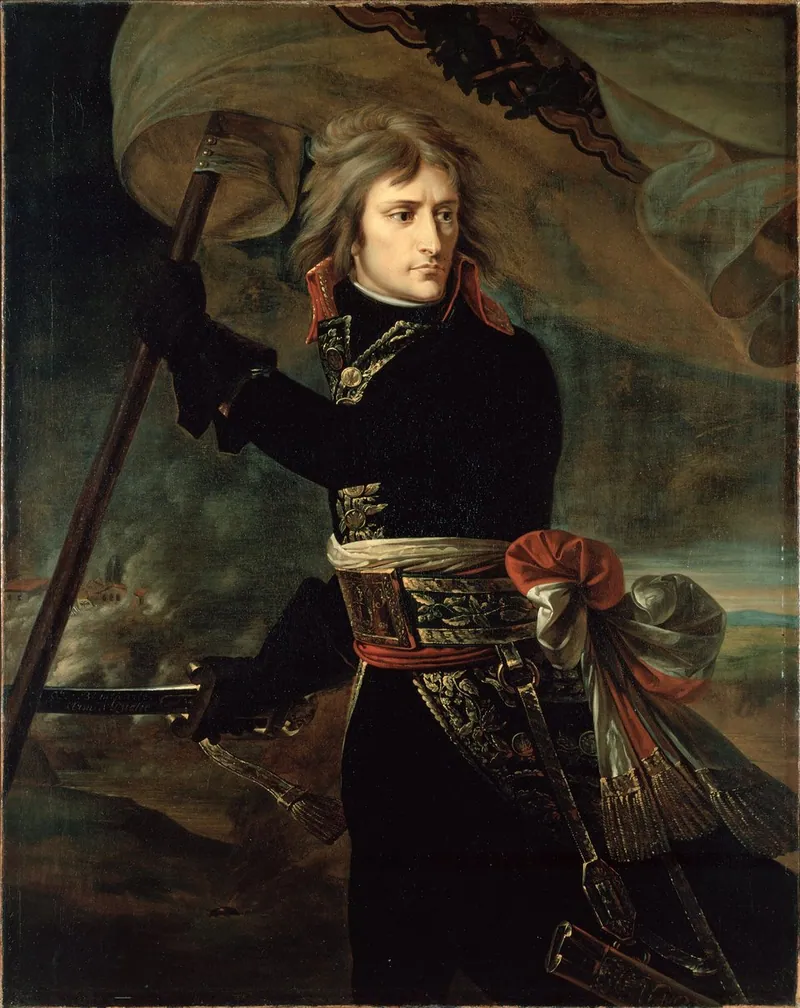
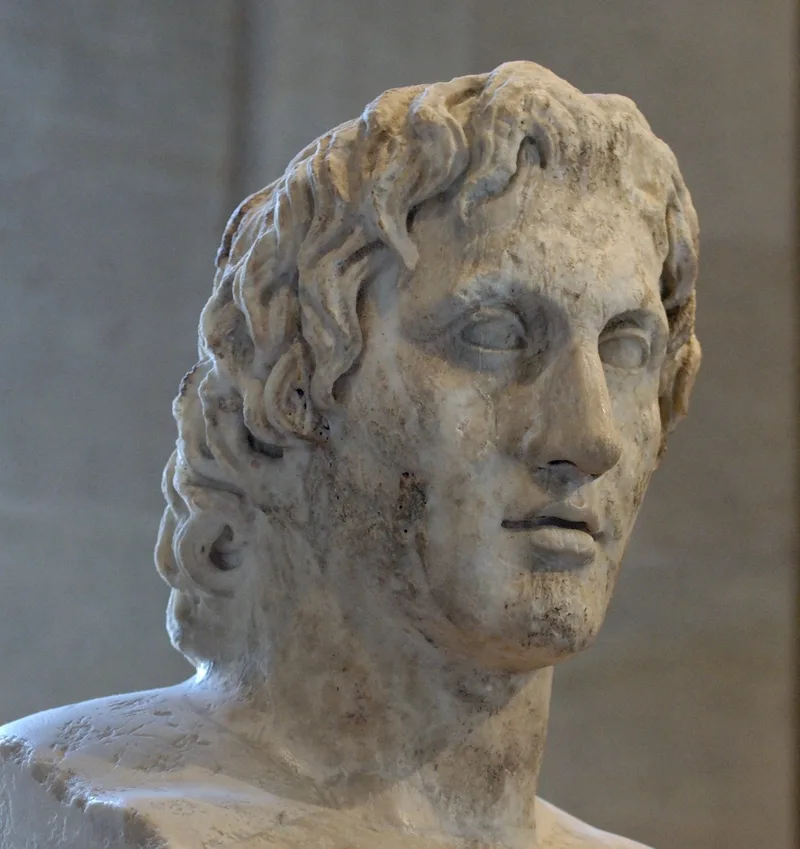
- Lived
- 15 August 1769 to 5 May 1821
- 356 to 323 BC
- Origin
- Ajaccio, Corsica, second child of the Bonaparte family
- Pella, son of King Philip II of Macedon
- First command
- The Army of Italy, March 1796, aged 26
- King of Macedon in 336 BC, at about 20, after his father was murdered
- Years in command
- 1796 to 1815
- 336 to 323 BC
- Notable opponents
- Austria, Prussia, Russia and Britain, the Mamluks in Egypt, Wellington and Blücher
- Darius III, the Persian satraps, Spitamenes, Porus
- Battles counted
- Sixty, seven of them lost, by Andrew Roberts's count. Forty won, by Napoleon's own
- Four great pitched battles, all won: Granicus, Issus, Gaugamela, Hydaspes
- Battles named here
- Pyramids, Acre, Austerlitz, Borodino, Waterloo
- Granicus, Issus, Tyre, Gaugamela, Hydaspes
- Death
- In exile on St Helena, 1821
- At Babylon in 323 BC, aged 32
Napoleon's dates from Jean Tulard's chronology, Alexander's from Arrian and the Encyclopaedia Iranica. The battle counts are claims by the authors named, not a tally we can check, so we give no win and loss totals of our own.2
Where their stories meet: Egypt
They lived twenty-one centuries apart, so they never met. But both took an army into Egypt, both entered it through Alexandria, and Napoleon read and wrote about Alexander as a model. On the way each also met a city on the Levantine coast that would not open its gates: Tyre for Alexander, Acre for Bonaparte.
Alexander in Egypt, 332 BC
Alexander reached Egypt after taking Tyre and Gaza. Briant writes in the Encyclopaedia Iranica that the annexation went much more smoothly than the sieges on the coast, because of the Egyptians' dislike of Persian rule. Arrian tells how Alexander sailed round the Mareotic lake, landed where the city named after him now stands, judged the site a very fine one and marked out its streets and temples himself.3
Plutarch adds the story that a grey-haired man appeared to him in a dream and recited Homer's lines about the island of Pharos off the coast of Egypt, and that the next morning he went to Pharos and chose the site there.4
Bonaparte in Egypt, 1798 to 1799
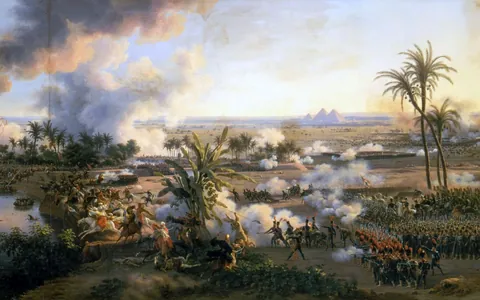
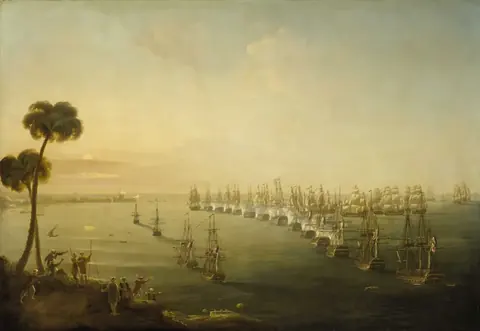
Twenty-one centuries later Bonaparte's army landed at Alexandria on 1 July 1798 and took the city the next day, the Fondation Napoléon's timeline records. On 21 July it beat the Mamluks at the Battle of the Pyramids and on 24 July it entered Cairo. On 1 August the French fleet was destroyed at Aboukir, in the Battle of the Nile.5
J. Holland Rose writes that the battle of the Pyramids gained a colony at the cost of some thirty French killed and about ten times as many wounded. The next spring Bonaparte marched into Syria and besieged Acre. There he lost nearly five thousand men killed, wounded or struck down by plague, Rose writes, and Acre could not be termed anything but a reverse.6
Rose also records the touch of theatre before the battle of the Pyramids. With the Nile beside the two armies, the minarets of Cairo beyond and the Pyramids looming to the south, Bonaparte appealed to his soldiers by the forty centuries that had rolled over them, the kind of imaginative touch, Rose writes, that always braced the French to the utmost daring and endurance.7
The American soldier and historian Theodore Ayrault Dodge, who compared the great captains in 1889, drew the lesson directly. Only in his Egyptian campaigns, he wrote, can Napoleon be likened to Alexander fighting semi-civilised armies, and in this he in no sense rises to the height of the Macedonian. Napoleon's genius, Dodge added, was most apparent on the familiar fields of Europe.8
Napoleon reads Alexander
In his commentary on Caesar's wars, dictated on St Helena, Napoleon wrote that fortune had favoured Alexander for eleven campaigns, against thirteen for Caesar and seventeen for Hannibal. Explaining why ancient tactics no longer worked in his own day, he wrote that the legionary had conquered the world with his short sword and Alexander had conquered Asia with the Macedonian pike, while the chief weapon of modern armies was the musket.9
Strategy: the plan for a whole war
The case for Napoleon
In 1805 Napoleon won a campaign before its great battle. At Ulm on 20 October some 25,000 Austrian soldiers with 60 guns filed past him to surrender, the Fondation Napoléon's timeline records, and six weeks later came Austerlitz.10
Dodge notes the rule behind it: except in 1796 and 1814, Napoleon always had more men than the enemy on the field at the proper time.11
The Prussian theorist Carl von Clausewitz held that in 1805, 1807 and 1809 Napoleon judged his opponents correctly. In 1812, he wrote, without a peace at Moscow there was nothing for him but to return, which meant a strategic defeat.12
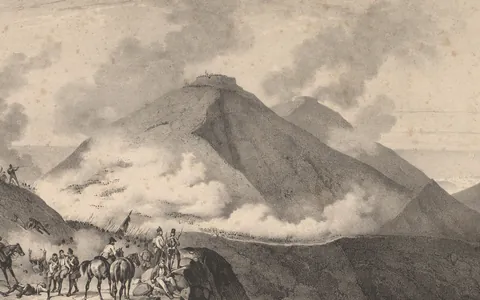
His first campaign showed the pattern early. He took command of the Army of Italy on 2 March 1796, and Jean Tulard's chronology records victories at Montenotte on 12 April and Mondovi on 21 April and an armistice with Piedmont at Cherasco on 28 April, all within a month of the first battle.13
The case for Alexander
Briant writes that from 334 BC Alexander had in view the whole extent of the Persian Empire as it had been under Darius I. After Issus he did not chase Darius to the Euphrates. He turned to Phoenicia and Egypt, in line with a plan made at Miletus the year before, to take the whole Aegean front of the empire, its soft underbelly. Only then did he march inland and beat Darius again at Gaugamela on 1 October 331.14
The weak point is that the plan had no natural end. At the river Hyphasis in 326 BC his army refused to go further. Arrian records the soldiers' joy when the king gave way: by them alone, they said, he had let himself be beaten.15
Plutarch says they had had all they could do to beat Porus and would not cross the Ganges as well.16
Battlefield tactics
The case for Napoleon
At Austerlitz on 2 December 1805 the allies weakened their centre on the Pratzen heights to press an attack on the French right. Napoleon saw it as the morning mist cleared and sent Soult to take the heights, which he did in half an hour. The Fondation Napoléon calls the result a crushing victory.17
The historian Andrew Roberts, quoted in the Kirkus review of his biography, counts sixty battles and seven defeats, and calls that an extraordinary record for any general of any age.18
Jean Tulard, author of the Dictionnaire Napoléon, is cooler: Napoleon's effects built on surprise stopped working once his enemies had learned the lesson, and his idea of war was more poker than chess.19
His last battle is the hardest case. At Waterloo, the National Army Museum writes, he had 72,000 men and 246 guns against Wellington's 68,000 and 156, with 48,000 Prussians coming up, and lost nearly 40,000 men killed, wounded or captured.20
The case for Alexander
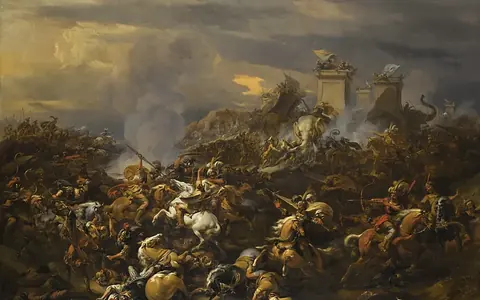
Briant names four great pitched battles: the Granicus in May 334, Issus in November 333, Gaugamela in 331 and the Hydaspes in the spring of 326. Alexander won all four.21
Briant is careful not to make every victory a work of genius. The first, at the Granicus, he puts down partly to the foolish tactics of the Persian satraps, which gave Alexander a quick victory and a clear road to the Anatolian coast. Darius, he adds, had not yet fully mobilised the royal army against a danger the Persian authorities seem to have underrated.22
At Gaugamela, Arrian reports, the army of Darius was said to number 40,000 cavalry and 1,000,000 infantry against Alexander's 7,000 cavalry and about 40,000 infantry. Diodorus gives Darius 800,000 foot and 200,000 horse. These are not real counts, but they show that the ancient writers believed the odds were heavily against him.23
At the Hydaspes he crossed a river in flood by night, in a storm, at a point upstream from Porus, while Craterus held the far bank.24
When Porus's elephants charged, Dodge writes, his eye was as keen as Napoleon's for the critical instant: he sent in the phalanx and led the cavalry himself round to the Indian rear.25

Supply and distance
The case for Napoleon
Napoleon made speed a law. One of his maxims says that the strength of an army, like power in mechanics, is mass multiplied by rapidity, and that a rapid march raises an army's morale and increases its means of victory.26
In the Rivoli campaign of January 1797, Dodge writes, men who had fought at San Michele on the 13th marched all night, won at Rivoli on the 14th and forced Provera's surrender at Mantua on the 15th.27
The same system broke in Russia. Clausewitz, using the French officer Chambray's figures, puts the centre that crossed the Niemen on 24 June 1812 at 301,000 men, and reckons that by Smolensk it had lost 105,000, of whom only about 10,000 fell in action.28
Rose gives the whole Grand Army as 600,000, plus 50,000 Austrians and Prussians, and says only 20,000 famished men recrossed the bridge at Kovno in December.29
The case for Alexander
Dodge calls Alexander a master of logistics. No winter cold or summer heat, mountain or desert stopped him, he wrote, and yet his troops were always well fed. He lived on the country as entirely as Napoleon, but was careful to gather granaries in the most useful places, and kept the gaps in his army filled with recruits from home and with natives he turned into good soldiers.30
His one great failure of supply came on the way home. In the Gedrosian desert in 325 BC, Arrian writes, the heat and lack of water destroyed a great part of the army and most of the baggage animals. Arrian reports a claim of the admiral Nearchus that Alexander chose the route partly from a desire to outdo Cyrus and Semiramis, who were said to have barely escaped it.31
Leading men
The case for Napoleon
When Napoleon came back from Elba in 1815, the National Army Museum writes, his army was made of veterans who had rallied to his cause, and Wellington accepted that Napoleon's presence on a battlefield made a huge difference to the morale and performance of his troops.32
Dodge found one fault in the young Napoleon of 1796: he underrated his adversary, and in time the habit became a strong factor in his failures.33
Napoleon showed the great qualities of a commander in full up to 1808, Dodge wrote, and came close to being, at his best, the greatest of the captains, but he did not show the same moral power afterwards. In April 1814, Tulard records, it was under pressure from his own marshals that he abdicated.34
The case for Alexander
Alexander led from the front. At the Granicus, Arrian writes, a Persian noble broke his helmet with a scimitar and Cleitus cut off the arm of a second attacker before he could strike. Storming a town of the Malli in India he was shot through his breastplate into the chest. Arrian's portrait of the king says he was exceedingly fond of incurring danger, and renowned for rousing his soldiers' courage by his own freedom from fear.35
His army was not his own creation. Dodge points out that Alexander, like Hannibal and Frederick, owed his training and his army to his father Philip.36
And it was not always loyal. Briant lists three crises among the Macedonian nobles: the execution of Philotas and Parmenio in 330, the killing of Cleitus in 328 or 327, and the quarrel over prostration before the king in 327.37
The price of conquest
The case for Napoleon
The sources are blunt about both men. At Jaffa in 1799, Rose writes, Bonaparte had his prisoners shot rather than weaken his small army by detaching a battalion to escort them to Egypt. Rose thought the massacre perhaps defensible from a military point of view, and added that such episodes open mankind's eyes to the ghastly shifts by which military glory may have to be won.38
At Borodino in 1812, the Fondation Napoléon writes, the Russians lost 45,000 dead, wounded or missing and the French between 28,000 and 35,000.39
The Swiss military writer Antoine-Henri Jomini called the invasion of Spain in 1808 a cunning and wanton attack that threatened the existence of the Spanish nation and was fatal to its author.40
The case for Alexander
When Thebes rebelled in 335 BC, Plutarch writes, Alexander sold more than thirty thousand of its people into slavery, after more than six thousand had been killed. Diodorus gives the same figures. At Tyre, Diodorus says, more than seven thousand defenders were cut down, the women and children sold, and some two thousand men of military age crucified.41
Jomini set both conquerors in one sentence: wars of conquest, unhappily, are often prosperous, as Alexander, Caesar and Napoleon during part of his career have fully proved. But there are natural limits in such wars, he added, which cannot be passed without great disaster.42
What came after
The case for Napoleon
The Civil Code of 2,281 articles was promulgated on 21 March 1804, the Fondation Napoléon records, and on St Helena Napoleon is quoted as saying that his true glory was not forty battles won, since Waterloo would wipe out their memory, but his Civil Code, which nothing would efface.43
Tulard thought the administrator perhaps superior to the general.44
His empire did not outlive him. After Leipzig in 1813 came the fall of Paris and the first abdication, and after Waterloo the second, on 22 June 1815. He died on St Helena on 5 May 1821.45
The case for Alexander
Alexander held an empire from Greece and Egypt to the Indus. Briant stresses how much of the Persian order he kept: the system of satrapies was maintained, a Persian, Mazaeus, became satrap of Babylon in October 331, and many of his new cities stood on sites already used under the Persian kings.46
Strabo sums up the end. Alexander reigned over Asia for ten or eleven years, and then the rule of Asia was divided among his successors.47

Arrian closed his history by saying that there was then no race of men, no city, nor even a single person whom Alexander's name had not reached, and that a hero so unlike any other could not have been born without the gods.48
How historians have judged them
The oldest ranking on record put Alexander first. Livy, following a Greek history by Acilius, tells how Scipio asked Hannibal at Ephesus whom he thought the greatest captain. Hannibal named Alexander, because with a small force he had defeated armies beyond counting and overrun the remotest regions. Plutarch tells the same story in his life of Flamininus.49
Dodge compared the two directly and gave each a different crown. In enthusiastic activity and all the qualities which compel good fortune, he wrote, Alexander stands clearly at the head. Of Alexander's life work he wrote that it surpasses anything in history. Yet he called Napoleon, up to 1808, close to being at his best the greatest of the captains, and thought that in intellectual grasp all six of the great captains he studied stand side by side.50
Modern scholars push each image a different way. Briant warns that stressing the three great victories over Persia has led to underestimating the strength and tenacity of the Persian resistance. Roberts calls Napoleon's record extraordinary, while Tulard writes that Napoleon did not understand national wars.51
Clausewitz called him the conqueror of the world. He refused to judge the campaigns of 1805, 1807 and 1809 as imprudent because of the disaster of 1812, calling that an unwarrantable and arbitrary judgement, while still holding that the Russian campaign could only end in defeat without a peace at Moscow.52
Battles on the site
Every battle page on Echoes of Battle where one of the two men commanded, with the guides that set them in context. Alexander's Granicus and Tyre and Napoleon's Acre, Ulm, Marengo and Wagram have no page of their own yet.
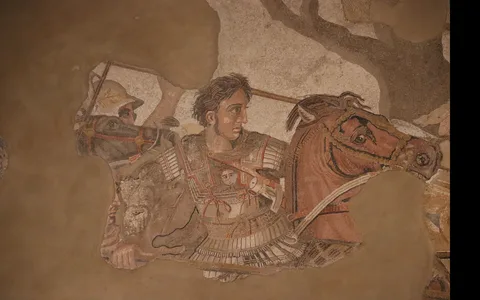 Alexander in command · 333 BCBattle of Issus
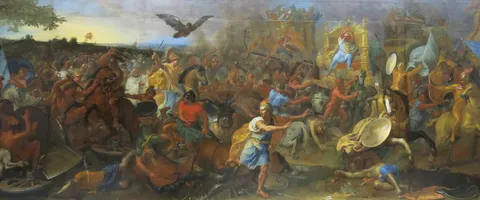 Alexander in command · 331 BCBattle of Gaugamela
 Alexander in command · 326 BCBattle of the Hydaspes
 Napoleon in command · 1796Battle of Montenotte
 Napoleon in command · 1798Battle of the Pyramids
 Egypt · 1798Battle of the Nile
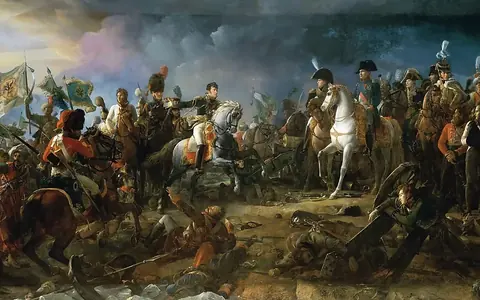 Napoleon in command · 1805Battle of Austerlitz
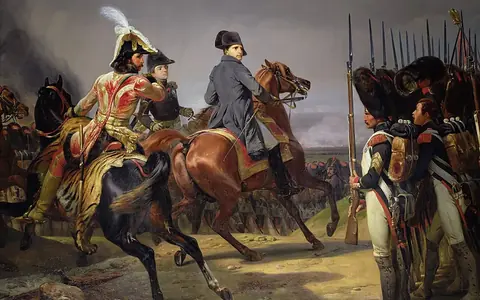 Napoleon in command · 1806Jena-Auerstedt
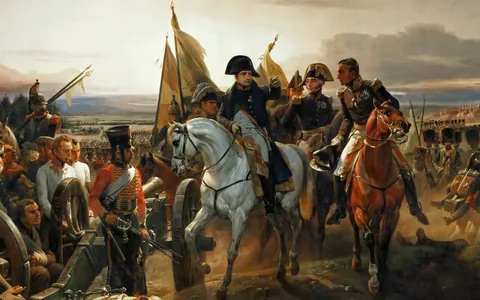 Napoleon in command · 1807Battle of Friedland
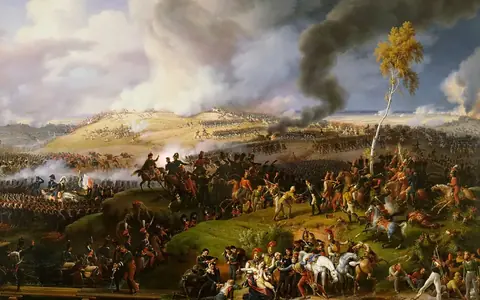 Napoleon in command · 1812Battle of Borodino
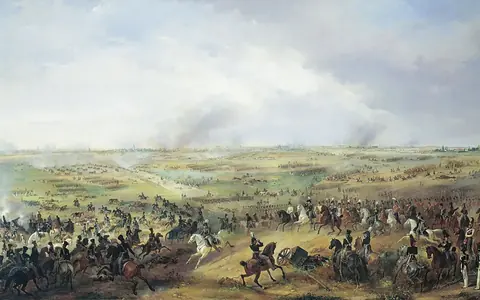 Napoleon in command · 1813Battle of Leipzig
 Napoleon in command · 1815Battle of Waterloo
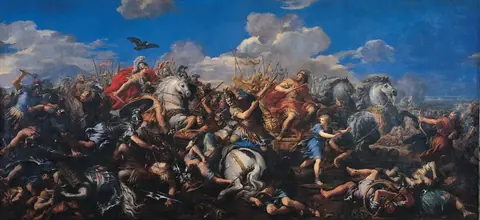 Guide · 336 to 323 BCThe Wars of Alexander the Great
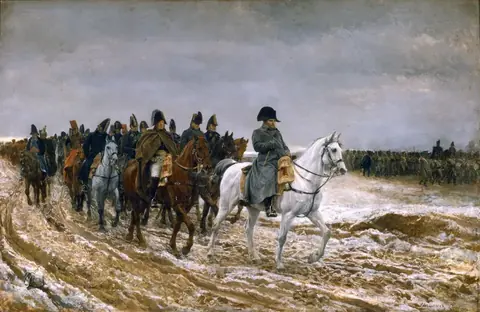 Guide · 1803 to 1815The Napoleonic Wars
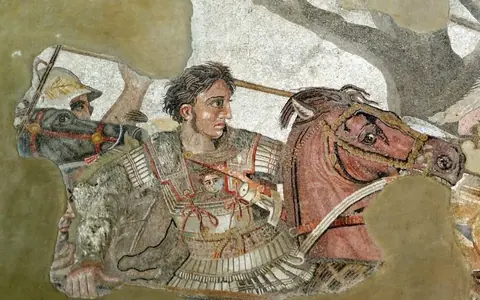
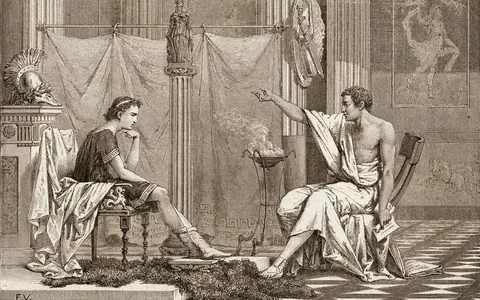 CommanderAlexander the Great
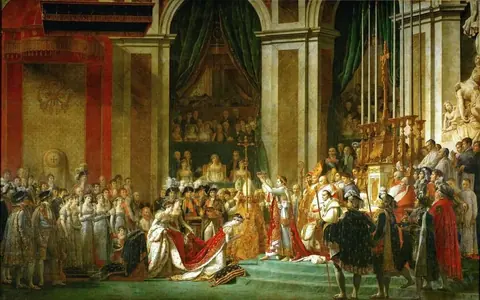 CommanderNapoleon Bonaparte
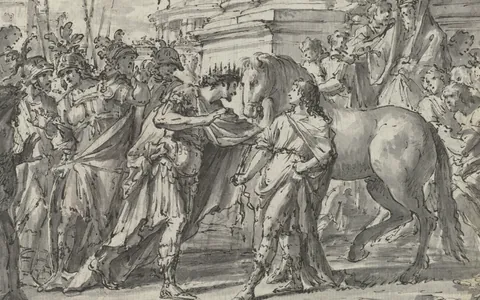 CommanderPhilip II of Macedon
 RankingThe Greatest Military Commanders in History
For the wider field, see Napoleon's invasion of Russia, the greatest Napoleonic battles, the greatest battles of the Persian Empire, Alexander vs Caesar and Napoleon vs Caesar.
Your verdict
We do not pick a winner. Here are the two cases at their strongest, and the questions that decide which one you find more convincing.
For Napoleon
- Twenty years of command against the regular armies of Austria, Prussia and Russia
- Ulm and Austerlitz, a campaign won by manoeuvre and a battle won by one blow
- Speed and concentration, more men at the decisive point
- Soldiers who rallied to him again after his first fall
- The Civil Code, which he valued above forty victories
For Alexander
- Four great pitched battles, all won, against armies the sources call far larger
- The Persian Empire conquered in about eleven years
- A master of supply, by Dodge's account, over deserts and mountains
- Led from the front, wounded again and again
- Ranked first by Hannibal and first on Napoleon's own list
Questions to weigh before you decide:
- Alexander died at 32 before any long decline, Napoleon's record runs on to 1815. How should a short career be set against a long one?
- Is beating the Persian royal army comparable to beating Austria, Prussia and Russia?
- Napoleon in Egypt walked in Alexander's footsteps and was stopped at Acre. Does that tell us anything?
- Should law and institutions, such as the Civil Code, count in a comparison of generals?
- How much do we really know of Alexander's battles from Arrian, writing more than four centuries later?
- Napoleon himself put Alexander first on his list. Should the judgement of one great commander on another weigh with us?




