

What was the Eastern Front in World War I and who won?
The Eastern Front was the World War I battle line from the Baltic to the Black Sea, where Germany, Austria-Hungary and later Bulgaria fought Russia and Romania from 1914. After Tannenberg, Gorlice-Tarnów and the Brusilov Offensive, revolution broke the Russian army, and the Central Powers won at Brest-Litovsk in March 1918.1
While the armies in France dug in, the war in the east kept moving. Encyclopaedia Britannica describes a front more than twice as long as the Western Front, and the Imperial War Museums a war of advances and retreats across plains, forests, lakes and mountain passes. Timothy Dowling of the Virginia Military Institute notes that it long remained what Winston Churchill called “the Unknown War”. This guide follows it from the Battle of Tannenberg and the Battle of Kraśnik in August 1914, through the Battle of Łódź and the Brusilov Offensive, to the peace of Brest-Litovsk. For the other main front of the war, read our guide to the Western Front of World War I.2
Causes of the war on the Eastern Front
Each power came east with its own aims. Austria-Hungary went to war to crush Serbia, and its chief of staff, Franz Conrad von Hötzendorf, planned an offensive north from Galicia into Russian Poland towards Lublin and Chełm. Germany meant to beat France first and hold the east with a single army, the Eighth, in East Prussia, trusting that Russia would mobilize slowly across its great distances.3
Russia entered the war in support of Serbia, Dowling writes, and in hope of gains on the Black Sea coast. Its generals would have preferred to deal with Austria-Hungary first, but Russia was bound to France, and under French pressure it agreed to invade East Prussia with two armies while four more attacked Austria-Hungary in Galicia. The Russian Empire thus attacked both its enemies at once, before its armies were fully ready.4
Russian Poland jutted west between German East Prussia and Austrian Galicia as a huge salient, and the shape of that frontier divided the early fighting into three theaters: East Prussia in the north, Galicia in the south and the Polish salient between them. Distances, rivers and Russia's thin railway network shaped strategy on every side; Britannica argues that better railways gave the Germans a decisive edge in mobility.5
Who fought on the Eastern Front
The Central Powers in the east were the German Empire and Austria-Hungary, joined later by Bulgaria, whose army fought in the campaign against Romania in 1916. Against them stood the Russian Empire and, from August 1916, the Kingdom of Romania. All the great armies were conscript forces. Figures for Russia depend on what is counted: Britannica gives about 1.4 million men in 102 regular divisions in August 1914, while Dowling describes a standing army of 1 million that grew to about 3.5 million on mobilization.6
The armies differed in quality. Britannica judges the German army among the most powerful instruments of war of its time, the Russian soldier brave but short of officers and artillery, and the Austro-Hungarian army weaker in leadership than either. The pattern held for much of the war: in the summary of the Imperial War Museums, Russia generally failed against Germany but did better against Austria-Hungary.7
There was no Polish state in 1914, yet the front ran across Polish lands, and Poles were conscripted into all three partitioning armies, the Russian, German and Austro-Hungarian. In 1915 and 1916 Poles died on both sides of the line. Each empire also tried to win Polish loyalty and raise Polish units for its own cause, which is how the Polish Legions came to fight beside Austria-Hungary.8
1914: Tannenberg, Galicia and Łódź
Rennenkampf's Russian First Army crossed into East Prussia on 17 August 1914 and beat the German Eighth Army at Gumbinnen on 20 August. Its commander, Max von Prittwitz, spoke of retreating behind the Vistula and was replaced by Paul von Hindenburg, with Erich Ludendorff as chief of staff. A plan already drawn up by Lieutenant Colonel Max Hoffmann turned almost the whole Eighth Army south against Samsonov's Second Army, which had lost touch with Rennenkampf; uncoded Russian radio messages told the Germans where both armies were.9
At Tannenberg, from 26 to 30 August, the Germans surrounded and destroyed Samsonov's center. Samsonov took his own life. The Germans took 92,000 prisoners by Britannica's count and 95,000 by Nagornaja's; total Russian losses were about 120,000 to 125,000, against German casualties of about 10,000 to 15,000. Reinforced by two corps from the west, the Eighth Army then drove Rennenkampf out of East Prussia in the First Battle of the Masurian Lakes in September.10
Tannenberg's fame outgrew its strategic weight. Britannica judges that the Germans could not turn the tactical victory into a strategic one, and Nagornaja that the battle mattered more as a symbol than as a turning point. In Germany it became a national myth, hailed as a second Cannae; in Russia it stood for disaster and fed the belief that the army had been sacrificed to save Paris.11
In Galicia the fortunes ran the other way. The Austro-Hungarian First Army won at Kraśnik on 23 August and the Fourth at Komarów soon after, but further east the Russian Third and Eighth Armies broke the Austro-Hungarian right and took Lemberg (Lviv) in the first days of September. Conrad's armies fell back behind the San, leaving the fortress of Przemyśl to be besieged. Britannica writes that Austria-Hungary's allies were already near breaking point; Dowling, that its army never truly recovered.12

In the autumn the fighting moved into the Polish salient. A German advance on Warsaw was turned back in October, and on 11 November August von Mackensen's Ninth Army struck between the Russian First and Second Armies in front of Łódź. The Russian Second Army was nearly surrounded until Plehve's Fifth Army came to its aid, and for a few days the Germans were themselves in danger of encirclement before they fought their way out. The year ended without a decision in the east, as in the west.13
1915: Gorlice-Tarnów and the Great Retreat
The winter brought costly battles on both flanks. In February 1915 a German offensive in the Second Battle of the Masurian Lakes routed the Russian Tenth Army, while in the Carpathians Austro-Hungarian attempts to relieve Przemyśl failed in snow and fog. The fortress surrendered to the Russians in March 1915.14
The German chief of staff, Erich von Falkenhayn, then decided on a great offensive in the east to cripple Russia's army. Mackensen's new Eleventh Army attacked between Gorlice and Tarnów in western Galicia on 2 May 1915, after a short and intense bombardment on a scale the Eastern Front had not seen. The Russian line broke. The Central Powers retook Przemyśl on 3 June and Lemberg on 22 June.15

In July a second offensive struck the Polish salient from the north. The Russian command chose to give up the salient rather than lose its armies in it, and by mid-August the Germans held Warsaw. By late September the retreat had ended on a line running from near Riga south to the Romanian border. The Russians had lost hundreds of thousands of men as prisoners alone, but the army had escaped encirclement. In September Tsar Nicholas II took the supreme command himself, with Mikhail Alekseyev as his chief of staff.16

Dowling argues that the success at Gorlice-Tarnów led Falkenhayn back to the west and to Verdun, believing the same methods would work there. From the summer of 1915, Britannica notes, all of Russian Poland was under German and Austro-Hungarian occupation, and Hindenburg installed a military government there.17
1916: the Brusilov Offensive and Romania
In March 1916, to draw German strength away from Verdun, the Russians attacked at Lake Naroch and failed; Britannica puts their losses at 150,000 men, Dowling at about 70,000. Then Austria-Hungary attacked Italy in May, and Italy appealed to Russia for help. General Aleksei Brusilov, commanding the Southwestern Front, opened his offensive on 4 June 1916.18
The Brusilov Offensive was meant as a supporting attack but became the main one. Brusilov attacked on a broad front after careful preparation, and the Austro-Hungarian lines, stripped of good troops for Italy, broke near Lutsk and in Bukovina, where Czernowitz fell. German reinforcements finally halted the advance, and by late summer it had lost its momentum. Russia had won back Bukovina and much of eastern Galicia.19
The price was enormous on both sides. Britannica counts nearly 400,000 prisoners taken by the Russians and Russian losses of about one million on Brusilov's front; Dowling puts Austro-Hungarian losses at more than 700,000 men and Russian casualties for the summer at nearly two million. Britannica calls the offensive imperial Russia's last really effective military effort and judges that it sounded the death knell of the monarchy; Dowling, that it virtually ended the Habsburg military effort.20
Romania, hoping to win Transylvania and other Austro-Hungarian lands with Romanian populations, declared war on Austria-Hungary on 27 August 1916 and invaded Transylvania. The Central Powers struck back from two sides: Falkenhayn's army drove the Romanians out of Transylvania while Mackensen, with German, Bulgarian and Ottoman troops, crossed the Danube from Bulgaria. Bucharest fell in December 1916, and the Central Powers gained Wallachia's grain and oil. The Romanian army held on in Moldavia beside the Russians.21
The Romanian campaign was a heavy blow to Russia as well. Britannica writes that it added some 300 miles to the already overlong Russian front, and Dowling about 320 miles. Dowling argues that the demoralizing experience in Romania, together with the losses of the summer, finally broke the imperial Russian army.22
1917 to 1918: revolution, the Kerensky Offensive and Brest-Litovsk
The February Revolution of 1917 (March in the Western calendar) replaced the tsar with a Provisional Government, and the Petrograd Soviet's Order No. 1 undermined the officers' authority over their men. The war minister, Alexander Kerensky, hoped a victory would revive the army. Women volunteers even formed a Battalion of Death, meant to shame the wavering men into fighting. The Kerensky Offensive, under Brusilov's direction, opened in Galicia on 1 July 1917 and advanced at first, but it collapsed when German reinforcements arrived and the troops refused to go on; a German counterattack drove the Russians out of Galicia.23
The Germans took Riga on 3 September 1917. After the Bolsheviks seized power on 6 to 7 November, Lenin's government sought peace, and an armistice with the Central Powers was signed at Brest-Litovsk on 15 December. When Trotsky broke off the talks with his formula of “neither peace nor war”, the Germans resumed their advance on 18 February 1918, and Lenin accepted their terms.24
Under the Treaty of Brest-Litovsk of 3 March 1918, Soviet Russia gave up Poland, Lithuania, Latvia and Estonia, recognized the independence of Finland and Ukraine, and lost most of Belarus. Germany wanted the treaty so it could move its divisions west for its spring offensives. The settlement did not last: it lost its force after Germany's defeat in the west in November 1918, and Britannica stresses that many of the territorial changes could not be undone.25
Poland on the Eastern Front: Piłsudski and the Polish Legions
When Austria-Hungary declared war on Russia on 6 August 1914, Józef Piłsudski sent his First Cadre Company of riflemen across the border into the Russian Kingdom of Poland, hoping to spark a rising. It reached Kielce, but no rising came. Later in August Austria-Hungary agreed to form Polish Legions under its command, and Piłsudski led their First Regiment, later the First Brigade.26
The Legions grew to three brigades and fought the Russians in Galicia, Russian Poland and Volhynia. Their hardest battle came at Kostiuchnówka in July 1916, where they helped delay the Russian summer offensive. Piłsudski then demanded a guarantee of Polish independence from the Central Powers.27

On 5 November 1916 Germany and Austria-Hungary proclaimed a Kingdom of Poland on the lands they had taken from Russia, hoping to raise a Polish army against Russia. Piłsudski joined its Provisional Council of State but would accept a Polish army only as the army of a sovereign state. In July 1917, when legionnaires were ordered to swear an oath of loyalty to the German and Austrian emperors, he told them to refuse; he was arrested and held at Magdeburg, and most of the Legions were disbanded or interned.28
Poles also served on the other side. After the March Revolution, Polish corps were formed from Poles in the Russian army, and in Paris Roman Dmowski headed the Polish National Committee. Released from Magdeburg in November 1918, Piłsudski reached Warsaw on 10 November and within days took command of the Polish forces. The new state soon had to fight for its borders, above all in the Polish-Soviet War.29
The Legions' legend outlived the war. The historian Paweł Brudek shows how Piłsudski and his followers built a myth of the First Cadre Company and the First Brigade as a lonely elite of patriots, a story he later used against his political opponents. Leśniewski and Britannica in turn describe how his imprisonment in Magdeburg made him a symbol of the struggle for independence and a national hero.30
Key commanders of the Eastern Front
On the German side, Hindenburg and Ludendorff won fame at Tannenberg, though Britannica gives the chief credit for the plan to Max Hoffmann and the most essential part in the battle to Hermann von François. August von Mackensen led the Ninth Army at Łódź, the breakthrough at Gorlice-Tarnów and the invasion of Romania. Erich von Falkenhayn, chief of the general staff until August 1916, directed the 1915 offensive and later an army in Romania.31

For Austria-Hungary, Conrad von Hötzendorf planned the campaigns of 1914 and 1915, often at odds with his German allies. On the Russian side, Grand Duke Nicholas was commander in chief until September 1915, when Tsar Nicholas II took over with Alekseyev as his chief of staff. The army commanders Rennenkampf and Samsonov are remembered for the disaster in East Prussia, and Aleksei Brusilov for the most successful Russian offensive of the war.32
How many soldiers died on the Eastern Front?
No exact total exists, and the estimates differ widely. For Russia, Britannica estimates about 1.7 million soldiers killed; the historian Alexandre Sumpf shows that older Soviet counts ran from about 0.5 to 0.9 million dead and argues that they understated the toll. Between 2.5 and 3 million soldiers of the Russian Empire were taken prisoner. German losses in the east are put at about 1.06 million killed, wounded or captured by Britannica and at more than 1.5 million by Dowling.33
Civilians suffered on a vast scale as armies crossed Polish, Lithuanian, Ukrainian and Romanian lands, and millions of people fled or were driven from their homes. Britannica writes that disease, hunger, cold and the fighting killed millions of noncombatants on this front; Sumpf counts 6 million refugees among the Russian Empire's war losses.34
Who won the Eastern Front, and why did Russia lose?
The Central Powers won the war in the east. Russia's armies were larger, but they had fewer officers, less artillery and far poorer railways than the Germans, and their early offensives were launched before they were ready. Revolution in 1917 then collapsed the Russian war effort, and Lenin's decrees on land and peace emptied the trenches as peasant soldiers went home.35
Yet the victory did not win the war. Dowling argues that while the war could only be decided in the west, the eastern front drained German strength throughout, and that the Brusilov Offensive drew German divisions away from Verdun. Austria-Hungary never recovered from its losses against Russia, and the treaty Germany imposed at Brest-Litovsk was undone within eight months by its defeat on the Western Front. Out of the ruins came new states, Poland among them.36
Major battles of the Eastern Front
Our articles on the battles of the Eastern Front of World War I, from Tannenberg and Kraśnik in August 1914 to the Brusilov Offensive of 1916, are listed below in date order.
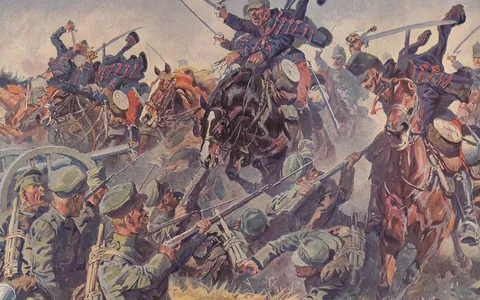
- 1914Battle of Kraśnik, 1914Austria-Hungary (First Army) vs Russian Empire (Fourth Army)
From 23 to 25 August 1914 Dankl's Austro-Hungarian First Army met the Russian Fourth Army south of Kraśnik and drove it back toward Lublin, Austria-Hungary's first victory.
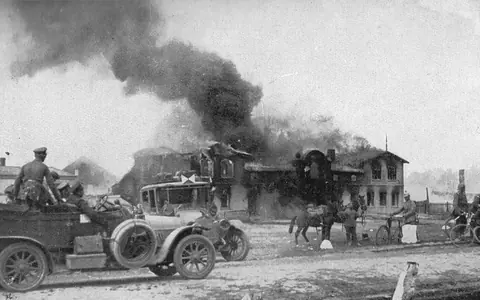
- 1914Battle of Tannenberg, 1914German Empire vs Russian Empire
How Germany encircled and destroyed a whole Russian army at Tannenberg in 1914, taking some 90,000 prisoners.
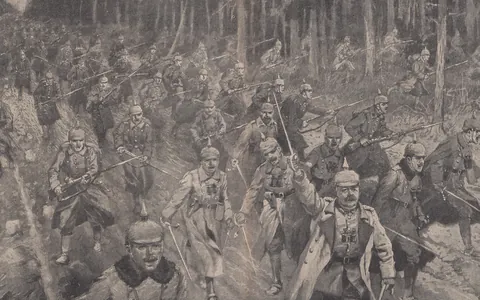
- 1914Battle of Łódź, 1914German Empire and Austria-Hungary vs Russian Empire
From 11 November to 6 December 1914 German and Russian armies fought a vast battle of maneuver around Łódź that cost some 200,000 lives and was then almost forgotten.
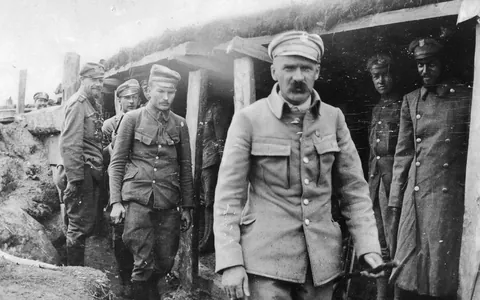
- 1916The Brusilov Offensive, 1916Russian Empire vs Austria-Hungary and Germany
From 4 June 1916 General Brusilov's armies broke the Austro-Hungarian front in Volhynia and Galicia. It was Russia's greatest success of the war, and one of its costliest.
Timeline of the Eastern Front
- 17 August 1914Rennenkampf's Russian First Army crosses into East Prussia.37
- 20 August 1914The Russians win at Gumbinnen; Prittwitz is soon replaced by Hindenburg and Ludendorff.38
- 23 August 1914
- 26 to 30 August 1914The Battle of Tannenberg: the Russian Second Army is destroyed.40
- Early September 1914The Russians take Lemberg (Lviv) and drive Austria-Hungary back in Galicia.41
- September 1914The First Battle of the Masurian Lakes clears East Prussia of the Russians.42
- 11 November 1914
- February 1915The Second Battle of the Masurian Lakes routs the Russian Tenth Army.44
- March 1915Przemyśl surrenders to the Russians.45
- 2 May 1915The German and Austro-Hungarian breakthrough at Gorlice-Tarnów begins.46
- August 1915Warsaw falls; the Russian army retreats out of Poland.47
- September 1915Tsar Nicholas II takes the supreme command.48
- 4 June 1916The Brusilov Offensive opens.49
- July 1916The Polish Legions fight at Kostiuchnówka.50
- 27 August 1916Romania declares war on Austria-Hungary.51
- 5 November 1916Germany and Austria-Hungary proclaim a Kingdom of Poland.52
- December 1916Bucharest falls to the Central Powers.53
- March 1917Revolution in Petrograd; the tsar abdicates.54
- 1 July 1917The Kerensky Offensive opens in Galicia and soon collapses.55
- July 1917Piłsudski is arrested after the oath crisis and held at Magdeburg.56
- 3 September 1917The Germans take Riga.57
- 6 to 7 November 1917The Bolsheviks seize power in Petrograd.58
- 15 December 1917Armistice between Russia and the Central Powers at Brest-Litovsk.59
- 18 February 1918The Germans resume their advance after the talks break down.60
- 3 March 1918The Treaty of Brest-Litovsk ends the war on the Eastern Front.61
Where to read next
The Eastern Front was one of the two great land fronts of World War I. Compare it with the Western Front of World War I, see the greatest battles of World War I and test yourself with the World War I battles quiz. For Poland's road from the Legions to independence, read the battles that won Polish independence, and for the same ground a generation later, the Eastern Front of World War II.
Notes
A number in the text points to a note; each note names the works that paragraph draws on, listed in full under Sources.
- Encyclopaedia Britannica, “Eastern Front (World War I)”; Imperial War Museums, “The Eastern Front in the First World War”; Encyclopaedia Britannica, “Eastern Front”; Timothy C. Dowling, “Eastern Front”. ↩
- Encyclopaedia Britannica, “Eastern Front (World War I)”; Imperial War Museums, “The Eastern Front in the First World War”; Timothy C. Dowling, “Eastern Front”. ↩
- Encyclopaedia Britannica, “Battle of Tannenberg”; Encyclopaedia Britannica, “Eastern Front (World War I)”; Timothy C. Dowling, “Eastern Front”; Oxana Nagornaja, “Tannenberg, Battle of”. ↩
- Timothy C. Dowling, “Eastern Front”; Encyclopaedia Britannica, “Eastern Front (World War I)”. ↩
- Encyclopaedia Britannica, “Eastern Front (World War I)”; Timothy C. Dowling, “Eastern Front”. ↩
- Encyclopaedia Britannica, “Eastern Front (World War I)”; Imperial War Museums, “The Eastern Front in the First World War”; Timothy C. Dowling, “Eastern Front”; Encyclopaedia Britannica, “Eastern Front”; Harald Heppner and Rudolf Gräf, “Romania”. ↩
- Encyclopaedia Britannica, “Eastern Front (World War I)”; Imperial War Museums, “The Eastern Front in the First World War”. ↩
- Paul Latawski, “Seed Corn of a Future Army”; Museum of Polish History, “The suffering and scale of destruction of Polish lands during the Great War is seldom present in the Western historical narrative”. ↩
- Encyclopaedia Britannica, “Battle of Tannenberg”; Timothy C. Dowling, “Eastern Front”; Oxana Nagornaja, “Tannenberg, Battle of”. ↩
- Encyclopaedia Britannica, “Battle of Tannenberg”; Oxana Nagornaja, “Tannenberg, Battle of”; Timothy C. Dowling, “Eastern Front”; Encyclopaedia Britannica, “Eastern Front (World War I)”. ↩
- Encyclopaedia Britannica, “Battle of Tannenberg”; Oxana Nagornaja, “Tannenberg, Battle of”. ↩
- Encyclopaedia Britannica, “Eastern Front (World War I)”; Timothy C. Dowling, “Eastern Front”; Encyclopaedia Britannica, “Eastern Front”. ↩
- Encyclopaedia Britannica, “Eastern Front (World War I)”; Timothy C. Dowling, “Eastern Front”; Encyclopaedia Britannica, “Eastern Front”. ↩
- Encyclopaedia Britannica, “Eastern Front”; Timothy C. Dowling, “Eastern Front”. ↩
- Encyclopaedia Britannica, “Eastern Front”; Timothy C. Dowling, “Eastern Front”. ↩
- Encyclopaedia Britannica, “Eastern Front”; Timothy C. Dowling, “Eastern Front”. ↩
- Timothy C. Dowling, “Eastern Front”; Encyclopaedia Britannica, “Eastern Front”. ↩
- Encyclopaedia Britannica, “Eastern Front”; Timothy C. Dowling, “Eastern Front”; Encyclopaedia Britannica, “World War I”. ↩
- Encyclopaedia Britannica, “World War I”; Timothy C. Dowling, “Eastern Front”; Encyclopaedia Britannica, “Eastern Front”. ↩
- Encyclopaedia Britannica, “Eastern Front”; Encyclopaedia Britannica, “World War I”; Timothy C. Dowling, “Eastern Front”. ↩
- Encyclopaedia Britannica, “Eastern Front”; Harald Heppner and Rudolf Gräf, “Romania”. ↩
- Encyclopaedia Britannica, “Eastern Front”; Timothy C. Dowling, “Eastern Front”. ↩
- Encyclopaedia Britannica, “Eastern Front”; Timothy C. Dowling, “Eastern Front”. ↩
- Encyclopaedia Britannica, “Eastern Front”; Timothy C. Dowling, “Eastern Front”; Susanne Schattenberg, “Brest-Litovsk, Treaty of”. ↩
- Encyclopaedia Britannica, “Eastern Front”; Susanne Schattenberg, “Brest-Litovsk, Treaty of”; Timothy C. Dowling, “Eastern Front”. ↩
- Michał Leśniewski, “Piłsudski, Józef”; Paweł Brudek, “Polish War Myths (East Central Europe)”; Paul Latawski, “Seed Corn of a Future Army”; Józef Piłsudski Institute of America, “Polish Legions”. ↩
- Michał Leśniewski, “Piłsudski, Józef”; Józef Piłsudski Institute of America, “Polish Legions”; Encyclopaedia Britannica, “Józef Piłsudski”. ↩
- Encyclopaedia Britannica, “Eastern Front”; Encyclopaedia Britannica, “Józef Piłsudski”; Michał Leśniewski, “Piłsudski, Józef”; Józef Piłsudski Institute of America, “Polish Legions”. ↩
- Encyclopaedia Britannica, “Eastern Front”; Michał Leśniewski, “Piłsudski, Józef”; Encyclopaedia Britannica, “Józef Piłsudski”. ↩
- Paweł Brudek, “Polish War Myths (East Central Europe)”; Michał Leśniewski, “Piłsudski, Józef”; Encyclopaedia Britannica, “Józef Piłsudski”. ↩
- Encyclopaedia Britannica, “Battle of Tannenberg”; Encyclopaedia Britannica, “Eastern Front (World War I)”; Encyclopaedia Britannica, “Eastern Front”; Timothy C. Dowling, “Eastern Front”; Harald Heppner and Rudolf Gräf, “Romania”. ↩
- Encyclopaedia Britannica, “Eastern Front (World War I)”; Encyclopaedia Britannica, “Eastern Front”; Timothy C. Dowling, “Eastern Front”; Encyclopaedia Britannica, “World War I”. ↩
- Encyclopaedia Britannica, “Eastern Front”; Alexandre Sumpf, “War Losses (Russian Empire)”; Timothy C. Dowling, “Eastern Front”. ↩
- Encyclopaedia Britannica, “Eastern Front”; Alexandre Sumpf, “War Losses (Russian Empire)”; Museum of Polish History, “The suffering and scale of destruction of Polish lands during the Great War is seldom present in the Western historical narrative”. ↩
- Encyclopaedia Britannica, “Eastern Front (World War I)”; Imperial War Museums, “The Eastern Front in the First World War”; Encyclopaedia Britannica, “Eastern Front”; Timothy C. Dowling, “Eastern Front”. ↩
- Timothy C. Dowling, “Eastern Front”; Encyclopaedia Britannica, “Eastern Front”; Encyclopaedia Britannica, “Eastern Front”; Susanne Schattenberg, “Brest-Litovsk, Treaty of”. ↩
- Encyclopaedia Britannica, “Eastern Front (World War I)”; Timothy C. Dowling, “Eastern Front”. ↩
- Encyclopaedia Britannica, “Battle of Tannenberg”; Timothy C. Dowling, “Eastern Front”. ↩
- Encyclopaedia Britannica, “Eastern Front (World War I)”; Timothy C. Dowling, “Eastern Front”. ↩
- Encyclopaedia Britannica, “Battle of Tannenberg”; Oxana Nagornaja, “Tannenberg, Battle of”. ↩
- Encyclopaedia Britannica, “Eastern Front (World War I)”; Timothy C. Dowling, “Eastern Front”. ↩
- Encyclopaedia Britannica, “Eastern Front (World War I)”; Timothy C. Dowling, “Eastern Front”. ↩
- Encyclopaedia Britannica, “Eastern Front (World War I)”; Timothy C. Dowling, “Eastern Front”. ↩
- Encyclopaedia Britannica, “Eastern Front”; Timothy C. Dowling, “Eastern Front”. ↩
- Encyclopaedia Britannica, “Eastern Front”; Timothy C. Dowling, “Eastern Front”. ↩
- Encyclopaedia Britannica, “Eastern Front”; Timothy C. Dowling, “Eastern Front”. ↩
- Encyclopaedia Britannica, “Eastern Front”; Timothy C. Dowling, “Eastern Front”. ↩
- Encyclopaedia Britannica, “Eastern Front”; Timothy C. Dowling, “Eastern Front”. ↩
- Encyclopaedia Britannica, “World War I”; Encyclopaedia Britannica, “Eastern Front”. ↩
- Michał Leśniewski, “Piłsudski, Józef”; Józef Piłsudski Institute of America, “Polish Legions”. ↩
- Encyclopaedia Britannica, “Eastern Front”; Harald Heppner and Rudolf Gräf, “Romania”. ↩
- Encyclopaedia Britannica, “Eastern Front”; Michał Leśniewski, “Piłsudski, Józef”. ↩
- Encyclopaedia Britannica, “Eastern Front”; Harald Heppner and Rudolf Gräf, “Romania”. ↩
- Encyclopaedia Britannica, “Eastern Front”; Timothy C. Dowling, “Eastern Front”. ↩
- Encyclopaedia Britannica, “Eastern Front”; Timothy C. Dowling, “Eastern Front”. ↩
- Encyclopaedia Britannica, “Józef Piłsudski”; Michał Leśniewski, “Piłsudski, Józef”. ↩
- Encyclopaedia Britannica, “Eastern Front”; Timothy C. Dowling, “Eastern Front”. ↩
- Encyclopaedia Britannica, “Eastern Front”; Timothy C. Dowling, “Eastern Front”. ↩
- Encyclopaedia Britannica, “Eastern Front”; Susanne Schattenberg, “Brest-Litovsk, Treaty of”. ↩
- Susanne Schattenberg, “Brest-Litovsk, Treaty of”; Encyclopaedia Britannica, “Eastern Front”. ↩
- Encyclopaedia Britannica, “Eastern Front”; Susanne Schattenberg, “Brest-Litovsk, Treaty of”. ↩
Sources
- Encyclopaedia Britannica, “Eastern Front (World War I)”.
- Imperial War Museums, “The Eastern Front in the First World War”.
- Encyclopaedia Britannica, “Eastern Front: 1917, the Russian Revolution”.
- Timothy C. Dowling, “Eastern Front”, 1914-1918-online, Freie Universität Berlin.
- Encyclopaedia Britannica, “Battle of Tannenberg”.
- Oxana Nagornaja, “Tannenberg, Battle of”, 1914-1918-online.
- Encyclopaedia Britannica, “Eastern Front: 1915, the Austro-Hungarian and German advance into Russia” (with 1916, Romania enters the war).
- Harald Heppner and Rudolf Gräf, “Romania”, 1914-1918-online.
- Paul Latawski, “Seed Corn of a Future Army: The Mobilisation of the Poles and the Creation of Polish Military Formations in the First World War”, British Journal for Military History 2, no. 2 (2016).
- Museum of Polish History, “The suffering and scale of destruction of Polish lands during the Great War is seldom present in the Western historical narrative” (interview with Andrzej Chwalba).
- Encyclopaedia Britannica, “World War I: the Eastern Front, 1916”.
- Susanne Schattenberg, “Brest-Litovsk, Treaty of”, 1914-1918-online.
- Michał Leśniewski, “Piłsudski, Józef”, 1914-1918-online.
- Paweł Brudek, “Polish War Myths (East Central Europe)”, 1914-1918-online.
- Józef Piłsudski Institute of America, “Polish Legions” (online exhibition).
- Encyclopaedia Britannica, “Józef Piłsudski”.
- Alexandre Sumpf, “War Losses (Russian Empire)”, 1914-1918-online.






