

Montgomery or Rommel: what does the evidence say?
Bernard Montgomery (1887 to 1976) and Erwin Rommel (1891 to 1944) faced each other in North Africa in 1942 and 1943 and again in Normandy in 1944. Montgomery won the battles of Alam Halfa, El Alamein and Medenine, and Rommel fought them with fewer men, fewer tanks and too little fuel. Historians have not settled it. Liddell Hart wrote that only Napoleon had made a comparable impression on the British, while Neitzel stresses Rommel's operational error and his closeness to Hitler. The National Army Museum calls Montgomery one of the British Army's greatest ever commanders. This page sets out the evidence for each and leaves the final verdict to you.
Few pairs of enemies have been compared as often. Rommel took command of the Afrika Korps in Libya in February 1941 and for eighteen months drove the British back and forth across the desert. Montgomery was given the Eighth Army in 1942, stopped Rommel's last thrust towards the Nile and broke his army at El Alamein two months later. Admirers of each have argued ever since.1
This is not a ranking. Below you will find the two careers side by side, the five episodes in which they actually fought each other, and six questions on which a general can be judged. Under each we give the strongest evidence for Montgomery and the strongest for Rommel, with their own words, the official historians of three countries and the German scholars who have reassessed Rommel since. At the end the decision is yours.
Side by side
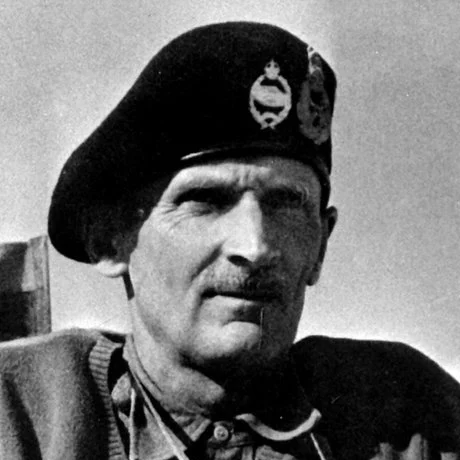
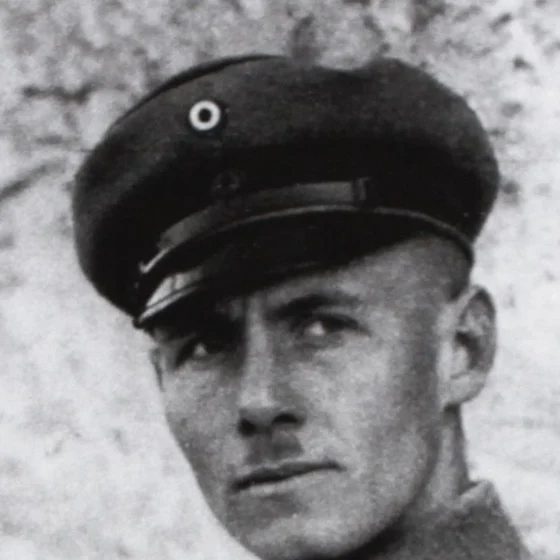
- Lived
- 1887 to 1976, born in London
- 1891 to 1944, born in Heidenheim, Württemberg
- Entered the army
- From Sandhurst into the Royal Warwickshire Regiment
- 1910, officer cadet in Infantry Regiment 124
- World War I
- Shot through the lung at Ypres in 1914, then a staff officer
- Western Front, then Monte Matajur in 1917 and the Pour le Mérite
- Commands in World War II
- 3rd Division 1939 to 1940, Eighth Army 1942 to 1943, 21st Army Group 1944 to 1945
- 7th Panzer Division 1940, Afrika Korps 1941, Panzer Army and Army Group Africa 1942 to 1943, Army Group B 1943 to 1944
- Field marshal
- 1944, announced on 1 September
- 22 June 1942, the day after Tobruk fell
- Battles named here
- Alam Halfa, El Alamein, Medenine, Normandy
- Tobruk, Gazala, Alam Halfa, El Alamein, Medenine, Normandy
- Own account
- El Alamein to the River Sangro (1948), Normandy to the Baltic (1947)
- The Rommel Papers, edited by Liddell Hart (1953)
- Death
- 24 March 1976 at Isington, Hampshire
- 14 October 1944 near Herrlingen, forced to take poison
Dates, commands and ranks as given by the National Army Museum, the Neue Deutsche Biographie, the Deutsches Historisches Museum and the US Army official histories. We give no win and loss totals because no source counts their battles the same way.2
Where they met: from Alam Halfa to Normandy
They fought each other in five episodes: Alam Halfa, El Alamein, the pursuit across Libya, Medenine and Normandy. In three of them Rommel was not fully in charge or not at full strength, and the sources say so. That is part of the argument.
Alam Halfa, 30 August to 7 September 1942
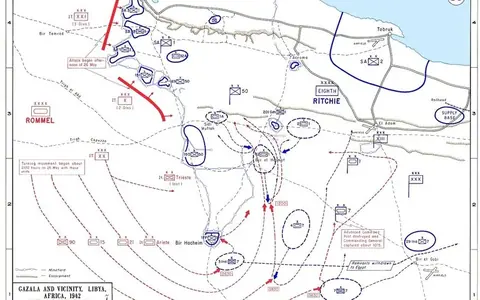
Rommel planned to break through the British minefields in the south by night and wheel north to the coast. The British official historian, I. S. O. Playfair, calls the timing, to say the least, wildly optimistic, and adds that Montgomery and his intelligence staff had read the signs correctly and were expecting just such a move. Rommel was also ill. Playfair notes that he could command only under medical supervision and judges that the Rommel of Alam el Halfa was not the Rommel of Gazala and Tobruk.3
Rommel's own account confirms the failure of the plan. His motorised forces were held up far too long by strong and unsuspected minefields, he wrote, and the element of surprise, which had formed the basis of the whole plan, had been lost.4
The strengths are disputed, and we give them side by side. Playfair counts 203 German and 243 Italian medium tanks at the start. The New Zealand official history, by Ronald Walker, counts 514 Axis tanks, 233 German and 281 Italian, against about 693 British tanks in the forward area, and gives the Eighth Army a two to one superiority in men.5
Montgomery wrote that by the middle of the day, as the attack developed, he had nearly 400 tanks in the vital area. He later wrote that the battle had never received the attention it deserved, because had it been lost, Egypt might well have been lost too.6
Montgomery told his corps commander, Horrocks, that he was on no account to allow the British armour to become mauled, because he was saving it for his own offensive. Playfair puts German losses at 1,859 killed, wounded and missing, Italian at 1,051 and British at 1,750, with 38 German and 11 Italian tanks destroyed and 67 British tanks put out of action.7
El Alamein, 23 October to 4 November 1942
When the British attack opened, Rommel was in Austria on sick leave and General Georg Stumme commanded in his place. Playfair writes that the Panzerarmee was without its trusted and almost fabulous leader. The Eighth Army, by contrast, had a vigorous and inspiring commander whose enthusiasm was infectious.8
Rommel came back once the battle had begun. He wrote that something over 200 German and about 300 Italian tanks faced more than 1,000 British, and that victory was simply impossible under the terms on which his army entered the battle.9

The figures differ by source. Playfair takes the fighting strength of the Eighth Army as 195,000 against about 50,000 Germans and 54,000 Italians, with 1,029 British tanks other than light against 496. The National Army Museum gives over 190,000 men and over 1,000 tanks on the British side against 116,000 men and 540 tanks. The Eighth Army lost about 13,560 men killed, wounded and missing, Playfair writes, and by 11 November it had taken some 30,000 prisoners. He also calls the battle anything but a walk-over, in which the German troops put up a magnificent defence.10
On 3 November Hitler ordered Rommel to show his troops no other road than that to victory or death. Rommel wrote that the order demanded the impossible, since even the most devoted soldier can be killed by a bomb. He obeyed at first, then pulled back what was left.11
The Neue Deutsche Biographie notes that Rommel's close relationship with Hitler clouded over at this point, when he ignored the orders to stand and withdrew his troops from the El Alamein position to save them from destruction.12
The pursuit, November 1942 to January 1943
Rommel was sure that Montgomery would never take the risk of following up boldly and overrunning him. The National Army Museum agrees that Montgomery's caution allowed the motorised part of the Axis army to escape. Montgomery saw it otherwise. On 23 January 1943, with Tripoli taken, he called the victory, the pursuit and the capture of the city within three months probably without parallel in history.13
Rommel's retreat has its own admirers. One historian quoted by Peter Lieb in 2013 called it one of the most brilliant retreats in the history of warfare.14
Medenine, 6 March 1943
Rommel's last attack in Africa came at Medenine in southern Tunisia. Playfair calls the plan scrappy, says Rommel seems to have taken no interest in the details, and writes that his former fiery spirit was burning low. He gives the British corps 460 anti-tank guns and 300 tanks, and the Axis 635 casualties and between 44 and 56 tanks lost.15
Montgomery wrote that he had over 500 anti-tank guns and 400 tanks in position, that 52 knocked out enemy tanks were left on the field and that he lost none.16
The US official historian George Howe counts at least 41 tanks lost by the Afrika Korps on 6 and 7 March and calls Rommel's last battle in Africa a costly failure. Rommel put his own loss at 40 tanks and wrote that the British commander had grouped his forces extremely well, and that the attack had come about a week too late. On 9 March sick leave took him out of Tunisia, and he never returned.17
Normandy, 1944
In 1944 the two met again as army group commanders. Rommel took over Army Group B in the West on 1 December 1943 by the Neue Deutsche Biographie, in January 1944 by the US official historian Forrest Pogue. Montgomery commanded the Allied assault forces in Normandy until 1 September 1944, when Eisenhower took over the direction of operations in the field.18
On 15 July Rommel warned Hitler that the unequal struggle was nearing its end. Two days later, on 17 July, his car was attacked from the air, as the British official historian L. F. Ellis records, and he was badly wounded. He was still recovering at home when the plot of 20 July was investigated.19
Reading the enemy
The case for Montgomery
At Alam Halfa the British knew what was coming. Playfair says the victory was made possible by a particularly accurate forecast of what Rommel was going to do, so that the attack met a tremendous volume of fire on ground of the defenders' choice. Walker writes that British intelligence had drawn a remarkably close picture of Axis intentions and strengths, estimating 82,000 men and 430 tanks.20
His superiors saw the same quality later. At the Mareth Line, two weeks after Medenine, Eisenhower wrote that Montgomery outflanked and surprised the enemy by a brilliant and rapid switch of forces in the midst of the battle.21
The case for Rommel
Rommel's defenders point out that the advantage in intelligence belonged to the British side, not to Montgomery alone. Liddell Hart, who edited Rommel's papers, notes that the defensive plan for Alam Halfa had been devised by Dorman-Smith and adopted by Auchinleck, and that Montgomery accepted it in principle. Liddell Hart also wrote that he had not realised how deep a sense of strategy Rommel had, and that his audacity was so shrewdly calculated that his moves may be called too hazardous, but not the reckless strokes of a blind and hot-headed gambler.22
Caution and audacity
The case for Montgomery
Rommel himself summed up Montgomery's method: his principle was to fight no battle unless he knew for certain that he would win it. Rommel added that this only works with material superiority, but that he had it, and that he was cautious, to Rommel's mind excessively so, but could afford to be. He judged him more of a strategist than a tactician, and credited him with outstanding achievements in higher strategic planning, not least in the invasion battle of 1944.23
Montgomery's admirers add that his caution saved lives. At Medenine his infantry and anti-tank guns broke the attack without wire or mines, and he called it a model defensive engagement and a great triumph for the infantry and the anti-tank gun.24
American historians drew the same lesson. Howe writes that German armour was stopped by resolute infantry, field artillery and massed anti-tank defences. The US Army's short history of the Tunisian campaign adds that at Medenine the British may have found the tactic that could stop the panzers: massed artillery and anti-tank fire combined with air raids.25
The case for Rommel
Rommel's case is that he did more with less. Lieb writes that he always fought outnumbered, with a hopelessly inferior logistical base, and still inflicted painful defeats on his enemy. The capture of Tobruk on 21 June 1942 crowned what one British history, quoted by Lieb, called probably the most spectacular series of victories ever gained over a British army.26
His critics have their own evidence. The German historian Sönke Neitzel writes in the Neue Deutsche Biographie that the dream of a drive to the Nile failed not least through Rommel's own serious operational error.27
Lieb notes that Rommel's first attempt on Tobruk in spring 1941 was marked by dilettantism and cost heavy losses, and that Field Marshal von Rundstedt once said he had all the qualities of a good divisional commander, but no more.28
Supply and logistics
The case for Montgomery
Montgomery built his battles on supply. He rebuilt the Eighth Army on leadership, equipment and training, he wrote, and from August the first Sherman tanks arrived, at last a match for the German tanks. The National Army Museum notes that he restored the army's flagging morale and made sure his men were properly supplied, and spent nearly two months training and re-equipping them.29
The case for Rommel
Rommel's offensives ran out of fuel. By 29 August 1942 only about 1,500 tons had reached Tobruk for his army, Playfair writes, and four of the seven ships the Italian high command had sent with fuel were sunk. Rommel decided to take a chance on a quick success rather than wait.30
His critics answer that he chose to attack at the end of that supply line. Neitzel writes that he pressed the drive into Egypt against the wishes of his superior Kesselring and of Mussolini, who wanted Malta taken first.31
Lieb adds that his sometimes headlong offensives, launched without enough logistical support, were not always beyond doubt.32

Leading men
The case for Montgomery
After Alam Halfa, Montgomery wrote, the morale of the soldiers became outstanding, and the army and air commanders and their staffs worked together at one headquarters. Eisenhower wrote of him in 1943, as the National Army Museum records, that his soldiers were certainly devoted to him and that he had a flair for showmanship.33
The case for Rommel
Rommel led from the front, in Africa and still in Normandy, Lieb writes, and in France in 1940 his division earned the name of the ghost division. His staff and peers were less admiring. Lieb quotes the chief of the army general staff, Franz Halder, on Rommel's morbid ambition and flaws of character, and notes that Guderian was disgusted by his self-promotion in the press.34
Masters and the regime
The case for Montgomery
Montgomery served a democracy and argued with it in the open. The National Army Museum calls him arrogant, unlikeable, but ultimately successful, and says he used his talent for self-publicity to claim all the credit for El Alamein. He owed his command to Churchill, who appointed him in 1942.35
The case for Rommel
Rommel's record cannot be separated from the regime he served. Neitzel calls him Hitler's favourite general and writes that his fame as the Desert Fox was built up by Goebbels' propaganda. He also writes that in Italy in 1943 Rommel was involved in German war crimes linked to the operation against the Italian army.36
Yet he defied Hitler at El Alamein, and in July 1944 he warned him that the front was about to collapse. After the plot of 20 July his name came up in the Gestapo interrogations. On 14 October 1944 two generals came to his house at Herrlingen and he took poison in their presence. A state funeral followed in Ulm, the Deutsches Historisches Museum and Lieb both record, to hide how he had died.37
Normandy and after
The case for Montgomery
Montgomery's plan was to threaten a break-out at Caen, draw the main German reserves there and break out in the west with the Americans. Pogue writes that the criticism of his slowness at Caen, which came from many American and some British commanders as early as mid-June, rests on a fundamental misunderstanding of his intentions.38
The case for Rommel
Rommel's defenders say Normandy was lost before it began. Ellis writes that the two German field marshals in the West had complete confidence neither in Hitler nor in each other. Lieb writes that against such material superiority the former Desert Fox was reduced to an extra.39
Montgomery, for his part, wrote that Rommel was no strategist, because he wanted to stop an invader on the beaches.40
How historians have judged them
The official historians were cautious with both. Walker gives British intelligence much of the credit for Alam Halfa. The US Army historian Gordon Harrison wrote in 1951 that Montgomery achieved renown as the man who mastered Rommel.41
Eisenhower, who commanded both British and American armies, wrote after the war that Montgomery was always a master in the methodical preparation of forces for a formal, set-piece attack.42
Rommel's reputation in Britain owes much to Liddell Hart, who wrote that in centuries of warfare only Napoleon had made a comparable impression on the British, and that Rommel became the hero of the Eighth Army troops who fought him. German scholarship has been harder on him. Neitzel stresses his operational error, his closeness to Hitler and the propaganda that made him famous. Lieb weighs both sides: the contemporaries who called his successes a propaganda construct, and the record of a general who always fought outnumbered and still won.43
Montgomery's own reputation divides too. The National Army Museum calls him one of the British Army's greatest ever commanders and also reports that his conduct at El Alamein remains the subject of debate. Churchill, as the museum quotes him, put it in one line in 1945: in defeat, unbeatable, in victory, unbearable.44
Battles on the site
Every battle page on Echoes of Battle that involves one of the two men, with the guides that set them in context. Medenine has no page of its own yet and is covered in the North African campaign.
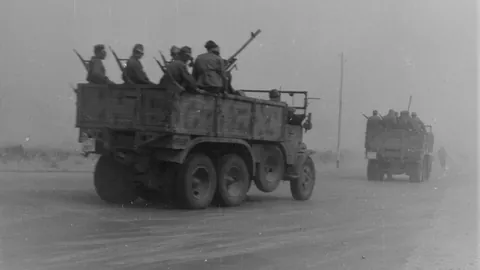 Both in command · 1942Battle of Alam Halfa
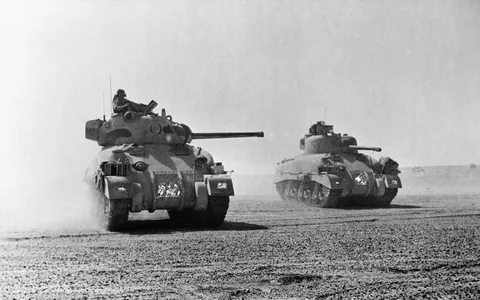 Both in command · 1942El Alamein: the end of the beginning
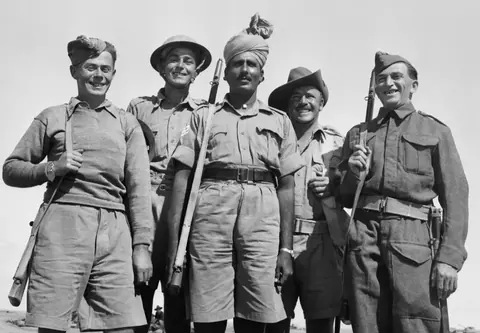 Both · 1940 to 1943The North African Campaign
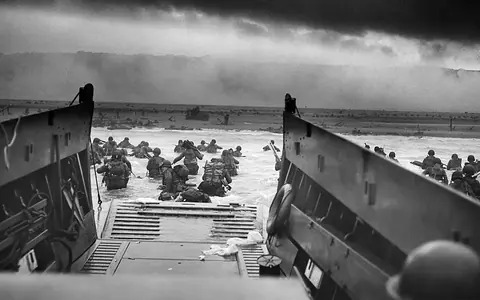 Both in command · 1944D-Day and Normandy
 Rommel · 1941The Siege of Tobruk
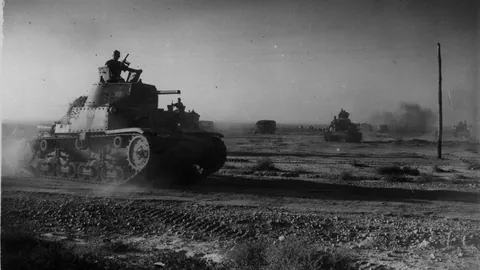 Rommel · 1942Battle of Gazala
 Rommel · 1942Mersa Matruh
 Rommel · 1917Caporetto: Monte Matajur
 Montgomery · 1940The Dunkirk Evacuation
 Montgomery · 1944The Battle of Falaise
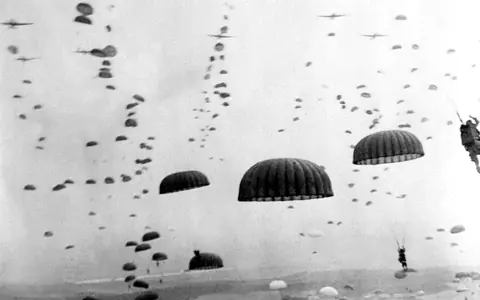 Montgomery · 1944Operation Market Garden
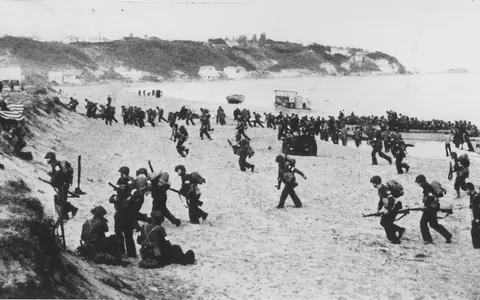 Behind Rommel · 1942Operation Torch
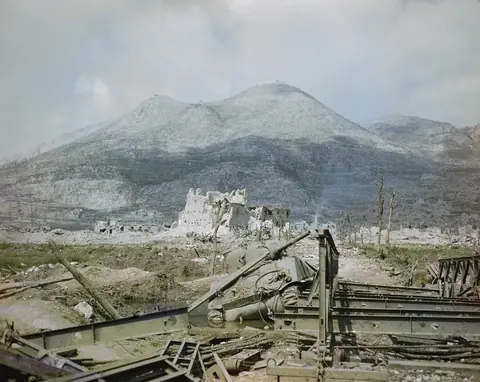 Both · 1943The Mediterranean and Italy
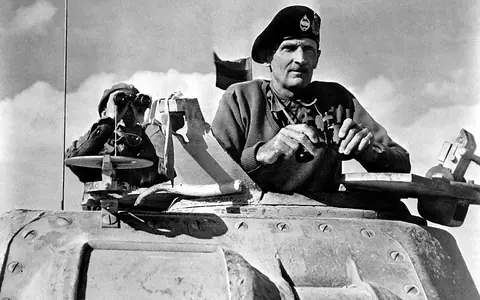 CommanderBernard Montgomery
 CommanderErwin Rommel
 RankingThe Greatest British Commanders
 GuideThe Military History of Germany
QuizHow Well Do You Know World War II Battles?
More head to head pages: Patton vs Rommel, Eisenhower vs Montgomery and Patton vs Montgomery. For the wider field, see the greatest battles of World War II and the greatest military commanders.
Your verdict
We do not pick a winner. Here are the two cases at their strongest, and the questions that decide which one you find more convincing.
For Montgomery
- He won every battle he fought against Rommel: Alam Halfa, El Alamein and Medenine
- He read Rommel's intentions at Alam Halfa and Medenine
- He restored the morale of a beaten army within weeks
- He worked the army and the air force as one
- Even Rommel credited his strategic planning, not least in Normandy
For Rommel
- He always fought outnumbered and at the end of a thin supply line
- Tobruk and Gazala, the victories that made him field marshal
- He was absent or ill when the decisive British blows fell
- He saved the core of his army after El Alamein against Hitler's order
- He impressed his enemies more than almost any commander of his age
Questions to weigh before you decide:
- Should a general be judged by what he did with what he had, or by whether he won?
- Is refusing battle until you are sure to win a virtue, or does it waste chances, as Rommel said of the pursuit?
- How much of Alam Halfa belongs to Montgomery, and how much to Auchinleck's plan, British intelligence and the air force?
- Do Rommel's victories outweigh the operational errors his German critics point to?
- How should Rommel's closeness to Hitler and the propaganda myth weigh in a military comparison?
- In Normandy, does Montgomery's plan to hold the German armour at Caen count for him, or does the slowness his critics saw count against him?
Cast your vote below and see how other readers have judged them.






