

What was the Russo-Japanese War and who won?
The Russo-Japanese War (1904 to 1905) was fought between the Russian Empire and the Empire of Japan over Korea and Manchuria. Japan opened it with a surprise attack on Port Arthur, won the battles at Port Arthur, Mukden and Tsushima, and in the Treaty of Portsmouth gained a free hand in Korea, the Port Arthur lease and southern Sakhalin.1
On the night of 8 to 9 February 1904, Japanese torpedo boats attacked the Russian squadron at anchor in Port Arthur, on the Liaodong Peninsula of northeastern China, before any declaration of war. The war that followed lasted nineteen months. It was fought on land in Manchuria and Korea and at sea in the waters around the Korean peninsula, and it ended with the Treaty of Portsmouth, signed on 5 September 1905.2
Japan won every major battle on land and at sea, and Encyclopaedia Britannica calls the war the first in modern times in which an Asian power defeated a European one. Victory came at a high price, however, and the peace left Japan without the war indemnity its public expected.3
Our battle guides cover the opening clash at Chemulpo Bay, the Battle of the Yellow Sea, the Battle of Liaoyang, the Battle of Mukden and the Battle of Tsushima. This page explains why the two empires went to war, how the fighting unfolded, who led it, what the peace settled and how the war is remembered.
Causes of the Russo-Japanese War
The war grew out of the rivalry between two expanding empires for dominance in Korea and in Manchuria, the northeastern region of Qing China. Russia had pushed its frontier across Siberia to the Pacific, where it founded Vladivostok in 1860; Japan, transformed after the Meiji Restoration of 1868, saw the Korean peninsula as its first field of expansion.4
The two aims were not the same. For the Meiji government Korea was the main strategic concern, and Japanese leaders regarded the neighboring mainland as vital to national security. In St. Petersburg, Nicholas II and the commercial interests behind Russian expansion saw East Asia above all as a field for empire and economic development.5
The immediate dispute began with the First Sino-Japanese War of 1894 to 1895. In the Treaty of Shimonoseki, China ceded the Liaodong Peninsula with Port Arthur to Japan. Russia, Germany and France, on the initiative of Nicholas II, forced Japan to give the peninsula back in what became known as the Triple Intervention.6
Russia then took for itself the territory it had just denied Japan. In 1896 it gained the right to run the Chinese Eastern Railway across Manchuria to Vladivostok, with a branch south toward Port Arthur, and in 1898 it obtained a 25-year lease of Port Arthur and the tip of the peninsula, where it built a naval base. Port Arthur gave Russia the ice-free, warm-water harbor it lacked in the Pacific.7
When the Boxer Uprising broke out in China in 1900, Russia joined the international intervention and used it to send large forces into Manchuria. Diplomacy in 1902 and 1903 failed to divide the region into spheres of influence, and the Russian government did little to answer Japan's proposals or to prepare for war.8
Japan, meanwhile, secured itself. In January 1902 it concluded the Anglo-Japanese Alliance with Great Britain, which became Japan's foremost ally and helped with its naval preparations. By the end of 1903 the Japanese government had decided on war.9
Who fought in the Russo-Japanese War
The belligerents were the Russian Empire and the Empire of Japan. Almost none of the fighting took place on their own soil: the land war was fought in Korea and in Manchuria, and the naval war in the Yellow Sea and the waters between Korea and Japan.10

Korea was the first country occupied. In February and March 1904 the Japanese First Army landed at Chemulpo (Incheon) and at Namp'o and marched north toward the Yalu River. When the Japanese squadron gave the Russian ships in Chemulpo harbor an ultimatum, the commanders of the British, French and Italian warships anchored there protested against the breach of a neutral Korean port.11
The war was also about Chinese territory. At the peace, the leases and railway Russia handed to Japan were transferred, in the treaty's words, "with the consent of the Government of China", and both armies undertook to leave Manchuria.12
The two armies were very differently placed. Russia had by far the larger army, but most of it was in Europe. Its planners had given priority to the European frontiers, and every reinforcement had to travel thousands of kilometers on the single-track and still incomplete Trans-Siberian Railway. Japan, close to the theater and in command of the sea lanes to Korea, could strike first but had limited trained reserves and money.13
Each side's aims shaped how it fought. Japan needed to win quickly, before the Trans-Siberian Railway could bring Russian reinforcements to the front in strength. Russia's commander in Manchuria, Aleksey Kuropatkin, planned to delay and fall back until he had built up superior numbers.14
How the Russo-Japanese War unfolded
The opening blow fell at Port Arthur on the night of 8 to 9 February 1904, planned by Admiral Togo Heihachiro. Japanese torpedoes badly damaged two battleships, the Retvizan and the Tsesarevich, and the cruiser Pallada. None was sunk, but the Russian squadron was then blockaded in the harbor.15
The war at sea settled into a contest of mines and sorties. Admiral Stepan Makarov, who had made the Port Arthur squadron active again, was killed on 13 April when his flagship Petropavlovsk struck a mine and sank. In mid-May Japan in turn lost two of its six modern battleships to Russian mines.16
On land, the Japanese First Army under General Kuroki Tamemoto crossed the Yalu River into Manchuria and defeated the Russians there on 1 May 1904. It was Japan's first victory over a European army.17
In May the Second Army landed on the Liaodong Peninsula and won the hard-fought Battle of Nanshan, cutting the Port Arthur garrison off from the main Russian army in Manchuria. General Nogi Maresuke's newly formed Third Army then closed in on the fortress.18

Russian attempts to break the ring failed. On 10 August the Port Arthur squadron sailed for Vladivostok and was beaten back in the Battle of the Yellow Sea. In late August and early September the main armies met at Liaoyang, after which Kuropatkin withdrew north to Mukden. His own offensive on the Shaho River in October 1904 failed.19
Port Arthur surrendered on 2 January 1905 after a five-month siege. The freed Third Army marched north, and from 19 February to 10 March the largest battle of the war was fought around Mukden. The Russian army withdrew, but it was not destroyed.20
Russia's last hope lay at sea. Its Baltic Fleet sailed from the Baltic on 15 October 1904 to sail around Africa to the Far East, firing on British fishing trawlers at the Dogger Bank on the way in the belief that they were Japanese torpedo boats. On 27 and 28 May 1905 the Japanese fleet destroyed it in the Tsushima Strait, and peace talks opened that summer.21
Major battles of the Russo-Japanese War
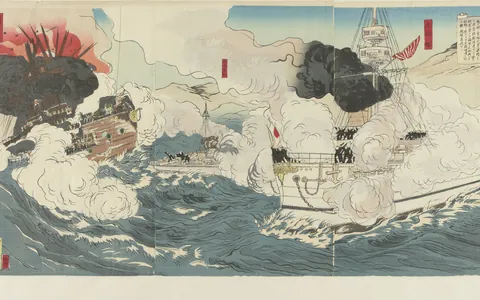
Chemulpo Bay, 9 February 1904. As Japanese troops landed at Chemulpo, Rear Admiral Uriu warned the neutral warships in the harbor that he would attack the Russian cruiser Varyag and gunboat Korietz unless they left by noon. The two ships sailed out, fought the Japanese squadron and returned to the harbor about 1 p.m. Their crews blew up the Korietz and set the Varyag on fire and sank her rather than surrender them.22
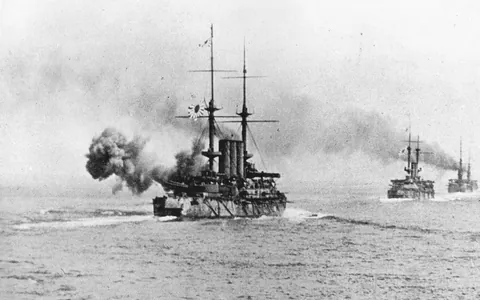
The Yellow Sea, 10 August 1904. The Russian squadron trapped in Port Arthur tried to break out and join the ships at Vladivostok. Admiral Togo's fleet caught it in the Yellow Sea, and most of the battered Russian ships turned back to Port Arthur, where they were later destroyed by Japanese siege guns firing from the hills.23
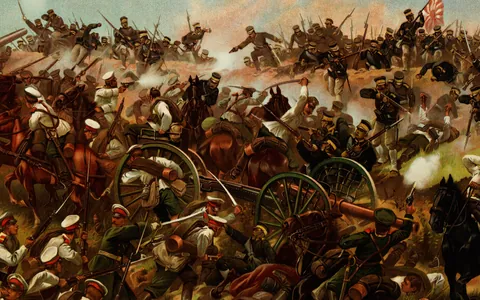
Liaoyang, late August to 3 September 1904. The first great clash of the main armies. The Japanese won, but at a heavy price, and the victory was incomplete: Kuropatkin withdrew the bulk of his army in good order to Mukden, where reinforcements kept arriving by rail.24
The siege of Port Arthur, August 1904 to 2 January 1905. Nogi's Third Army found the fortress far stronger than expected. Russian trenches, barbed wire and machine guns cut down massed Japanese assaults, and the Japanese turned to siege works and tunneling. The fight for 203 Metre Hill lasted from September to December; once the Japanese held it, their heavy howitzers could fire on the Russian ships in the harbor and sank them.25
On 2 January 1905 the fortress commander, Lieutenant General Anatoly Stessel, surrendered. Both Britannica and The Diplomat note that he did so although the garrison still had supplies; Britannica adds that he did not consult his officers. The siege cost about 31,000 Russian and 58,000 to 60,000 Japanese casualties.26

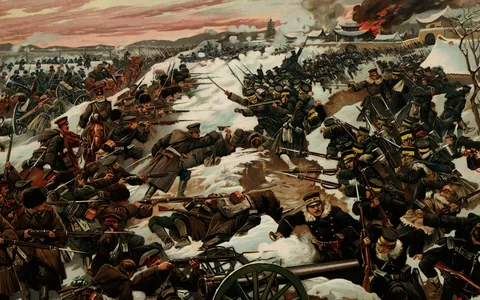
Mukden, 19 February to 10 March 1905. The final and greatest land battle of the war, with some 300,000 to 330,000 Russians against about 270,000 Japanese. Oyama tried to encircle Kuropatkin's armies on both flanks, as the Prussians had done at Sedan in 1870. The Russians fell back and the Japanese took Mukden on 10 March, but Kuropatkin escaped the encirclement.27
Losses at Mukden were enormous, and the sources count them differently. Britannica and the Encyclopedia of Modern Europe give about 89,000 Russians (including 30,000 prisoners) and 71,000 Japanese; EBSCO gives about 100,000 and 70,000; the US Office of the Historian gives 60,000 and 41,000. Japan was by then near the end of its manpower and money.28
Tsushima, 27 to 28 May 1905. After a voyage of more than seven months, Admiral Zinovy Rozhestvensky's fleet tried to reach Vladivostok through the Tsushima Strait between Korea and Japan. Togo was waiting off the Korean coast. In two days the Russian fleet was destroyed: of some 38 ships, only three or four reached Vladivostok, and the rest were sunk, captured or interned in neutral ports.29
Key commanders of the Russo-Japanese War
Japan. Admiral Togo Heihachiro commanded the Combined Fleet from the first attack on Port Arthur to Tsushima. Marshal Oyama Iwao had overall command of the armies in Manchuria, among them Kuroki Tamemoto's First Army, which won on the Yalu, and Nogi Maresuke's Third Army, which besieged Port Arthur and then fought at Mukden.30
Russia. Admiral Yevgeny Alekseyev, the viceroy in the Far East, was the first commander in chief. Admiral Stepan Makarov briefly revived the Port Arthur squadron before his death in April 1904. General Aleksey Kuropatkin, the war minister, resigned his post to take command of the army in Manchuria; Lieutenant General Anatoly Stessel held Port Arthur, and Admiral Zinovy Rozhestvensky led the Baltic Fleet to Tsushima.31
Britannica judges the Russian high command harshly: it calls Kuropatkin a competent war minister who proved irresolute and passive in the field, and it holds the confused policy of the government and the ineffective leadership of the troops, more than any other factor, responsible for the defeat. The Encyclopedia of Russian History stresses instead how unprepared Russia was for a war at the far end of a single railway.32
The negotiators. At Portsmouth, Russia was represented by Sergei Witte, a former finance minister, and Japan by its foreign minister, Baron Komura Jutaro; both signed the treaty.33
Who won the Russo-Japanese War? The Treaty of Portsmouth
Japan won the war on the battlefield: it won all the major land and naval battles. By the spring of 1905, however, both sides wanted peace. Japan was financially exhausted and feared a long war of attrition far from its bases, while Russia faced revolution at home after the fall of Port Arthur, Mukden and Tsushima.34
It was the Japanese government that took the initiative and asked the United States president, Theodore Roosevelt, to mediate. The delegations met at the navy yard of Portsmouth, New Hampshire, in August 1905, and the treaty was signed on 5 September.35
Under the treaty, Russia acknowledged that Japan possessed "paramount political, military and economical interests" in Korea and promised not to interfere there. It transferred to Japan the lease of Port Arthur and Dalian with the adjacent territory, and the railway from Changchun to Port Arthur without compensation. It ceded the southern half of Sakhalin up to the 50th parallel, and both armies were to leave Manchuria, except the leased territory, within eighteen months.36
Russia paid no indemnity. Witte had orders to refuse any payment, and Japan, short of money, dropped the demand under pressure from Roosevelt and accepted half of Sakhalin instead of all of it. The Japanese public, which felt it had won, saw the treaty as an affront, and riots broke out in Tokyo.37
So the answer to "who won" has two parts. Japan won the war and gained what it had fought for in Korea and southern Manchuria. Russia lost the war, but the Encyclopedia of Modern Europe describes the treaty as widely seen as a diplomatic success for Witte, who kept Russia from paying a war indemnity. Roosevelt received the Nobel Peace Prize for his mediation, although the US Office of the Historian notes that how far he shaped the outcome is unclear.38

Legacy of the Russo-Japanese War
In Russia the defeat fed the unrest that became the Revolution of 1905. Historians differ on how much weight to give the war: the Encyclopedia of Russian History calls the defeat the prime cause of the revolution, while Rotem Kowner describes the revolution as running alongside the battlefield fiascos.39
For Japan the war made it the leading military power of East Asia, and its military gained political weight at home. Korea paid the price: Japan tightened its control over the country and formally annexed it in 1910.40
Beyond the two empires, the first defeat of a European great power by an Asian state in the modern age was read across Asia as a sign that Western rule could be challenged, and it encouraged nationalist and anti-colonial movements.41
Militarily, the war looked forward. Mass infantry attacks against trenches, barbed wire, machine guns and heavy artillery, especially at Port Arthur, foreshadowed the fighting of World War I. Foreign observers with both armies saw the effect of machine-gun fire on massed infantry, yet most European armies drew the wrong lessons.42
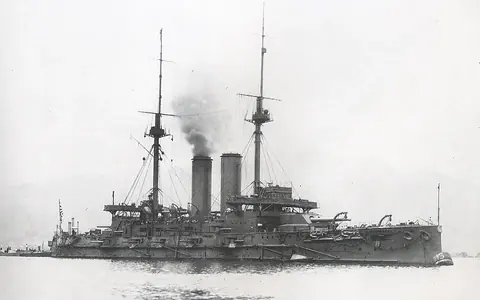
In Japan, the naval war is remembered above all through Togo's flagship Mikasa, preserved as a memorial ship at Yokosuka, the main site of memory for Tsushima and the war at sea.43
Battles of the Russo-Japanese War
Our articles on the battles of the war are listed below in date order.
- 1904Battle of Chemulpo Bay, 1904Empire of Japan vs Russian Empire
On 9 February 1904 the Russian cruiser Varyag and gunboat Korietz sailed out of neutral Chemulpo to fight a Japanese squadron. Beaten in an hour, they came back and were scuttled.
- 1904Battle of the Yellow Sea, 1904Empire of Japan (Combined Fleet) vs Russian Empire (Port Arthur squadron)
On 10 August 1904 Togo's fleet caught the Russian squadron escaping from Port Arthur; a hit on the Tsesarevich's bridge killed Admiral Vitgeft and broke the Russian line.
- 1904Battle of Liaoyang, 1904Empire of Japan (Manchurian Army) vs Russian Empire (Manchurian Army)
In late August 1904 Oyama's three armies attacked Kuropatkin's larger army at Liaoyang; when Kuroki crossed the Taitzu, the Russians retreated to Mukden.
- 1905Battle of Mukden, 1905Empire of Japan vs Russian Empire
For three weeks in 1905 half a million men fought along a front of 150 kilometers in Manchuria. Oyama tried to encircle Kuropatkin's armies at Mukden; the Russians escaped the trap but lost the battle.
- 1905Battle of Tsushima, 1905Japan vs Russia
How Admiral Togo crossed the T and annihilated a Russian fleet that had sailed halfway around the world.
Timeline of the Russo-Japanese War
- 1895The Triple Intervention of Russia, Germany and France forces Japan to return the Liaodong Peninsula to China.44
- 1898Russia leases Port Arthur and the tip of the Liaodong Peninsula from China.45
- 1902Japan and Britain conclude the Anglo-Japanese Alliance in January.46
- 1904Japanese torpedo boats attack the Russian squadron at Port Arthur on the night of 8 to 9 February; on 9 February the Varyag and Korietz are lost at Chemulpo Bay.47
- 1904Admiral Makarov is killed when the Petropavlovsk strikes a mine on 13 April.48
- 1904Japan wins on the Yalu on 1 May and then at Nanshan, cutting off Port Arthur.49
- 1904The Port Arthur squadron fails to break out in the Battle of the Yellow Sea on 10 August.50
- 1904The Battle of Liaoyang ends on 3 September with a Russian withdrawal to Mukden.51
- 1904The Baltic Fleet sails for the Far East on 15 October; Kuropatkin's offensive on the Shaho River fails the same month.52
- 1905Port Arthur surrenders on 2 January.53
- 1905The Battle of Mukden is fought from 19 February to 10 March.54
- 1905
- 1905The Treaty of Portsmouth is signed on 5 September.56
- 1910Japan annexes Korea.57
Where to read next
See also our rankings of the greatest naval battles in history, the greatest battles of the industrial age and the largest battles in history; our guides to the Crimean War, the Eastern Front of World War I and the Pacific War; the battles of Korea; the industrial age; and the industrial age battles quiz.
Notes
A number in the text points to a note; each note names the works that paragraph draws on, listed in full under Sources.
- Encyclopaedia Britannica, “Russo-Japanese War”; Encyclopedia of Modern Europe; Foreign Relations of the United States, 1905. ↩
- Encyclopaedia Britannica, “Russo-Japanese War”; Encyclopedia of Western Colonialism since 1450; Office of the Historian, “The Treaty of Portsmouth and the Russo-Japanese War, 1904-1905”. ↩
- Encyclopaedia Britannica, “Russo-Japanese War”; Encyclopedia of Modern Europe; Encyclopedia of Russian History; Office of the Historian, “The Treaty of Portsmouth and the Russo-Japanese War, 1904-1905”. ↩
- Encyclopaedia Britannica, “Russo-Japanese War”; Encyclopedia of Western Colonialism since 1450; National Museum of Health and Medicine, “American Angels of Mercy”. ↩
- Encyclopaedia Britannica, “Russo-Japanese War”; Michael R. Auslin, Encyclopedia of Modern Europe; John W. Steinberg, Encyclopedia of Russian History. ↩
- Encyclopaedia Britannica, “Russo-Japanese War”; Michael R. Auslin, Encyclopedia of Modern Europe; Office of the Historian, “The Treaty of Portsmouth and the Russo-Japanese War, 1904-1905”; National Museum of Health and Medicine, “American Angels of Mercy”. ↩
- Encyclopaedia Britannica, “Russo-Japanese War”; Encyclopedia of Western Colonialism since 1450; Office of the Historian, “The Treaty of Portsmouth and the Russo-Japanese War, 1904-1905”; National Museum of Health and Medicine, “American Angels of Mercy”. ↩
- Encyclopaedia Britannica, “Russo-Japanese War”; Michael R. Auslin, Encyclopedia of Modern Europe; Encyclopedia of Western Colonialism since 1450. ↩
- Michael R. Auslin, Encyclopedia of Modern Europe; Rotem Kowner, The Asia-Pacific Journal; Encyclopedia of Western Colonialism since 1450. ↩
- Encyclopaedia Britannica, “Russo-Japanese War”; Encyclopedia of Western Colonialism since 1450. ↩
- Encyclopaedia Britannica, “Russo-Japanese War”; Michael R. Auslin, Encyclopedia of Modern Europe; National Museum of Health and Medicine, “American Angels of Mercy”; Report of Commander Marshall, Vicksburg; Extracts from the report of the Russian minister to Korea, Foreign Relations of the United States, 1904. ↩
- Foreign Relations of the United States, 1905; The World and Japan Database, “Treaty of Portsmouth”. ↩
- Encyclopaedia Britannica, “Russo-Japanese War”; Michael R. Auslin, Encyclopedia of Modern Europe; John W. Steinberg, Encyclopedia of Russian History. ↩
- Encyclopaedia Britannica, “Russo-Japanese War”; John W. Steinberg, Encyclopedia of Russian History; Encyclopedia of Western Colonialism since 1450. ↩
- Tony Bunting, “Battle of Port Arthur”; K. Kubata, Naval Historical Review; Michael R. Auslin, Encyclopedia of Modern Europe. ↩
- Encyclopaedia Britannica, “Russo-Japanese War”; Encyclopedia of Western Colonialism since 1450; Michael R. Auslin, Encyclopedia of Modern Europe; K. Kubata, Naval Historical Review. ↩
- Encyclopaedia Britannica, “Russo-Japanese War”; Michael R. Auslin, Encyclopedia of Modern Europe; Encyclopedia of Western Colonialism since 1450. ↩
- Encyclopaedia Britannica, “Russo-Japanese War”; John W. Steinberg, Encyclopedia of Russian History; Michael R. Auslin, Encyclopedia of Modern Europe. ↩
- Encyclopaedia Britannica, “Russo-Japanese War”; Tony Bunting, “Battle of the Yellow Sea”; Encyclopedia of Western Colonialism since 1450; John W. Steinberg, Encyclopedia of Russian History; Encyclopaedia Britannica, “Russo-Japanese War summary”. ↩
- Encyclopaedia Britannica, “Russo-Japanese War”; Joseph Hammond, The Diplomat; Encyclopedia of Modern Europe. ↩
- Encyclopaedia Britannica, “Russo-Japanese War”; John W. Steinberg, Encyclopedia of Russian History; K. Kubata, Naval Historical Review; Encyclopaedia Britannica, “Battle of Tsushima”. ↩
- Report of Commander Marshall, Vicksburg; Extracts from the report of the Russian minister to Korea, Foreign Relations of the United States, 1904; TASS, “Ceremony honoring Russian cruiser Varyag and Korietz sailors held in Incheon”. ↩
- Tony Bunting, “Battle of the Yellow Sea”; Encyclopedia of Western Colonialism since 1450; Joseph Hammond, The Diplomat; K. Kubata, Naval Historical Review. ↩
- Encyclopaedia Britannica, “Russo-Japanese War”; Michael R. Auslin, Encyclopedia of Modern Europe. ↩
- Encyclopaedia Britannica, “Russo-Japanese War”; Joseph Hammond, The Diplomat; K. Kubata, Naval Historical Review. ↩
- Encyclopaedia Britannica, “Russo-Japanese War”; Tony Bunting, “Battle of Port Arthur”; Joseph Hammond, The Diplomat; Michael R. Auslin, Encyclopedia of Modern Europe. ↩
- Encyclopaedia Britannica, “Russo-Japanese War”; Encyclopedia of Modern Europe; EBSCO Research Starters, “Battle of Mukden”; Joseph Hammond, The Diplomat. ↩
- Encyclopaedia Britannica, “Russo-Japanese War”; Encyclopedia of Modern Europe; EBSCO Research Starters, “Battle of Mukden”; Office of the Historian, “The Treaty of Portsmouth and the Russo-Japanese War, 1904-1905”; John W. Steinberg, Encyclopedia of Russian History. ↩
- Encyclopaedia Britannica, “Russo-Japanese War”; Encyclopaedia Britannica, “Battle of Tsushima”; K. Kubata, Naval Historical Review. ↩
- Encyclopaedia Britannica, “Russo-Japanese War”; K. Kubata, Naval Historical Review; Encyclopedia of Modern Europe; John W. Steinberg, Encyclopedia of Russian History; EBSCO Research Starters, “Battle of Mukden”. ↩
- Encyclopaedia Britannica, “Russo-Japanese War”; John W. Steinberg, Encyclopedia of Russian History; Encyclopedia of Western Colonialism since 1450; Joseph Hammond, The Diplomat. ↩
- Encyclopaedia Britannica, “Russo-Japanese War”; John W. Steinberg, Encyclopedia of Russian History. ↩
- Michael R. Auslin, Encyclopedia of Modern Europe; Foreign Relations of the United States, 1905; The World and Japan Database, “Treaty of Portsmouth”. ↩
- Encyclopaedia Britannica, “Russo-Japanese War”; Encyclopedia of Modern Europe; Office of the Historian, “The Treaty of Portsmouth and the Russo-Japanese War, 1904-1905”; Rotem Kowner, The Asia-Pacific Journal. ↩
- Encyclopaedia Britannica, “Treaty of Portsmouth”; Office of the Historian, “The Treaty of Portsmouth and the Russo-Japanese War, 1904-1905”; Foreign Relations of the United States, 1905. ↩
- Foreign Relations of the United States, 1905; The World and Japan Database, “Treaty of Portsmouth”. ↩
- Encyclopedia of Modern Europe; Dictionary of American History; Office of the Historian, “The Treaty of Portsmouth and the Russo-Japanese War, 1904-1905”. ↩
- Encyclopedia of Modern Europe; Encyclopedia of Russian History; Dictionary of American History; Office of the Historian, “The Treaty of Portsmouth and the Russo-Japanese War, 1904-1905”. ↩
- Encyclopaedia Britannica, “Russo-Japanese War”; John W. Steinberg, Encyclopedia of Russian History; Rotem Kowner, The Asia-Pacific Journal. ↩
- Encyclopaedia Britannica, “Russo-Japanese War”; Michael R. Auslin, Encyclopedia of Modern Europe; National Museum of Health and Medicine, “American Angels of Mercy”. ↩
- Michael R. Auslin, Encyclopedia of Modern Europe; Encyclopedia of Western Colonialism since 1450; Encyclopedia of Russian History. ↩
- Encyclopaedia Britannica, “Russo-Japanese War”; Michael R. Auslin, Encyclopedia of Modern Europe; Joseph Hammond, The Diplomat. ↩
- Rotem Kowner, The Asia-Pacific Journal; K. Kubata, Naval Historical Review. ↩
- Encyclopaedia Britannica, “Russo-Japanese War”; Michael R. Auslin, Encyclopedia of Modern Europe. ↩
- Encyclopaedia Britannica, “Russo-Japanese War”; National Museum of Health and Medicine, “American Angels of Mercy”. ↩
- Michael R. Auslin, Encyclopedia of Modern Europe; Rotem Kowner, The Asia-Pacific Journal. ↩
- Tony Bunting, “Battle of Port Arthur”; Encyclopedia of Western Colonialism since 1450; Report of Commander Marshall, Vicksburg; Extracts from the report of the Russian minister to Korea, Foreign Relations of the United States, 1904. ↩
- Encyclopaedia Britannica, “Russo-Japanese War”; Encyclopedia of Western Colonialism since 1450. ↩
- Encyclopaedia Britannica, “Russo-Japanese War”; John W. Steinberg, Encyclopedia of Russian History; Encyclopedia of Western Colonialism since 1450. ↩
- Tony Bunting, “Battle of the Yellow Sea”; Encyclopedia of Western Colonialism since 1450. ↩
- Michael R. Auslin, Encyclopedia of Modern Europe; Encyclopedia of Western Colonialism since 1450. ↩
- Encyclopaedia Britannica, “Russo-Japanese War”; John W. Steinberg, Encyclopedia of Russian History. ↩
- Encyclopaedia Britannica, “Russo-Japanese War”; Joseph Hammond, The Diplomat. ↩
- Encyclopaedia Britannica, “Russo-Japanese War”; Encyclopedia of Modern Europe. ↩
- Encyclopaedia Britannica, “Battle of Tsushima”; K. Kubata, Naval Historical Review. ↩
- Encyclopaedia Britannica, “Treaty of Portsmouth”; Foreign Relations of the United States, 1905. ↩
- Encyclopaedia Britannica, “Russo-Japanese War”; Michael R. Auslin, Encyclopedia of Modern Europe. ↩
Sources
- Encyclopaedia Britannica, “Russo-Japanese War”.
- Encyclopedia of Modern Europe: Europe 1789-1914, via Encyclopedia.com, “Portsmouth, Treaty of”.
- Foreign Relations of the United States, 1905, Document 915 (Office of the Historian), “Treaty of peace between Japan and Russia”.
- Encyclopedia of Western Colonialism since 1450, via Encyclopedia.com, “Russo-Japanese War”.
- Office of the Historian, US Department of State, “The Treaty of Portsmouth and the Russo-Japanese War, 1904-1905”.
- Encyclopedia of Russian History, via Encyclopedia.com, “Portsmouth, Treaty of”.
- National Museum of Health and Medicine (US), “American Angels of Mercy: Dr. Anita Newcomb McGee's Pictorial Record of the Russo-Japanese War”.
- Michael R. Auslin, Encyclopedia of Modern Europe: Europe 1789-1914, via Encyclopedia.com, “Russo-Japanese War”.
- John W. Steinberg, Encyclopedia of Russian History, via Encyclopedia.com, “Russo-Japanese War”.
- Rotem Kowner, The Asia-Pacific Journal: Japan Focus 20, no. 12 (2022), “Time to Remember, Time to Forget: The Battle of Tsushima in Japanese Collective Memory since 1905”.
- Report of Commander Marshall, USS Vicksburg, 7 August 1904, in Foreign Relations of the United States, 1904, Document 793 (Office of the Historian), “Mr. Loomis to Mr. McCormick”.
- Extracts from the report of the Russian minister to Korea, Mr. Pavloff, in Foreign Relations of the United States, 1904, Document 792 (Office of the Historian), “Neutrality of the United States in the war between Russia and Japan”.
- The World and Japan Database (GRIPS and the University of Tokyo), “Treaty of Portsmouth”.
- Tony Bunting, Encyclopaedia Britannica, “Battle of Port Arthur”.
- K. Kubata, Naval Historical Review, Naval Historical Society of Australia, “The Battle of Tsushima, 1905”.
- Tony Bunting, Encyclopaedia Britannica, “Battle of the Yellow Sea”.
- Encyclopaedia Britannica, “Russo-Japanese War summary”.
- Joseph Hammond, The Diplomat, November 2014, “Siege of Port Arthur: Verdun in Manchuria”.
- Encyclopedia of Modern Europe: Europe 1789-1914, via Encyclopedia.com, “Mukden, Battle of”.
- Encyclopaedia Britannica, “Battle of Tsushima”.
- TASS, 9 February 2017, “Ceremony honoring Russian cruiser Varyag and Korietz sailors held in Incheon”.
- EBSCO Research Starters, “Battle of Mukden”.
- Encyclopaedia Britannica, “Treaty of Portsmouth”.
- Dictionary of American History, via Encyclopedia.com, “Portsmouth, Treaty of”.






