

What was the Waterloo campaign and who won?
The Waterloo campaign was Napoleon's last campaign, fought in what is now Belgium in June 1815 during the Hundred Days. He beat the Prussians at the Battle of Ligny and was held at Quatre Bras, but on 18 June Wellington's allied army and Blücher's Prussians defeated him at the Battle of Waterloo. The Seventh Coalition won.1
The Waterloo campaign was the military climax of the Hundred Days, the period between Napoleon's return to Paris on 20 March 1815 and the return of Louis XVIII on 8 July. From 15 to 18 June his army fought two coalition armies in what is now Belgium: the Duke of Wellington's multinational army and Field Marshal Gebhard Leberecht von Blücher's Prussians.2
Our guides tell the story of the Battle of Ligny and the Battle of Quatre Bras, both fought on 16 June, and the Battle of Waterloo on 18 June. The campaign closed the Napoleonic Wars, in which Wellington had made his name in the Peninsular War and Napoleon had lost an army in Russia in 1812. For the national stories, see the military history of Britain, France and Germany.3
Causes of the Waterloo campaign
Napoleon had abdicated in April 1814 and been given the island of Elba. On 26 February 1815 he sailed from it with about a thousand men and on 1 March landed at Golfe-Juan, near Cannes.4
The troops sent to stop him went over to him. Marshal Michel Ney, who had promised Louis XVIII to bring Napoleon back in an iron cage, joined him in mid-March. The king fled to Ghent and Napoleon entered Paris on 20 March, where he issued a more liberal constitution, drafted by his former critic Benjamin Constant.5
The powers at the Congress of Vienna answered at once. On 13 March the eight signatories of the 1814 Treaty of Paris declared Napoleon an outlaw, a declaration aimed at one man rather than at France, whose king was their ally. On 25 March Austria, Britain, Prussia and Russia renewed their alliance, each promising 150,000 men until he was overthrown. The smaller states joined over the following weeks, forming the Seventh Coalition.6
The allies planned to invade France with several armies at once. The Russians still had to cross central Europe, so the invasion could not begin before early July, and Wellington and Blücher, cantoned in the Netherlands, agreed to be ready by then.7
Napoleon could wait on the defensive near Paris and Lyon, leaving much of France to the invaders, or strike first. He chose to attack the two armies in Belgium before the Austrians and Russians arrived. Together they outnumbered him, so he had to beat them one at a time, and a quick victory would secure the north before he turned east.8
His target was the seam between them. Wellington's supply lines ran back to the Channel ports and Blücher's east toward Liège and the Rhine, and the two armies met near Charleroi. Advancing there, Napoleon meant to take the central position and drive each back along its own line of retreat.9

Who fought in the Waterloo campaign
On one side stood the French Armée du Nord under Napoleon in person, built largely from veterans who rallied to him. Britannica gives its strength as about 105,000 men, the University of Southampton's study of the campaign as some 120,000.10
Wellington's army was a coalition in itself: British troops, the King's German Legion, Hanoverians, Brunswickers, Nassauers, and Dutch and Belgian troops of the United Kingdom of the Netherlands. Britannica counts some 31,000 British among more than 93,000 men at the start of the campaign, and the historian Brendan Simms puts the British share at Waterloo at 36 percent.11
Many had never been under fire, and Wellington doubted Netherlands units that had served Napoleon a year before, so he mixed nationalities and veteran and new units.12
For the Netherlands the campaign was a defense of the state itself. The peace of 1814 had joined today's Belgium to the Dutch provinces as a buffer against France, guarded by new fortresses. King William I's son, William, Prince of Orange, commanded the largest corps of Wellington's army.13
The King's German Legion had been formed in 1803 as part of the British Army from soldiers of Hanover, whose elector was George III, after Napoleon overran the electorate, and it was among Wellington's best troops. Hanover also sent its own regiments, and the duchies of Brunswick and Nassau sent contingents.14
Blücher's Army of the Lower Rhine had four corps: 120,000 men by Britannica's count, 115,000 by the Fondation Napoléon's. Many were militia or new conscripts, some from provinces that had belonged to the French Empire a year before. August von Gneisenau was its chief of staff.15

Ligny and Quatre Bras, 15 to 17 June 1815
On 15 June the French crossed the frontier near Charleroi and drove back the Prussian corps of Hans von Zieten. The move surprised both allied commanders, and by evening Napoleon stood between their armies, ready to turn against either.16
The crossroads at Quatre Bras, on the road to Brussels, was first held by troops of General Hendrik de Perponcher's 2nd Netherlands Division under Duke Bernhard of Saxe-Weimar. The Rijksmuseum credits this Netherlands and Nassau force, led by Saxe-Weimar and the Prince of Orange, with repelling the first French advance.17
Napoleon gave Marshal Ney the left wing and the crossroads as his objective, while he turned against the Prussians. Ney attacked cautiously and piecemeal, and Wellington fed in reinforcements until he held the crossroads. Frederick William, Duke of Brunswick, was killed leading his troops. Britannica gives about 4,700 allied and 4,300 French casualties, the Salem Press reference on EBSCO about 4,800 and 4,000.18
At Ligny Napoleon attacked Blücher's army, about 80,000 men by the Fondation Napoléon's count and 83,000 by Britannica's; Friedrich Wilhelm von Bülow's IV Corps had not arrived. The corps of Jean-Baptiste Drouet d'Erlon, meant to fall on the Prussian flank, spent the day marching between the two battlefields under conflicting orders and fought in neither.19
By evening the French had broken the Prussian center. Blücher's horse was shot and fell on him; his aide-de-camp, Count Nostitz, got him away, and Gneisenau drew off the army. Britannica counts more than 12,000 Prussian and about 10,000 French casualties, plus some 8,000 Prussian deserters in the night; the National Army Museum gives Prussian losses of over 20,000 and French losses of half that.20
The decisive choice came on 17 June. Instead of retreating east toward the Rhine, the Prussians fell back north to Wavre, staying within reach of Wellington, although, Britannica notes, this put their own communications at risk. Wellington withdrew from Quatre Bras to the ridge of Mont-Saint-Jean, south of Waterloo, and resolved to fight there once the Prussians promised to come.21
At midday Napoleon detached Marshal Emmanuel de Grouchy with about 33,000 men, roughly a third of his army, to follow the Prussians, and led the rest after Wellington. Heavy rain slowed the French and soaked the ground.22
The Battle of Waterloo, 18 June 1815
On 18 June Wellington kept most of his army behind the crest of the ridge, sheltered from the French guns, with strongpoints in front at the château of Hougoumont, the farm of La Haye Sainte and Papelotte. Britannica and the National Army Museum give Napoleon about 72,000 men and 246 guns against 68,000 men and 156 guns; the University of Southampton gives 74,500 against 74,300.23
Napoleon waited for the sodden ground to dry, which gave the Prussians time. The battle began late in the morning with an attack on Hougoumont, held by British Guards and German troops, which the French fought for all day and never took.24
In the early afternoon a grand battery of some 80 guns bombarded the allied center and d'Erlon's corps attacked. It drove back Count Bijlandt's Netherlands brigade in the front line, but British infantry stopped it and British heavy cavalry routed it. The horsemen charged on too far and were cut up by French cavalry; the Scots Greys of the Union Brigade lost heavily.25
Around 1 pm Napoleon saw Prussian troops approaching from the east. From about 4 pm Ney sent mass after mass of cavalry against Wellington's right center, but the allied infantry formed squares and held. At about 4:30 pm Bülow's corps attacked the French right at Plancenoit, drawing in ever more French troops, the Young and Old Guard included.26
In the center La Haye Sainte was held by the 2nd Light Battalion of the King's German Legion. It held out for most of the afternoon and fell at about 6 pm, and French guns brought up to it tore at Wellington's line. Brendan Simms argues that its roughly 400 riflemen have the best claim to have turned the battle, because they bought time for the Prussians.27
A little after 7 pm Napoleon sent battalions of the Imperial Guard against Wellington's right center. By then Zieten's Prussian I Corps had reached Wellington's left, freeing troops for his center. The Guard met heavy fire, halted and broke. Dutch accounts add that General David Hendrik Chassé sent his 1st Brigade, under Hendrik Detmers, against the Guard with the bayonet.28
The failure of the Guard set off a general French retreat. Wellington ordered his whole line forward while the Prussians broke through on the French right, and Napoleon's army dissolved. At about 9 pm Wellington and Blücher met near the inn of La Belle Alliance, and the Prussians took up the pursuit through the night.29
Grouchy never reached the field: he was locked in combat at Wavre with Johann von Thielmann's Prussian III Corps, the rearguard left behind by the other three corps. Grouchy drove Thielmann back on 19 June, then brought his force back to France intact.30

Key commanders of the Waterloo campaign
Napoleon planned the campaign and led the main army himself, with Ney on the left wing and Grouchy, after Ligny, leading the pursuit. His corps commanders included d'Erlon, Honoré Reille and Georges Mouton, count de Lobau, who held the right against Bülow.31
Ney, hailed as the bravest of the brave for his rearguard in the retreat from Russia, had rejoined Napoleon in March. His caution at Quatre Bras and his cavalry charges at Waterloo have been argued over ever since. The Fondation Napoléon's biography judges that he was outmaneuvered at Quatre Bras and that his handling of the battle contributed to the final defeat.32
Wellington, the victor of the Peninsular War, came from the Congress of Vienna to command the allied army. Britannica writes that Waterloo established him as the most renowned hero in Europe.33
Blücher, then 72, was a rough old soldier who kept his promise to Wellington. Gneisenau rallied the army after Ligny and, with Blücher, sent it to Waterloo, Bülow's corps first. Among the Netherlands commanders, the Prince of Orange led Wellington's I Corps and was wounded at Waterloo, and Saxe-Weimar's Nassauers held the far left around Papelotte.34
Who won the Waterloo campaign?
The Seventh Coalition won. The National Army Museum notes that the outcome was in doubt until the late afternoon, when Blücher's Prussians arrived in force and broke through Napoleon's right flank, and it quotes Wellington's verdict that it was “the nearest run thing you ever saw in your life”.35
The cost was heavy, and the counts differ. Britannica and the Salem Press reference give French losses at Waterloo of about 25,000 killed and wounded and 9,000 captured, against about 15,000 casualties in Wellington's army and about 8,000 Prussian. The National Army Museum gives nearly 40,000 French and 22,000 allied casualties, and Thierry Lentz of the Fondation Napoléon counts 10,800 dead, 6,800 of them French, and around 35,000 wounded.36
Napoleon left his beaten army and was back in Paris on 21 June. The next day he abdicated for the second time, in favor of his son. The allied armies marched on Paris, and on 3 July a convention at Saint-Cloud ended the fighting; the French army withdrew behind the Loire, where it was later disbanded. The allies entered Paris on 7 July, and Louis XVIII returned the next day, ending the Hundred Days.37
Napoleon went to Rochefort hoping to sail to the United States, but a British squadron barred the way. On 15 July he gave himself up to Captain Maitland of HMS Bellerophon, and the British sent him to St. Helena in the South Atlantic, where he died in 1821.38
Those who had joined him paid a price. Ney was arrested in August, insisted as a peer on being tried by the upper chamber, and was condemned for treason and shot in Paris on 7 December 1815.39
The peace was harsher than in 1814. By the Second Treaty of Paris of 20 November 1815, France returned to its frontiers of 1790, losing part of the Saar and of Savoy, owed an indemnity of 700 million francs and accepted an allied army of occupation of 150,000 men under Wellington for three to five years. Prussian voices had demanded Alsace; Britain preferred a temporary occupation to large cessions. The occupation ended in 1818, two years early.40

Why did Napoleon lose the Waterloo campaign?
The sources point to a chain of causes: the Prussian retreat to Wavre, which kept Blücher in touch with Wellington; the late start at Waterloo on sodden ground; and the absence of Grouchy's third of the army. Two days earlier d'Erlon's corps, which might have turned Ligny into a rout, had fought nowhere.41
Blame has fallen in turn on Ney, Grouchy and Napoleon himself. Thierry Lentz lists the questions that still divide historians: whether Ney threw away the cavalry, whether Grouchy should have arrived before Blücher, and whether Marshal Soult was a poor chief of staff. The Salem Press reference adds Napoleon's confusing orders to Ney, and a study of Grouchy presented by the Fondation Napoléon asks whether he was made a scapegoat.42
On the allied side the campaign was won by two armies working together: Wellington stood at Mont-Saint-Jean only because the Prussians promised to come. Simms writes that about 45 percent of Wellington's men spoke some form of German and that by evening most allied soldiers on the field were German, and the Salem Press reference lists historians who argue that the Dutch, Belgian and German share has been eclipsed by the focus on the British.43
Consequences and memory of the Waterloo campaign
Waterloo ended 23 years of recurring war between France and the other European powers. In the National Army Museum's words, the peace that followed lasted, apart from the Crimean War, until 1914; the Salem Press reference credits the 1815 settlement with preventing a major European war until 1854.44
Each country remembers the campaign in its own way. Wellington named the battle after his headquarters at Waterloo; Blücher wanted it called La Belle Alliance, after the inn where the two commanders met, in honor of the British and Prussian cooperation, and German usage long kept that name.45
In Britain Waterloo made Wellington a national hero, and its name was given to streets, railway stations, bridges and parks across Britain and the Commonwealth; to meet one's Waterloo entered the English language.46
In the Netherlands King William I had the Lion's Mound raised on the battlefield where his son, the Prince of Orange, was believed to have been wounded, and Jan Willem Pieneman's huge painting of the prince at Quatre Bras, once at Soestdijk Palace, now hangs in the National Military Museum.47

Major battles of the Waterloo campaign
Below, in date order, are our articles on the battles of this campaign.
- 1815Battle of Ligny, 1815French Empire vs Prussia
On 16 June 1815, two days before Waterloo, Napoleon beat Blücher's Prussians at Ligny, but their army escaped north to fight again.
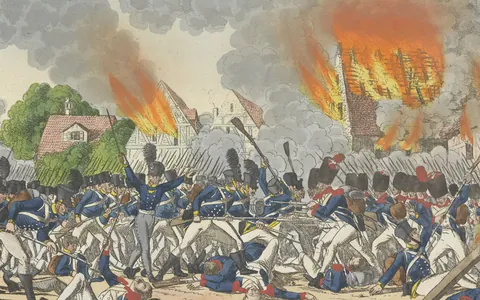
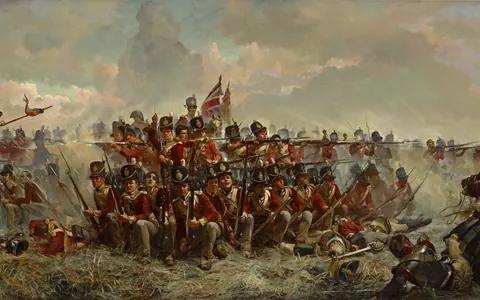
- 1815Battle of Quatre Bras, 1815French Empire vs Britain, Netherlands, Brunswick, Nassau and Hanover
On 16 June 1815 Marshal Ney attacked Wellington's army at the crossroads of Quatre Bras. The Allies held, and the fight kept a French corps away from Ligny.
- 1815The Battle of Waterloo, 1815Coalition (Britain, Prussia) vs French Empire
Napoleon's last gamble, undone by a defiant ridge, unbroken infantry squares, and the Prussians arriving out of the woods just in time.

Timeline of the Waterloo campaign
- 26 Feb 1815Napoleon sails from Elba with about a thousand men.48
- 1 Mar 1815He lands at Golfe-Juan, near Cannes.49
- 13 Mar 1815The powers at the Congress of Vienna declare Napoleon an outlaw.50
- 20 Mar 1815Napoleon enters Paris; Louis XVIII has fled; the Hundred Days begin.51
- 25 Mar 1815Austria, Britain, Prussia and Russia sign the treaty of alliance against him.52
- 15 Jun 1815The French cross the frontier near Charleroi.53
- 16 Jun 1815Napoleon defeats the Prussians at Ligny; Ney fails to take Quatre Bras.54
- 17 Jun 1815The Prussians retreat to Wavre, Wellington to Mont-Saint-Jean; Grouchy is sent after the Prussians.55
- 18 Jun 1815Battle of Waterloo; at Wavre, Thielmann holds Grouchy.56
- 22 Jun 1815Napoleon abdicates for the second time.57
- 3 Jul 1815The convention of Saint-Cloud ends the fighting around Paris.58
- 7 to 8 Jul 1815The allies enter Paris; Louis XVIII returns, ending the Hundred Days.59
- 15 Jul 1815Napoleon surrenders to the captain of HMS Bellerophon.60
- 20 Nov 1815The Second Treaty of Paris is signed.61
- 7 Dec 1815Marshal Ney is shot in Paris.62
Where to read next
The campaign is the last chapter of our guide to the Napoleonic Wars. Read our portraits of Napoleon Bonaparte and the Duke of Wellington, the comparison Napoleon vs Wellington and the greatest Napoleonic battles, and test yourself with the Napoleonic battles quiz.
Notes
A number in the text points to a note; each note names the works that paragraph draws on, listed in full under Sources.
- Encyclopaedia Britannica, “Battle of Waterloo”; National Army Museum, “Battle of Waterloo”; Encyclopaedia Britannica, “Battle of Waterloo”. ↩
- Encyclopaedia Britannica, “Hundred Days”; Fondation Napoléon, “Février-juillet 1815”; Encyclopaedia Britannica, “Battle of Waterloo”; University of Southampton, “Napoleon and His Forces in the Battle of Waterloo”. ↩
- Encyclopaedia Britannica, “Battle of Waterloo”; National Army Museum, “Battle of Waterloo”; National Army Museum, “Wellington”; Encyclopaedia Britannica, “Arthur Wellesley, 1st duke of Wellington”; Fondation Napoléon, “Blücher and the Waterloo campaign”. ↩
- Encyclopaedia Britannica, “Hundred Days”; Fondation Napoléon, “Blücher and the Waterloo campaign”; Fondation Napoléon, “Février-juillet 1815”; Encyclopaedia Britannica, “Battle of Waterloo”; University of Southampton, “Battle of Waterloo”. ↩
- Fondation Napoléon, “Février-juillet 1815”; Encyclopaedia Britannica, “Michel Ney, duc d’Elchingen”; Fondation Napoléon, “NEY, Michel”; EBSCO Research Starters, “Battle of Waterloo”; Encyclopaedia Britannica, “Hundred Days”. ↩
- University of Southampton, “Battle of Waterloo”; University of Southampton, “The Treaty of Vienna”; Fondation Napoléon, “Treaty of the Seventh Coalition”; Encyclopaedia Britannica, “Battle of Waterloo”. ↩
- Encyclopaedia Britannica, “Battle of Waterloo”; University of Southampton, “Napoleon makes his move”; University of Southampton, “Allied strategy in the Battle of Waterloo”; Fondation Napoléon, “Blücher and the Prussians at Waterloo”. ↩
- University of Southampton, “Napoleon makes his move”; EBSCO Research Starters, “Battle of Waterloo”; Encyclopaedia Britannica, “Battle of Waterloo”; National Army Museum, “Battle of Waterloo”. ↩
- University of Southampton, “Napoleon makes his move”; University of Southampton, “Allied strategy in the Battle of Waterloo”; EBSCO Research Starters, “Battle of Waterloo”; Encyclopaedia Britannica, “Battle of Waterloo”. ↩
- National Army Museum, “Battle of Waterloo”; University of Southampton, “Battle of Waterloo”; EBSCO Research Starters, “Battle of Waterloo”; Encyclopaedia Britannica, “Battle of Waterloo”; University of Southampton, “Napoleon makes his move”. ↩
- Encyclopaedia Britannica, “Battle of Waterloo”; University of Southampton, “Napoleon and His Forces in the Battle of Waterloo”; Brendan Simms, “Wellington Doesn’t Deserve the Credit for Winning Waterloo”. ↩
- Encyclopaedia Britannica, “Battle of Waterloo”; University of Southampton, “Napoleon and His Forces in the Battle of Waterloo”; University of Southampton, “Battle of Waterloo”; EBSCO Research Starters, “Battle of Waterloo”. ↩
- EBSCO Research Starters, “Second Peace of Paris”; University of Southampton, “Allied strategy in the Battle of Waterloo”; University of Southampton, “Napoleon and His Forces in the Battle of Waterloo”; Encyclopaedia Britannica, “Battle of Waterloo”. ↩
- National Army Museum, “Captain Augustus Hartmann, 2nd Line Battalion, King’s German Legion, 1815”; Brendan Simms, “Wellington Doesn’t Deserve the Credit for Winning Waterloo”; Encyclopaedia Britannica, “Battle of Waterloo”; University of Southampton, “Napoleon and His Forces in the Battle of Waterloo”. ↩
- Encyclopaedia Britannica, “Battle of Waterloo”; Fondation Napoléon, “Blücher and the Prussians at Waterloo”; Encyclopaedia Britannica, “Battle of Waterloo”; University of Southampton, “Allied strategy in the Battle of Waterloo”; National Army Museum, “The Memorable Battle of Waterloo”. ↩
- University of Southampton, “Napoleon and His Forces in the Battle of Waterloo”; Encyclopaedia Britannica, “Battle of Waterloo”; National Army Museum, “Wellington”; Fondation Napoléon, “Blücher and the Prussians at Waterloo”. ↩
- A. J. van der Aa, “Saxen-Weimar, Bernhard”; Rijksmuseum, “The Prince of Orange at the Battle of Quatre-Bras, 16 June 1815”; Nationaal Militair Museum, “Waterloo crossroads”; University of Southampton, “Napoleon and His Forces in the Battle of Waterloo”. ↩
- Encyclopaedia Britannica, “Battle of Waterloo”; EBSCO Research Starters, “Battle of Quatre Bras”; University of Southampton, “Napoleon and His Forces in the Battle of Waterloo”; Encyclopaedia Britannica, “Michel Ney, duc d’Elchingen”; Rijksmuseum, “Sneuvelen van Frederik Willem van Brunswijk tijdens de slag bij Quatre-Bras, 1815”; Royal Collection Trust, “Johann Friedrich Matthäi, The Death of Frederick William, Duke of Brunswick-Wolfenbüttel at the Battle of Quatre Bras, 1815”. ↩
- Fondation Napoléon, “Blücher and the Prussians at Waterloo”; Encyclopaedia Britannica, “Battle of Waterloo”; National Army Museum, “Battle of Waterloo”. ↩
- Encyclopaedia Britannica, “Battle of Waterloo”; University of Southampton, “Napoleon and His Forces in the Battle of Waterloo”; National Army Museum, “The Memorable Battle of Waterloo”; National Army Museum, “Battle of Waterloo”. ↩
- Encyclopaedia Britannica, “Battle of Ligny”; Fondation Napoléon, “Blücher and the Prussians at Waterloo”; National Army Museum, “Battle of Waterloo”; University of Southampton, “Napoleon and His Forces in the Battle of Waterloo”. ↩
- Encyclopaedia Britannica, “Battle of Waterloo”; National Army Museum, “Battle of Waterloo”; National Army Museum, “Dawn of Waterloo”; Thierry Lentz, “Bullet Point #35”. ↩
- Encyclopaedia Britannica, “Battle of Waterloo”; National Army Museum, “Battle of Waterloo”; University of Southampton, “Napoleon and His Forces in the Battle of Waterloo”. ↩
- Encyclopaedia Britannica, “Battle of Waterloo”; National Army Museum, “Dawn of Waterloo”; Thierry Lentz, “Bullet Point #35”; National Army Museum, “Battle of Waterloo”; University of Southampton, “Napoleon and His Forces in the Battle of Waterloo”; Encyclopaedia Britannica, “Waterloo Battlefield”. ↩
- Encyclopaedia Britannica, “Battle of Waterloo”; EBSCO Research Starters, “Battle of Waterloo”; National Army Museum, “Battle of Waterloo”; University of Southampton, “Napoleon and His Forces in the Battle of Waterloo”; National Army Museum, “Dawn of Waterloo”. ↩
- Encyclopaedia Britannica, “Battle of Waterloo”; Thierry Lentz, “Bullet Point #35”; National Army Museum, “Battle of Waterloo”; EBSCO Research Starters, “Battle of Waterloo”; Fondation Napoléon, “Blücher and the Prussians at Waterloo”; Encyclopaedia Britannica, “Battle of Waterloo”. ↩
- University of Southampton, “Napoleon and His Forces in the Battle of Waterloo”; Brendan Simms, “Wellington Doesn’t Deserve the Credit for Winning Waterloo”; National Army Museum, “The Men Who Decided Waterloo”; National Army Museum, “Battle of Waterloo”; Encyclopaedia Britannica, “Battle of Waterloo”. ↩
- Encyclopaedia Britannica, “Battle of Waterloo”; National Army Museum, “Battle of Waterloo”; EBSCO Research Starters, “Battle of Waterloo”; Fondation Napoléon, “Blücher and the Prussians at Waterloo”; Rijksmuseum, “Schilderij van de aanval van Chassé tijdens de Slag bij Waterloo, 1815”; A. J. van der Aa, “Detmers, Hendrik”. ↩
- Encyclopaedia Britannica, “Battle of Waterloo”; EBSCO Research Starters, “Battle of Waterloo”; National Army Museum, “Battle of Waterloo”; Fondation Napoléon, “Blücher and the Prussians at Waterloo”. ↩
- Encyclopaedia Britannica, “Battle of Waterloo”; Fondation Napoléon, “Blücher and the Prussians at Waterloo”; University of Southampton, “Napoleon and His Forces in the Battle of Waterloo”; University of Southampton, “Battle of Waterloo”; Fondation Napoléon, “Napoleon and Grouchy”. ↩
- Encyclopaedia Britannica, “Battle of Waterloo”; University of Southampton, “Napoleon and His Forces in the Battle of Waterloo”; Encyclopaedia Britannica, “Battle of Waterloo”; Fondation Napoléon, “Napoleon and Grouchy”. ↩
- Encyclopaedia Britannica, “Battle of Waterloo”; Fondation Napoléon, “NEY, Michel”; Encyclopaedia Britannica, “Michel Ney, duc d’Elchingen”. ↩
- National Army Museum, “Wellington”; Encyclopaedia Britannica, “Arthur Wellesley, 1st duke of Wellington”; Encyclopaedia Britannica, “Battle of Ligny”; National Army Museum, “Battle of Waterloo”. ↩
- Encyclopaedia Britannica, “Battle of Waterloo”; German Historical Institute Washington, “Zusammentreffen des Fürsten Blücher und des Herzogs Wellington auf dem Schlachtfeld von Waterloo am 18. Juni 1815”; National Army Museum, “The Memorable Battle of Waterloo”; Fondation Napoléon, “Blücher and the Prussians at Waterloo”; University of Southampton, “Napoleon and His Forces in the Battle of Waterloo”; Rijksmuseum, “Battle of Waterloo, Jan Willem Pieneman”; A. J. van der Aa, “Saxen-Weimar, Bernhard”; National Army Museum, “Battle of Waterloo”. ↩
- National Army Museum, “Wellington, Waterloo, 1815”; Encyclopaedia Britannica, “Waterloo Battlefield”; National Army Museum, “Wellington”. ↩
- Encyclopaedia Britannica, “Battle of Waterloo”; EBSCO Research Starters, “Battle of Waterloo”; National Army Museum, “Battle of Waterloo”; Thierry Lentz, “Bullet Point #35”. ↩
- Encyclopaedia Britannica, “Battle of Waterloo”; Fondation Napoléon, “Février-juillet 1815”; University of Southampton, “Battle of Waterloo”; Fondation Napoléon, “Blücher and the Prussians at Waterloo”; National Army Museum, “Battle of Waterloo”; Encyclopaedia Britannica, “Hundred Days”. ↩
- Encyclopaedia Britannica, “Battle of Waterloo”; Fondation Napoléon, “Février-juillet 1815”; Encyclopaedia Britannica, “Hundred Days”; EBSCO Research Starters, “Battle of Waterloo”. ↩
- Encyclopaedia Britannica, “Michel Ney, duc d’Elchingen”; Fondation Napoléon, “NEY, Michel”; Fondation Napoléon, “Maréchal Ney, 7 December 1815”. ↩
- Encyclopaedia Britannica, “Treaties of Paris”; EBSCO Research Starters, “Second Peace of Paris”; James Smith Allen, “Allen on Haynes (2018)”; University of Southampton, “The Occupation of France after the Battle of Waterloo”; Fondation Napoléon, “Blücher and the Waterloo campaign”; University of Southampton, “Stability for France after the Battle of Waterloo”. ↩
- Encyclopaedia Britannica, “Battle of Ligny”; National Army Museum, “Battle of Waterloo”; Encyclopaedia Britannica, “Battle of Waterloo”; National Army Museum, “Dawn of Waterloo”; Encyclopaedia Britannica, “Battle of Waterloo”. ↩
- Thierry Lentz, “Bullet Point #35”; EBSCO Research Starters, “Battle of Quatre Bras”; Fondation Napoléon, “Napoleon and Grouchy”. ↩
- University of Southampton, “Napoleon and His Forces in the Battle of Waterloo”; National Army Museum, “Battle of Waterloo”; Brendan Simms, “Wellington Doesn’t Deserve the Credit for Winning Waterloo”; EBSCO Research Starters, “Battle of Waterloo”. ↩
- Encyclopaedia Britannica, “Battle of Waterloo”; National Army Museum, “Battle of Waterloo”; EBSCO Research Starters, “Second Peace of Paris”. ↩
- Fondation Napoléon, “Blücher and the Waterloo campaign”; German Historical Institute Washington, “Zusammentreffen des Fürsten Blücher und des Herzogs Wellington auf dem Schlachtfeld von Waterloo am 18. Juni 1815”. ↩
- Encyclopaedia Britannica, “Arthur Wellesley, 1st duke of Wellington”; EBSCO Research Starters, “Battle of Waterloo”; National Army Museum, “Battle of Waterloo”. ↩
- National Army Museum, “Battle of Waterloo”; Encyclopaedia Britannica, “Waterloo Battlefield”; Rijksmuseum, “Battle of Waterloo, Jan Willem Pieneman”; Nationaal Militair Museum, “Waterloo crossroads”; Rijksmuseum, “The Prince of Orange at the Battle of Quatre-Bras, 16 June 1815”. ↩
- Fondation Napoléon, “Février-juillet 1815”; University of Southampton, “Battle of Waterloo”. ↩
- Encyclopaedia Britannica, “Battle of Waterloo”; Fondation Napoléon, “Février-juillet 1815”. ↩
- University of Southampton, “Battle of Waterloo”; Fondation Napoléon, “Treaty of the Seventh Coalition”. ↩
- Encyclopaedia Britannica, “Hundred Days”; Fondation Napoléon, “Février-juillet 1815”. ↩
- Encyclopaedia Britannica, “Battle of Waterloo”; University of Southampton, “The Treaty of Vienna”. ↩
- Encyclopaedia Britannica, “Battle of Waterloo”; University of Southampton, “Napoleon and His Forces in the Battle of Waterloo”. ↩
- Encyclopaedia Britannica, “Battle of Waterloo”; EBSCO Research Starters, “Battle of Quatre Bras”. ↩
- Encyclopaedia Britannica, “Battle of Waterloo”; Fondation Napoléon, “Blücher and the Prussians at Waterloo”. ↩
- Encyclopaedia Britannica, “Battle of Waterloo”; Encyclopaedia Britannica, “Battle of Waterloo”; National Army Museum, “Battle of Waterloo”. ↩
- Encyclopaedia Britannica, “Battle of Waterloo”; Fondation Napoléon, “Février-juillet 1815”. ↩
- University of Southampton, “Battle of Waterloo”; Fondation Napoléon, “Blücher and the Prussians at Waterloo”. ↩
- Encyclopaedia Britannica, “Battle of Waterloo”; National Army Museum, “Battle of Waterloo”; Encyclopaedia Britannica, “Hundred Days”. ↩
- Encyclopaedia Britannica, “Battle of Waterloo”; Fondation Napoléon, “Février-juillet 1815”. ↩
- Encyclopaedia Britannica, “Treaties of Paris”; EBSCO Research Starters, “Second Peace of Paris”; University of Southampton, “The Occupation of France after the Battle of Waterloo”. ↩
- Encyclopaedia Britannica, “Michel Ney, duc d’Elchingen”; Fondation Napoléon, “Maréchal Ney, 7 December 1815”. ↩
Sources
- Encyclopaedia Britannica, “Battle of Waterloo: The Battles of Quatre-Bras and Ligny”.
- National Army Museum, London, “Battle of Waterloo”.
- Encyclopaedia Britannica, “Battle of Waterloo”.
- Encyclopaedia Britannica, “Hundred Days”.
- Fondation Napoléon, “Février-juillet 1815 : d’une île à l’autre, les Cent-Jours”.
- University of Southampton, Wellington and the Battle of Waterloo (FutureLearn), “Napoleon and His Forces in the Battle of Waterloo”.
- National Army Museum, London, “Wellington: The Iron Duke”.
- Encyclopaedia Britannica, “Arthur Wellesley, 1st duke of Wellington”.
- Fondation Napoléon, “Blücher and the Waterloo campaign”.
- University of Southampton, Wellington and the Battle of Waterloo (FutureLearn), “Battle of Waterloo: Outlawry of Napoleon”.
- Encyclopaedia Britannica, “Michel Ney, duc d’Elchingen”.
- Fondation Napoléon, “NEY, Michel”.
- EBSCO Research Starters (Salem Press), “Battle of Waterloo”.
- University of Southampton, Wellington and the Battle of Waterloo (FutureLearn), “The Treaty of Vienna”.
- Fondation Napoléon, “Treaty of the Seventh Coalition: Treaty of 9 April 1815, Treaty of 25 March 1815”.
- University of Southampton, Wellington and the Battle of Waterloo (FutureLearn), “Napoleon makes his move”.
- University of Southampton, Wellington and the Battle of Waterloo (FutureLearn), “Allied strategy in the Battle of Waterloo”.
- Fondation Napoléon, “Blücher and the Prussians at Waterloo”.
- University of Southampton, Wellington and the Battle of Waterloo (FutureLearn), “Battle of Waterloo: Armies, Battle Tactics and Orders”.
- Brendan Simms, History News Network, 8 March 2015, “Wellington Doesn’t Deserve the Credit for Winning Waterloo”.
- EBSCO Research Starters (Salem Press), “Second Peace of Paris”.
- National Army Museum, London, Online Collection, “Captain Augustus Hartmann, 2nd Line Battalion, King’s German Legion, 1815”.
- National Army Museum, London, Online Collection, “The Memorable Battle of Waterloo: The Perilous Situation of Marshal Blücher in the Battle of Ligny, 1815”.
- A. J. van der Aa, Biographisch woordenboek der Nederlanden, vol. 20 (DBNL), “Saxen-Weimar, Bernhard”.
- Rijksmuseum, Amsterdam, “The Prince of Orange at the Battle of Quatre-Bras, 16 June 1815”.
- Nationaal Militair Museum, Soest, “Waterloo crossroads”.
- EBSCO Research Starters (Salem Press), “Battle of Quatre Bras”.
- Rijksmuseum, Amsterdam, “Sneuvelen van Frederik Willem van Brunswijk tijdens de slag bij Quatre-Bras, 1815”.
- Royal Collection Trust, “Johann Friedrich Matthäi, The Death of Frederick William, Duke of Brunswick-Wolfenbüttel at the Battle of Quatre Bras, 1815”.
- Encyclopaedia Britannica, “Battle of Ligny”.
- National Army Museum, London, “Dawn of Waterloo”.
- Thierry Lentz, Fondation Napoléon, “Bullet Point #35: How did Napoleon manage to lose the Battle of Waterloo?”.
- Encyclopaedia Britannica, “Battle of Waterloo: The first hours of battle”.
- Encyclopaedia Britannica, “Waterloo Battlefield”.
- Encyclopaedia Britannica, “Battle of Waterloo: Crisis and the French collapse”.
- National Army Museum, London, “The Men Who Decided Waterloo”.
- Rijksmuseum, Amsterdam, “Schilderij van de aanval van Chassé tijdens de Slag bij Waterloo, 1815”.
- A. J. van der Aa, Biographisch woordenboek der Nederlanden, vol. 5 (DBNL), “Detmers, Hendrik”.
- University of Southampton, Wellington and the Battle of Waterloo (FutureLearn), “Battle of Waterloo: The Capture of Paris”.
- Fondation Napoléon, “Napoleon and Grouchy: The last great Waterloo mystery unravelled”.
- German Historical Institute Washington, German History in Documents and Images, “Zusammentreffen des Fürsten Blücher und des Herzogs Wellington auf dem Schlachtfeld von Waterloo am 18. Juni 1815”.
- Rijksmuseum, Amsterdam, “Battle of Waterloo, Jan Willem Pieneman”.
- National Army Museum, London, Online Collection, “Wellington, Waterloo, 1815”.
- Fondation Napoléon, “Maréchal Ney, 7 December 1815”.
- Encyclopaedia Britannica, “Treaties of Paris”.
- James Smith Allen, review of Christine Haynes, Our Friends the Enemies, Nineteenth-Century French Studies, “Allen on Haynes (2018)”.
- University of Southampton, Wellington and the Battle of Waterloo (FutureLearn), “The Occupation of France after the Battle of Waterloo”.
- University of Southampton, Wellington and the Battle of Waterloo (FutureLearn), “Stability for France after the Battle of Waterloo”.





