

What was the Western Front of World War II and who won?
The Western Front was the war against Nazi Germany in France, the Low Countries and western Germany. Germany won in 1940, forcing the Dunkirk evacuation. The Allies returned in the Battle of Normandy, survived the Battle of the Bulge and crossed the Rhine, and Germany surrendered in May 1945.1
The Western Front had three phases of large-scale fighting: the German conquest of the Low Countries and France in May and June 1940, the air war over Britain from July to October 1940, and the ground war from the Normandy landings in June 1944 to the German surrender in May 1945. It decided the fate of western Europe, though most German soldiers who died in the war fell on the Eastern Front. Polish soldiers fought here too, from Falaise to Arnhem. For a ranking of the war's battles see the greatest battles of World War II.2
Causes of the war on the Western Front
Germany invaded Poland on 1 September 1939, and two days later Britain and France declared war on Germany. They could not prevent the defeat of Poland, described in our guide to the invasion of Poland, and faced the prospect of a long and costly war.3
What followed in the west was a lull through the winter of 1939 and 1940 that newspapers called the “Phoney War”. Apart from patrol skirmishes and occasional dogfights, both sides stayed behind their defenses; the French border with Germany was covered by the Maginot Line, a continuous belt of fortifications. In April 1940 Germany invaded Denmark and Norway, and by May it was ready to strike in the west.4
Who fought on the Western Front
1940. On 10 May 1940 Germany attacked France, Belgium, the Netherlands and Luxembourg. The British Expeditionary Force had been in France since the autumn of 1939 and fought alongside the French, Belgian and Dutch armies.5
1944 and 1945. The D-Day landings were made by about 156,000 Allied troops from the United States, Britain, Canada, Free France and Norway, mostly American, British and Canadian. Later in 1944 the American Seventh Army and the French First Army formed a further army group in the south. On the other side stood the armies of Nazi Germany.6
Poland. Polish soldiers who had escaped after the defeat of 1939 fought in the west in their own formations. Two Polish fighter squadrons, Nos. 302 and 303, flew in the Battle of Britain; the 1st Polish Armoured Division of Stanisław Maczek fought in Normandy under Canadian command; and the 1st Polish Independent Parachute Brigade of Stanisław Sosabowski jumped at Arnhem.7
1940: the fall of France and Dunkirk
The German plan was a gamble. Army Group B attacked into Belgium and the Netherlands to draw the Allied armies north, while Army Group A, under Gerd von Rundstedt, made the main armored thrust through the Ardennes, a forested region the French treated as nearly impassable. German panzers came out of the Ardennes at Sedan on 12 May and crossed the Meuse the next day.8

In just over six weeks Germany defeated Belgium, Luxembourg and the Netherlands, took Paris and forced France to sign an armistice, on 22 June 1940, in the railway carriage at Compiègne. It was one of the most complete victories in modern war.9
The British Expeditionary Force, with French and Belgian troops, was pushed back to the port of Dunkirk. Operation Dynamo, directed by Vice Admiral Bertram Ramsay from Dover, rescued more than 338,000 British and Allied soldiers between 26 May and 4 June 1940, though the army left its tanks and heavy guns behind. Read the full story in our article on the Dunkirk evacuation.10
1940 to 1943: the Battle of Britain and the long wait
With France beaten, Germany needed control of the air before it could invade Britain. The Battle of Britain was fought between July and October 1940: the Luftwaffe attacked shipping in the Channel and then airfields and communications centers, but RAF Fighter Command defeated it and Hitler abandoned his invasion plans. Pilots from the Commonwealth, Poland and Czechoslovakia flew with the RAF, and the Polish No. 303 Squadron became one of the most successful units of the battle.11
For almost four years after that there was no large-scale ground fighting in the west. The third phase of the Western Front began only with the Allied landings in Normandy in June 1944.12
1944: D-Day, Normandy and the liberation of France
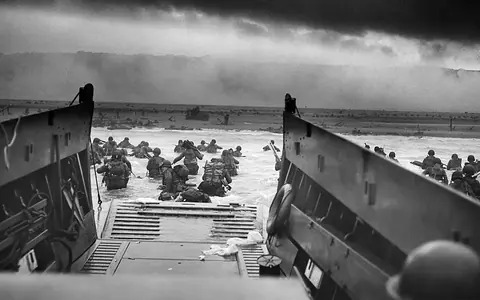
Operation Overlord opened on 6 June 1944, D-Day, under the overall command of Dwight D. Eisenhower. It was the largest amphibious invasion in history: American troops landed on Utah and Omaha beaches, British and Canadian troops on Gold, Juno and Sword, and more than 23,000 paratroopers landed behind the German lines the night before. Counts of the troops landed that day range from about 133,000 (the Eisenhower Library and the US Holocaust Memorial Museum) to 156,000 (the National WWII Museum).13
The Allies suffered more than 10,000 casualties on D-Day itself, killed, wounded and missing, about 6,600 of them American; the National WWII Museum gives 2,700 British and 1,074 Canadian casualties. German losses are estimated at 4,000 to 9,000. By the end of June more than 850,000 Allied troops had come ashore.14
The Germans then held the beachhead for six weeks in what is known as the Battle of Normandy. On 25 July the Allies broke out near Saint-Lô in Operation Cobra, and by mid August they had encircled much of the German army in Normandy near Falaise.15
The 1st Polish Armoured Division, about 16,000 men and some 400 tanks, landed in Normandy on 1 August and fought under the II Canadian Corps in Operations Totalize and Tractable. On 19 August it took Hill 262, the northern end of the Mont-Ormel ridge, which the Poles called Maczuga (the Mace). Cut off from the rest of the corps, Polish units held the hill and the area around Chambois against German troops trying to break out until Canadian tanks reached them on 21 August. The pocket was closed, but not strongly enough to stop every German escape. Our article on the Battle of Falaise tells the story in full.16
Paris rose against the Germans in mid August. Eisenhower sent in General Philippe Leclerc's French 2nd Armored Division, and the city was liberated on 25 August, and Charles de Gaulle walked down the Champs-Élysées in triumph. On 15 August a second Allied invasion, Operation Dragoon, landed on the coast of Provence; French Army B under General de Lattre de Tassigny took the great ports of Toulon and Marseille.17
Market Garden, Arnhem and the Scheldt

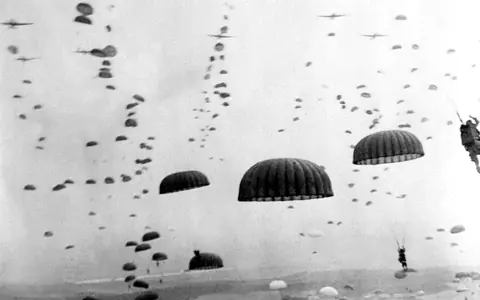
In September 1944 Bernard Montgomery tried to end the war quickly with Operation Market Garden: airborne divisions would seize a chain of bridges in the Netherlands, ending with the Rhine bridge at Arnhem, and British XXX Corps would drive across them toward the Ruhr. The landings began on 17 September in one of the largest airborne operations in history. About 10,000 men of the British 1st Airborne Division and the Polish brigade landed at Arnhem, but their landing zones lay 11 km from the bridge, only one battalion reached it, and XXX Corps never got through. When the survivors were ferried back across the Rhine after nine days of fighting, only about 2,000 of the 10,000 got back.18
Sosabowski's 1st Polish Independent Parachute Brigade was dropped late, half of it at Driel south of the Rhine on 21 September and the rest near Grave two days later, and tried to cross the river to reinforce the British in Oosterbeek. Afterwards the failure was blamed on Sosabowski, and he was removed from command in December 1944. In 2006 the Netherlands awarded the brigade the Military William Order and Sosabowski, posthumously, the Bronze Lion.19

Meanwhile the British had taken Antwerp in early September with its docks virtually intact, but the port, some 80 km from the open sea, was useless while the Germans held the Scheldt estuary. In the Battle of the Scheldt, from early October to 8 November 1944, the First Canadian Army under Guy Simonds, standing in for the ill Harry Crerar, cleared it with British and Polish formations, including Maczek's division. RAF bombing breached the dykes of Walcheren, and amphibious assaults hit Westkapelle and Flushing on 1 November. The First Canadian Army took 41,043 prisoners and suffered 12,873 casualties, 6,367 of them Canadian, and the first supply convoy reached Antwerp on 28 November.20
The Battle of the Bulge
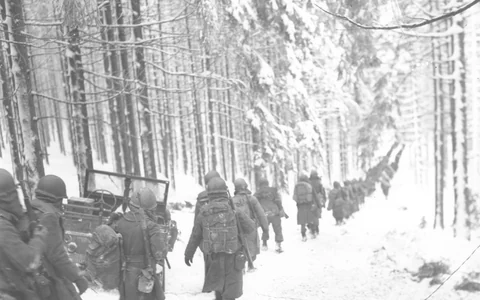
On 16 December 1944 some 30 German divisions with more than 1,000 tanks attacked through the Ardennes. The Battle of the Bulge was the last major German offensive in western Europe. Surrounded at Bastogne, the US 101st Airborne Division under Brigadier General Anthony McAuliffe answered a German demand to surrender with one word, “Nuts!”, until the Third Army of George S. Patton broke through to the town. By 25 January 1945 the Allies had restored their line.21

Casualty figures vary with the source. The US Holocaust Memorial Museum gives 80,000 to 100,000 German and 75,000 to 80,000 American casualties; the National WWII Museum counts well over 80,000 American casualties, with an official Army count of 19,246 dead and more than 23,000 captured. Waffen-SS units murdered at least 300 captured American soldiers and some 100 Belgian civilians; at Malmedy on 17 December Kampfgruppe Peiper shot more than 80 American prisoners.22
1945: across the Rhine to the German surrender
The retreating Germans blew up the Rhine bridges, all except one. On 7 March 1945 a task force of the US 9th Armored Division found the Ludendorff railway bridge at Remagen still standing and seized it; five divisions crossed before it collapsed on 17 March.23

On the night of 23 March Montgomery's 21st Army Group crossed the Rhine around Wesel in Operation Plunder, supported the next day by Operation Varsity, a parachute drop on the east bank, while Patton's Third Army crossed further south. By the end of March the Allies were firmly established east of the river.24
Eisenhower now aimed to encircle a large part of the German army in the Ruhr, Germany's industrial heartland. On 1 April armored divisions of the US First and Ninth Armies met near Lippstadt, trapping Army Group B in the Ruhr pocket; its last parts surrendered in mid April. Hitler killed himself in Berlin on 30 April, and German forces surrendered unconditionally in the west on 7 May and in the east on 9 May; 8 May is remembered as the end of the war in Europe.25
Key commanders of the Western Front
Allies. Dwight D. Eisenhower was named Supreme Allied Commander for Overlord in December 1943 and led the campaign to the end. Bernard Montgomery commanded the ground forces landing in Normandy and then the 21st Army Group of British and Canadian armies; Omar Bradley commanded the US 12th Army Group and George S. Patton its Third Army. Harry Crerar and Guy Simonds led the First Canadian Army, Stanisław Maczek the 1st Polish Armoured Division and Stanisław Sosabowski the Polish parachute brigade. Their rivalries are compared in Eisenhower vs Montgomery.26
Germany. Gerd von Rundstedt led the decisive Army Group A in 1940 and, with Erwin Rommel, commanded the defense of northwest France when the Allies landed in 1944; Rommel had led one of the first panzer divisions across the Meuse in 1940. Walter Model commanded Army Group B when it was trapped in the Ruhr and dissolved it rather than surrender formally.27
Who won the Western Front, and why did Germany lose?
Germany won the first round decisively: in 1940 it routed the Allied armies in about six weeks and occupied France and the Low Countries for four years. The Western Allies won the second. Air superiority helped the D-Day landings succeed and kept German reinforcements away from Normandy, and the failed Ardennes offensive cost Germany 80,000 to 100,000 casualties that irreparably weakened its forces.28
The Western Front did not defeat Germany alone. For most of the war 75 to 80 percent of the German army fought in the East, and about four of every five German soldiers killed in the war died there; but German losses in the west were almost irreplaceable, because most of Germany's resources went east. The two fronts together crushed Germany between them.29
Major battles of the Western Front
Our articles on the battles of the Western Front of World War II are listed below in date order.
- 1944The Battle of the BulgeUnited States and allies vs Germany
December 1944: fog, snow and a desperate German gamble in the Ardennes forest. The siege of Bastogne, McAuliffe's Nuts, and Patton's race north.
- 1944D-Day, 1944Allies (USA, Britain, Canada) vs Nazi Germany
Five beaches, thousands of ships, and one morning that breached the Atlantic Wall and opened the Western Front.
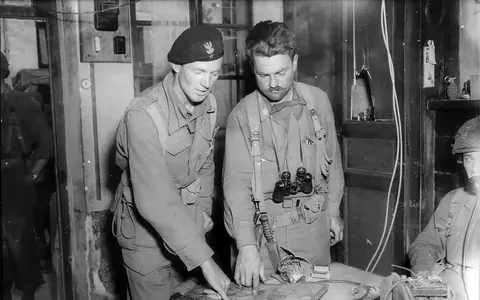
- 1944The Battle of Falaise, 1944Allies (USA, Britain, Canada, Poland, Free France) vs Germany
The Polish armored division corked the Falaise Pocket.
- 1944Operation Market GardenAllies (Britain, US, Poland) vs Germany
The Allied airborne gamble of September 1944, a chain of Dutch bridges, and the bridge too far at Arnhem where the plan came apart.
- 1944Battle of the Scheldt, 1944Allies (First Canadian Army) vs Germany (Fifteenth Army)
In October and November 1944 Canadian, British and Polish troops fought across flooded polders and Walcheren island to open the Scheldt and the port of Antwerp.
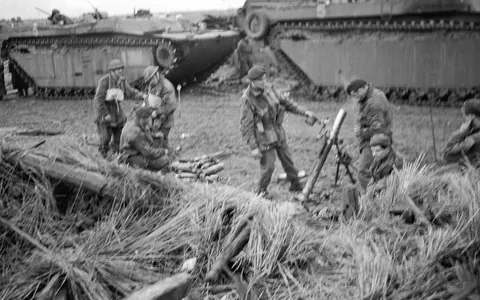
- 1945The Ruhr Pocket, 1945United States (12th Army Group) vs Germany (Army Group B)
On Easter Sunday 1945 two U.S. armies met at Lippstadt and trapped Model's Army Group B in the Ruhr. Seventeen days later some 317,000 Germans had surrendered.
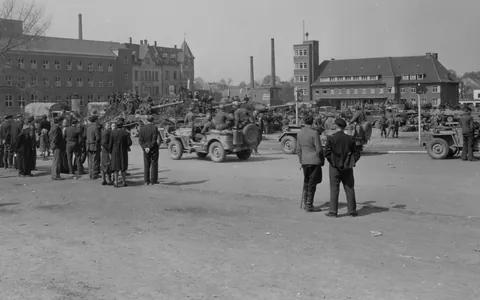
Timeline of the Western Front
- 3 September 1939Britain and France declare war on Germany, two days after the invasion of Poland.30
- 10 May 1940Germany attacks France, Belgium, the Netherlands and Luxembourg.31
- 26 May to 4 June 1940
- 22 June 1940France signs an armistice with Germany at Compiègne.33
- July to October 1940The Battle of Britain.34
- 6 June 1944D-Day: the Allied landings in Normandy.35
- 19 to 21 August 1944The Polish 1st Armoured Division holds Hill 262 as the Falaise pocket closes.36
- 25 August 1944Paris is liberated.37
- 17 to 26 September 1944Operation Market Garden fails at Arnhem.38
- 28 November 1944The first convoy reaches Antwerp after the Battle of the Scheldt.39
- 16 December 1944Germany opens the Ardennes offensive, the Battle of the Bulge.40
- 7 March 1945US troops seize the Rhine bridge at Remagen.41
- 1 April 1945Army Group B is encircled in the Ruhr pocket.42
- 7 and 8 May 1945Germany surrenders unconditionally; the war in Europe ends.43
Where to read next
The Western Front was one theater of World War II. See also our hubs on the Eastern Front, the North African campaign, the Mediterranean theater and the Pacific War, and on the Western Front of World War I. Read the biographies of Stanisław Maczek and Stanisław Sosabowski, the story of the battle for Castle Itter in the last days of the war, and test yourself with the World War II battles quiz.
Notes
A number in the text points to a note; each note names the works that paragraph draws on, listed in full under Sources.
- Imperial War Museums, “Why the Luftwaffe Dominated the Battle of France”; Air & Space Forces Magazine, “The Fall of France”; United States Holocaust Memorial Museum, “D-Day”; United States Holocaust Memorial Museum, “Encircling the Ruhr”. ↩
- Pritzker Military Museum & Library, “WWII Western Front”; United States Holocaust Memorial Museum, “D-Day”; The National WWII Museum, “Operation Barbarossa”. ↩
- Air & Space Forces Magazine, “The Fall of France”; Imperial War Museums, “The Phoney War”. ↩
- Imperial War Museums, “The Phoney War”; Air & Space Forces Magazine, “The Fall of France”; Imperial War Museums, “Why the Luftwaffe Dominated the Battle of France”. ↩
- Imperial War Museums, “Why the Luftwaffe Dominated the Battle of France”; Imperial War Museums, “The Phoney War”; Air & Space Forces Magazine, “The Fall of France”. ↩
- The National WWII Museum, “Fact Sheet”; United States Holocaust Memorial Museum, “D-Day”; The National WWII Museum, “Operation Dragoon”. ↩
- Imperial War Museums, “8 Facts You Need to Know About the Battle of Britain”; Royal Air Force Museum, “303 Squadron”; HistoryNet, “Hallowed Ground”; Juno Beach Centre, “Major-General Stanislaw Maczek”; National Army Museum, “Operation Market Garden”. ↩
- Imperial War Museums, “Why the Luftwaffe Dominated the Battle of France”; Air & Space Forces Magazine, “The Fall of France”. ↩
- Imperial War Museums, “Why the Luftwaffe Dominated the Battle of France”; Air & Space Forces Magazine, “The Fall of France”; Imperial War Museums, “The Fall of France, 1940 (HU 93606)”. ↩
- Imperial War Museums, “What You Need to Know About the Dunkirk Evacuations”; English Heritage, “Dunkirk 1940”; Imperial War Museums, “Why the Luftwaffe Dominated the Battle of France”. ↩
- Imperial War Museums, “8 Facts You Need to Know About the Battle of Britain”; Royal Air Force Museum, “303 Squadron”; Pritzker Military Museum & Library, “WWII Western Front”. ↩
- Pritzker Military Museum & Library, “WWII Western Front”; United States Holocaust Memorial Museum, “D-Day”. ↩
- United States Holocaust Memorial Museum, “D-Day”; Eisenhower Presidential Library, “World War II”; The National WWII Museum, “Fact Sheet”. ↩
- United States Holocaust Memorial Museum, “D-Day”; Eisenhower Presidential Library, “World War II”; The National WWII Museum, “Fact Sheet”. ↩
- United States Holocaust Memorial Museum, “D-Day”; HistoryNet, “Hallowed Ground”. ↩
- Juno Beach Centre, “Major-General Stanislaw Maczek”; HistoryNet, “Hallowed Ground”. ↩
- The National WWII Museum, “The Liberation of Paris”; United States Holocaust Memorial Museum, “D-Day”; The National WWII Museum, “Operation Dragoon”; Musée national de la Marine, “Opération Dragoon. 1944, le débarquement de Provence en photographies (press kit)”. ↩
- National Army Museum, “Operation Market Garden”; Imperial War Museums, “Battle of Arnhem”; Veterans Affairs Canada, “Battle of the Scheldt”. ↩
- Airborne Assault Museum, “1st Polish Independent Parachute Brigade”; dzieje.pl, “W PE film „Honor generała” przywracający pamięć o Sosabowskim”; Government of the Netherlands, “Toespraak minister Brekelmans bij herdenking 1ste Poolse Onafhankelijke Parachutistenbrigade”. ↩
- Veterans Affairs Canada, “Battle of the Scheldt”; Juno Beach Centre, “The Battle of the Scheldt”. ↩
- United States Holocaust Memorial Museum, “Battle of the Bulge”; The National WWII Museum, “The Battle of the Bulge”; U.S. National Archives, “Honoring the 80th Anniversary of the Battle of the Bulge”. ↩
- United States Holocaust Memorial Museum, “Battle of the Bulge”; The National WWII Museum, “The Battle of the Bulge”; U.S. National Archives, “Honoring the 80th Anniversary of the Battle of the Bulge”. ↩
- U.S. National Park Service, “Remagen Bridge”; The National WWII Museum, “Crossing the Rhine at Remagen”; Naval History and Heritage Command, “Operation Plunder”. ↩
- Naval History and Heritage Command, “Operation Plunder”; United States Holocaust Memorial Museum, “Encircling the Ruhr”. ↩
- Naval History and Heritage Command, “Operation Plunder”; United States Holocaust Memorial Museum, “Encircling the Ruhr”; The National WWII Museum, “Fact Sheet”. ↩
- U.S. National Park Service, “Supreme Allied Commander”; United States Holocaust Memorial Museum, “D-Day”; Naval History and Heritage Command, “Operation Plunder”; Veterans Affairs Canada, “Liberation of the Netherlands”; The National WWII Museum, “The Liberation of Paris”; Veterans Affairs Canada, “Battle of the Scheldt”; Juno Beach Centre, “Major-General Stanislaw Maczek”; Airborne Assault Museum, “1st Polish Independent Parachute Brigade”. ↩
- Air & Space Forces Magazine, “The Fall of France”; United States Holocaust Memorial Museum, “D-Day”; The National WWII Museum, “Fact Sheet”; United States Holocaust Memorial Museum, “Encircling the Ruhr”. ↩
- Imperial War Museums, “Why the Luftwaffe Dominated the Battle of France”; Air & Space Forces Magazine, “The Fall of France”; United States Holocaust Memorial Museum, “D-Day”; U.S. National Archives, “Honoring the 80th Anniversary of the Battle of the Bulge”; United States Holocaust Memorial Museum, “Battle of the Bulge”. ↩
- The National WWII Museum, “Operation Barbarossa”; Pritzker Military Museum & Library, “WWII Western Front”. ↩
- Air & Space Forces Magazine, “The Fall of France”; Imperial War Museums, “The Phoney War”. ↩
- Imperial War Museums, “Why the Luftwaffe Dominated the Battle of France”; Imperial War Museums, “The Phoney War”. ↩
- Imperial War Museums, “What You Need to Know About the Dunkirk Evacuations”; English Heritage, “Dunkirk 1940”. ↩
- Air & Space Forces Magazine, “The Fall of France”; Imperial War Museums, “The Fall of France, 1940 (HU 93606)”. ↩
- Imperial War Museums, “8 Facts You Need to Know About the Battle of Britain”; Pritzker Military Museum & Library, “WWII Western Front”. ↩
- United States Holocaust Memorial Museum, “D-Day”; Eisenhower Presidential Library, “World War II”. ↩
- HistoryNet, “Hallowed Ground”; Juno Beach Centre, “Major-General Stanislaw Maczek”. ↩
- The National WWII Museum, “The Liberation of Paris”; The National WWII Museum, “Fact Sheet”. ↩
- National Army Museum, “Operation Market Garden”; Imperial War Museums, “Battle of Arnhem”. ↩
- Veterans Affairs Canada, “Battle of the Scheldt”; Juno Beach Centre, “The Battle of the Scheldt”. ↩
- United States Holocaust Memorial Museum, “Battle of the Bulge”; The National WWII Museum, “The Battle of the Bulge”. ↩
- U.S. National Park Service, “Remagen Bridge”; The National WWII Museum, “Crossing the Rhine at Remagen”. ↩
- United States Holocaust Memorial Museum, “Encircling the Ruhr”; Naval History and Heritage Command, “Operation Plunder”. ↩
- United States Holocaust Memorial Museum, “Encircling the Ruhr”; The National WWII Museum, “Fact Sheet”. ↩
Sources
- Imperial War Museums, “Why the Luftwaffe Dominated the Battle of France”.
- Air & Space Forces Magazine, John T. Correll, “The Fall of France”.
- United States Holocaust Memorial Museum, “D-Day”.
- United States Holocaust Memorial Museum, “Encircling the Ruhr”.
- Pritzker Military Museum & Library, “WWII Western Front”.
- The National WWII Museum, Robert M. Citino, “Operation Barbarossa: The Biggest of All Time”.
- Imperial War Museums, “The Phoney War: Britain's Start to World War 2”.
- The National WWII Museum, “Fact Sheet: The D-Day Invasion at Normandy, June 6, 1944”.
- The National WWII Museum, “Operation Dragoon: Invasion of Southern France”.
- Imperial War Museums, “8 Facts You Need to Know About the Battle of Britain”.
- Royal Air Force Museum, “303 Squadron”.
- HistoryNet, David T. Zabecki, “Hallowed Ground: Mont-Ormel, France”.
- Juno Beach Centre, “Major-General Stanislaw Maczek”.
- National Army Museum, “Operation Market Garden”.
- Imperial War Museums, “The Fall of France, 1940 (HU 93606)”.
- Imperial War Museums, “What You Need to Know About the Dunkirk Evacuations”.
- English Heritage, “Dunkirk 1940: The Making of the Miracle”.
- Eisenhower Presidential Library, “World War II: D-Day, The Invasion of Normandy”.
- The National WWII Museum, “The Liberation of Paris”.
- Musée national de la Marine, Toulon, “Opération Dragoon. 1944, le débarquement de Provence en photographies (press kit)”.
- Imperial War Museums, “Battle of Arnhem”.
- Veterans Affairs Canada, “Battle of the Scheldt”.
- Airborne Assault Museum (ParaData), “1st Polish Independent Parachute Brigade”.
- dzieje.pl (Muzeum Historii Polski), “W PE film „Honor generała” przywracający pamięć o Sosabowskim”.
- Government of the Netherlands (Rijksoverheid), “Toespraak minister Brekelmans bij herdenking 1ste Poolse Onafhankelijke Parachutistenbrigade”.
- Juno Beach Centre, “The Battle of the Scheldt”.
- United States Holocaust Memorial Museum, “Battle of the Bulge”.
- The National WWII Museum, Keith Huxen, “The Battle of the Bulge”.
- U.S. National Archives, The Text Message, “Honoring the 80th Anniversary of the Battle of the Bulge”.
- U.S. National Park Service, “Remagen Bridge”.
- The National WWII Museum, Edward G. Lengel, “Crossing the Rhine at Remagen”.
- Naval History and Heritage Command, “Operation Plunder: Crossing the Rhine”.
- U.S. National Park Service, “Supreme Allied Commander: Eisenhower and the Planning for D-Day”.
- Veterans Affairs Canada, “Liberation of the Netherlands”.






